Cultural Studies
Cultural Studies

Matières spectrales: Sociologie des Fantômes
Avery F. Gordon, Julia Burtin Zortea
Dans ce livre unique et fascinant, Avery F. Gordon examine l’expérience sociologique de la « hantise » en s’appuyant sur des références aussi bien littéraires que politiques. La hantise désigne un système qui altère l’expérience d’un vécu linéaire et déforme la façon dont nous séquençons habituellement le passé, le présent et le futur. En prenant pour terrain les romans de Toni Morrison ou Luisa Valenzuela et en les confrontant à des sources plus traditionnelles de la sociologie (articles de presse, comptes rendus judiciaires, rapports d’enquêtes), Matières spectrales démontre que les structures sociales héritées du passé influencent plus la vie présente que ne le présument la plupart des chercheur·ses en sciences humaines.
Afin de montrer comment les fantômes hantent le présent, l’autrice passe au crible une partie de l’histoire de la psychanalyse, avant d’examiner des épisodes de l’histoire tels que l’esclavage aux États-Unis ou les disparitions massives pendant la dictature militaire en Argentine, où des lois interdisaient à la population de parler des disparu·es.
Profondément interdisciplinaire et véritablement innovant par son approche, Matières spectrales est écrit avec une puissance à la hauteur de son sujet, et offre une vision nouvelle des intersections complexes de la race, du genre et de la classe.
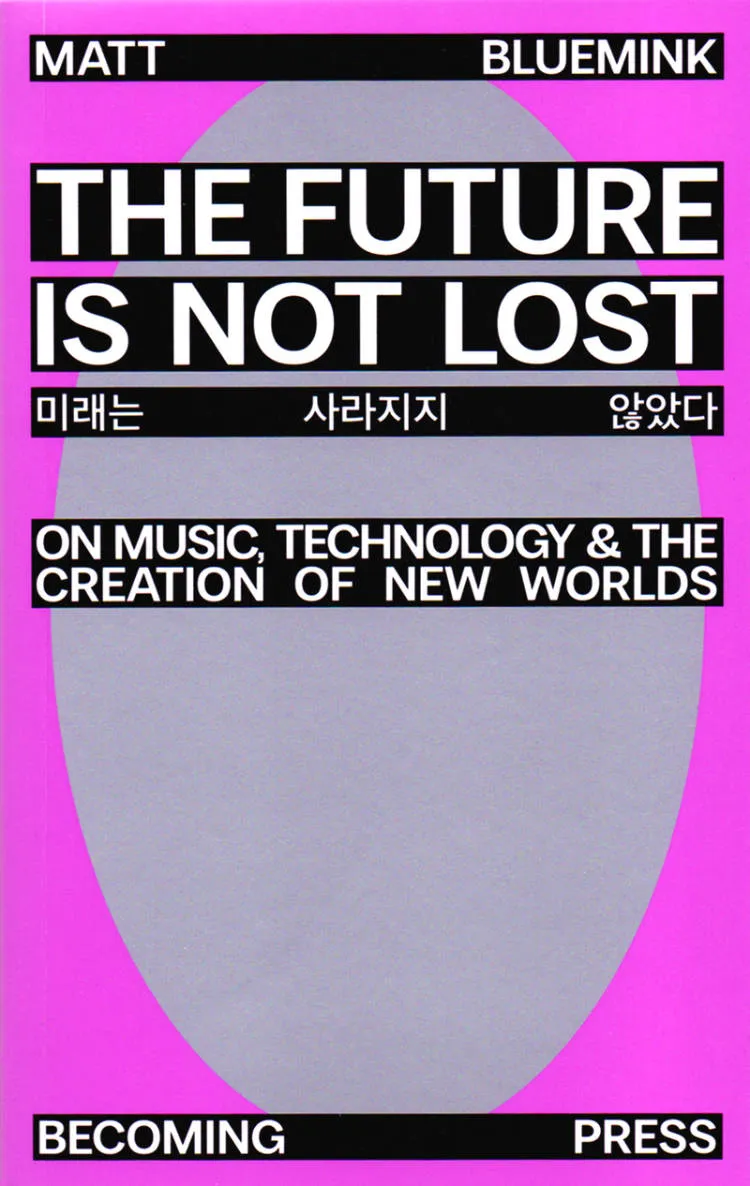
The Future is not Lost: On Music, Technology, and the Creation of New Worlds
Matt Bluemink, Alessandro Sbordoni
Mark Fisher taught a generation to hear the future's disappearance in contemporary music, as if the rhythm of the world was synchronised to the periodic flowering of new creative forms. His diagnosis was devastating: stagnation in music was akin to a venous insufficiency, or worse, some kind of nuclear winter that would ward off the spring for endless generations to come.
Drawing on musicians like SOPHIE, Arca and Iglooghost, Matt Bluemink declares that the future is not lost; it still speaks to us through music. If Fisher’s Hauntology — dwelling on ghosts of the past — is the logic of depression, then Bluemink’s Anti-Hauntology posits a logic of hope where voices from the future continue to guide the development of the present.
Island-hopping through Stiegler's philosophy of technics, Simondon's theory of individuation, and the spatial imaginaries of cyberpunk and solarpunk, Bluemink builds a theoretical framework equal to the times — one that takes seriously our capacity to, not only diagnose the world, but remake it. In order to create a new future we must re-imagine our relationship with music, with technology, and with culture. The world of tomorrow is a blank canvas; an open book. New beginnings are always possible.
Matt Bluemink is the founder and editor-in-chief of Blue Labyrinths online magazine. His research is focused on the relationship between the philosophy of technology, media theory and urbanism. He also writes on contemporary music, literature, and digital culture.

Gender and Postsecularity in Visual Culture and Knowledge Production
Boka En, Sabine Grenz and 2 more
A collection exploring the intersections of gender and religion in post-secular knowledge production and visual culture.
Over the last three decades, religious practices and belongings have gained increased visibility across the globe, turning secularity and its relationship with religion into subjects of intense interdisciplinary and international debate. Previously marginalized in gender studies, the secular and the religious now attract growing interest in academic and activist feminism, prompting a critical reflection on secularity's emancipatory potential. This publication aims to foster this interest by providing a platform for interdisciplinary and transregional discussions on the complex dynamics of secularity, religiosity, and gender, as well as new approaches to explore these relationships.
The contributions examine the entanglements and boundaries of religions and secularities in everyday life, art, culture, and knowledge production. By presenting relevant case studies, this book underscores an understanding of religion as both a category of knowledge and a marker of identity.

All Ah We is One: Caribbean Carnival Costume
Caribbean Carnivals have been taking place around the UK since 1959. These joyous celebrations of culture and community began as acts of resistance in the face of enslavement — a defiant stand from communities who refused to lose who they were and where they came from.
Drawing from this rich and radical history, Aisling Serrant explores Carnival through one of its most vibrant and unmissable features: costume. First turned to by former slaves in the Caribbean as an act of reclamation and quiet resistance, with roots in West African and European masquerade alike, the colourful costumes of Carnival weekend remain a vital mode of self-expression, protest, and camaraderie. From Canboulay to Leeds and Notting Hill, the costume makers, wearers, and the communities they attract, embody Carnival in the spirit of an expression used across the Caribbean to signify unity among nations and peoples: all ah we is one.

Theory of Water
A genre-bending exploration of that most elemental force—water—through Indigenous storytelling, personal memory, and the work of influential artists and writers.
For many years, Leanne Betasamosake Simpson took solace in skiing—in all kinds of weather, on all kinds of snow across all kinds of terrain, often following the trail beside a beloved creek near her home. Recently, as she skied on this path against the backdrop of uncertainty, environmental devastation, rising authoritarianism and ongoing social injustice, her mind turned to the water in the creek and an elemental question: What might it mean to truly listen to water? To know water? To exist with and alongside water?
So began a quest to understand her people's historical, cultural, and ongoing interactions with water in all its forms (ice, snow, rain, perspiration, breath). Pulling together these threads, Leanne began to see how a "Theory of Water" might suggest a radical rethinking of relationships between beings and forces in the world today. In this inventive work, Simpson draws on Nishnaabeg origin stories while artfully weaving the work of influential writers and artists alongside her personal memories and experience—and in doing so, reimagines water as a catalyst for radical transformation, capable of birthing a new world.
Theory of Water is a resonant exploration of an intricate, multi-layered relationship with the most abundant element on our planet—one that, as Simpson eloquently shows, is shaping our present even as it demands a radical rethinking of how we might achieve a just future.

Oriental Cyborg
Who is the Oriental Cyborg? asks Aditi Kini in this collection of notes, jokes, and queries into the provenance of a creature designed for labor, 3-D printed in the technoscientific post-colonies, modeled on old automata. Race is a technology, that we know, and technology can be raced — so why inquire into this at all? Perhaps this, the Oriental Cyborg, is a fantasy more than a memory, or an echo more than a form — or just an essayist’s extraction of personal anguish and humor from globalist decay.
Taking on the form of historical analysis / lyrical essay / documentary poem / experimental buzzword / positionality statement, this chapbook and its titular character might still be an elusive mystery even after reading.
“’What is a ghost but a person removed from corporeality?’ This is one among layers of questions Aditi Kini poses in Oriental Cyborg, a lyrical excavation into survival in the era of techno racial capitalism, and its “deleting touch” that so easily voids—reduces to faceless services—the exploited individuals performing various acts of techno-labor. A grieved searching drives this hybrid essay, which feels urgent and necessary as threats from AI grab headlines. This work compels us to see our culture’s love affair with technological progress as a means for continued colonization and domination. It also reminds us, and celebrates, that those erased don’t stay silent forever. We privileged may not be able to hear them yet, but those who are listening know. They roar.” — Allison Cobb
“In the mirror of Aditi Kini’s Oriental Cyborg, I become the monster—a hopeless automaton, an intelligence stripped of roar. With titanium-threaded theory, Kini radiantly stitches together the ideal Asian working machine. Get your own Oriental cyborg today: super dazzling and sexy, historically embroidered, an oracular truth who never tires, never complains, forever mute, what perfection!” — Lily Hoàng
Aditi Kini is an undisciplined writer. They’ve done both NYC and the MFA (at UC San Diego). They were a finalist/alternate for the 2020-22 Jerome Award for Literature. They edit Lumpenpockets, “a nonquarterly sick rag.” Read their words in Hayden’s Ferry Review, The Rumpus, Denver Quarterly, The New York Times, and elsewhere. They’re at work on multiple projects, all at once. They are blessed with two dogs, Lucy the Happy and Charly Kong, who make life worth living.

An Archive of Feelings
In this bold new work of cultural criticism, Ann Cvetkovich develops a queer approach to trauma. She argues for the importance of recognizing—and archiving—accounts of trauma that belong as much to the ordinary and everyday as to the domain of catastrophe. An Archive of Feelings contends that the field of trauma studies, limited by too strict a division between the public and the private, has overlooked the experiences of women and queers. Rejecting the pathologizing understandings of trauma that permeate medical and clinical discourses on the subject, Cvetkovich develops instead a sex-positive approach missing even from most feminist work on trauma. She challenges the field to engage more fully with sexual trauma and the wide range of feelings in its vicinity, including those associated with butch-femme sex and aids activism and caretaking.
An Archive of Feelings brings together oral histories from lesbian activists involved in act up/New York; readings of literature by Dorothy Allison, Leslie Feinberg, Cherríe Moraga, and Shani Mootoo; videos by Jean Carlomusto and Pratibha Parmar; and performances by Lisa Kron, Carmelita Tropicana, and the bands Le Tigre and Tribe 8. Cvetkovich reveals how activism, performance, and literature give rise to public cultures that work through trauma and transform the conditions producing it. By looking closely at connections between sexuality, trauma, and the creation of lesbian public cultures, Cvetkovich makes those experiences that have been pushed to the peripheries of trauma culture the defining principles of a new construction of sexual trauma—one in which trauma catalyzes the creation of cultural archives and political communities.

New Forms of Art and Contagious Mental Illness
Carl Julius Salomonsen, Andrew Hodgson
Over the years 1919–20, the celebrated medical scientist and doctor Carl Julius Salomonsen began giving public lectures and publishing pamphlets regarding a new “epidemic” that had begun to affect the European populace: the increasing ubiquity of modernist art.
In a 1919 pamphlet titled New Forms of Art and Contagious Mental Illness, he wrote: “We stand, at this moment, before a movement in art which is psychopathic in character, and whose victorious journey through all countries is probably caused by the same spiritual disease that gave the older, religious spiritual epidemic such a powerful spread.” This pamphlet and the accompanying talks were countered by a retaliatory pamphlet published by members of Grønningen, a Copenhagen modernist painters group, to which Salomonsen responded with a further pamphlet.
Translated into English for the first time by literary theorist Andrew Hodgson, the entire altercation is gathered in this book, documenting one of the earliest rejections of modernist art.
Edited & Translated by Andrew Hodgson.

Iliazda at the Birthday Party – Autobiographical Lecture, 1922
The English translation of Zdanevich's Dadaist autobiographical lecture in Paris in 1922, where he adopts the name Iliazda. In this entertaining lecture, the achievements of the avant-garde is presented as a combination of zaum, polymorphous sexuality, aleatory forms and scatological interpretation of culture.
The second volume of the bie bao series presents a eulogy entitled Iliazda at the Birthday Party, a pseudo-autobiographical lecture delivered by Ilya Zdanevich in Paris in 1922. It reports on Zdanevich's artistic and political adventures up until then. Along with an autobiography full of self-admiration, in this lecture Zdanevich gives an interpretation of his zaum dramas inspired by Freudianism, and humorously describes a colourful image of the Russian microcosm in Montparnasse.
Additionally, this second volume also includes Iliazd's letter to Ardengo Soffici from 1964, where one can read, in the most unambiguous terms, about Zdanevich's positions against war, imperialism, and all forms of nationalism. Subtitled 50 Years of Russian Futurism, the letter to Soffici presents us with an altogether new Zdanevich—a "fellow traveller" in both leftist and avant-garde circles. As well as the extended introduction and extensive annotations, the texts are further contextualised with Johanna Drucker's visual presentation of the birth of the Iliazd cult.
The bie bao series will include eight publications, covering many layers of Zdanevich's rich theoretical and artistic output. Each volume consists of a bio-bibliographical introduction, a commentary, a translation with annotations, and artistic intervention.
Iliazd (Ilya Zdanevich, 1894-1975) was a Russian poet, designer, typographer, theoretician, art critic, and publisher, close to the avant-garde circles and one of the promoters of Futurism in Russia, author of a poetic work, drama written in zaum abstract poetic trans-sense or "transrational" language, and novels.

Black Phoenix: Third World Perspectives on Contemporary Art and Culture
Facsimile compilation of the late-'70s journal on diasporic and colonial histories that paved the way for the British Black Arts Movement.
Published in three issues between 1978 and 1979, Black Phoenix: Journal of Contemporary Art & Culture in the Third World (the subtitle was changed to Third World Perspectives on Contemporary Art and Culture for its second and third issues) stands as a key document of its time. More than a decade after '60s liberation movements and the historic Bandung and Tricontinental Conferences that called for social and political alignment and solidarity to dismantle Western imperialism and (neo)colonialism, Black Phoenix issued a rallying call for the formation of a Third World, liberatory arts and culture movement on the eve of Margaret Thatcher's election in 1979.
Based in the UK, and both international and national in scope, Black Phoenix positioned diasporic and colonial histories at the center of an evolving anti-racist and anti-imperialist consciousness in late 1970s Britain—one that would yield complex and nuanced discourses on race, class and postcolonial theory in England in the decade that followed.
A precursor to the British Black Arts Movement that formed in 1982 (which encompassed such cultural practitioners as the Black Audio Film Collective and cultural studies theorist Stuart Hall), Black Phoenix proposed a horizon for Blackness beyond racial binaries, across the Third World and the colonized of the interior in the West.
This single-volume facsimile reprint gathers all three issues of the journal, which include contributions by art critics, scholars, artists, poets and writers, including editors Rasheed Araaen and Mahmood Jamal, Guy Brett, Kenneth Coutts-Smith, Ariel Dorfman, Eduardo Galeano, N. Kilele, Babatunde Lawal, David Medalla, Ayyub Malik, Susil Sirivardana and Chris Wanjala.