Artists' Books
Artists' Books
rosa rosa rosae rosae
Produced in conjunction with the exhibition that took place at Maison Pelgrims (10/9-23/10/2021), the book presents original interventions by the artists of the rosa rosae rosae project : Alicia Jeannin, Alicja Melzacka, Angela Detanico & Rafael Lain, Annaïk Lou Pitteloud, Audrey Cottin, buren, Charlie Usher, Eleanor Ivory Weber, Eva Giolo, Henry Andersen, Jan Vercruysse, Maíra Dietrich, Marc Buchy, Maxime Jean-Baptiste, Niels Poiz, Oriol Vilanova, Sabir (Lucie Guien, Amélie Derlon Cordina, Sophie Sénécaut / Perrine Estienne, Kevin Senant, Maud Marique, Pauline Allié, Carole Louis), Slow Reading Club, Sofia Caesar, Surya Ibrahim, Yiannis Papadopoulos, Yoann Van Parys
Edited by Pauline Hatzigeorgiou / SB34
Graphic design by Tipode Office
The book was produced with the support of Fédération Wallonie-Bruxelles (aide à l'édition) and Région Bruxelles-Capitale (Image de Bruxelles)
Le Chauffage — Issue #2
Francesca Percival, Felix Rapp and 1 more
Le Chauffage (french for “The Heater”) is an artist-run publication based in Brussels and Vancouver. It is conceived as a cross-continental, community oriented platform. Le Chauffage brings together the work and writing of artists / friends from different cities with the intent to spark discussion and fuel casual forms of critical discourse.
The second issue of Le Chauffage contains photographs and texts, photographs of text, photographs as text and vice versa. Loosely thinking through the format of The Photo Essay celebrated by John Szarkowski in an eponymously titled exhibition at MoMA in 1965, this issue considers some of the artistic possibilities that can be found in such an archaic and historically male-dominated form.
Many of the contributions that make up this second issue are not photo essays per se. But each one of them considers the printed page as a space in its own right. The magazine becomes an interior where words and images entertain a malleable and distinctly porous relationship. At times, it is also a space where artists and writers from different cities were invited to meet and collaborate. And since interest in other people is also an interest in yourself, it is always unclear who is really transforming who?
Contributions by: Bob Cain & Linda Miller, Moyra Davey, Laurie Kang, Niklas Taleb, Madeleine Paré & Diane Severin Nguyen, Josephine Pryde, Slow Reading Club, Ken Lum, Isaac Thomas, Vijai Maia Patchineelam, Artun Alaska Arasli & Graeme Wahn, Stephen Waddell, Maya Beaudry & Chloe Chignell, Lisa Robertson, groana melendez, Victoria Antoinette Megens and Will Holder.
Editors: Emile Rubino and Felix Rapp
Co-Editor: Francesca Percival
Design: Francesca Percival and Felix Rapp
Cover Design: Francesca Percival
Printed by: Cassochrome, Belgium
Edition of 350
Bookmarks of sorts
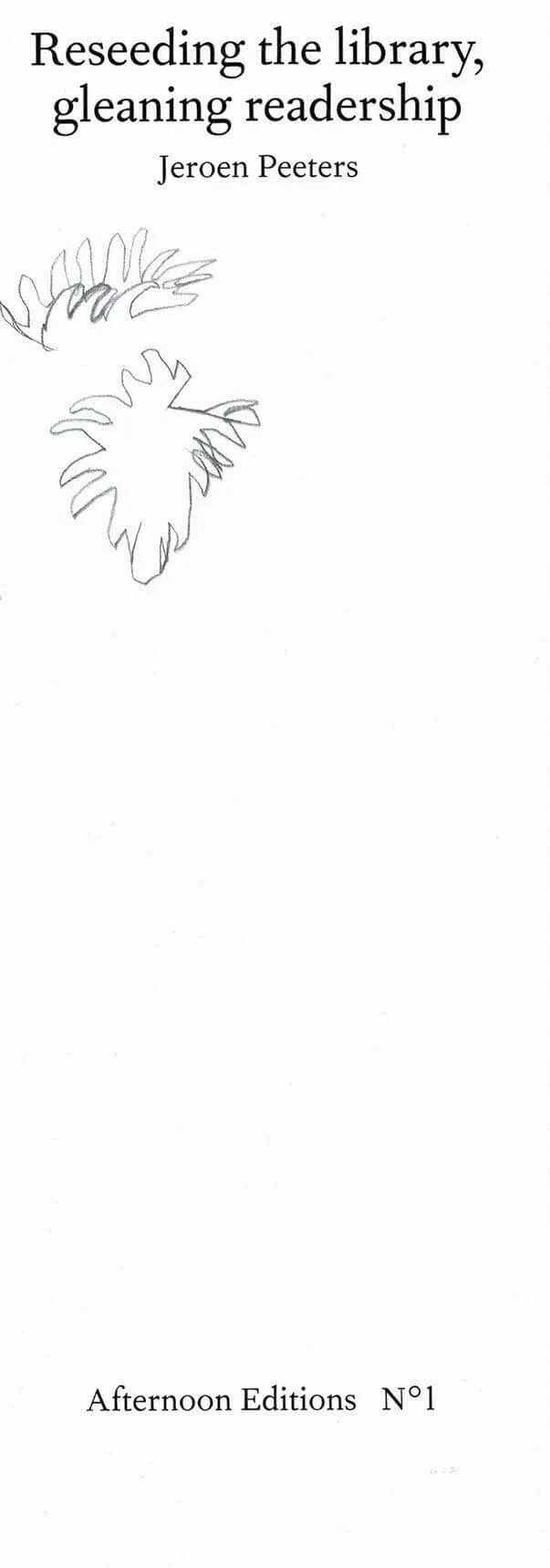
Afternoon Editions no. 5: a collection of found papers annotated by Jeroen Peeters, titled Bookmarks of sorts. During several years Jeroen Peeters collected notes left by readers in library books: faded reader tickets, scraps with notes, a shopping list, train tickets and other little papers used as bookmarks. He noted each time the date and the book in which they were found. Afterwards he wrote commentaries to this collection, an essay on alternative reading practices, marginalia and extra-illustration, on the exchange between readers and the imaginary community lingering in all those library books.
Weaknesses
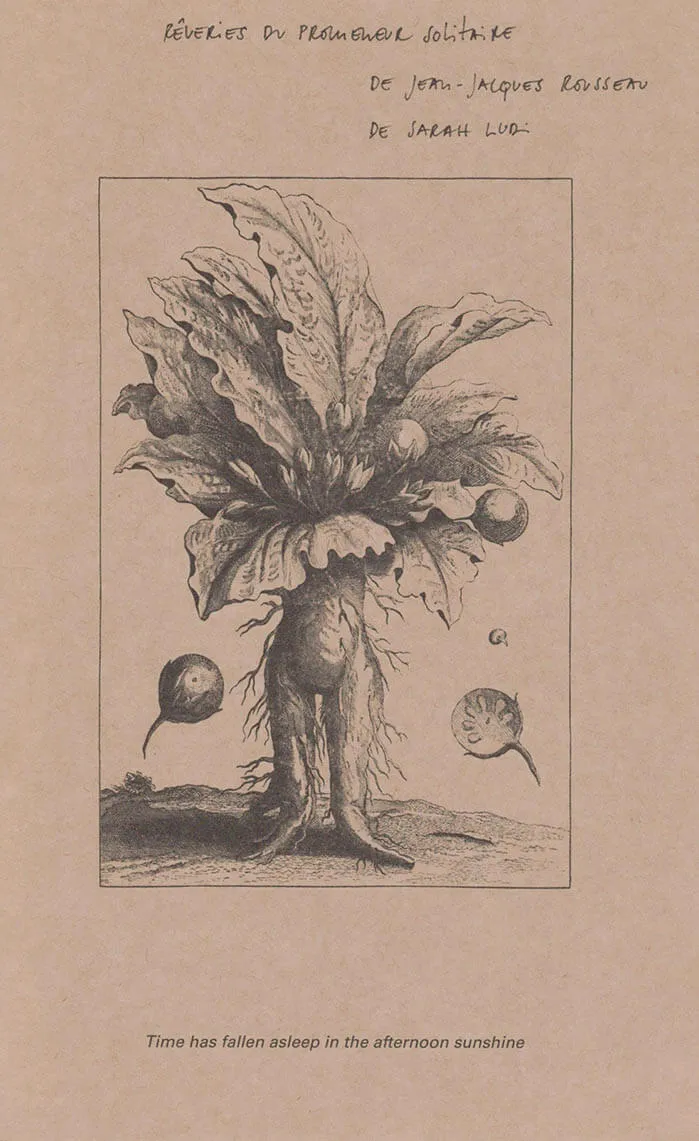
Afternoon Editions no. 2: text and drawings by Chrysa Parkinson titled Weaknesses. Between January and March 2019 Time has fallen asleep in the afternoon sunshine was presented as a solo-exhibition at Index Foundation in Stockholm. During this period Chrysa Parkinson was invited as a guest writer for Afternoon Editions. Weaknesses is a leap in memory.
David Robilliard Notebooks 1983-1988
This book follows the first exhibition of Robilliard’s notebooks, ‘Disorganised Writings and Sketches’ with Rob Tufnell in Cologne in April 2019. It was made with support from the Elephant Trust and the book’s designers, A Practice for Everyday Life and with assistance from James Birch, one of David’s gallerists, and Chris Hall, custodian of the estate of Andrew Heard. The book is dedicated to Andrew Heard.
Rob Tufnell presents a new publication of extracts from the notebooks of the poet and artist David Robilliard (b.1952 – d.1988). After his premature death from an AIDS-related illness in 1988, Robilliard left a large number of notebooks in the care of his close friend and fellow artist Andrew Heard. These were obsessively filled with drafts of poems, diary entries, addresses and telephone numbers, blunt observations, quiet reflections, short stories, ideas for paintings, portraits and crude drawings. Robilliard’s superficially simple, pithy prose and verse is riddled with the dichotomies of an era that was both exuberant and miserable. His notebooks reveal his creative process, his interests, ideas, ambitions and then his illness but always embody his often repeated belief that ‘Life’s not good it’s excellent.’
Many of the books contain the inscription: ‘If found please return to 12 Fournier Street, London E1. Thank you’ – the home and studio of his patrons, Gilbert & George. In their lament ‘Our David’ (1990) they describe their protégé as:
“...the sweetest, kindest, most infuriating, artistic, foul-mouthed, witty, sexy, charming, handsome, thoughtful, unhappy, loving and friendly person we ever met... Starting with pockets filled with disorganised writings and sketches, he went on to produce highly original poetry, drawings and paintings.”
The publication exists in two editions: yellow and pink.
Anna Oppermann: Drawings
Surreal, psychedelic riffs on domestic objects from a trailblazing feminist artist.
From her beginning in the mid-1960s through the early '70s, German artist Anna Oppermann (1940-1993) - best known for her encyclopedic, immersive installations - created an astonishing series of surreal, almost psychedelic drawings that quietly explode the private space of the home, and her experience within it. These early drawings contribute to a feminist reentering of spheres traditionally associated with women, casting everyday objects as symbolic, consequential protagonists: houseplants sprawl to take over the picture plane, windows and mirrors provide views into other worlds and tables display drawings that themselves open out into new domestic scenes. By placing her own body—her knees, arms, the back of her head—as reference points in the work, Oppermann emphasizes the gendered realms of the home and the relationships that we form to our private spaces.
This volume gathers these drawings and early installations in an English-language publication for the first time.
Pasts, Futures, and Aftermaths: Revisiting the Black Dada Reader
The sequel to Pendleton's acclaimed Black Dada Reader, compiling an anti-canon of radical experimentation and thought.
In 2011, artist Adam Pendleton (born 1984) assembled Black Dada Reader, a compendium of texts, documents and positions that elucidated a practice and ethos of Black Dada. Resembling a school course reader, the book was a spiral-bound series of photocopies and collages, originally intended only for personal reference, and eventually distributed informally to friends and colleagues. The contents - an unlikely mix of Hugo Ball, W.E.B. Du Bois, Adrian Piper, Gertrude Stein, Sun Ra, Stokely Carmichael, Gilles Deleuze -formed a kind of experimental canon, realized through what Pendleton calls radical juxtaposition. In 2017, Koenig Books published the Reader in a hardcover edition, with newly commissioned essays and additional writings by the artist. A decade later, Pendleton has composed another reader, building upon the constellation of writers, artists, filmmakers, philosophers and critics that emerged in the first volume.
Source texts by Sara Ahmed, Mikhail Bakhtin, Toni Cade Bambara, Amiri Baraka, Augusto de Campos, Hardoldo de Campos, and Décio Pignatari, Angela Davis, Gilles Deleuze, Julius Eastman, Adrienne Edwards, Clarice Lispector, Achille Mbembe, Philippe-Alain Michaud, Charles Mingus, Piet Mondrian, Leslie Scalapino, Leonard Schwartz and Michael Hardt, Juliana Spahr, Cecil Taylor and Malcolm X.
Catalog issue 17 — ‘Introduction’
Catalog is a serial publication about cataloging, written by Lieven Lahaye and designed by Ott Metusala. This is Catalog issue 17, ‘Introduction’, it’s part of a sub-series, researching the life, work and near invisibility of writer Duncan Smith (1954–1991).
HOOT nr. 3 — Kamilé Krasauskaité
Gufo, Clément Faydit and 1 more
Last year, on a summer night in Marseille, someone, within all the hungry people I am meeting during my dinners, specifically set her attention on my projects. Later during the fall I received a call from Austė ZDANČIŪTĖ, the cultural attache at the Lithuanian embassy in France, who introduced me to Kamilè Krasauskaitè. Since that fall, we kept on exchanging and making future plans in France where she would have a residency. The more we chatted, the closest we began. Kamilè is a almost-thirty-years-old Lithuanian artist that has been including sourdough bread in her work and builds a poetic and mesmerising world around that dimension of food, fermentation, senses, environment, rituals...Through our communication I decided to share that encounter that we managed to welcome in Marseille. We kneaded some bread together, shared it in a forest of Marseillais sunflowers, walked the streets, met people, questioned and compared artists' lives in Europe. This issue might be an excerpt of all the long conversations we had, it was hot and sunny in Marseille, it was in June.
Having a party (hope you will be there)
"Having a party (hope you will be there)", is a catalogue of an exhibition organized by Mickael Marman and D&TLG at CFAlive in Milan with artists from the black European diaspora, including original contributions, photos of the show, as well as a brand new intro text by Olamiju Fajemisin.
WILL YOU MARRY ME?
The ultimate ambition of this book-tool is to “disappear on the street”. Its pages collect words and stories of people whose right to exist and be visible in public spaces was forced to confront the concepts of “legality” and “justice”.
Considering the assumption that the law is a fluid parameter, which changes depending on where we are in the world, the historical period in which we live and the sort of privileges we enjoy, the law defines what is considered moral, licit, in other words, what is right. It distributes power and the perception of power in society, defining, categorizing, dividing and controlling.
WILL YOU MARRY ME? is a public lecture and an artist’s book by Sara Leghissa and Marzia Dalfini, investigating a specific portion of the spectrum of illegality, namely the relationship between illegal acts and public space. It explores how we can act disobedience before everyone’s eyes, suggesting possible forms of complicity and public resistance.
All the content was collected by the artist during meetings and conversations that took place in Prato, Milan, Ramallah, Marseille, Madrid, Nyon and Lausanne and with this book-tool their words become manifestos that the reader is invited to detach and relocate into the public space.
Designed by Marzia Dalfini. Published by NERO with the support of L’Altra.
Format: 42 x 29,7 cm
Pages: 28
Language: IT / EN
Year: 2021
Side Magazine #01 – The Professor
The first issue of the editorial discursive space for the Bergen Assembly triennial, conceived by Saâdane Afif, explores the identity, role and position of the Professor.
Side Magazine is conceived as a site of research for the fourth edition of Bergen Assembly convened by Saâdane Afif. Yasmine d'O., who has been invited as curator of the upcoming edition, will be the executive editor.
Side Magazine is dedicated to the seven characters in The Heptahedron, a play written by the French poet, essayist, and scholar Thomas Clerc in 2016. In order of apparition these characters are the Professor, the Moped Rider, the Bonimenteur, the Fortune Teller, an Acrobats, the Coalman, and the Tourist.
The first issue of Side Magazine is dedicated to the figure of the Professor. It features seven articles, each of which explores the identity, role, and position of the Professor. Contributors include Uli Aigner, Lili Reynaud-Dewar, Jörg Heiser, Christian Nyampeta, Marjorie Senechal, and Vivian Slee.
Seven issues of Side Magazine will be released in the run up to the opening of Bergen Assembly 2022, opening September 8. A special eighth issue will be published after the opening days. This, combined with the existing seven issues as a collection, constitute the exhibition catalogue and guide.
Saâdane Afif (born 1970 in Vendôme, France) creates installations made up of unexpected encounters between objects. These creations, of uncertain status, oscillate between function and symbol, between art and design, and provoke shifts of meaning that engage a reflection on today's industrial society.
Play-White
The racist term "play-white" comes from the apartheid era, when it connoted a black or mixed race person who lived as a white person: “So and so is a play-white.” South African artist Bianca Baldi draws from studies of biomimicry and her own family history, as well as literary precedents—such as Nella Larsen’s novel Passing (1929)—to reflect on racial passing and the instability of racial identities. Play-White alternates between layers of visualization and moments of discretion in order to explore questions of presence and evasion beyond their representation in black and white.
With contributions by Bianca Baldi, Mika Conradie, Shoniqua Roach, Amy Watson, and others; design by Katharina Tauer & Wolfgang Hückel in collaboration with K. Verlag.
Published 2021
I am Welton Santos.
I am Welton Santos reenacts a dialogue between the Brazilian geo-bio-architect Welton Santos and an Interviewer. The book, which is always read collectively, is used in reading performances by groups of at least 3 people.
Printed on the occasion of an artist residency at PAV, Parco d’Arte Vivente, Turin, July 2016. Texts based on transcripts of interviews with Welton Santos.
Elizabeth in the Woolds
Elizabeth in the Woolds is the product of two superimposed compositional strategies; a thematic aggregate based on notes dating back to 2008 and an epic prose narrative. Elizabeth is the device through which this simultaneous register moves. Screen writing provides a model for multiple voices. In a film script, the narrator can be the camera; there’s a machine at the centre of the story structure which figures a demand for resolution of plot; a contrario, the thematic approach (S, U, N, as electric light) obliterates chronology, and enumerates an atemporal topological figure, or the way the world is built.
(730pp., self-published first edition of 50, Kortrijk, 2021)
TYPP (The YellowPress Periodical)
TYPP is the community journal of Sint Lucas School of Arts in Antwerp. TYPP is partly a generator for the shared research of our advanced master students, and partly a platform for carefully selected contributions by tutors, students, alumni, guest lecturers and friends of SLA. TYPP is a stage where art and research from this community is shared with you, to enjoy, read, look, learn and get inspired.
Each edition is carefully and freely designed by Ward Heirwegh.
The German Library Pyongyang
From December 11, 2015, until April 10, 2016, the German Library in Guangzhou, China, became The German Library Pyongyang, a reimagining of an initiative of the Goethe-Institut that originally operated in North Korea between 2004 and 2009. This temporary intervention by Sara van der Heide is an imaginary transformation of the current geography of the German Library in Guangzhou. Van der Heide’s project is a contemporary version of the Goethe-Institut’s original library initiative in North Korea, devised as a vessel to discuss national cultural policy in a post-Cold War and postcolonial era that looks critically toward the parallel histories of Germany and the two Koreas. The German Library Pyongyang offers a space for critical questions, but it also functions as a context for transcending thinking that is prescribed by the lines of the nation-state, language, and geography. The several artistic, linguistic, and graphic interventions in the library merge with the continuing activities of the German learning center in Guangzhou, and all institutional printed matter in Chinese is replaced by Korean.
This publication brings together the four original exhibition booklets in German, Korean, English, and Chinese. An additional reader is included with critical reflections as well as documentation of the exhibition and the organized seminar.
Design by Dongyoung Lee
English/German/Korean/Chinese
24 European Ethnographic Museums
With the series '24 European Ethnographic Museums' Van der Heide questions the construction and identity of the ethnographic museum today. Here, the project becomes a collection of artefacts in and upon itself and by recording the names of these institutions Van der Heide places the viewer in front of the dilemma: who is authorized to decide what is an artefact, and what should be collected and for what reason? In the 19th century, with the birth of the current European nations, museums openly referred to their colonial past. Today the museums bare more euphemistic names like: ‘Museum der Kulturen’ or ‘World Museum’ but still place the West as the self-acclaimed center of the world. The existence of the ethnographic museum, which is intertwined with the complicated and loaded colonial past, has been subject to contemporary criticism. While some of the European ethnographic institutions have attempted to come to terms with the past of their collections and their heritage, Van der Heide focuses upon how language continues to reflect the political present of the institutions.
Untitled
Sasha Phyars-Burgess’ first monograph, Untitled. Spanning three bodies of work, this 200-plus page monograph includes poems by Ser Alida and Aurora Masum-Javed, a conversation between Sasha Phyars-Burgess, Juliana Huxtable and Carolyn Lazard, and essay by Bill Gaskins. Designed by Studio Lin.
As recipient of the second annual Capricious Photo Award, Sasha is a vital, emerging voice in contemporary photography, engaging the charged line between documentary and fine art. Her work ranges from affecting studies on diaspora, family and place to revolving social phenomenons in which energy, beauty and power meet.
The second annual jury panel was helmed by Capricious Founder and Publisher Sophie Mörner and Associate Publisher Anika Sabin alongside Lauren Cornell, Katherine Hubbard, JOFF, Matt Keegan, Guadalupe Rosales, Ka-Man Tse, and Lyndsy Welgos.
== #2 (edition)
First launched in 2012, and published by mfc michèle didier (micheledidier.com), == is a small-run arts publication, edited by Matt Keegan. ==#2, 2015, is designed by Su Barber and published in an edition of 500 by Capricious Publishing. Barber and Keegan worked together on North Drive Press (northdrivepress.com) between 2005-2010, and this publication shares a variety of traits with NDP.
==#2 is a non-thematic arts publication contained in a box with a 96-page bound volume featuring artist-to-artist interviews, texts, and transcriptions. Six loose multiples are also included.
Contributors include: Sam Anderson, Uri Aran, Fia Backström, Darren Bader, Judith Barry, Stefania Bortolami, Daniel Bozhkov, Milano Chow, Anna Craycroft, Lucky DeBellevue, Cristina Delgado, Haytham El-Wardany, Jake Ewert, Vincent Fecteau, Corrine Fitzpatrick, Harrell Fletcher, Rachel Foullon, Aurélien Froment, Kenny Greenberg, Calla Henkel, Leslie Hewitt, Jaya Howey, Adelita Husni-Bey, Iman Issa, Ruba Katrib, Jill Magid, Jo Nigoghossian, Aaron Peck, Max Pitegoff, David Placek, Olivia Plender, Lisa Robertson, Andrew Russeth, Amy Sillman, Diane Simpson, Greg Parma Smith, Jessica Stockholder, Martine Syms, and Anicka Yi.
Se Te Subió El Santo (Are You In A Trance?)
Se Te Subió El Santo is a collection of self – portraits taken by the artist directly after she awoke every morning while away on a week-long residency in Iowa City, IA at the Center for Afrofuturist Studies in Spring 2016. This daily practice confronts notions of the artist’s interests in rendering a full self implicit of gender, race, sexuality, and spirituality while challenging and collapsing the intersections of each identity as well.
The title of the work is taken from Ana Mendieta, the Iowa Years: A critical study, 1969 through 1977 where Julia Ann Herzberg writes in the dissertation:
Ana and Raquelin Mendieta’s vocabulary contained many Afro-Cuban idiomatic expressions. For example, they would often respond to a friend who was acting in an unruly or hyperactive manner by asking” “Se te subió el santo? (“Are you in a trance?”) In the Afro-Cuban context, the expression “subirse el santo” is used in religious ceremony when the orisha/saint takes possession of the believer.
The monograph also includes an essay by author Akwaeke Emezi.
First edition, 94 page, black and white, leather bound hardcover with white foil embossment
TIONA NEKKIA MCCLODDEN is an interdisciplinary research-based conceptual artist, filmmaker and curator whose work explores, and critiques issues at the intersections of race, gender, sexuality and social commentary. McClodden’s interdisciplinary approach traverses documentary film, experimental video, sculpture, and sound installations. Themes explored in McClodden’s films and works have been re-memory and more recently narrative biomythography.
Fugues
FUGUES is a study of objects. Elements repeat and imitate one another like a polyphonic canon of voices narrating stories of domestic confinement in looped time.
With images by photographer Nicole Maria Winkler & texts by artist Issy Wood, writer Ella Plevin, model Freja Beha Erichsen and curator Elaine Tam.
Sonnet(s)
A lost gem of permutational conceptualism from a key figure in artist's book culture, available again
Known internationally as one of Mexico's most important conceptual artists, Ulises Carrión (1941-89) played a decisive role in defining and conceptualizing the genre of the artists' book through his manifesto, The New Art of Making Books (1975), which he wrote soon after the 1972 publication of SONNET(S) and his move from Mexico City to Amsterdam, where he opened the legendary bookshop gallery, Other Books and So, the first space dedicated exclusively to artists' publications and an important precursor to such artists' book hubs as Printed Matter.
One of Carrión's earliest bookworks, SONNET(S) represents a landmark shift in the artist's output from poetry to artists' books. Here, Carrión takes a single poem by Dante Gabriel Rossetti through 50 typographic and procedural permutations. This republication is supplemented by new essays on Carrión's bookworks by contemporary artists, writers, and scholars from Mexico, Europe and the US.
Published March 2021
Index of Operational and Code Names
Le titre du livre « Index of operational and code names » reprend l'intitulé d'un document trouvé sur Internet constitué d'une liste de 437 mots anglais classés par ordre alphabétique et accompagnés de brèves indications concernant les opérations militaires pour lesquelles ces mots ont servi de noms de code.
Ce document a inspiré à Diane Guyot la série « Index War » réalisée selon un protocole simple consistant à produire un dessin pour chaque mot de la liste.
Composé de 86 dessins issus de cette série, certains reproduits pour le support du livre, d'autres présentés au sein d'un cahier photographique tels qu'ils sont aujourd'hui accrochés dans les intérieurs de leurs propriétaires, et d'une partie textuelle placée en fin de volume qui restitue l'intégralité du document source, le livre, comme le suggère la mention volume 1 qui accompagne son titre, ne marque pas le point d'achèvement de l'œuvre mais témoigne au contraire d'un processus en cours.
L'articulation des composantes de l'œuvre dans l'espace du livre en constitue en mème temps une nouvelle version, à la fois spécifique et autonome. L'activation du dispositif codex/index invite le lecteur à une méditation sur la notion de code, où s'entrecroisent sémiotique de l'image, technique de propagande et technologie de l'information.