rile*books

Search books

Search books by title, author, publisher, keywords...

Cover of The Helens of Troy, New York

New Directions Publishing

The Helens of Troy, New York

Bernadette Mayer

€12.00

Profiles of all the women named Helen in Troy, NY, with poems and images, mixing the classical with the ordinary and delightful intelligence with irreverence. 

'everybody died there’s nothing more to say my hair’s braided like a family i took off, it was fun, i loved it if you did something wrong, they punished you one helen is enough, trust me'

Language: English

recommendations

Cover of Sea, Poison

New Directions Publishing

Sea, Poison

Caren Beilin

Fiction €16.00

Cumin Baleen is a forty-one-year-old writer living in Philadelphia—this city of hospitals—who works at the upscale grocery Sea & Poison and is navigating the onset of an autoimmune condition. To start a medication that may help, an eye exam is required and this leads to a nightmarish laser eye surgery. The laser shoots into her brain, making her language spare and her sentences clause-less, a vexing constraint that stalls her book on gynecological malpractice: she wants others, in the realm of our for-profit medical industry that "renders the Hippocratic Oath its opposite," to see poison.

Meanwhile, Cumin is kicked out of her boyfriend Mari's studio after he falls for Janine, their landlord, and starts renting a closet in Maron's bedroom—polyamorous Maron who is hooking up with Alix, whom Cumin lusts after. Disheveled from medicines and medical scams, Cumin declares, "I don't know what to say, I'm saying I have a cracked appearance. It's not a pity party, it's a character sketch. Insofar as you'll need to be looking at me, that your mind should fill me up with its own swaying cognitive and toxic reeds if we are to do this, your imagination should touch me with its ridiculous poison."

Caren Beilin's hypnotic and fractured story is at once an homage to Shusaku Endo's terrifying novel of human vivisection The Sea and Poison and the spirit of OuLipo, the pioneering French writing group that sought new literary potential through constraints.

Caren Beilin was born in Philadelphia in 1983. She is the author of the novel Revenge of the Scapegoat, which won the Vermont Book Award for Fiction. Her other books are Blackfishing the IUD, Spain, The University of Pennsylvania, and Americans, Guests, or Us. She lives in Cleveland and Philadelphia and teaches at Case Western Reserve University.

Cover of A Musical Hell

New Directions Publishing

A Musical Hell

Alejandra Pizarnik, Yvette Siegert

Poetry €13.00

“An aura of legendary prestige surrounds the work of Alejandra Pizarnik,” writes César Aira. Her last collection to be published before her suicide in 1972, A Musical Hell is the first book of poems by Pizarnik to be published in its entirety in the U.S. Pizarnik writes at the edge of poetic impossibility, opening with a blues singer, expanding into silence, and closing into a theater of shadows and songs of the drowned.

Cover of Unfit

New Directions Publishing

Unfit

Ariana Harwicz, Jessie Mendez Sayer

Mothering €16.00

A bracing novel that asks how far we would go for the ones we love—and what we would do to destroy the ones we hate. 

Lisa has lost custody of her young twin boys. Caught between the French legal system’s sluggish bureaucracy and her sinister, scheming in-laws, she’s alone and lost, an Argentine migrant in rural France picking grapes for a pittance, only allowed to see her children in supervised visits once a month. Scapegoated and outcast, destitute and desperate, Lisa decides to take radical action: early one morning, she sneaks into her in-laws’ farmhouse, takes back her children, sets the barn ablaze, and makes her escape.

What follows is a white-knuckled road trip that explores human beings pushed to the edge. Clearly, Lisa is not in her right mind, and as Harwicz deftly mingles a chorus of contradictory voices into her very unreliable narration, the reader comes to regard the protagonist with an unsettling mixture of sympathy and suspicion. Written in savage, chiseled prose, Unfit shoots off, a gripping chase that questions all our assumptions—and points out our hypocrisies— about motherhood, custody rights, love, violence, anti-semitism, and migration. The latest novel by the acclaimed author of Die, My Love (soon to be adapted to a film starring Jennifer Lawrence), Unfit is addictively terrifying, savagely sophisticated, and shockingly brilliant.

Translated from Spanish by Jessie Mendez Sayer

Cover of Água Viva

New Directions Publishing

Água Viva

Clarice Lispector

Fiction €15.00

In Água Viva Clarice Lispector aims to 'capture the present'. Her direct, confessional and unfiltered meditations on everything from life and time to perfume and sleep are strange and hypnotic in their emotional power and have been a huge influence on many artists and writers, including one Brazilian musician who read it one hundred and eleven times. Despite its apparent spontaneity, this is a masterly work of art, which rearranges language and plays in the gaps between reality and fiction.

Clarice Lispector (December 10, 1920 – December 9, 1977) was a Brazilian writer acclaimed internationally for her innovative novels and short stories. Born to a Jewish family in Podolia in Western Ukraine, as an infant she moved to Brazil with her family, amidst the disasters engulfing her native land following the First World War. 

Cover of Midwinter Day

New Directions Publishing

Midwinter Day

Bernadette Mayer

Poetry €17.00

Midwinter Day, as Alice Notley noted, is an epic poem about a daily routine. A poem in six parts, Midwinter Day takes us from awakening and emerging from dreams through the whole day-morning, afternoon, evening, night-to dreams again:...

a plain introduction to modes of love and reason/ Then to end I guess with love, a method to this winter season/ Now I've said this love it's all I can remember/ Of Midwinter Day the twenty-second of December// Welcome sun, at last with thy softer light/ That takes the bite from winter weather/ And weaves the random cloth of life together/ And drives away the long black night!

Cover of Studying Hunger Journals

Station Hill Press

Studying Hunger Journals

Bernadette Mayer

Poetry €27.00

In 1972 Bernadette Mayer began this project as an aid to psychological counseling, writing in parallel journals so that, as she wrote in one (in bed, on subways, at parties, etc.), her psychiatrist read the other. Using colored pens to “color-code emotions,” she recorded dreams, events, memories, and reflections in a language at once free-ranging and precise—a work that creates its own poetics. She sought “a workable code, or shorthand, for the transcription of every event, every motion, every transition” of her own mind and to “perform this process of translation” on herself in the interest of evolving an innovative, inquiring language. STUDYING HUNGER JOURNALS registers this intention within a body of poetry John Ashbery has called “magnificent.”

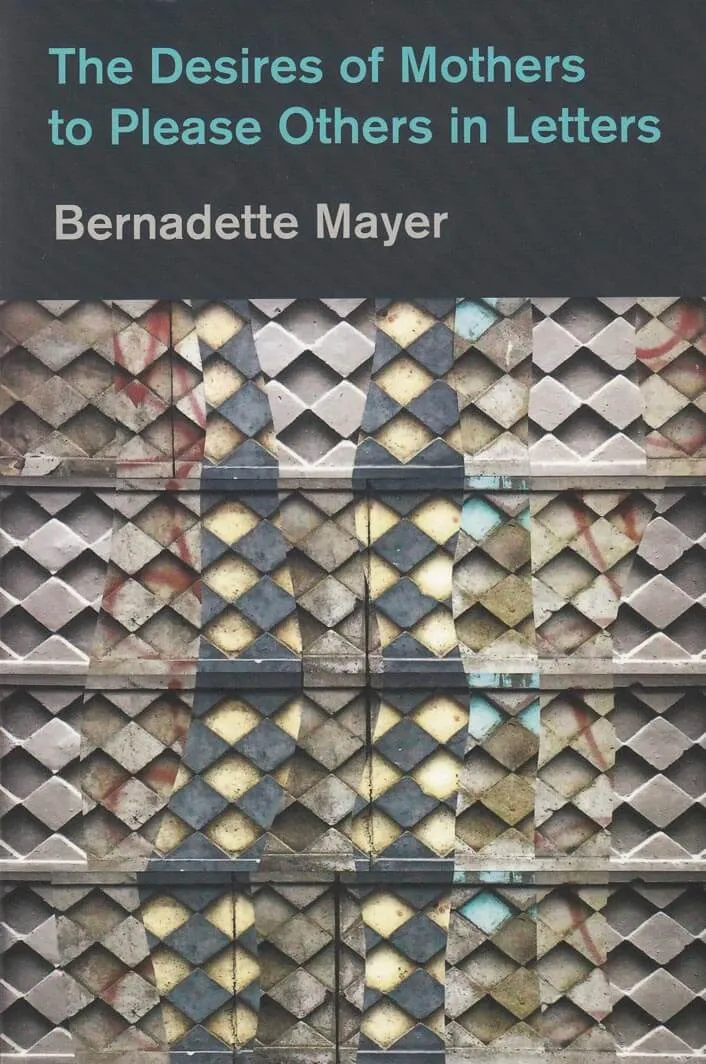
Cover of The Desires of Mothers to Please Other in Letters

Nightboat Books

The Desires of Mothers to Please Other in Letters

Bernadette Mayer

A reissue of Bernadette Mayer's classic fugitive intergenre text. Endlessly inclusive, The Desires of Mothers to Please Others in Letters, first published in 1994 and long out of print, evokes the complexity of real persons as it simultaneously reinvents multiple genres: epistle, prose poem, and memoir.

Written between 1979 and 1980 while pregnant with her third child, Mayer extends her imaginative letters into meditations for us all on life as it is lived in real time, with its responsibilities and manifold desires. Fierce, lyrical, intimate, and wise, both new and familiar readers, both mothers and non–mothers, will find this book beckoning again and again to offer delicious writing, timely information, consolation, and advice.

With Introduction by Laynie Browne

Cover of  Memory

Semiotext(e)

Memory

Dorothea Lasky

Poetry €18.00

A spiritual homage to Bernadette Mayer's monumental artwork of the same title, Dorothea Lasky's Memory is a cycle of "poet's essays" stirred by two profound questions. What constitutes personhood and consciousness? What memories get lost, and why?

Expansive in her quest for answers, Lasky launches an inspired investigation of the forces that form our lives and deepest senses of ourselves. She identifies three dimensions of memory—ancestral, personal, and poetic—and in her singularly clear voice, undertakes to enter into their mysteries. From those recesses, she returns with a wide-ranging collection of essays that like lyric poems find the universal inside the particular. Memory reflects on the banal; private emotions and historical trauma; dear departed poets (Diane di Prima, Lucie Brock-Broido); her father's battle with Alzheimer's; and cultural events that have become charged sites of collective reminiscence (the moon landing, the music of Neutral Milk Hotel). Other pieces face the flip side of memory, asking what's left where memory is absent, and what's "real" beyond the horizon of death. The book closes with "Time, the Rose, and the Moon," an ars poetica published here in English for the first time, which offers the ancient symbol of the Ouroboros as a figure for the nonlinear processes of time, memory, and art.

Like Mayer before her, Lasky reveals memory to be huge and haunting, as she accumulates impressions that challenge the very possibility of fixed meaning. "Every rose has the scent of death," she writes. "And poetry is a perfume. That will stay on your body forever.... Whatever happens this time around, remember that."

Dorothea Lasky is the author of six full-length collections of poetry, including, most recently, The Shining (2023). She is also the author of the prose book Animal (2019) and a forthcoming book about Sappho, as well as the editor of Essays (2023) and a coeditor of Open the Door: How to Excite Young People About Poetry (2013). Her writing has appeared in POETRY, The New Yorker, The Paris Review, The Atlantic, and Boston Review, among other places.