rile*books

Search books

Search books by title, author, publisher, keywords...

Cover of Oh You Nameless And New-Named Ridges

1080 Press

Oh You Nameless And New-Named Ridges

Bernadette Mayer, Lee Ann Brown

€35.00

Poets Lee Ann Brown and Bernadette Mayer, old friends, began a specific correspondence in early 2020 with the intention of editing them into a book. The poems, letters, letter-poems, pletters, cover the first songbirds of spring, works and advice from friends, art, lists from the messy old internet, the possibility of seeing one another again, some day. Bernadette passed away on November 22, 2022, 3 weeks before this book was completed and bound. Throughout the text Lee Ann and Bernadette merge two distinct and unique voices in both a poetic, loving and humorous sharing. In a letter from Bernadette to Lee Ann she writes: “I imagine the voice to be/ yrs/ Because it is/not/mine.”

Published in 2022 ┊ 64 pages ┊ Language: English

recommendations

Cover of Black Bedouin

1080 Press

Black Bedouin

Mohammed Zenia, Tenaya Nasser

Poetry €30.00

Black Bedouin, by Mohammed Zenia and Tenaya Nasser is a book of the IMMEDIATE — written immediately (in the span of five days, very literally at the printing press at 1080PRESS) in response to the current genocide against, and in solidarity with, the people of Sudan and in the context of immediate echoes in Palestine, Congo, Pakistan, and more — and throughout it all imbued with the immediacy that the global situation demands of us and our moral consciences. Black Bedouin rings in the creative immediacy of New York School all-night-writing-to-mimeograph-next-day with the political immediacy of a this-is-happening-right-now Crass single or Etel Adnan's incomparable (but here spiritually correlated) The Arab Apocalypse. In other words, Black Bedouin hits every star in a very cool and specific constellation. — Dave Morse

Cover of 10 Wyomings

1080 Press

10 Wyomings

Ken Taylor

Poetry €15.00

Cattle prods confused for northern lights, peyote desert music in the car radio, the Brady Bunch remixed to falsettos driving off into the sunset kind of coded and depleted of love for the mountains. "10 Wyomings" reaches out into the recess of a cultural imagination, memoir-eque in a place and digging around in the cross over between what's been placed in the head and the experience of being out on the range balancing that time to the importance of a place just being there and drop some good poems in the bucket.

Cover of The Almond

1080 Press

The Almond

Theadora Walsh

“Today is the day with the letter,” Celan writes to Bachmann on October 30, 1957. Theadora Walsh’s essay-poem, The Almond concerns, for I hesitate to write “about” or “is in relation to”, the love between Paul Celan and Ingeborg Bachmann. Two Austrian writers flung across Europe by the atrocities of the Holocaust, excavating the narrows of a language not theirs, or taken from them. An almond is the closest two people can be, and becomes the binding structural conceit of the book, two segments reaching across the blank page to each other, across history, time and language.

Cover of Butterflies Come Out At Night

1080 Press

Butterflies Come Out At Night

Alex Patrick Dyck

Poetry €35.00

A fullness of the erotic that pervades the entirety of the book to its edges, where a continual corruption of our often unexpressed desires overflows into forms both lyrical and traditional. "Butterflies Come Out At Night" continuously asks where the "you" stands, and if desire can empower one to reach a fullness of self. No othering, but flowing seamless from source to rapid source. The book explores this encompassing and embracing body of care and power through poetry, collage, enchantments, and spells and keeps an aura that constantly shifts where the erotic nature of both writer and reader bloom through out the reading.

Cover of nmp.16 - Certainly (certainly)

no more poetry

nmp.16 - Certainly (certainly)

Rachel Schenberg, Jordi Infeld

Poetry €16.00

This book emerged out of a collaborative writing project that began in 2020 in response to The 3:15 Experiment. The ‘experiment’ involved a group of poets who, every August, would write nightly at 3:15am from wherever they were. It began in 1993 with six poets (Bernadette Mayer, Danika Dinsmore, Jen Hofer, Kathleen Large, Lee Ann Brown, and Myshel Prasad) at the Jack Kerouac School of Disembodied Poetics (Naropa University, Colorado), then continued every August for 22 years, with the group growing to over 25 poets, participating from various time-zones. Four of the initial poets—Mayer, Dinsmore, Hofer, and Brown—compiled The 3:15 Experiment (Owl Press, 2001), a selection of their middle-of-the-night writings between 1993-2000.

This edition builds further on this practice.

"We started thinking about a reading and writing practice that is shared but still divisible, divisible but not subtractable. The structures created by synchronicity, repetition, and temporal constraint felt generative. We found that these structures produced the conditions for another logic to emerge, a night-time logic. This night-time logic gestured to a different kind of self perhaps, a self somewhere between a waking-I and a sleeping-I, a self emerged through habit. After all, logic is just a habit.

This nightly rhythm has now become a yearly ritual: every October we’ve returned to this shared practice. As Jen Hofer says, it’s just “to see what is there. Merely what is there, merely to see.”(2) The poems in this book have been compiled from our first batch of 1:53’s. We edited them ‘together-together’—together trying to attune to each poem’s internal logic, while also trying to locate a collective voice that (we hope) textures throughout.

(Certainly) any writing idea of Bernadette’s is one worth pursuing. This book is dedicated to Bernadette Mayer (1945-2022), and the certainty of possibility her work opens up to us."

on nmp.16: 
english, chicago screw, folio cover, 148 x 210 mm
first edition, edition of 115 (numbered).

Cover of Memory

Siglio Press

Memory

Bernadette Mayer

Fiction €45.00

In July 1971, Bernadette Mayer embarked on an experiment: for one month she shot a roll of 35mm film each day and kept a journal. The result was a conceptual work that investigates the nature of memory, its surfaces, textures and material. Memory is both monumental in scope (over 1,100 photographs, two hundred pages of text and six hours of audio recording) and a groundbreaking work by a poet who is widely regarded as one of the most innovative experimental writers of her generation. Presaging Mayer's durational, constraint-based diaristic works of poetry, it also evinces her extraordinary —and often unheralded— contribution to conceptual art.

Mayer has called Memory "an emotional science project," but it is far from confessional. This boldly experimental record follows the poet's eye as she traverses early morning into night, as quotidian minutiae metamorphose into the lyrical, as her stream of consciousness becomes incantatory. In text and image, Mayer constructs the mercurial consciousness of the present moment from which memory is —as she says— "always there, to be entered, like the world of dreams or an ongoing TV show."

This publication brings together the full sequence of images and text for the first time in book form, making space for a work that has been legendary but mostly invisible. Originally exhibited in 1972 by pioneering gallerist Holly Solomon, it was not shown again in its entirety until 2016 at the Poetry Foundation in Chicago and then again in 2017 in New York City at the CANADA Gallery. The text was published without the photographs in 1975 by North Atlantic Books in an edition that has long been out of print.

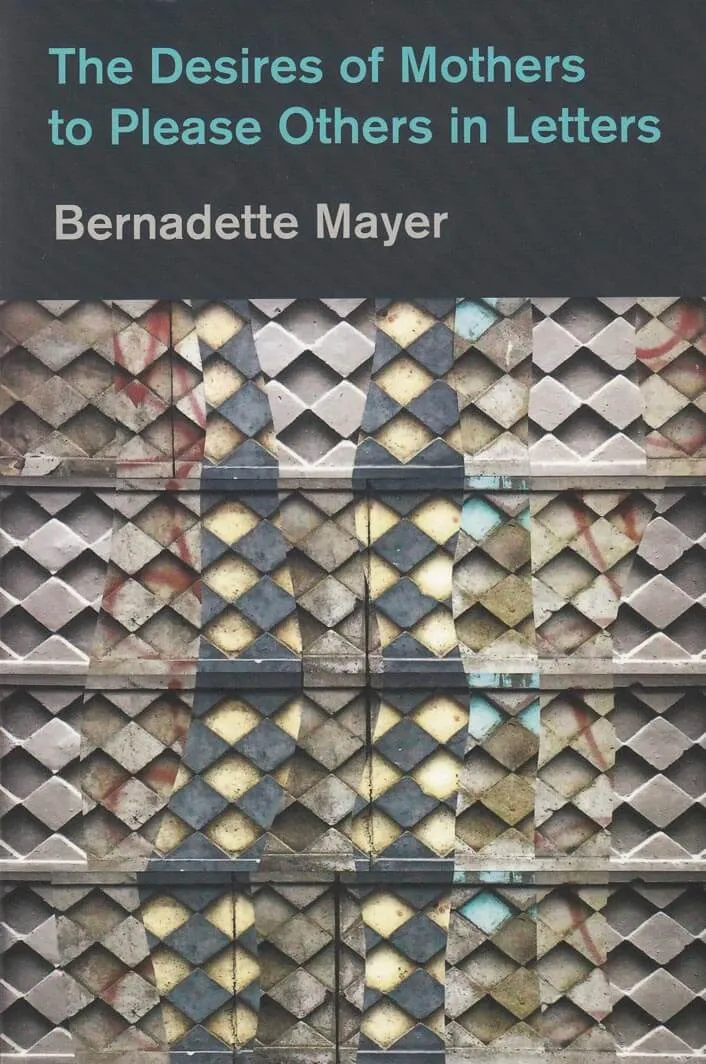
Bernadette Mayer (born 1945) is the author of over 30 books, including the acclaimed Midwinter Day (1982), a book-length poem written during a single day in Lenox, Massachusetts, The Desires of Mothers to Please Others in Letters (1994) and Work and Days (2016), which was a finalist for the National Book Critics Circle Award. Associated with the New York School as well as the Language poets, Mayer has also been an influential teacher and editor. In the art world, she is best known for her collaboration with Vito Acconci as editors of the influential mimeographed magazine 0 TO 9.

Cover of Slips of the Mind: Poetry as Forgetting

University of Chicago Press

Slips of the Mind: Poetry as Forgetting

Jennifer Soong

Poetry €30.00

An audacious account of what happens when forgetting becomes a way of writing and writing becomes a way of forgetting.  

In Slips of the Mind, poet and critic Jennifer Soong turns away from forgetting’s long-standing associations with suppression, privation, and error to argue that the absence or failure of memory has often functioned as a generative creative principle. Exploring forgetting not as the mere rejection of a literary past or a form of negative poetics, Soong puts to the test its very aesthetic meaning. What new structures, forms of desires, styles, and long and short feelings do lapses in time allow? What is oblivion’s relationship to composition? And how does the twentieth-century poet come to figure as the quintessential embodiment of such questions? 

Soong uncovers forgetting’s influence on Gertrude Stein, Lyn Hejinian, Tan Lin, Harryette Mullen, Lissa Wolsak, and New York School poets John Ashbery, James Schuyler, Bernadette Mayer, and Ted Berrigan, among others. She reveals that forgetting’s shapeshifting produces differences in poetic genre, interest, and degrees of intentionality—and that such malleability is part of forgetting’s nature. Most provocatively, Soong shows how losing track of things, leaving them behind, or finding them already gone resists overdetermination and causality in the name of surprise, as poets leverage forgetting in order to replace identity with style. Slips of the Mind is the kind of literary criticism that will reward all readers of modern and contemporary poetry.

Cover of Studying Hunger Journals

Station Hill Press

Studying Hunger Journals

Bernadette Mayer

Poetry €27.00

In 1972 Bernadette Mayer began this project as an aid to psychological counseling, writing in parallel journals so that, as she wrote in one (in bed, on subways, at parties, etc.), her psychiatrist read the other. Using colored pens to “color-code emotions,” she recorded dreams, events, memories, and reflections in a language at once free-ranging and precise—a work that creates its own poetics. She sought “a workable code, or shorthand, for the transcription of every event, every motion, every transition” of her own mind and to “perform this process of translation” on herself in the interest of evolving an innovative, inquiring language. STUDYING HUNGER JOURNALS registers this intention within a body of poetry John Ashbery has called “magnificent.”