rile*books

Search books

Search books by title, author, publisher, keywords...

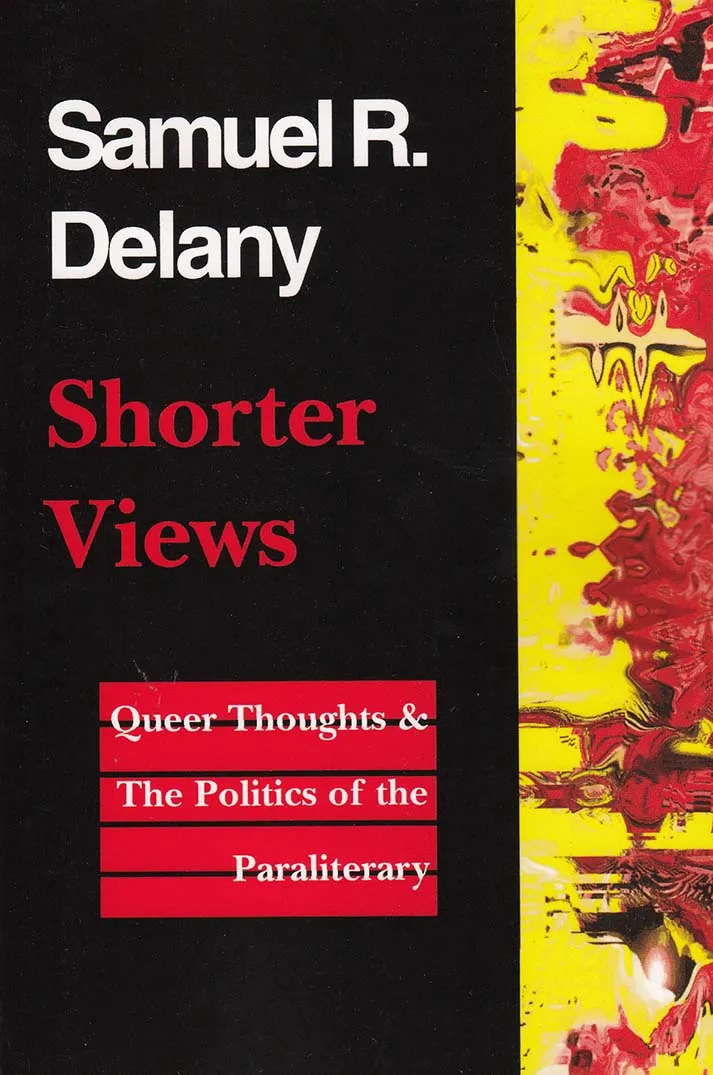
Cover of Shorter Views: Queer Thoughts & the Politics of the Paraliterary

Wesleyan

Shorter Views: Queer Thoughts & the Politics of the Paraliterary

Samuel R. Delany

€28.00

In Shorter Views, Hugo and Nebula award-winning author Samuel R. Delany explores the closely felt issues of identity, race, and sexuality; the untangling of the intricacies of literary theory, and the writing process itself. The essays cluster around topics related to queer theory on the one hand, and on the other, questions concerning the paraliterary genres: science fiction, pornography, comics, and more.

Language: English

recommendations

Cover of The Original 1939 Notebook of a Return to the Native Land: Bilingual Edition

Wesleyan

The Original 1939 Notebook of a Return to the Native Land: Bilingual Edition

Aimé Césaire

Poetry €18.00

The first bilingual edition of this radically original work.

Aimé Césaire's masterpiece, Notebook of a Return to the Native Land, is a work of immense cultural significance and beauty. This long poem was the beginning of Césaire's quest for négritude, and it became an anthem of Blacks around the world. Commentary on Césaire's work has often focused on its Cold War and anticolonialist rhetoric—material that Césaire only added in 1956. The original 1939 version of the poem, given here in French, and in its first English translation, reveals a work that is both spiritual and cultural in structure, tone, and thrust. This Wesleyan edition includes the original illustrations by Wifredo Lam, and an introduction, notes, and chronology by A. James Arnold.

Cover of The Lesbian Body

Winter Editions

The Lesbian Body

Monique Wittig

Fiction €22.00

In this genre- and gender-breaking work of theory-fiction, legendary writer and cofounder of the 1970s French feminist movement Monique Wittig celebrates the body—lesbian, literary and defiantly political—and challenges the order of heterosexuality in literature. 

First published in French in 1973, The Lesbian Body mines the relationship between a lover and a beloved—also a writer and a text—to explore the ideological and historical constructions of the female subject. Organized according to the principle of montage, poetic passages are juxtaposed with anatomic lists that mark lesbian eros. Through expressions of joy, violence, and tenderness, the site of pleasure is celebrated. In her transfiguration of gender and its paradigms, Wittig transformed French vocabulary, feminizing grammar and lesbianizing myths. This edition brings the English translation of Wittig’s groundbreaking work back into circulation for the first time since the mid-1980s, revised according to the author's notes, and with an introduction by Paul B. Preciado.

The Lesbian Body is a fundamental work of lesbian existence. Wittig's applied vision is a state of natural delirium, a revolutionary excess of utopianism, refusal, and mutual self-creation. Revisiting it reveals how much passionate free thought has been lost, and simultaneously, how many of her tropes and discoveries have integrated into our collective consciousness.” — Sarah Schulman

“In this stunning new rendering of The Lesbian Body by the French author, theorist, activist and teacher, the late Monique Wittig, we are plunged into an imagined world of passionate violence and erotic lesbian mayhem intertwined in strikingly bold poetic images. Wittig, in the reach and volatility of her imagination, stands alongside such important American writers as Audre Lorde, Adrienne Rich, and Valerie Solanas, all of whose work deserves to be read again, or for the first time.” — Esther Newton

“To read the book is to be forced by Wittig into another grammar and happily contaminated by its strange forms. You will never think straight again.” — Jack Halberstam

“For me, Wittig opened up a sense of the world that had been, quite literally, unimaginable. She tore us apart.” — Judith Butler

“Together with Ursula Le Guin and Samuel R. Delany, Wittig is the first to design a nonbinary utopia, a world in which the binary categorization of sexes and genders will have ceased to exist.” — Paul B. Preciado

Introduction by Paul B. Preciado
Translated by David Le Vay

Cover of We Circle Through The Night and Are Consumed by Fire

SB34

We Circle Through The Night and Are Consumed by Fire

Simon Asencio, Pauline Hatzigeorgiou

This publication acts as a postscriptum to the exhibition project Through The Valley of The Nest of Spiders by Simon Asencio for SB34—The Pool in Brussels. Dedicated to Samuel R. Delany's sci-fi and sexutopia novel, the exhibition was conceived as a process of annotating the book, expanding on the ethics discussed by the characters of the novel through installation, performative readings and with the complicity of other artists and their works. This devious object pursues such an intertextual process, extending and disseminating the writings forged by the exhibition. 

Cette publication se présente comme le post-scriptum de l'exposition de Simon Asencio Through The Valley of The Nest of Spiders pour SB34—The Pool à Bruxelles. Dédiée au roman de science-fiction et de sexutopie de Samuel R. Delany dont elle porte le titre, l'exposition a été pensée comme un processus d'annotation de ce livre, développant les formes éthiques mises en pratique par les personnages du récit, à travers des installations, des lectures et situations performatives, avec la complicité d'autres artistes. Cet objet interlope poursuit ce processus intertextuel, en prolongeant et disséminant les écritures forgées par l'exposition.

With contributions by / avec les contributions de: Reinhold Aman, Henry Andersen, Simon Asencio, Jen Brodie, Chloe Chignell, Jack Cox, Samuel R. Delany, Diana Duta, Loucka Fiagan, gladys, Stefa Govaart, Sean Gurd, Pauline Hatzigeorgiou, Maxime Jean-Baptiste, Bernard-Marie Koltès, David J. Melnick, Matthieu Michaut, Margaret Miller, LaTasha N. Nevada Diggs, Anouchka Oler Nussbaum, Grisélidis Réal, Páola Revenióti, Sabrina Seifried, Raphaëlle Serres, Valerie Solanas, sabrina soyer, Megan Susman.

Cover of Sacred Spells: Collected Works

Nightboat Books

Sacred Spells: Collected Works

Assotto Saint

Poetry €23.00

The collected life-work of an interdisciplinary writer, performer, and central figure in the Black Gay cultural arts and AIDS movements.

In this timely collection of poetry, plays, fiction, and performance texts, Assotto Saint draws upon music and incantation, his Haitian heritage, and a politics of liberation to weaves together a tapestry of literature that celebrates life in the face of death. Influential to contemporary writers such as Essex Hemphill, Marlon Riggs, and Melvin Dixon, Sacred Spells is Saint’s crucial legacy–five hundred incandescent pages of painful, lyric writing that exemplifies the visceral, spiritual dimensions of an artistic practice that’s integral to Black and LGBTQ activist movements worldwide, both historic and present.

Cover of On Dangerous Ground

Bierke

On Dangerous Ground

Vaginal Davis

Performance €10.00

Vaginal Davis offers insights into her collaborative practice of making music in art-punk bands in Los Angles and Berlin.

The artist Vaginal Davis certainly moves on dangerous ground with her transgressive shuffling of gender and genre boundaries. The self-described "sexual repulsive" co-founded several art/punk bands in her expansive 40-year-plus career, namely Afro Sisters, ¡Cholita!, Pedro, Muriel & Esther (PME), black fag and Tenderloin. As a writer and "Whoracle et Delphi", Ms. Davis turns her quirky hairy eyeball to the collective practice of making music in the saucy underground scenes of Los Angeles and Berlin. In their contributions, longtime comrades and collaborators Bibbe Hansen (artist and Warhol Silver Factory habitué) and Felix Knoke (guest performer for The Hidden Cameras and band member of Tenderloin) rave about joint performances and rehearsals, divulging sacred secrets and rifts. Bruce "Judy" LaBruce, Glen Meadmore and Lisa "Suckdog" Carver make surprise guest appearances, along with images from live performance spectacles The White to Be Angry, Trust Fund, Interracial Dating Game, We're Taking Over, Afro De Sade and Camp/Anti-Camp: A Queer Guide to Everyday Life.

Edited by Jenny Schlenzka and Julia Grosse.
Texts and works by Vaginal Davis, Bibbe Hansen, Felix Knoke.

Published on the occasion of Vaginal Davis's exhibition at Gropius Bau, Berlin, in 2025.

Vaginal Davis is a Berlin-based American intersexed artist, queer icon of art and music. Vaginal Davis herself is a living work of art: a performer, writer and creator of iconic zines; a visual artist, experimental filmmaker; a self-proclaimed Blacktress and drag terrorist, a gossip columnist, influential socialite, educator and countercultural renegade. Since the late 1970s, her oeuvre has pushed the boundaries of art, music and performance. Inspired by the militancy of the Black Panthers’ pursuit of social justice in the United States, she named herself after feminist and Black Power activist Angela Davis.

Cover of We Both Laughed in Pleasure

Nightboat Books

We Both Laughed in Pleasure

Lou Sullivan

Fiction €22.00

Drawn from Lou Sullivan’s meticulously kept journals, this landmark book records the life of arguably the first publicly gay trans man to medically transition.

We Both Laughed In Pleasure: The Selected Diaries of Lou Sullivan narrates the inner life of a gay trans man moving through the shifting social, political, and medical mores of the second half of the 20th century. Sullivan kept comprehensive journals from age eleven until his AIDS-related death at thirty-nine. Sensual, lascivious, challenging, quotidian and poetic, the diaries complicate and disrupt normative trans narratives. Entries from twenty-four diaries reveal Sullivan’s self-articulation and the complexity of a fascinating and courageous figure.

Edited by: Ellis Martin and Zach Ozma
Introduction by: Susan Stryker

Cover of Tripwire 16 - Performance/Writing

Tripwire Journal

Tripwire 16 - Performance/Writing

David Buuck, Kevin Killian

A special issue focused on performance writing, with work by Tanya Lukin Linklater (with Michael Nardone), Jibade-Khalil Huffman & Simone White, Jean-Thomas Tremblay, Claudina Domingo (trans. Ryan Greene), Kim Rosenfield, Nathan Walker, Liz Knox, Rona Lorimer, Léo Richard, & Hector Uniacke, Mohamed A. Gawad & Dalia Neis, Mei-mei Berssenbrugge & Teddy Yoshikami, interviewed by Michelle N. Huang, Kyoo Lee and Jocelyn Saidenberg, Adriana Garriga-López, Gabrielle Civil, plus a Kevin Killian Tribute, with Eileen Myles * Scott Hewicker * Cliff Hengst * Karla Milosevich * Craig Goodman * Michelle Rollman * Anne McGuire * Wayne Smith * Tanya Hollis * Steve Orth * Lindsey Boldt * Maxe Crandall * Arnold J. Kemp * Carla Harryman, Lee Ann Brown & Tony Torn * Susan Gevirtz * Laynie Browne * Patrick Durgin * Norma Cole * Jo Giardini. & reviews: Jessica Lopez Lyman & Jocelyn E. Marshall on Gabrielle Civil, alex cruse on Merce Cunningham, Rob Stanton on Anne Boyer, Jack Chelgren on Miyó Vestrini, David Grundy on Stephen Jonas, Virginia Konchan on Sarah Vap.

Cover of Feminist Fatwas

Everyday Analysis

Feminist Fatwas

Rafia Zakaria

Essays €10.00

Feminist Fatwas traces how Muslim feminists are resisting misogynistic interpretations of the Quran (like the verse male clerics have used to condone wife-beating). 

For centuries, the translators and interpreters of the Holy Quran have been men. This is changing now as more and more Muslim feminists cast their eye on the patriarchal contexts of these interpretations. Feminist Fatwas tells the story of  Verse 34 in Chapter 4 which has been interpreted by male clerics as condoning a husband beating his wife. This essay traces the groundbreaking work of knocking down this misogynist Quranic interpretations. The story of how Muslim feminists are doing this work is a chronicle of the slow and quiet feminist revolution taking place within Islam as women take on significant and powerful roles. 

Rafia Zakaria is a Pakistani-American attorney, feminist, journalist, and author. She has written for The Nation, Guardian Books, The New Republic, The Baffler, Boston Review, and Al Jazeera. In 2021, she published Against White Feminism, in which she critiques the emphasis that conventional feminist thought places on the experiences of white women while excluding women of color