rile*books

Search books

Search books by title, author, publisher, keywords...

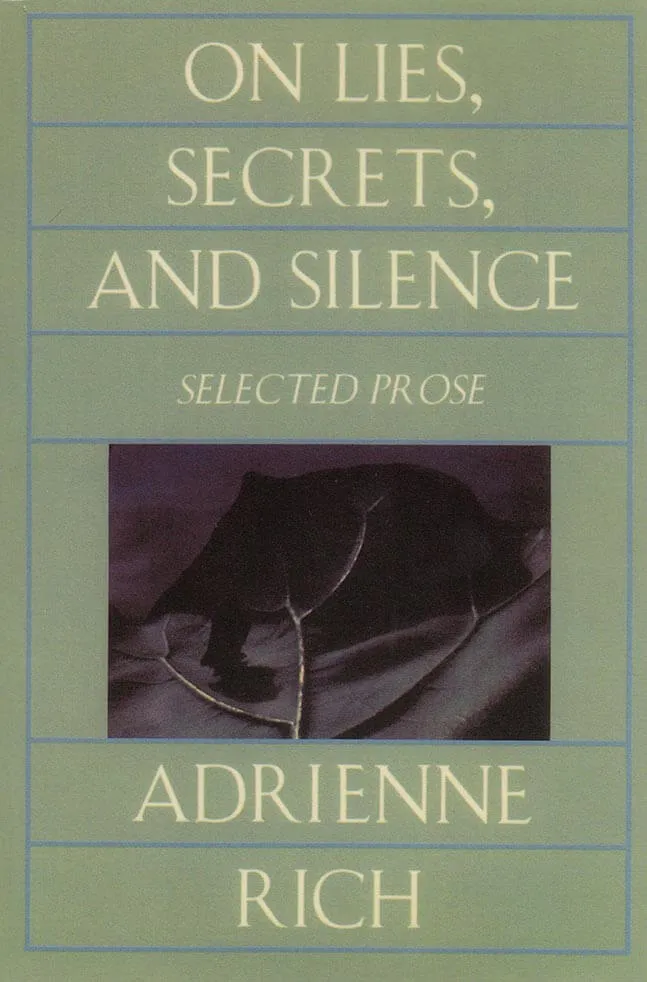
Cover of On Lies, Secrets And Silence

W. W. Norton & Company

On Lies, Secrets And Silence

Adrienne Rich

€20.00

Collection of early prose writings by Adrienne Rich. On Lies, Secrets, and Silence is a sort of travel diary, documenting Adrienne Rich's journeys to the frontier and into the interior. It traces the development of one individual consciousness, 'playing over such issues as motherhood, racism, history, poetry, the uses of scholarship, the politics of language.' Rich has written a headnote for each essay, briefly discussing the circumstances of its writing.

Adrienne Rich (1929–2012) was for decades among the most influential writers of the feminist movement and one of the best-known American public intellectuals. She wrote two dozen volumes of poetry and more than a half-dozen of prose. Her constellation of honors includes two National Book Awards, a MacArthur Foundation “genius” grant, and a Medal for Distinguished Contribution to American Letters by the National Book Foundation. Ms. Rich’s volumes of poetry include The Dream of a Common Language, A Wild Patience Has Taken Me This Far, An Atlas of the Difficult World, The School Among the Ruins, and Telephone Ringing in the Labyrinth. Her prose includes the essay collections On Lies, Secrets, and Silence; Blood, Bread, and Poetry; an influential essay, “Compulsory Heterosexuality and Lesbian Existence,” and the nonfiction book Of Woman Born, which examines the institution of motherhood as a socio-historic construct. In 2010, she was honored with The Griffin Trust for Excellence in Poetry's Lifetime Recognition Award.

Language: English

recommendations

Cover of After Sex

Silver Press

After Sex

Alice Spawls, Edna Bonhomme

Essays €18.00

Who decides what happens after sex? The last decade has seen many significant changes to the laws governing women’s reproductive rights around the world, from liberalisation in Ireland to new restrictions in the USA. After Sex offers personal and political perspectives from the mid-20th century to the present day, setting feminist classics alongside contemporary accounts. These essays, short stories and poems trace the debates and tell the stories; together, they ask us to consider what reproductive justice might look like, and how it could reshape sex.

The writers pay special attention to people — both fictional and real — who have sought control over their sexual lives, and the joy, comedy, difficulties and disappointments that entails. But above all, After Sex testifies to the power of great writing to show us why that freedom is worth pursuing — without shame and without apology.

With contributions from: 
Lauren Berlant, Joanna Biggs, Edna Bonhomme, Gwendolyn Brooks, Beverley Bryan, Stella Dadzie and Suzanne Scafe, Storm Cecile, Lucille Clifton, Rachel Connolly, T.L. Cowan, ’Jane Does’, Maggie Doherty, Nell Dunn, Andrea Dworkin, Anne Enright, Deborah Friedell, Tracy Fuad, Kristen Ghodsee, Vivian Gornick, Donna Haraway, bell hooks, Barbara Johnson, Jayne Kavanagh, Lisa Hallgarten and Angela Poulter, Jamaica Kincaid, Patricia Knight, R.O. Kwon, Ursula K. Le Guin, Natasha Lennard, Sophie Lewis, Audre Lorde, Amelia Loulli, Erin Maglaque, Holly Pester, Adrienne Rich, Denise Riley, Sally Rooney, Loretta J. Ross, Madeleine Schwartz, SisterSong, Sophie Smith, Annabel Sowemimo, Amia Srinivasan, Keeanga-Yamahtta Taylor, Judith Jarvis Thomson, Alice Walker and Bernard Williams.

Cover of The Power of Adrienne Rich: A Biography

Nan A. Talese

The Power of Adrienne Rich: A Biography

Hillary Holladay

Poetry €30.00

The first comprehensive biography of Adrienne Rich, feminist and queer icon and internationally revered National Book Award winning poet.

Adrienne Rich was the female face of American poetry for decades. Her forceful, uncompromising writing has more than stood the test of time, and the life of the woman behind the words is equally impressive. Motivated by personal revelations, Rich transformed herself from a traditional, Radcliffe-educated lyric poet and married mother of three sons into a path-breaking lesbian-feminist author of prose as well as poetry. In doing so, she emerged as both architect and exemplar of the modern feminist movement, breaking ranks to denounce the male-dominated literary establishment and paving the way for the many queer women of letters to take their places in the cultural mainstream. Drawing on a wealth of unpublished materials, including Rich's correspondence and in-depth interviews with numerous people who knew her, Hilary Holladay digs deep into never-before-accessed sources to portray Rich in full dimension and vivid, human detail.

Cover of Mother Reader

Seven Stories Press

Mother Reader

Moyra Davey

Fiction €27.00

'My aim for Mother Reader has been to bring together examples of the best writing on motherhood of the last sixty years, writing that tells firsthand of the mother's experience.

Many of the writings in Mother Reader comment on and interpolate one another, in citations, in footnotes, in direct homage. As I was assembling this collection one text would lead to one another, treasure-hunt fashion, the clue provided by an acknowledgement or bibliography. And just as often the writing circles back.

In Mother Reader chapters are excerpted from autobiographies, memoirs, and novels; entries are lifted from diaries; essays and stories are culled from collections, anthologies, and periodicals. My project has been to assemble a compendium or sampler of these ''kindred spirit'' works on motherhood, so that readers, and especially mothers with limited time on their hands, can access in one volume the best literature on the subject and know where turn to continue reading." [Moyra Davey in the introduction]

Writings by Margaret Atwood, Susan Bee, Rosellen Brown, Myrel Chernick, Lydia Davis, Buchi Emeta, Annie Ernaux, Mary Gaitskill, Susan Griffin, Nancy Hutson, Mary Kelly, Jane Lazarre, Ursula K. Le Guin, Doris Lessing, Ellen McMahon, Margaret Mead, Vivian Montgomery, Toni Morrison, Tillie Olsen, Alicia Ostrker, Grace Paley, Sylvia Plath, Adrienne Rich, Sara Ruddick, Lynda Schor, Mira Schor, Dena Schottenkirk, Mona Simpson, Elizabeth Smart, Joan Snyder, Elke Solomon, Susan Rubin Suleiman, Alice Walker, Joy Williams, Martha Wilson, Barbara Zucker.

Cover of Lost & Found: The CUNY Poetics Document Initiative, Series IV

CUNY Center for the Humanities

Lost & Found: The CUNY Poetics Document Initiative, Series IV

CUNY

From a never before seen manuscript of poems by Harlem Renaissance poet Helene Johnson to a treasure trove of Adrienne Rich's teaching materials from City College, this new series overturns all expectations. We have brought you facsimile reproductions and variorum editions, notes, storyboards, memos, screenplays, letters and of course, poetry from all around America. Building cultural history from the ground up, Series IV provides a completely different vantage point from which to further explore our literary heritage. LOST & FOUND: THE CUNY POETICS DOCUMENT INITIATIVE SERIES IV consists of eight beautifully printed chapbooks (600 pages in all), featuring rare and unpublished texts, including late work by Harlem Renaissance poet Helene Johnson, Adrienne Rich's teaching materials, a newly discovered film script by Edward Dorn, the formative correspondence of Pauline Kael & Robert Duncan, and a facsimile reproduction of Vincent Ferrini's 1946 Tidal Wave: Poems of the Great Strikes.

SERIES IV includes:

Edward Dorn: Abilene! Abilene! (Parts I & II) (ed. Kyle Waugh)

Vincent Ferrini: Before Gloucester (eds. Ammiel Alcalay & Kate Tarlow Morgan)

Helene Johnson: After the Harlem Renaissance (ed. Emily Rosamond Claman)

Pauline Kael & Robert Duncan: Selected Letters 1945-1946 (PARTS I & II) (ed. Bradley Lubin)

Adrienne Rich: Teaching at CUNY, 1968-1974 (Parts I & II) (eds. Iemanjá Brown, Stefania Heim, erica kaufman, Kristin Moriah, Conor Tomás Reed, Talia Shalev & Wendy Tronrud)

Cover of The Lesbian Body

Winter Editions

The Lesbian Body

Monique Wittig

Non-fiction €22.00

In this genre- and gender-breaking work of theory-fiction, legendary writer and cofounder of the 1970s French feminist movement Monique Wittig celebrates the body—lesbian, literary and defiantly political—and challenges the order of heterosexuality in literature. 

First published in French in 1973, The Lesbian Body mines the relationship between a lover and a beloved—also a writer and a text—to explore the ideological and historical constructions of the female subject. Organized according to the principle of montage, poetic passages are juxtaposed with anatomic lists that mark lesbian eros. Through expressions of joy, violence, and tenderness, the site of pleasure is celebrated. In her transfiguration of gender and its paradigms, Wittig transformed French vocabulary, feminizing grammar and lesbianizing myths. This edition brings the English translation of Wittig’s groundbreaking work back into circulation for the first time since the mid-1980s, revised according to the author's notes, and with an introduction by Paul B. Preciado.

The Lesbian Body is a fundamental work of lesbian existence. Wittig's applied vision is a state of natural delirium, a revolutionary excess of utopianism, refusal, and mutual self-creation. Revisiting it reveals how much passionate free thought has been lost, and simultaneously, how many of her tropes and discoveries have integrated into our collective consciousness.” — Sarah Schulman

“In this stunning new rendering of The Lesbian Body by the French author, theorist, activist and teacher, the late Monique Wittig, we are plunged into an imagined world of passionate violence and erotic lesbian mayhem intertwined in strikingly bold poetic images. Wittig, in the reach and volatility of her imagination, stands alongside such important American writers as Audre Lorde, Adrienne Rich, and Valerie Solanas, all of whose work deserves to be read again, or for the first time.” — Esther Newton

“To read the book is to be forced by Wittig into another grammar and happily contaminated by its strange forms. You will never think straight again.” — Jack Halberstam

“For me, Wittig opened up a sense of the world that had been, quite literally, unimaginable. She tore us apart.” — Judith Butler

“Together with Ursula Le Guin and Samuel R. Delany, Wittig is the first to design a nonbinary utopia, a world in which the binary categorization of sexes and genders will have ceased to exist.” — Paul B. Preciado

Introduction by Paul B. Preciado
Translated by David Le Vay

Cover of Repetition

The Last Books

Repetition

Peter Handke

Fiction €15.00

An English translation of Peter Handke’s 1986 novel Repetition, previously out of print for a quarter of a century.

“In Repetition, Handke allows the peculiar light which illuminates the space under a leafy canopy or a tent canvas to glisten between words, placed here with astounding caution and precision; in doing so, he succeeds in making the text into a sort of refuge amid the arid lands which, even in the culture industry, grow larger day by day.” —W. G. Sebald

“In his earliest work … Handke found a way of conveying a state of mind … where words seem to come between you and the world, where nothing coheres or appears natural, and from the vantage-point of which the ease with which other people talk and go about their business seems deeply suspicious. But just as Kafka felt there were moments when, miraculously, a written sentence – even one written by himself – seemed full light, seemed to fill its own space and establish its own rhythm, and when even the whole story seemed mysteriously to stand as solidly in the world as a tree or a rock, so it has been with Handke. He has, in his later work, appeared to make a conscious effort to escape from the debilitating awareness of his own lack of authority or authenticity, and tried to write as though somehow the story were already written, had, in a sense, always been there… Repetition is the triumphant climax of his career so far…

What saves the book from the sort of sentimentality we find in John Berger’s recent work is first of all Handke’s uncanny ability to convey what it is this urge for pattern has to overcome, and secondly, his extraordinary attention to detail, historical, geographical, botanical, and linguistic. (No review can possibly convey the richness of Filip’s meditation on his brother’s two books, or Handke’s magical way with images.)

His narrative … is one of the most dignified and moving evocations I have ever read of what it means to be alive, to walk upon this earth.” —Gabriel Josipovici

Cover of Artificial Gut Feeling

Divided Publishing

Artificial Gut Feeling

Anna Zett

Fiction €14.00

If winning can only occur in a competition between equal opponents, someone who isn’t equal will need to adopt a different strategy and let go of the promise, or the curse, of victory. Anna Zett takes up the challenge in this collection of personal science fiction, registering the traces systems of power leave in the body, in its locomotory, nervous and digestive systems. Zett’s voice appears in several textual guises, addressing authority, resistance, trauma and the physicality of language. Dedicated to the feminist revolution, the post-socialist subject of Artificial Gut Feeling questions logocentric and capitalist beliefs about the economy of meaning. This book gathers together fists, guts and brains to gain a deeper understanding of the non-verbal roots of dialogue.

"This being is able to transform movement into speech. It winds itself about inside me like a thick snake and I have to use all my strength to let it spin and do what it does. When I wilfully try to stop it, it begins to whisper words to me and that is even more unpleasant. If I were to associate this gut feeling with an emotion, I would say disgust. But this disgust is not directly linked to your name."—Anna Zett

Cover of Resentment: A Comedy

Semiotext(e)

Resentment: A Comedy

Gary Indiana

Fiction €18.00

In a novel capturing an era that seems at once familiar and grotesque, a New York writer lands in Los Angeles in 1994.

Originally published in 1997, Resentment was the first in Gary Indiana's now-classic trilogy (followed in 1999 by Three Month Fever: The Andrew Cunanan Story and in 2003 by Depraved Indifference) chronicling the more-or-less permanent state of “depraved indifference” that characterized American life at the millennium's end.

In Resentment, Seth, a New York–based writer arrives in Los Angeles (where he has history and friends) in mid-August, 1994, to observe what will become the marathon parricide trial of the wealthy, athletic, and troubled Martinez brothers, broadcast live every day on Court TV. Still reeling from the end of his obsessive courtship of a young SoHo artist/waiter, Seth moves between a room at the Chateau Marmont and a Mount Washington shack owned by his old cab-driving, ex-Marxist friend, Jack, while he writes a profile of Teddy Wade—one of the era's hottest young actors, who has “dared” to star as a gay character in a new Hollywood film. Studded throughout with scathing satirical portraits of media figures, other writers, and the Martinez trial teams, Resentment captures an era that seems, two decades later, at once grotesque, familiar, and a precursor to our own.

Introduction by Patrick McGrath
Afterword by Chris Kraus