rile*books

Search books

Search books by title, author, publisher, keywords...

Cover of Offences

Semiotext(e)

Offences

Constance Debré

€17.00

Ten stab wounds. An old woman in a pool of blood. A nineteen-year-old neighbor now a murderer. 

Since publishing her first novel in 2018, Constance Debré’s work has exposed the flaws in the social order with dizzying passion and intelligence. Her first-person trilogy—Playboy, Love Me Tender, and Name—describes the trajectory of leaving a comfortable bourgeois life as mother and wife employed as a criminal justice attorney to become a writer and lesbian. Her books radically challenge all received ideas of the couple, motherhood, family, and inheritance. 

In Offenses, Debré trains her sights on a single case of inevitably flawed justice that, like hundreds of others like it, reveals the enmeshed culpabilities of the perpetrator, the victim, the place, and the past. In a housing project adjacent to Paris, an unemployed teenager kills his elderly neighbor in order to pay off a drug debt of €450. Writing with impassioned detachment, Debré uses forensic detail to explore the ambient senselessness behind this senseless crime.

There is a geography, Debré writes. We live in a vertical world, you don’t see. A world made of worlds. Not side by side but set concentrically and upon one another. A bit like Middle Age representations of the universe, a bit like Dante’s circles of hell. Each world only communicating with the worlds directly in contact with it and none of the others.

In Offenses, Debré scathingly describes the misery of poverty and the absence of any horizon beyond.
Published in 2026 ┊ 97 pages ┊ Language: English

recommendations

Cover of Reverse Cowgirl

Semiotext(e)

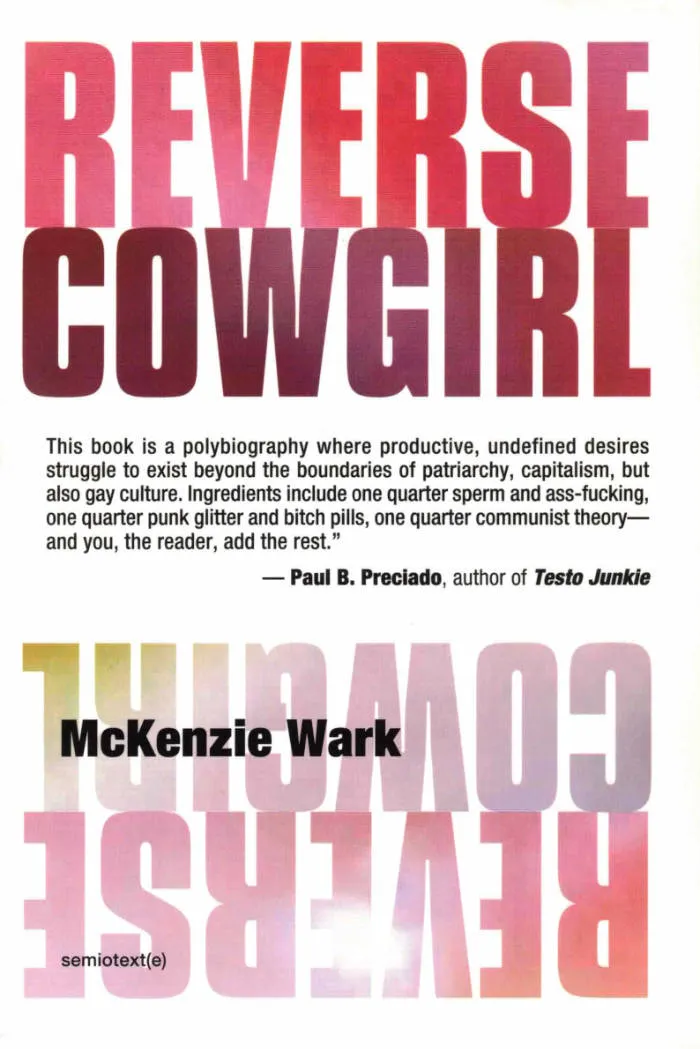
Reverse Cowgirl

McKenzie Wark

Fiction €16.00

McKenzie Wark invents a new genre for another gender: not a memoir but an auto-ethnography of the opacity of the self.

Another genre for another gender.

What if you were trans and didn't know it? What if there were some hole in your life and you didn't even know it was there? What if you went through life not knowing why you only felt at home in your body at peak moments of drugs and sex? What if you expended your days avoiding an absence, a hole in being? Reverse Cowgirl is not exactly a memoir. The author doesn't, in the end, have any answers as to who she really is or was, although maybe she figures out what she could become.

Traveling from Sydney in the 1980s to New York today, Reverse Cowgirl is a comedy of errors, chronicling the author's failed attempts at being gay and at being straight across the shifting political and media landscapes of the late twentieth century. Finding that the established narratives of being transgender don't seem to apply to her, Wark borrows from the genres of autofiction, fictocriticism, and new narrative to create a writing practice that can discover the form of a life outside existing accounts of trans experience: an auto-ethnography of the opacity of the self.

Cover of Can the Monster Speak?: Report to an Academy of Psychoanalysts

Semiotext(e)

Can the Monster Speak?: Report to an Academy of Psychoanalysts

Paul B. Preciado

Essays €16.00

Paul Preciado's controversial 2019 lecture at the École de la Cause Freudienne annual conference, published in a definitive translation for the first time. 

In November 2019, Paul Preciado was invited to speak in front of 3,500 psychoanalysts at the École de la Cause Freudienne's annual conference in Paris. Standing in front of the profession for whom he is a mentally ill person suffering from gender dysphoria, Preciado draws inspiration in his lecture from Kafka's Report to an Academy, in which a monkey tells an assembly of scientists that human subjectivity is a cage comparable to one made of metal bars.  

Speaking from his own mutant cage, Preciado does not so much criticize the homophobia and transphobia of the founders of psychoanalysis as demonstrate the discipline's complicity with the ideology of sexual difference dating back to the colonial era, an ideology which is today rendered obsolete by technological advances allowing us to alter our bodies and procreate differently. Preciado calls for a radical transformation of psychological and psychoanalytic discourse and practices, arguing for a new epistemology capable of allowing for a multiplicity of living bodies without reducing the body to its sole heterosexual reproductive capability, and without legitimizing hetero-patriarchal and colonial violence.  

Causing a veritable outcry among the assembly, Preciado was heckled and booed and unable to finish. The lecture, filmed on smartphones, was published online, where fragments were transcribed, translated, and published with no regard for exactitude. With this volume, Can the Monster Speak? is published in a definitive translation for the first time.

Cover of Alien Daughters Walk Into the Sun: An Almanac of Extreme Girlhood

Semiotext(e)

Alien Daughters Walk Into the Sun: An Almanac of Extreme Girlhood

Jackie Wang

Fiction €18.00

The early writings of renowned poet and critical theorist Jackie Wang, drawn from her early zines, indie-lit crit, and prolific early 2000s blog. 

Compiled as a field guide, travelogue, essay collection, and weather report, Alien Daughters Walk into the Sun traces Jackie Wang's trajectory from hard femme to Harvard, from dumpster dives and highway bike rides to dropping out of an MFA program, becoming a National Book Award finalist, and writing her trenchant book Carceral Capitalism. Alien Daughters charts the dream-seeking misadventures of an "odd girl" from Florida who emerged from punk houses and early Tumblr to become the powerful writer she is today. Anarchic and beautifully personal, Alien Daughters is a strange intellectual autobiography that demonstrates Wang's singular self-education: an early life lived where every day and every written word began like the Tarot's Fool, with a leap of faith.

Cover of Playboy

Semiotext(e)

Playboy

Constance Debré

LGBTQI+ €18.00

The prequel to Love Me Tender, narrating Debré's transformation from affluent career woman to broke single lesbian and writer.

I see all her beauty, I see the beauty of women. I see my own body, new. I tell myself there are so many things that are possible.

First published in France in 2018, Playboy is the first volume of Constance Debré's renowned autobiographical trilogy that describes her decision, at age forty-three, to abandon her marriage, her legal career, and her bourgeois Parisian life to become a lesbian and a writer.

The novel unfolds in a series of short, sharp vignettes. The narrator's descriptions of her first female lovers—a married woman fifteen years older than her, a model ten years her junior—are punctuated by encounters with her ex-husband, her father, and her son.

As Debré recently told Granta: “It was a bit like Saint Augustine and his conversion. In the same week, I had sex with a girl and I had the feeling that I could write. I had this incredible feeling that I could catch things, that life was there to be caught.”

Looking at the world through fresh eyes, the narrator of Playboy questions everything that once lay beneath the surface of her well-managed life. Laconic, aggressive, and radically truthful, she examines gender and marriage, selfishness and sacrifice, money and family, even the privilege inherent in her downward mobility.

Writing her way toward her own liberation, Debré chronicles the process that made her one of the most brilliant, important French writers today.

Cover of Love Me Tender

Semiotext(e)

Love Me Tender

Constance Debré

LGBTQI+ €18.00

A novel of lesbian identity and motherhood, and the societal pressures that place them in opposition. 

The daughter of an illustrious French family whose members include a former Prime Minister, a model, and a journalist, Constance Debré abandoned her marriage and legal career in 2015 to write full-time and begin a relationship with a woman. Her transformation from affluent career woman to broke single lesbian was chronicled in her 2018 novel Play boy, praised by Virginie Despentes for its writing that is at once "flippant and consumed by anxiety."  

In Love Me Tender, Debré goes on to further describe the consequences of that life-changing decision. Her husband, Laurent, seeks to permanently separate her from their eight-year old child. Vilified in divorce court by her ex, she loses custody of her son and is allowed to see him only once every two weeks for a supervised hour. Deprived of her child, Debré gives up her two-bedroom apartment and bounces between borrowed apartments, hotel rooms, and a studio the size of a cell. She involves herself in brief affairs with numerous women who vary in age, body type, language, and lifestyle. But the closer she gets to them, the more distant she feels. Apart from cigarettes and sex, her life is completely ascetic: a regime of intense reading and writing, interrupted only by sleep and athletic swimming. She shuns any place where she might observe children, avoiding playgrounds and parks "as if they were cluster bombs ready to explode, riddling her body with pieces of shrapnel."  

Writing graphically about sex, rupture, longing, and despair in the first person, Debré's work is often compared with the punk-era writings of Guillaume Dustan and Herve Guibert, whose work she has championed. As she says of Guibert: "I love him because he says I and he's a pornographer. That seems to be essential when you write. Otherwise you don't say anything." But in Love Me Tender, Debré speaks courageously of love in its many forms, reframing what it means to be a mother beyond conventional expectations.

Cover of JEANNE

Moist Books

JEANNE

Arielle Burgdorf

Fiction €16.00

When Jean, a young translator of French and Russian, receives a mysterious commission, she leaps at the chance to escape her current life—and husband—and relocate to Montréal. Marriage has destroyed her sense of self, but work offers a way to rebuild it, as Jean slowly rediscovers her identity via a series of literary encounters (as well as lots of sex, drugs, and rock 'n' roll). With nods to the Situationists and Oulipo, JEANNE is an experimental yet at the same time intensely readable novel about gender, alterity, and linguistic insecurity. Will translation always be seen as an act of betrayal? Or does one's willingness to speak through and with the other yield its own rewards?

Cover of The Lesbian Body

Winter Editions

The Lesbian Body

Monique Wittig

LGBTQI+ €22.00

In this genre- and gender-breaking work of theory-fiction, legendary writer and cofounder of the 1970s French feminist movement Monique Wittig celebrates the body—lesbian, literary and defiantly political—and challenges the order of heterosexuality in literature. 

First published in French in 1973, The Lesbian Body mines the relationship between a lover and a beloved—also a writer and a text—to explore the ideological and historical constructions of the female subject. Organized according to the principle of montage, poetic passages are juxtaposed with anatomic lists that mark lesbian eros. Through expressions of joy, violence, and tenderness, the site of pleasure is celebrated. In her transfiguration of gender and its paradigms, Wittig transformed French vocabulary, feminizing grammar and lesbianizing myths. This edition brings the English translation of Wittig’s groundbreaking work back into circulation for the first time since the mid-1980s, revised according to the author's notes, and with an introduction by Paul B. Preciado.

The Lesbian Body is a fundamental work of lesbian existence. Wittig's applied vision is a state of natural delirium, a revolutionary excess of utopianism, refusal, and mutual self-creation. Revisiting it reveals how much passionate free thought has been lost, and simultaneously, how many of her tropes and discoveries have integrated into our collective consciousness.” — Sarah Schulman

“In this stunning new rendering of The Lesbian Body by the French author, theorist, activist and teacher, the late Monique Wittig, we are plunged into an imagined world of passionate violence and erotic lesbian mayhem intertwined in strikingly bold poetic images. Wittig, in the reach and volatility of her imagination, stands alongside such important American writers as Audre Lorde, Adrienne Rich, and Valerie Solanas, all of whose work deserves to be read again, or for the first time.” — Esther Newton

“To read the book is to be forced by Wittig into another grammar and happily contaminated by its strange forms. You will never think straight again.” — Jack Halberstam

“For me, Wittig opened up a sense of the world that had been, quite literally, unimaginable. She tore us apart.” — Judith Butler

“Together with Ursula Le Guin and Samuel R. Delany, Wittig is the first to design a nonbinary utopia, a world in which the binary categorization of sexes and genders will have ceased to exist.” — Paul B. Preciado

Introduction by Paul B. Preciado
Translated by David Le Vay

Cover of Sick issue 6

Self-Published

Sick issue 6

Olivia Spring

Poetry €16.00

Writing on the fragmentation of chronic illness, why ‘full access’ isn’t something arts venues should aim for, the complexities of receiving gender-affirming care while living with chronic illness, the realities of constantly having to ration your energy, an interview with musical artist Dead Gowns, abortion access and bodily autonomy, poetry, artwork, book recommendations, and much more.

Essays, features, poetry, art, interviews & more from Vida Adamczewski, A/Bel Andrade, Amy Berkowitz, Khairani Barokka, Jax Bulstrode, Sarah Courville, Jen Deerinwater , Amy Dickinson, Mizy Judah Clifton, Alton Melvar M Dapanas, Dead Gowns, Sergey Isakov, Theo LeGro, Elias Lowe, Cathleen Luo, Jameisha Prescod, Olivia Spring, Leigh Sugar, Oriele Steiner, Emerson Whitney, Chantal Wnuk, Caroline Wolff, and Emma Yearwood

SICK is an independent, thoughtful magazine exploring illness and disability, founded & edited by Olivia Spring and designed by Kaiya Waerea. Founded in Norwich, UK in 2019, we are currently based in Maine, USA and London, UK. We typically publish one issue per year.