Books
Books
in random order

Anxiety vol.1
Featuring poems and short stories by Coco Gordon Moore, Nate Lippens, Jimmy Cooper, Danielle Chelosky, Matthew Kinlin, and Thomas Moore, as well as an interview of Jack Skelley by Lydia Sviatoslavsky and photographs by David Catalano. Edited
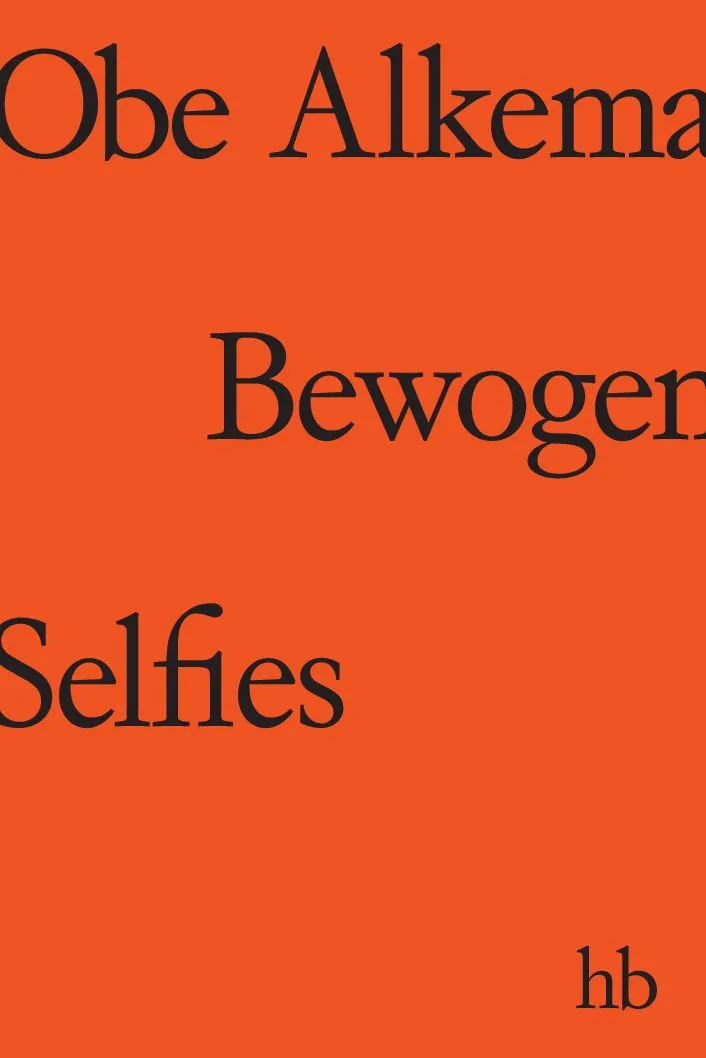
Bewogen selfies
In Bewogen selfies onderzoekt Obe Alkema de verhouding tussen landschap en herinnering. Wat treft hij aan bij terugkeer naar belangrijke plaatsen uit zijn geheugen? Wat herinnert hij zich niet, maar Google wel? Is er een gedenkschrift te puren uit zijn metadata?
Memoires, rechtstreeks verteld en met omwegen, uit eerste hand en van horen zeggen. Archieven en herinneringen eisen spreektijd, houden het niet meer droog of worden tot spreken gebracht. Wat hebben ze eigenlijk te melden? Ze lopen helemaal leeg, net als Alkema zelf. Een leven zoals zovele, poedelnaakt en geretoucheerd, vol zin en onzin.

Islands After Tourism
Tourism does more than transforming spaces and forcing emotions: its geographies also conceal a persisting power that captures the imagination. In their operational sturdiness, tourismscapes appear intractable and inert, making their alternative renderings almost unthinkable. It feels uncanny to picture islands and their coasts freed from programs of leisure. But in recent years, the exhaustion of people and landscapes has brought forth a renewed imperative to think outside this ubiquitous extractive industry. Through essays, pieces of fiction, and visual references, this book discusses both the difficulty and the necessity of disrupting the monocultural imaginations of tourism. To escape the devouring vortex of its sticky nature and messianic promises, the cultural and political work necessary is not only this of negation and resistance, but also that of bold re-conceptualizations and re-imaginings.

Love Belongs to Those Who Do the Feeling: New & Selected Poems (1966-2006)
An exciting collection of new and selected poetry by Judy Grahn. The book contains selections from Judy's entire body of poetic work from The Work of a Common Woman, The Queen of Wands and The Queen of Swords, to new poems written between 1997 and 2008.
Judy's poetry is rangy and provocative. It has been written at the heart of so many of the important social movements of the last forty years that the proper word is foundational.

Entangled – Texts On Textiles
What does it mean to be a curator who writes, and, more specifically, how can curators write about textiles? This publication steps outside the framework of the typical exhibition catalogue to occupy "the space between literature and criticism".
The Community of writers was set up to create time and space to retreat from these outside opinions and demands and to let curiosity and the joy of writing be the driving forces of the writing process. This book has been realised under the auspice of Interweaving Structures: Fabric as Material, Method, and Message, and specifically through collaboration between the Faculty of Fine Art, Music and Design at the University of Bergen and the Central Museum of Textiles in Łódź. The two partners have strong positions of specialisation—the museum acts as a caretaker of material textile traditions and art in Poland, and the faculty has a strong textile art tradition and offers the only education programme for curators in Norway.
Edited by Anne Szefer Karlsen.
Contributions by Andreas Hoffmann, Heather Jones, Martina Petrelli, Anne Szefer Karlsen, Lea Vene, Johanna Zanon.

Going Out – Walking, Listening, Soundmaking
Going Out explores the relationship between walking, listening, and soundmaking in the arts – from the first soundwalks and itinerant performances in the 1960s to today’s manifold ambulatory projects. The book consists of an extensive essay by Elena Biserna followed by an anthology of 51 historical and contemporary contributions in the form of documentation, essays, interviews, manifestos, scores, narratives and reflections.
Essay by Elena Biserna.
Contributions by Max Neuhaus, Willem de Ridder, William Levy, Collective Actions Group, David Helbich, Janet Cardiff, Jacek Smolicki, Carolyn Chen, Tao G. Vrhovec Sambolec, Hildegard Westerkamp, Albert Mayr, Tim Ingold, Akio Suzuki, katrinem, Beatrice Ferrara & Leandro Pisano, Catherine Clover, AM Kanngieser, Gascia Ouzounian & Sarah Lappin, Ultra-red, Vivian Caccuri, Stefan Szczelkun, LIGNA, Edyta Jarząb, Oupa Sibeko, Brian Hioe, Brandon LaBelle, Adrian Piper, Andra McCartney & Sandra Gabriele, Amanda Gutiérrez, Jennifer Lynn Stoever, Stephanie Springgay, Carmen Papalia, Christine Sun Kim, Charles Eppley, Budhaditya Chattopadhyay, Viv Corringham, BNA-BBOT, Ella Parry-Davies & Ann, Mendi + Keith Obadike, Gwenola Wagon & Stéphane Degoutin, Eleni Ikoniadou, Justin Bennett, Christina Kubisch & Christoph Cox, RYBN, Alisa Oleva, Naomi Waltham-Smith, Anna Raimondo, Libby Harward.

After Institutions
The current crisis of museums and the future of Institutional Critique.
Faced with waning state support, declining revenue, and forced entrepreneurialism, museums have become a threatened public space. Simultaneously, they have assumed the role of institutional arbiter in issues of social justice and accountability. The canon of Institutional Critique has responded to the social embeddedness of art institutions by looking at the inner workings of such organizations. In After Institutions, Karen Archey expands the definition of Institutional Critique to develop a broader understanding of contemporary art's sociopolitical entanglements, looking beyond what cultural institutions were to what they are and what they might become.
Karen Archey is curator of contemporary art at the Stedelijk Museum Amsterdam. She is a 2015 Creative Capital | Warhol Foundation Arts Writers Grant recipient for short-form writing. Since joining the Stedelijk Museum in April 2017, Archey has organized solo exhibitions by artists Rineke Dijkstra, Stefan Tcherepnin, Catherine Christer Hennix, Steffani Jemison, Metahaven, Jeff Preiss, Charlie Prodger, and Hito Steyerl. She has written numerous catalogue essays and is a contributor to several art publications, including Artforum and Frieze.

Oostende
Oostende is a book about displacement and the sometimes-overwhelming internal monologue we live with. In between poetry, diary and novel, the book reflects on Zicari’s life in Buenos Aires and Belgium, as he navigates work fragility, friendship, sex and love, migration and the fiction laying behind everyday actions and life changing decisions.
Zícari's portrayal of his private life is far from the domain of the concrete, instead he ventures into the uncontrollable production of fantasies that sustain his inner discourse. It is around this dichotomy between the real and the imaginary, the tension between the experienced and the illusion, that Martín Zícari builds a book sustained in orality and proximity.
Martín Zícari, PhD, is a writer and producer based in Brussels. He has published poetry collections such as "Oostende" (Paripé Books, Madrid, 2023), "Del Príncipe Azul al Hombre Invisible en una Semana" (Editorial Municipal de Rosario, Argentina, 2018), and "Pequellpu" (LUMA Foundation, Switzerland, 2015), as well as the short novel "Scalabritney" (Entropia, Argentina, 2014), among others. His research has been featured in scientific journals such as Performance Research, Memory Studies, and the Journal of Latin American Cultural Studies.

Delirious Verse
Delirious Verse presents the first English translation of a talk given by the Italian poet Amelia Rosselli in the early 1980s, in which she read aloud from and expanded upon her seminal essay “Metrical Spaces.” Drawing on intensive literary and musical studies, and shaped by her trilingual upbringing as a refugee from fascist Italy, Rosselli conceptualizes a new kind of poetic form: a graphic-prosodic “time-space” capable of containing “all possible imaginable rhythms.”
The book includes a new translation of “Metrical Spaces” by Jennifer Scappettone and an afterword by Andrea di Serego Alighieri.
Edited and translated by Andrea di Serego Alighieri and Phil Baber.

Time has fallen asleep in the afternoon sunshine
Verzamelde gedichten - Against the Forgetting
For the project Time has fallen asleep in the afternoon sunshine a group of people/ performers memorize a book of their choice. Together they form a library collection consisting of living books. After years of learning by heart and reciting for readers, some of the books have now been written down from memory to create new editions, versions resulting from this process. This book is one of those books, chosen by one person, learned by heart and recited many times, and now written down again from memory. This edition is not a re-edition of the original text. It is a re-writing of the text after the process of reading, memorizing and reciting, with all the alterations that might have occured in the course of this process.
www.timehasfallenasleepintheafternoonsunshine.be

Notice
A classic queer text of trauma, written by one of the most talented novelists of her generation.
Published by Doubleday in 1994, Heather Lewis's chilling debut novel took place on the northeastern equestrian show-riding circuit, to which Lewis herself belonged in her teens. Expelled from boarding school, its fifteen-year-old narrator moves numbly through a world of motel rooms, heroin, dyke love, and doped horses. Kirkus Reviews found it “brutal, sensual, honest, seductive … a powerful debut,” while the New York Times found the book “grating and troublesome … it's difficult to imagine a more passive specimen.”
Almost immediately, Lewis began writing Notice, a novel that moves even further into dark territory. The teenaged narrator Nina begins turning tricks in the parking lot of the train station near the Westchester County home of her absent parents. She soon falls into a sadomasochistic relationship with a couple. Arrested, she's saved by a counselor and admitted to a psychiatric facility. But these soft forms of control turn out to be even worse. Writing in the register of an emotional fugue state, Notice's helpless but all-knowing narrator is as smooth and sharp as a knife.
Rejected by every publisher who read it during Lewis's life, Notice was eventually published by Serpent's Tail in 2004, two years after her death. The book, long out of print, emerged as a classic queer text of trauma, written by one of the most talented novelists of her generation.

Par-delà étrange et familier
Dans cet ouvrage, malheureusement son dernier, Mark Fisher revisite des artefacts culturels familiers afin de cartographier les variétés de l’étrange dont ils sont porteurs. Longtemps sensible aux dimensions bizarre et omineuse qu’il devinait, sans les nommer, entre autres dans les œuvres de Lovecraft, les films de David Lynch ou les albums de The Fall, M. Fisher tente ici la synthèse essentielle d’un questionnement qui l’avait hanté, jusqu’à ce livre.
Avec son regard si particulier, celui du critique culturel tout à la fois pop et moderniste, puisant aux sources de la psychanalyse et du marxisme, Fisher se penche sur des objets sensibles pour y saisir les rapports entre présence et absence, entre ce qui devrait être mais n’est pas, ce qui ne devrait pas se présenter mais survient. C’est en compagnie de ces spectres — du titre d’un autre ouvrage — que nous sommes invités à voyager, pour questionner les formes mêmes de nos existences sociales, jusqu’aux frontières de l’étrange.

KW Institute for Contemporary Art
Pia Arke
Pia Arke, Ros Carter and 1 more
Pia Arke (1958–2007) was a Greenlandic Inuk and Danish artist, writer and photographer. She is known for her self-portraits and landscape photographs of Kalaallit Nunaat (Greenland), as well as for her paintings, collages, performative film works and writing. Arke strove to make visible the silence that surrounded the colonial history and complex political and cultural relationship between Greenland and Denmark.
This publication accompanies the first international exhibitions of Arke’s work outside of Greenland and the Nordic countries, happening over the course of 2024 at John Hansard Gallery in Southampton (UK) and at KW Institute for Contemporary Art in Berlin (DE). It reflects on Arke’s ideas and legacy in a wider international context and aims to demonstrate how the work she made and the ideas she expressed connect with current discourse and contemporary thinking.
Texts by Krist Gruijthuijsen, Woodrow Kernohan, Ros Carter, Alice Maude-Roxby, Mette Sandbye, Tiara Roxanne, Sofie Krogh Christensen, Nivi Christensen, Siri Paulsen, Trinh T. Minh-ha

How to Leave the World
Everyone is asking about his identity. Gay? Muslim? French? Moroccan? Instead of choosing a side, he writes a book. A book about the forest and the city, Paris and Tangiers, shame and forgiveness, dating apps and spiritual discovery. A book about growing up as a diaspora kid in rural France, with desires that want to emerge at any cost. Told in mesmerising prose, How to Leave the World is a beautiful non-answer.
A rare book that depicts the isolation and poetry of rural life. — Annie Ernaux
What it takes to imagine social and physical freedom is what it meant to keep reading this incredible book. — Bhanu Kapil
Marouane Bakhti is a writer and arts journalist. Born in Nantes, France to a Moroccan father and a French mother, he studied history and journalism at the Sorbonne. He writes criticism for Mouvement magazine and lives in Paris. How to Leave the World is his first novel.
Lara Vergnaud is a literary translator of French and has translated over a dozen novels, including works by Zahia Rahmani, Fatima Daas, Mohamed Leftah and Mohamed Mbougar Sarr. Lara was born in Tunisia, grew up in the United States and currently lives in southern France.
978-1-7395161-3-0
21.6 x 13.9 cm
112 pp, paperback
September 2024

Words are my warders but don’t keep an I on me
An experimental essay on voice, narrative, literature and translation. In this text Daniela tunes into the hums of voices heard within books, to the recollected csitation, to singing with stitched lips.

Antilogy
Drawing from notions of "bad poetry" as the critical undoing of normative taste, Antilogy brings together works by the Brazilian artist and poet Alex Hamburger.
Central to Hamburger's practice and engagement with poetry is a focus on writing as the expression of a performative disruption and playful reworking of semiotic systems. With references to Fluxus intermediality, Brazilian concretism, experimental music, and sound poetry, Hamburger's work dynamically collapses the distinctions between fact and fiction, theory and performance, system and noise. From visual poems to abstract narrative to personal fantasy, Antilogy reminds us about the potent sense of refusal and experimentation that all art should carry.
Alex Hamburger was born in Belgrade, Serbia, in 1948. From the 80s onward his researches and proposals turned to the possibilities of fusion and intertwining of languages, developing works in Verbal, Visual and Sound Poetry, Object-Poem, Artist's books, Installation, Performance art, etc. He has published seven books in various poetical genres, three CDs of Sound Poetry and has performed several performance pieces, some in partnership with the visual artist Marcia X, with whom he established a fruitful relationship throughout the 80s, contributing decisively for a better understanding and acceptance of the above practices in the local art circuit of Rio de Janeiro. His work is held in the collections of contemporary art institutions, in Brazil and abroad, including The Museum of Modern Art, RJ, The Museum of Modern Art, SP, Printed Matter Bookstore, New York, Compendium of Contemporary Fine Prints, Hamburg, ICA, London among others. Alex Hamburger continues to live and work in Rio de Janeiro, Brazil.

Worthy of the Event
Set against a backdrop of trans life that begins with her own transition in the 1960s, Vivian Blaxell takes us on a witty and expansive sweep through history, from Australia to Japan, to Hawai’i to Mexico, to heretofore unmapped regions of the mind. In seven devastatingly intelligent parts, her essay covers a vast range in time and space — from the arson of a Japanese temple to a transformative encounter with a coral reef, from Nietzsche and Hegel to Indigenous metaphysics, from a perplexing relationship with a beautiful man to the unknowable minds of animals. Fleshy and philosophical, searching and exalted, utterly distinctive and assured, Worthy of the Event belatedly establishes Vivian Blaxell as one of the major writers of her generation.

The Poeticians

On Discourse and the Curatorial
Production of exhibitions and production of discourse on exhibitions.
With the paradigm of salon exhibitions, developed some three centuries ago, bourgeois art patrons were moved to transform their experience of an exhibition into words. This incitement to discourse persists as a central component of contemporary curatorial practice, within and beyond exhibitions as singular events. In On Discourse and the Curatorial, Mick Wilson draws out the link between the dual imperatives to generate discourse and to cultivate culture, which emerge in the genealogy of the salon, the exhibition complex, and the museum.
In the early 2010s, the idea of "the curatorial" arose after a short but intense debate about what it means to curate exhibitions. The books in the On the Curatorial series look at the consequences of that discussion today and ask: Do we need different curatorial tools to engage with deepening social, political, and ecological crises? The series allows earlier participants in the debate to reflect on how their concepts and practices have changed, while younger generations of curators explore the ongoing need for new conceptual approaches to curation.
The series is edited by Carolina Rito, who is professor of creative practice research at the Research Centre for Arts, Memory, and Communities, Coventry University, UK, and executive editor of Contemporary Journal.
Mick Wilson is professor of art and director of doctoral studies at the University of Gothenburg and co-chair of the Centre for Art and the Political Imaginary.

Care Work
Leah Lakshmi Piepzna-Samarasinha
Lambda Literary Award winning poet and essayist and long-time disability justice advocate Leah Piepzna-Samarasinha writes passionately and personally about disability justice in her latest book of essays. Discussing subjects such as the creation of care webs, collective access, and radically accessible spaces, she also imparts her own survivor skills and wisdom based on her years of activist work, empowering the disabled - in particular, those in queer and/or BIPOC communities - and granting them the necessary tools by which they can imagine a future where no one is left behind.

The Complete C Comics
In the mid-1960s, legendary artist and writer Joe Brainard (I Remember) teamed with poets such as John Ashbery, Frank O’Hara, Barbara Guest, Ron Padgett, Kenneth Koch, Ted Berrigan, and many more for these pioneering collaborative comic strips—unavailable for decades and collected here for the first time.
“PEOPLE OF THE WORLD… RELAX!”
In the creative hotbed of 1960s New York, Joe Brainard was a whirlwind. He was a maker of paintings, assemblages, collages, book covers, poetry-reading flyers, and more. But some of his most exciting work was done with his friends. In 1964, the twenty-two-year-old Brainard turned his talents to rewiring the lowly comic book form into something new and surprising. He invited his friends Frank O’Hara, Ted Berrigan, John Ashbery, Kenneth Koch, Peter Schjeldahl, Barbara Guest, Ron Padgett, and others—all of them New York School poets—to collaborate with him on comics that they would write and he would draw.
The results were unlike any comics seen before. Previously available only on the rare-book market (at very high prices) but available here under one cover for the first time, the two issues of C Comics still feel as fresh as when the first page rolled off the mimeograph machine more than sixty years ago. Brainard’s energetic line and joyful humor charge across every page, illustrating O’Hara’s recasting of a cowboy as a mash-note-writing lover, Padgett’s experiments with traditional cartoon sound effects (ROAR! GRRR! SKREE!), cameos by Ernie Bushmiller’s Nancy, and heaps of Dadaesque delights.
This edition includes a foreword from Padgett and an essay by comics historian Bill Kartalopolous, who details the creation (and creators) of C Comics. A masterpiece of collaboration and spontaneity, C Comics is a testament to the vastness of Brainard’s creativity and his ability to push any artistic form in a new and powerful direction.
Foreword by Ron Padgett
Contributions by Bill Kartalopoulos

My Kevin, My Paris
In the fall of 2017, Obe Alkema got acquainted with the American poet Kevin Killian, first at the New Narrative conference at UC Berkeley, then at the Poets & Critics Symposium in Paris that was all about his poetry. A year and a half later, Alkema traveled back to Paris, this time as a participant of a writing residency. He was there to research the landscape of memory, but more than he expected and initially realized, Kevin’s death the previous month (June 2019) affected his return. Besides inevitable, mourning and remembering became obsessions for Alkema, as he shows in ‘My Kevin, Our Paris’, a memoir about Kevin Killian (1952–2019), but especially about his Kevin and their Paris.

KAMERA CAHIER N° 5
Louise Crawford, Stéphan Guéneau
A special edition issue curated, designed and published by AVARIE, Paris and Labor Neunzehn, Berlin. It accompanies KAMERA SERIES, while it is an independent and valuable object to collect.
The central idea that informs and directs the booklets’ montage is the interplay between the concepts of addition and subtraction. This is achieved by unveiling a missing image in the screening or an unreleased second from an artist's film, expanded to 24 pages. Additionally, each booklet contains a piece directly removed from the show.
The editing establishes a dialogue between film frames and performed writings derived from texts, scripts, storyboards, and notes. The KAMERA exhibition is consequently extended into a physical space—the book—allowing for its widespread dissemination, complementing and contrasting with its potential online occurrence.
KAMERA SERIES is a screening program of experimental films, video art works and printed matter taking place in a former GDR building in Berlin.
75 numbered copies +
screenprinted newsprints’ fragment
24 pages / color plates
book size 21 x 14,5 cm
papers fedrigoni sirio rough pearl 210 and arena white rough 120

Studying Hunger Journals
In 1972 Bernadette Mayer began this project as an aid to psychological counseling, writing in parallel journals so that, as she wrote in one (in bed, on subways, at parties, etc.), her psychiatrist read the other. Using colored pens to “color-code emotions,” she recorded dreams, events, memories, and reflections in a language at once free-ranging and precise—a work that creates its own poetics. She sought “a workable code, or shorthand, for the transcription of every event, every motion, every transition” of her own mind and to “perform this process of translation” on herself in the interest of evolving an innovative, inquiring language. STUDYING HUNGER JOURNALS registers this intention within a body of poetry John Ashbery has called “magnificent.”