Books
Books
in random order

Beloved
Staring unflinchingly into the abyss of slavery, this spellbinding novel transforms history into a story as powerful as Exodus and as intimate as a lullaby.
Sethe, its protagonist, was born a slave and escaped to Ohio, but eighteen years later she is still not free. She has too many memories of Sweet Home, the beautiful farm where so many hideous things happened. And Sethe's new home is haunted by the ghost of her baby, who died nameless and whose tombstone is engraved with a single word: Beloved. Filled with bitter poetry and suspense as taut as a rope, Beloved is a towering achievement by Nobel Prize laureate Toni Morrison.

From static oblivion
A reflection about the status of the image as a balance of forces in tension and a paradoxical act of cancellation of the body through its own representation.
In Ion Grigorescu’s work, as in the book, the body is continually shown in different ways - from photography to film, from performance to drawing - and yet it remains absent, obscuring its own identity in an attempt to question the collective one. As it is impossible to show his art during the regime, it ends up hiding, disappearing inside the image. Instead of showing, the image conceals, because it is non-documentary and non-transmittable; it is an act of birth, a prove of the artist’s resistance, especially as a human being inside (or against) any geographical or historical background. In the rituals of his gestures and in the symbolism of his performances, Grigorescu finds a way to stay alive, preserving his own intellectual status while also defending the dignity of everyday life.
The book traces the progression, both expansive and inclusive, of his work, which inscribes itself into the space of the body and of the world. Grigorescu absorbs elements of the surrounding reality, showing us a continuity between art and life: his act of dissidence is not an outcry of provocation, nor is it extreme; it is an anti-aesthetic operation which uses experimentation and rough techniques to uncover the fiction of art, to denounce the artifice of representation and to affirm images as an instrument of subversive power.
Ion Grigorescu (Bucharest, 1945) is one of the most significant Romanian contemporary artists of the Post-War period and an iconic figure of the conceptual and performative art since the early 70s. He represented Romania at Venice Biennial in 1997 and 2011; his works are in the main public collections, such as MoMA, New York; mumok and Erste Foundation, Vienna; Tate Modern and Deutsche Bank AG, London; Centre Pompidou, Paris.

The Prime Times Vol.1
Dans « The Prime Times, Volume 1 », Sophie T. Lvoff met en scène sa pratique quotidienne d’atelier. Au travers de poèmes en haïku, de gros titres et de photographies de son atelier traversé par la lumière du jour au milieu de l’après-midi, le journal chronique la torpeur des longues journées de travail mêlées d’attente, de glimpses et de glances.
En attendant the prime time, Sophie lit les nouvelles sur son téléphone, parcourt paresseusement sa bibliothèque, écrit des emails à des amix éloigné·es et parfois à elle-même. Elle note des blagues et des poèmes dans son cahier, mange des snacks, doute d’elle-même, fume, jette des regards autour d’elle, jusqu’au moment précis où la photo doit être prise.
In « The Prime Times, Volume 1 », Sophie T. Lvoff dramatizes her daily studio practice. Through haiku poems, headlines, doodles and photographs of her studio pierced by mid-afternoon daylight, the journal chronicles the torpor of long workdays mixed with waiting, glimpses, and glances.
While waiting for the prime time, Sophie reads the news on her phone and lazily reads her collection of books, writes emails to far-away friends and sometimes to herself. She notes things in notebooks and writes jokes and poems, stretches, eats snacks, doubts herself, smokes, glances around, until the precise moment when the picture has to be taken.

Your Silence Will Not Protect You
With a preface by Reni Eddo-Lodge and an introduction by Sara Ahmed.
Audre Lorde (1934-92) described herself as ‘Black, lesbian, mother, warrior, poet’. Born in New York, she had her first poem published while still at school and her last the year she died of cancer. Her extraordinary belief in the power of language – of speaking – to articulate selfhood, confront injustice and bring about change in the world remains as transformative today as it was then, and no less urgent. This edition brings Lorde’s essential poetry, speeches and essays, including ‘The Master’s Tools Will Never Dismantle the Master’s House’, together in one volume for the first time.

Antilogy
Drawing from notions of "bad poetry" as the critical undoing of normative taste, Antilogy brings together works by the Brazilian artist and poet Alex Hamburger.
Central to Hamburger's practice and engagement with poetry is a focus on writing as the expression of a performative disruption and playful reworking of semiotic systems. With references to Fluxus intermediality, Brazilian concretism, experimental music, and sound poetry, Hamburger's work dynamically collapses the distinctions between fact and fiction, theory and performance, system and noise. From visual poems to abstract narrative to personal fantasy, Antilogy reminds us about the potent sense of refusal and experimentation that all art should carry.
Alex Hamburger was born in Belgrade, Serbia, in 1948. From the 80s onward his researches and proposals turned to the possibilities of fusion and intertwining of languages, developing works in Verbal, Visual and Sound Poetry, Object-Poem, Artist's books, Installation, Performance art, etc. He has published seven books in various poetical genres, three CDs of Sound Poetry and has performed several performance pieces, some in partnership with the visual artist Marcia X, with whom he established a fruitful relationship throughout the 80s, contributing decisively for a better understanding and acceptance of the above practices in the local art circuit of Rio de Janeiro. His work is held in the collections of contemporary art institutions, in Brazil and abroad, including The Museum of Modern Art, RJ, The Museum of Modern Art, SP, Printed Matter Bookstore, New York, Compendium of Contemporary Fine Prints, Hamburg, ICA, London among others. Alex Hamburger continues to live and work in Rio de Janeiro, Brazil.

I Love Shopping
Chickens have a collective soul. Heaven is full of the skateboarders you kissed in middle school. If the algorithm is its own hell, Lauren Cook, author of the critically (and uncritically) acclaimed Sex Goblin, stands in front of it fully armored. I Love Shopping invites its readers to inhabit a world just like ours, reflected through a big, benevolent funhouse mirror.
First published in a limited edition, this is the first trade edition of the cult classic.

Tendrils: Ecopoetics of Community and Justice
Tendrils threads through grief, joy and solidarity toward futures shaped by collaboration and care. Reaching through ecological crises, these poems seek new ways of living kinship in the more-than-human world.
This anthology gathers international voices that entangle, illuminate and resist: a collective turn to the future with renewal and possibility.
Edited and introduced by fieldnotes collective: Pratyusha, Jessica J. Lee, Alycia Pirmohamed and Nina Mingya Powles.
With contributions by Shasta Hanif Ali, Hala Alyan, Hana Pera Aoake, Polly Atkin, Kara Barlow, Khairani Barokka, Kat Benedict, Ahimsa Timoteo Bodhrán, Corinna Board, Jody Chan, Supriya Kaur Dhaliwal, Kerri ní Dochartaigh, Carlina Duan, Chloe Elliott, Zoë Fay-Stindt, Sophie Hoyle, Petero Kalulé (petals), Bhanu Kapil, Jayant Kashyap, Maija Makela, Lola Olufemi, Carl Phillips, Nat Raha, Shumin Tan, Dženana Vucic and Alice Willitts.

Ding Dong Bell
Ding Dong Bell is an invitation to cross the threshold into a world that belongs not only to the imagination, but also to the concrete possibility of a different way of inhabiting reality. In this space, details weave together landscapes and reveal characters, hinting at unexpected encounters in a continuous search for shapes and textures, in a chromatic immersion and a sequence of perspectives on a syncretic and archaic world, on an alchemical pictorial practice, where the complex figurative iconography of living beings and cosmic constellations is progressively enriched with tonal stratifications and semantic density.
The collection of paintings outlines universes in which plants, animals, human beings, and subtle presences coexist outside any pre-established hierarchy. The forms cross each other lymphatically and transform without ever being fully accomplished, metamorphically generating a visual ecosystem based on the continuous exchange of substances and the visceral mixture of matter. In this fluid chorus, everything is constantly redefined in the process of becoming, yet without losing its identity. What emerges is a symbolic horizon that becomes a universal hope: an invitation to living beings, witnesses of contemporaneity, to cultivate mutual respect and nurture a providential alliance, where the different planes of existence vibrate in resonance.
The titles of the works, inspired by traditional English nursery rhymes, and the accompanying texts take the form of ancient and surreal chants, capable of evoking both the childhood of the world and its possible future. Their language, closer to illuminated manuscripts than to linear narration, constructs a vivid imaginary world in which whirlwinds and impulses evoke the idea of original totality: at the end of this long succession of worlds, everything seems to tend towards a single, shared substance of being.
Barbara Cammarata (born in 1977) lives and works in Catania (Sicily).

Re-Enchanting the World
In this edited collection of work spanning more than 20 years, Silvia Federici provides a detailed history and critique of the politics of the commons from a feminist perspective. In her clear and combative voice, Federici provides readers with an analysis of some of the key issues in contemporary thinking on this subject. Drawing on rich historical research, she maps the connections between the previous forms of enclosure that occurred with the birth of capitalism and the destruction of the commons and the "new enclosures" at the heart of the present phase of global capitalist accumulation.
Considering the commons from a feminist perspective, this collection argues that women and reproductive work are crucial to both our economic survival and the construction of a world free from the capitalist hierarchies. Federici is clear that the commons should not be understood as happy islands in a sea of exploitative relations—but rather autonomous spaces from which to challenge the existing organization of life and labor.

Aunonomic Reasoning
Precipitous philosophies. Synaptic-nerve narrations. Syntactic spirals. Hyper-coiled horizons. Will Alexander’s mental range has arrived. An anomalous scripting of the word “automatic,” Aunonomic Reasoning is a whirlwind of lingual torrents triggered by creative mishearing that at once exposes the occupations of orthodox surrealism, summons a voice for the scathed populace of imperial affliction, and forges new paths of phonetic potentiality to mend semantic injury. Pushing prosaic margins beyond their boundaries, these texts take on the etymological condition of the essay as “attempt” with iridescent siege, prepositional frenzy, paratactic provocation, noetic disreckoning, and a critical demand to dismantle: all of which signatures of Alexander’s unilateral poetic innovations.

Better Living Catalog
Pippa Garner’s Better Living Catalog, originally published in 1982, takes the form of a mail order catalog featuring clever and whimsical inventions that parody consumer goods while simultaneously critiquing America’s obsession with ingenuity, efficiency, leisure, and comfort. These works, which were made as prototypes and photographed for the publication, take the form of improbable accessories, clothing, footwear, home appliances, and office gadgets.
For example, the “Reactiononometer,” a portable wristband, instantly measures social success, while the “Digital Diet Loafers” display the wearer’s weight with every step. If the “Munch-o-Matic” reduces deskwork interruptions by flinging a snack right into the user’s mouth, other items promise financial solvency (the controlled cash flow “Autowallet”), sustainable waste management, or mess-free companionship (the “Pet-a-Vision” TV console). The artist asserts that all of the products in the book are “absolute necessities for contemporary survival.”
The Better Living Catalog was a pop hit when it was published, earning Garner spots on nighttime TV talk shows and attention from magazines like Vogue and Rolling Stone. In a meme-filled culture, the works still resonate today, finding their analog in widely-circulating consumer products, and—in the case of the “High Heel Skates”—even appearing unattributed in the runway collection of a major luxury fashion brand.
A few years after the Better Living Catalog was published, Garner began her gender transition, which she has characterized as an artistic project that draws conceptual parallels to the altered consumer goods she has continued to create since the 1970s. The artist’s practice has always been about hacking—gender hacking, she stated, was “an excellent premise for maverick conceptual art and diametrically opposed to anything I’d ever done.”
Many of the prototypes Garner created for the publication were repurposed or recycled, making this previously rare gem of an artist book one of the artist’s few works to now be widely available.
Born in 1942 in Evanston, Illinois, Pippa Garner (formerly known as Philip Garner) began her practice in the late sixties as a member of the highly regarded Transportation Design department at ArtCenter, California, with plans to become a car stylist, and was drafted to Vietnam to serve as a combat illustrator. In the mid-80s, Garner began her gender transition, which she considers a conceptual artwork, marking an extension of her practice from twenty years of altering cars, garments, and consumer products to using her own body as raw material. Garner appeared on the Tonight Show Starring Johnny Carson and other talk shows, showcasing her satirical consumer product inventions, and her artwork has been featured in Car & Driver, Rolling Stone, Arts & Architecture, and Vogue, among other publications. In the 1980s, her performance, design, and video work was exhibited in institutions including the Los Angeles Institute of Contemporary Art; Whitney Museum of American Art; and Museum of Contemporary Art, Los Angeles; since 2015, she has had exhibitions at STARS, O-Town House, Redling Fine Art, and Parker gallery in Los Angeles; Jeffrey Stark in New York; JOAN, Los Angeles; Kunstverein München; 49 Nord 6 Est – Frac Lorraine, Metz; Kunsthalle Zurich; and Art Omi, Ghent, New York. She is the author of three other books: Utopia… or Bust! Products for the Perfect World (1984), Garner’s Gizmos & Gadgets (1987), and the zine Beauty 2000 (1992/2021).

The Vivisectors
A reclusive graduate student is forced into a friendship that destabilizes her life in this surreal, allegorical romance.
In a famed but crumbling university city overrun by nature, where power is held in a fragile balance between academics and a contingent of rogue gardeners, the reclusive narrator of The Vivisectors spends her days propping up the career of her needy and fraudulent professor boss. Then a controversy ruptures her careful routine: Adam, a contrarian student and an obsession of the boss, comes into heated conflict with a young professor, with both men claiming discrimination. The crisis subsumes the university, though the narrator is unmoved—not even the attempted suicide of her estranged mother has been enough to dispel her lack of engagement with the world. But when her boss commands her to befriend Adam, the narrator finds herself both caught up in the events threatening to tear the city apart and increasingly drawn to the alluring student at the heart of it all.
Coursing with icy suspense and told with violent precision, The Vivisectors is a new kind of love story for an age of deteriorated communication. With the unsparing style and intellectual ambition that made her award-winning debut The Doloriad a celebrated provocation, Missouri Williams holds a mirror up to humanity’s most intimate contradictions and reflects them back through a novel of profound, spiky spiritual reckoning.

The Speak Angel Series
The Speak Angel Series is composed of six full-length books in various forms but towards the achievement of a unifying epic narrative in which the poet, as character, leads all the souls of all the living and dead to a point zero where the remaking of the cosmos can be performed. As this is being done, the official public world takes place in Paris, France and the United States, and new “characters” are incorporated from the news and from the poet’s life.
The forms include a long-line narrative broken by lyric stand-alones, an operatic form designed to make the reader chant if reading aloud, two spiritual sequels to the author’s book The Descent of Alette, written in the same stanzaic form, a book that is simply a collection of different kinds of poems, a book formed by literary collaging, and a final, long book that is the volume’s ultimate culmination.
The Speak Angel Series took years to accomplish but is finally ready; it is meant to be read for plot, pleasure, musical experience, wisdom and truth. Why not? The books present something like a cosmology in the philosophical sense, a reading of existence and of death. The dead are very close-by and available in the series, which is a work of stunning ambition.

SIXFINGERAFTERWARDS
William Rowe, the poet, and eminent translator of Latin American poetry from Vallejo to Raul Zurita & others presents his latest book of poems, Sixfingersafterwards, in six sections. The title word ‘afterwards’, which refers to a large part of the first section of poems takes inspiration from an Ayahuasca session. According to Freud, Afterwardness or Nachtraglichkeit as originally harmless memory can later be re-experienced as traumatic through the lens of new mature understanding. The Marxists view the capitalist state as inherently connected to a ‘death culture’ where the pursuit of profit overrides the human life, turning the system into a form of a vampirism that consumes the living labour. All the sections are written with a deep commitment, elaborating a painful truth in a remarkable open poetic sensitivity. Our language ravaged by ‘vampirism’ where ‘Language itself seemed to form death communiques.’ Other sections are about love, ‘when my daughter says she loves me very much.’ Or a section of Quechua poems translated by Rowe, which shed light on the extensive range of his writing and interconnectedness of his creativity. The poems in this collection leave nothing out of the traumatic pain from capitalism nor its ‘dark dark shine of money.
I dreamt of Rowe, reading these poems to the track called Walking on the ceiling, by the late Chicago blues guitarist, who played with six fingers. I renamed it to Walking the ceiling toward eternity, to honour the Sixfingersafterwards. A must-read!
- Ulli Freer
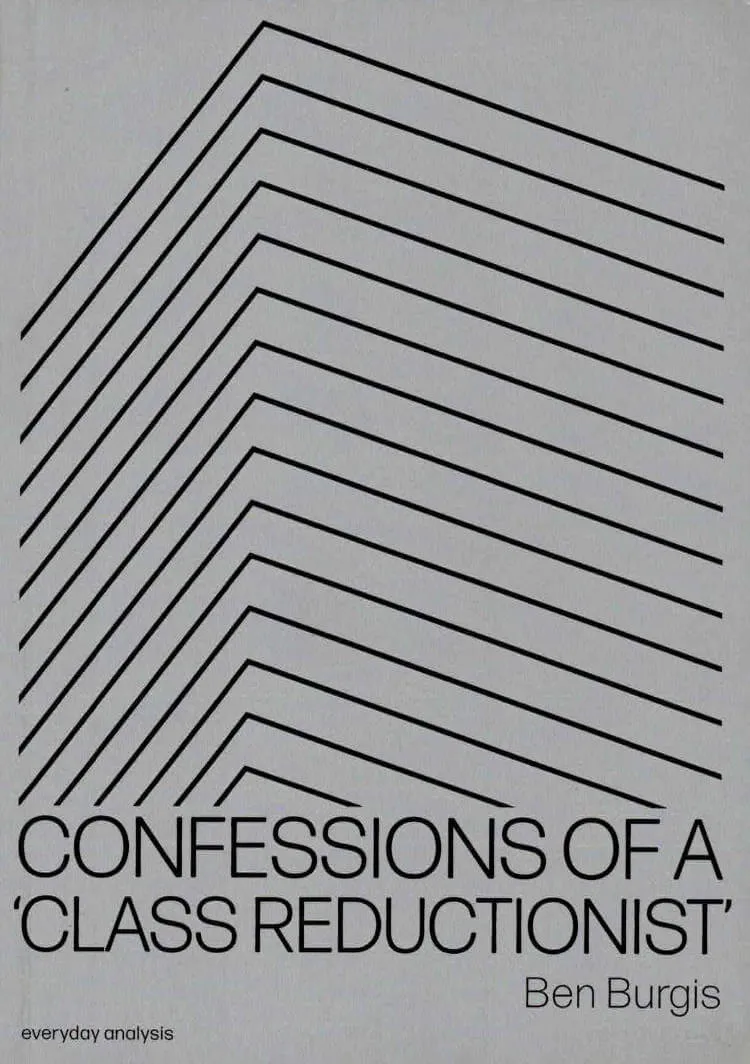
Confessions Of A Class Reductionist
In these essays, Ben Burgis criticizes fashionable radical-liberal identity politics and makes the case for universalism about rights and an unabashedly “class-first” approach to socialist political strategy. This may sound to some ears like a call for abandoning marginalized people. On the contrary, he argues, focusing on economic inequality empowers the victims of bigotry and retrograde social practices the resources and material security to stand up for themselves far more effectively than any diversity trainer or “anti-racism” consultant could represent their interests. As we face a rising tide of reactionary authoritarianism, it’s more important than ever to ditch the identitarian pieties of the recent past and think hard about how the Left can actually win.

Oostende
Oostende is a book about displacement and the sometimes-overwhelming internal monologue we live with. In between poetry, diary and novel, the book reflects on Zicari’s life in Buenos Aires and Belgium, as he navigates work fragility, friendship, sex and love, migration and the fiction laying behind everyday actions and life changing decisions.
Zícari's portrayal of his private life is far from the domain of the concrete, instead he ventures into the uncontrollable production of fantasies that sustain his inner discourse. It is around this dichotomy between the real and the imaginary, the tension between the experienced and the illusion, that Martín Zícari builds a book sustained in orality and proximity.
Martín Zícari, PhD, is a writer and producer based in Brussels. He has published poetry collections such as "Oostende" (Paripé Books, Madrid, 2023), "Del Príncipe Azul al Hombre Invisible en una Semana" (Editorial Municipal de Rosario, Argentina, 2018), and "Pequellpu" (LUMA Foundation, Switzerland, 2015), as well as the short novel "Scalabritney" (Entropia, Argentina, 2014), among others. His research has been featured in scientific journals such as Performance Research, Memory Studies, and the Journal of Latin American Cultural Studies.

Green Agents in Time
The 71 storyboards in this publication are the result of a collaborative process between G.C. Heemskerk and Bernice Nauta, and function as the foundation for their short film The Plantiarchy (2025). The project proposes a parallel reality in which the relation between plants and humans are drastically transformed. In this proposed universe, the plant is the protagonist: it playfully and critically tells a story of colonial expansion, botany, more-than-human eroticism and speculative plant-sentience, flipping the historicised script of control and dependency.
The Plantiarchy comprises a residency period at Hotel Maria Kapel (Hoorn, NL) and various exhibitions including Museum de Lakenhal (Leiden, NL), IKOB Museum (Eupen, BE) and Marres (Maastricht, NL), followed by the short film which premiered at Go Short (Nijmegen, NL) in 2025.
Introduction by Annosh Urbanke
Edited by Jan-Pieter ‘t Hart
Designed by Tjobo Kho with Lucas M. Franco & Vlad Omelianenko

OEI #86/87 Publishing Practices, Publishing Poetics
Tobi Maier, Cecilia Grönberg and 1 more
Once more, an astonishing issue of OEI – a thrilling, compelling, stimulating feast of ideas regarding publishing and the book: the perfect big companion to read and hug in bed while the virus spreads outside.
Bringing together contributions from circa 130 publishing structures, publishing communities, magazines, small press endeavors, artists, poets, writers, editors, theoreticians, curators, scholars, and art bookstores, OEI # 86–87 reflects upon the challenges, pressures and possibilities of publishing and creating publics in different contexts and places in a time of far-reaching – economical, medial, political, social, technological – transformations.
The potential and the versatility of publishing open it to a diversity of practices and approaches in the arts, but as an eminently social form of art, a collective or micro-collective work with shared responsibilities, it is also a never-ending process of “crafting a variegated approach to how you create, publish, distribute, and build a social ecosystem around your efforts”, of trying to “build up and strengthen the community around these printed forms” (Temporary Services).
It is the conviction of OEI #86–87 that print has the power to play an important part in the construction of social spaces, of a social world. As Benjamin Thorel puts it in one of the essays in the issue, “conceiving of the dynamics of publishing as making publics as well as making things public is not a pun – insofar as the artists/publishers encompass, beyond the book itself, its possible ‘lives’, imagining the different spaces, and the different people, amongst whom a publication will circulate.” This is what Michael Warner has called “a public [as] poetic worldmaking”, implying “that all discourse or performance addressed to a public must characterize the world in which it attempts to circulate, projecting for that world a concrete and livable shape, and attempting to realize that world through address.”
This is also, as stressed by Annette Gilbert and others, what can make publishing such an active force, a force co-constituting texts and publications and publics. Indeed, with Michalis Pichler, it is tempting to say that in publishing as practice – perhaps more than in any other art field – “artists have been able to assert the aesthetic value of their own socio-politically informed concerns and to engage, often under precarious conditions, in cultural activities fully aligned with their political values.”
OEI #86–87 also includes sections on and with contemporary poetry from Canada; Fluxus publishing; Krister Brandt/Astrid Gogglesworth; Kalas på BORD (Öyvind Fahlström); Lars Fredrikson; Claude Royet-Journoud’s poetry magazines; Carl Einstein; Gail Scott; Ållebergshändelser; OEI #79: edit/publish/distribute!; “det offentligas försvinnande” and many many other things. [publisher’s note]
Design by Konst & Teknik

Mud … and the Earth System
Mud … and the Earth System explores groundbreaking research in Earth system sciences and highlights the challenges of communicating these findings to the public.
As once-stable “mudscapes” transform, they become both symptoms and symbols of a rapidly warming planet. This book delves into humanity’s connection to these changes through the study of ancient organic and inorganic compounds that have come alive after millennia. It poses essential questions about what these evolving ‘mud’ compounds reveal about Earth’s deep past and our imminent future.
Born from collaborative research led by artist Rikke Luther at the Interdisciplinary Research of Ocean, Climate and Society (ROCS) at the University of Copenhagen in collaboration with Earth scientist, Professor Katherine Richardson, this publication showcases how artistic practices – such as image-making, conceptual mapping, and filmmaking – enhance scientific representation.
Mud… and the Earth System features commissioned essays from experts in Earth Science, Political Aesthetics, and Molecular Geobiology. The book pairs their insights with compelling artwork, including large-scale maps of emerging ‘mudscapes’ in Svalbard, Iceland, Greenland, and Gotland.
The essays give perspectives on the DNA that is collected and stored in mud, which connects life across timescales as an evolutionary resource framing the interactions of human societies with the extreme complexities of the Earth system. Esther Leslie’s “Mud Crystal and Polar Thinking” sets the scene, followed by Karina K. Sand’s “Death and Life: in Mud: Two Million Years in a Split Second,” and Earth scientist Katherine Richardson’s contribution “A Muddy Diary.”
As Richardson sums up, “Mud is an important medium for storing the archives that describe the history of both life and climate on Earth, and we are only just beginning to understand the fantastic stories that mud can tell.”
Contributions by Esther Leslie, Rikke Luther, Katherine Richardson, Karina Sand

Plastic: A Poem
Set during a single twelve-hour night shift in an injection molding factory, plastic is a book-length poem exploring the life of the industrial worker turned poet.
Bringing together memoir, ekphrasis, and satire, plastic is based on Matthew Rice’s experience working in a plastic molding factory for ten years. Illustrating alienated twenty-first-century Irish labor in poetic form, plastic engages with the inflictions and implications of a “post-industrial,” “post-Troubles” society, all while weaving in depictions of factory work from literature, film, and the visual arts.
Time-stamped to highlight the claustrophobia of the worker’s experience, Rice meditates on masculinity, sectarianism, and intergenerational trauma. But at its core is a poem about feeling a calling while being submerged in the world of menial labor—making plastic airplane parts by night, making poetry by day.
Invoking the brevity of Seamus Heaney, plastic is an expansive and imaginative poem that offers the working class a grace, dignity, and truth not often found in contemporary literature.
MATTHEW RICE was born in Belfast. He holds an MA in poetry from Queen’s University Belfast and is currently undertaking a PhD at the Seamus Heaney Centre at Queen’s. His debut collection, The Last Weather Observer, was published in 2021 to critical acclaim, highly commended for the Forward Prize for Best First Collection, and included in the Arts Council of Northern Ireland’s top ten books of the year.

Barge Life: On Jean Vigo's L'Atalante
How to live together in cramped quarters? How to create a microcosm against hostile surroundings? In Barge Life, Florian Deroo tackles these questions by looking at a mythical classic of French cinema: Jean Vigo’s 1934 film L’Atalante. A work brimming with the energies of surrealism and anarchism, L’Atalante follows a young couple, two shipmates, and a clowder of cats who dwell in the belly of a river barge. Deroo offers a wide-ranging essay on the film, revealing how it lovingly delineates a small group that withdraws from the rhythms of modern life to establish a different kind of existence elsewhere. In L’Atalante’s most riveting moments, the river barge becomes a vehicle for a powerful fantasy: a supple and mobile collective life, lived in sensuous interdependence.
Combining film criticism, philosophy, and biography, Deroo’s Barge Life reconsiders an important forerunner to the French New Wave and the early death of its director. Drawing readers into the intimately cramped living spaces of L’Atalante, Deroo explores the allure of retreating into a self-sufficient shelter, along with its intractable problems.

Incubation: a space for monsters
New edition of this long out of-print classic of diasporic literature, featuring a forward by Eunsong Kim, an afterword by Emgee Dufresne, and new endnotes by Bhanu Kapil.
Incubation: a space for monsters is a formally innovative, hybrid-genre book that incorporates poetry and prose. Set in a shifting narrative environment, where human bodies, characters, and text are neither one thing nor another, this fragmentary-diaristic text journeys through the spaces in-between. Originally published in America in 2006 by Leon Works, and out of print for the last seven years, this is the first time this seminal text has been available in the UK.
Following protagonist Laloo – Cyborg, girl, mother, child, immigrant, settler – on a roadtrip through American landscapes, genre styles, and form, Incubation creates radical space for what is ‘monstrous’. Appropriating iconic American tropes, and the structure of Jack Kerouac’s On the Road, Incubation explores the challenges faced by immigrants in attaining such notions of freedom in so hostile an environment. In this fragmentary document there is a celebration in the cobbling together of lives; global in scope, with an intimate focus on interior voice, this landmark text evidences the early innovations and talents of this T.S. Eliot prizewinning author.

Wanderlust
Soufiane Ababri's sketchbooks.
Soufiane Ababri (b. 1985, Rabat) is a Moroccan artist based in France. His protean work (drawings, installations, performances) explores questions of gender, homosexuality, racism and colonialism.

The Beach Machine
Aggressively rebounding after recessions and the pandemic, sprawling landscapes of tourism in the Mediterranean continue to build upon the iconic spatial typology of sea & sun vacationing: the beach. But behind the leisurely scattered bodies and the quiescent summer shores, beachfronts are assembled as intensely ordered infrastructures for the heavy machineries of tourism.
Approaching the beach as an operational socio-technical landscape, this book unpacks stories of construction, programming, and maintenance: from traces of moving sands in Lefkada island to mirror postwar developments in Delos and Mykonos islands, and from historic and bodily excursions to workings of the Athenian riviera to rituals of eco-certification under Blue Flags.
The texts frame the beach as a machine, one with protocols of function and metabolic needs, studying how it directs the capture of land and bodies, while establishing forms of environmental control. As a repeatable and proliferating type of infrastructure space, the beach has the potential to expose parallel evidence of seeming globalizations and patchy planetarities.
Contents:
Flying Flags, Fixing Sands
by George Papam
Moving Sands: Ammoglossa
by Eleni Grapsa
Delos Symposia
and Delos LTD:
Making Global Leisurescapes
by Petros Phokaides
Beach Making:
The Naked Body on the Rocks
by Phevos Kallitsis
Beach Effect
by Hannah Freed-Thall
Hello Hygiene:
A Guide for Bathers
by Lydia Xynogala