Books
Books
in random order

Pourquoi les chats sont dans la rue?
Manuel d’actions et réactions adaptées aux différentes situations, dessiné à partir de l’expérience d’Edwige Ehlinger.

My Lesbian Novel
The latest in writer and visual artist Renee Gladman's ever-expanding body of imaginative investigation is a sui generis novel of queerness and art-making, philosophy and sex.
The narrator of My Lesbian Novel is Renee Gladman, an artist and writer who has produced the same acclaimed body of experimental art and prose as real-life Renee Gladman, and who is now being interviewed by an unnamed interlocutor about a project in process, a seeming departure from her other works, a lesbian romance.
Between reflections on art making and on the genre of lesbian romance - "though aspects of the formula drive me crazy... people who write these stories understand how beautiful women are" - a romance novel of her own takes shape on the page, written alongside the interview, which sometimes skips whole years between questions, so that time and aging become part of the process.
The result is a beautifully orchestrated dialogue between reflection and desire, or clarity and confusion, between the pleasures of form and the pleasures of freedom in the unspooling of sentences over time.
Renee Gladman is a writer and artist preoccupied with crossings, thresholds, and geographies as they play out at the intersections of poetry, prose, drawing, and architecture. She is the author of fourteen published works, including a cycle of novels about the city-state Ravicka and its inhabitants, the Ravickians, all published by Dorothy— Event Factory, The Ravickians, Ana Patova Crosses a Bridge, and Houses of Ravicka. She has been awarded fellowships, artist grants, and residencies from the Radcliffe Institute for Advanced Study at Harvard, Foundation for Contemporary Arts, the Lannan Foundation, and KW Institute for Contemporary Art (Berlin), and was a 2021 Windham-Campbell Prize winner in fiction. She makes her home in New England with poet-ceremonialist Danielle Vogel.

A Book Knot Book
A Book Knot Book is a 208 pages long performance, the first from the research and publishing initiative Body Text. In this study of language in action systems of meaning-making crash, sparkle and swoon. In a playful voice over A Book Knot Book self-reflects on the materialities and choreographies of publishing, reading and writing. With guest stars in fragments; Monique Wittig, Yvonne Rainer, Cristina Rivera Garza, Amiri Baraka, Will Rawls, David Abram, Thich Nhat Hanh and more.
Edited and designed by Sara Kaaman. Published with the support of Stockholm University of the Arts.

Juvenilia #2
Ludi Juvenales (Latin for "juvenile games') is a poetry, art and games series interested in youth, childhood, play, and immaturity.
Ludi Juvenales is edited by Elise Houcek & Zoe Darsee.
www.ludijuvenales.com
Juvenilia #2 by Willa Smart.
Copyright C Willa Smart 2024. All rights reserved.
Cover art by K. Fabricant.
Design by Elise Houcek & Zoe Darsee.
Risograph printed with BearBear in Milwaukee, Wisconsin.
Edition of 50.

Burn & Gloom! Glow & Moon!
Retrospective monograph: a journey through over two decades of intersectional and queering practices in film, performance, sculpture, community work, and textiles.
In Daschner's textile-based works, threads are minimal yet highly visible, akin to the pinch needed to wake up from a dream. These works—as well as her collages—merge with her confronting yet inviting image politics: she cuts and pastes stories of love and pleasure, violence and resilience, death and rebirth.
The written contributions reflect on Katrina Daschner as part of a hardworking generation of queer artists and makers who have been responding to the major conceptual shifts and gender upheavals happening in contemporary art since the 1990s, especially in New York and London. They highlight Katrina Daschner's longstanding line of intersectional queer interest that continues to undermine (neo-)liberal, heteropatriarchal conceptions of sexuality, gender, subjectivity, and relationships
Edited by Övül Ö. Durmuşoğlu.
Texts by Amelia Groom, Tim Stüttgen; foreword by Övül Ö. Durmuşoğlu; interviews by Rike Frank.

After Institutions
The current crisis of museums and the future of Institutional Critique.
Faced with waning state support, declining revenue, and forced entrepreneurialism, museums have become a threatened public space. Simultaneously, they have assumed the role of institutional arbiter in issues of social justice and accountability. The canon of Institutional Critique has responded to the social embeddedness of art institutions by looking at the inner workings of such organizations. In After Institutions, Karen Archey expands the definition of Institutional Critique to develop a broader understanding of contemporary art's sociopolitical entanglements, looking beyond what cultural institutions were to what they are and what they might become.
Karen Archey is curator of contemporary art at the Stedelijk Museum Amsterdam. She is a 2015 Creative Capital | Warhol Foundation Arts Writers Grant recipient for short-form writing. Since joining the Stedelijk Museum in April 2017, Archey has organized solo exhibitions by artists Rineke Dijkstra, Stefan Tcherepnin, Catherine Christer Hennix, Steffani Jemison, Metahaven, Jeff Preiss, Charlie Prodger, and Hito Steyerl. She has written numerous catalogue essays and is a contributor to several art publications, including Artforum and Frieze.

The New Sentience. Reimagining Animal Poetry
As our treatment of nonhuman animals is increasingly implicated in planetary crises—from climate change to global pandemics to unprecedented rates of biodiversity loss and species extinction—it’s clear that an urgent reconsideration of our relationship to other animals is not only necessary but overdue.
How we write about animals, how we represent them in our poems and stories, doesn’t simply reflect how we relate to them in the world; it also shapes how we treat them. Any cultural shift in how we conceive of other animals requires a shift in how we read and write about them. The New Sentience seeks to help catalyze this shift by ushering in a new kind of animal poetry, what editors Ashley Capps and Allison Titus dub “kinpoetics.” Whereas animals in Western poetry have disproportionately functioned as symbols, the poems in this anthology foreground a meaningful awareness of animal sentience and subjectivity, depicting other animals as individuals with dynamic selfhood, personalities, and emotional lives.
Stylistically wide-ranging, the poets featured here, among them Wendell Berry, Lucille Clifton, E. E. Cummings, Mary Oliver, Ross Gay, and Margaret Atwood, apply scrutinous lyrical attention to the animal experience in such surprising and illuminating ways that the reader can’t avoid an earnest reexamination of what humans owe our more-than-human kin. With humility, empathy, and curiosity, the work in this anthology reaffirms the vital connections between humans, animals, and the natural world. This pioneering book will impel readers to a deeper understanding of the lives of the creatures that share our planet and will inspire poets and writers to a more compassionate, meaningful engagement with animal subjects and lives.

Angst
In 1942, butcher Heinrich Angst started to set up his own business in Zurich. Today, Angst AG operates the municipal abattoir and supplies catering businesses and butchers throughout the canton. Angst is a book documenting an installation with 50 used and framed sausage wrapping papers presented at Fondation Fernet Branca in Saint Louis, France. On the other hand the book is gathering 50 systemically relevant poems surrounding writing, everyday life as a dance with obligation and panic, a society without children, fear as a fundamental quality of life and hopefulness to bury fear together.

If UR Reading This It's 2 Late
The first monograph on the work of artist Tony Cokes, creating a visual cartography of a body of moving image work that spans twenty years.
Tony Cokes's video works are eviscerating critiques and affective art works, bringing together color theory, sound, music, and texts, and quoting a polyphony of voices including Aretha Franklin, Mark Fisher, David Bowie, Public Enemy, and Donald Trump. Combining political and social commentary with cultural theory and a critique of capitalism, Cokes's works viscerally confront the social condition, particularly the prejudices and threats suffered by black subjects. This book is the first monograph on his practice, creating a visual cartography of a body of work that spans twenty years.
It features four critical pathways into Cokes's decades-long practice, with essays contributed by notable academics, and conversations between Cokes and artist Kerry Tribe. Cokes's work deals with mediation and distribution, and the book itself becomes another conduit for the dissemination of theory, critique, and counter-narrative—a process that Cokes so powerfully engages in as an artist.
This book accompanies Cokes's solo exhibition, If UR Reading This It's 2 Late: Vol. 1–3, across three international art institutions: Goldsmiths Centre for Contemporary Art, London; Carpenter Center for the Visual Arts, Harvard University; and ARGOS centre for audiovisual arts, Brussels.

Close to Me & Closer...(the Language of Heaven) and Desamere
Alice Notley's two books collected here, CLOSE TO ME & CLOSER... and DESAMERE, are works that are wholly their art, meaning they occur as their language shape measure. She's invented a measure. The text is a rich current crossing, as at the moment of imagining, into being in death and in an expanded life. Notley transgresses conventional contemporary categories of genre; rather than genre, the form of the writing is the mind's inner sense and motion.
"Alice Notley is, I think, the most challenging and engaging of our contemporary radical female poets...infused with uncommon verbal originality, intelligence and joyous playfullness, full of heart, intensity and wonder, provocatively addressing forever unsolved questions of form and identity, life and death, imagination and gender, Notley's poems are unsettling and inspiring"—the San Francisco Chronicle.

Tar Hollow Trans: Essays
"I've lived a completely ordinary life, so much that I don't know how to write a transgender or queer or Appalachian story, because I don't feel like I've lived one.... Though, in searching for ways to write myself in my stories, maybe I can find power in this ordinariness."
Raised in southeast Ohio, Stacy Jane Grover would not describe her upbringing as "Appalachian." Appalachia existed farther afield—more rural, more country than the landscape of her hometown.
Grover returned to the places of her childhood to reconcile her identity and experience with the culture and the people who had raised her. She began to reflect on her memories and discovered that group identities like Appalachian and transgender are linked by more than just the stinging brand of social otherness.
In Tar Hollow Trans, Grover explores her transgender experience through common Appalachian cultural traditions. In "Dead Furrows," a death vigil and funeral leads to an investigation of Appalachian funerary rituals and their failure to help Grover cope with the grief of being denied her transness. "Homeplace" threads family interactions with farm animals and Grover's coming out journey, illuminating the disturbing parallels between the American Veterinary Association's guidelines for ethical euthanasia and the World Professional Association for Transgender Health's guidelines for transgender care.
Together, her essays write transgender experience into broader cultural narratives beyond transition and interrogate the failures of concepts such as memory, metaphor, heritage, and tradition. Tar Hollow Trans investigates the ways the labels of transgender and Appalachian have been created and understood and reckons with the ways the ever-becoming transgender self, like a stigmatized region, can find new spaces of growth.

Issue #9: Companions
Irene de Craen, Katia Krupennikova
The editorial/imaginative centre of the ninth issue of Errant Journal is located in the regions that have experienced Russian imperial aggression from where it makes connections across times, geographies, and ontologies to explore the radical potential of companionship. Companionship is understood not as agreement, but as a shared responsibility across unequal histories. It means not being full without the other. While forms of imperial and colonial violence might differ in places and through times, the issue recognizes how colonial mechanisms are sustained, how they present themselves as if they were past while shapeshifting and continuing in new forms and places in the present. By bringing these contexts in relation, this issue aims to show how certain borders, biases, clichés, and power structures travel, mutate, and shape both human and non-human lives and landscapes. Ultimately, companionship is about prioritizing life and about insisting that no oppression is singular.
This issue is a concept by and co-edited with Katia Krupennikova.
Contributors: Adriana Arroyo, Keto Gorgadze, Andreas Kalkun, Chung Kai Lee, Samira Makki, Ana Mikadze, Petrică Mogoș, Fabienne Rachmadiev, Vaim Sarv, Victoria Soyan Peemot, Czyka Tumaliuan, Iryna Zamuruieva, Irene de Craen, Katia Krupennikova

First Nettles
First Nettles collects poems written between 2021 and 2024, from precarious off-key lyrics to sprawling elegies of damaged life. A book of flailing, desperate music, hurt and hopeful, held together by pins and gaffer tape, art and courage and comradeship. Includes the sequence “Seizures” (2022) – “perfect in its openness and lyrical disfigurement” (Danny Hayward).
“[An] exhilarating collection […]. The sequences here are ferociously and admirably radical, with some superb political satire and verve to the poems.” —Adam Piette, Blackbox Manifold, no. 34
Designed and typeset by Phil Baber; cover collage by Sam Keogh

MW Collected Texts (Bootleg)
This bootleg edition collects scanned copies of Monique Wittig's writing. It includes; The Lesbian Body, Les Guérillères, The Opoponax, and Lesbian Peoples: material for a dictionary— In true bootleg style, punk enough to carry the truly radical words of Wittig: scans, a little grainy, with marginalia of unknown origins. Now, we can dress ourselves in the ravishingly erotic, violent splendorous brilliance to become baby Wittigs.
This edition was assembled out of a deep love of Wittig's work by Chloe Chignell.
Monique Wittig was a French author and feminist theorist particularly interested in overcoming gender and the heterosexual contract. She published her first novel, L'opoponax, in 1964. Her second novel, Les Guérillères (1969), was a landmark in lesbian feminism.

ONE THOUSAND GHOSTS IN THIS FEAST
Sahar Khraibani’s ONE THOUSAND GHOSTS IN THIS FEAST contends with desire, grief, and language as sites of injury and release. Written over a period of three days—amid ongoing genocide, land seizure, and displacement—the long poem counters logics of possession with those of relation. Khraibani’s all-caps, first-person address impels the poem forward, centering intertextuality as a force through which spectral presences shine.
Sahar Khraibani is a writer and artist whose work has been presented with Montez Press, The Brooklyn Rail, Magnum Foundation, the Poetry Foundation, the Poetry Project, and Hyperallergic among others. Sahar is a recipient of the Creative Capital / Arts Writers Grant, a fellowship at The Poetry Project, a MacDowell Fellowship, a 2024 residency at Mass MoCA, and is an alumni of the Whitney Independent Study Program. Sahar teaches at Pratt Institute and is the author of Anatomy of A Refusal (1080PRESS, 2025).
ONE THOUSAND GHOSTS IN THIS FEAST lays bare the “SENSELESS DECAY” potentiated by empire’s relentless categorization, containment, and calculated death delivery. Khraibani’s debut chapbook collapses the imposed and perceived distance written by borders, disrupts anticipated colonial language logics, and bursts “INTO THE MADNESS OF THE ORGY” with queer interference reverberating in all directions. From the soil, from the graveyard, from the dancefloor, from their favorite spot on the eroding waterfront, Sahar broadcasts, IN ALL CAPS, “THE UNNAMEABLE TRUTH.”
— Andrea Abi-Karam

SABR N°03 - Perles à compter
« Quelques perles coulent entre ses doigts. Les récits de Larem se délient du temps que l’on connaît. Elle raconte, superpose, recule et avance, jouissant des temps qu’elle invoque. »
Emma Berger-Pierre est artiste plasticienne et chercheuse. Dans son travail, elle reprend les objets de ses grands-parents pour tirer des récits familiaux de l’immigration algérienne, les enjeux liés aux guerres coloniales et aux banlieues françaises, plus particulièrement Mantes-la-Jolie. Liée à la silenciation de ces histoires et des violences, elle tisse les liens intimes et systémiques de continuation des stratégies et ambiance de guerre, et des résistances, qui se perpétuent dans les quartiers populaires et dans la sphère familiale.
SABR/Collection est une série de publications qui rassemble des œuvres littéraires de format court et de genres variés. Dirigée par Nesrine Salem, la collection souhaite mettre en avant les macro-réalités des auteur·ices choisi·es pour rendre visible le caractère intersectionnel des luttes.

I have brought you a severed hand
Ghayath Almadhoun, Catherine Cobham
Fluid and unselfconscious, Ghayath Almadhoun writes love poems in the shape of nightmares: I have brought you a severed hand is a surreal mix of absurd humour, heteroerotic lust and dead seriousness. Caught between two exiles, the one inherited from his Palestinian father and the one he chose and lives, Almadhoun attempts to explain water and tame hope.
This book never misses the defiant beat of an exile’s haunted footing across wars, seas and memory. Almadhoun turns the genocidal logic of colonialism upside down, emptying out the crumbs of humanity and civilisation. —Don Mee Choi
Almadhoun uses every possible means of silence to make the total devastation palpable. —Alfred Schaffer
Many poets attempt to traverse the gulf between the experience of tragedy and the ability to relay its magnitude to anyone else. But few living have done it with such flourish, such sustained passion and formal precision as Ghayath Almadhoun. —Kaveh Akbar
Ghayath Almadhoun (born 1979, Damascus) is a Syrian-Palestinian poet who moved to Sweden in 2008. He has published five collections of poetry in Arabic, the latest being Adrenalin (Almutawassit, 2017) and I have brought you a severed hand (Almutawassit, 2024). In 2017, Adrenalin was translated into English by Catherine Cobham and published by Action Books. In 2023, Almadhoun curated, edited and translated the poetry anthology Kontinentaldrift: Das Arabische Europa (Verlag Das Wunderhorn and Haus für Poesie), which includes thirty-one Arabic poets living in Europe. The English translation of I have brought you a severed hand is published simultaneously by Divided in the UK and Europe and by Action Books in the USA. Almadhoun currently lives between Berlin and Stockholm. His work has been translated into nearly thirty languages.
Catherine Cobham taught Arabic language and literature at the University of St Andrews, Scotland, for many years and was head of the department of Arabic and Persian from 2011 until 2021. She has translated the work of a number of Arab writers, including poetry by Adonis, Mahmoud Darwish, Ghayath Almadhoun, Tammam Hunaidy and Nouri al-Jarrah, and novels and short stories by Yusuf Idris, Naguib Mahfouz, Hanan al-Shaykh, Fuad al-Takarli and Jamal Saeed. She has written articles in academic journals and co-written with Fabio Caiani The Iraqi Novel: Key Writers, Key Texts (Edinburgh University Press, 2013).

Elizabeth in the Woolds
Elizabeth in the Woolds is the product of two superimposed compositional strategies; a thematic aggregate based on notes dating back to 2008 and an epic prose narrative. Elizabeth is the device through which this simultaneous register moves. Screen writing provides a model for multiple voices. In a film script, the narrator can be the camera; there’s a machine at the centre of the story structure which figures a demand for resolution of plot; a contrario, the thematic approach (S, U, N, as electric light) obliterates chronology, and enumerates an atemporal topological figure, or the way the world is built.
(730pp., self-published first edition of 50, Kortrijk, 2021)

Document
Amelia Rosselli, Roberta Antognini and 1 more
The pivotal 1976 work of one of Italy's most significant post-war voices asks how poetry can document lived experience while dialoguing with the Petrarchan sonnet tradition. Long fascinated by the classical sonnet as an ideal model, Rosselli took on the Petrarchan structure of a canzoniere—a text in which meaning is generated by sequence—to contain the flood of 175 poems for her third collection. Speaking of Document, Rosselli said: “It was hard work; those who do not write poetry cannot imagine to what lengths poets go in order to compose, even if they barely scrape by, and even if it’s still the case that poetry is either inspired or worthless.” This “hard work” conveyed the pain, intensity, and turmoil of her existence and of our own violent chaotic times. Originally published in 1976, Document is the last of her major collections to be translated into English.
I think the great anti-fascist poet Amelia Rosselli has always been in a "lockdown" mode of existence. Document documents Rosselli's internal well, an echo chamber-she orchestrates the signals of global turmoil of war, violence, class struggle, religion, consumerism, financial capitalism. Nothing goes amiss inside her chamber. Rosselli’s oblique, taut, and mocking entries pile up relentlessly—they make up an anti-fascist soliloquy that also echoes the "lockdown" of our current troubled era. — DON MEE CHOI
Amelia Rosselli is one of the towering poets of the twentieth century, so we owe immense gratitude to Roberta Antognini & Deborah Woodard for bringing Documento, Rosselli’s third book, to an anglophone public in full for the first time, in a sharp translation with helpful notes. Less overtly biting and difficult than Rosselli’s previous work-at least at first-these barbed lyrics will initiate new readers into her mind-bending oeuvre. As she writes at the start, "in the end I wrote beautiful things, all of them / for you." Yes: that means you. — BARRY SCHWABSKY

Broken Villas
Written in response to three “physical” photographs, ‘Broken Villas’ contains and considers how a vessel might clasp tightly to known volumetric identities, but also loom with a set of accentuated clues towards otherness: the excavated seams in the earth and what we fill those holes with, imaginary or otherwise; the glacial erraticism of the boulder; the queer crimping of a hotel pillowcase; the modes via which objects are housed as display, but also packaged away, with sorrow, with fear, with erotism etc.

Five Stars: Selected Amazon Reviews, Vol 4
Five Stars: Selected Amazon Reviews, Volume 4 by Kevin Killian, selected by Ted Rees & David Buuck, with introductory words from Kevin edited by Dodie Bellamy. Curated from the over 2500 reviews that William Hall has lovingly archived, this latest edition showcases Kevin’s incomparable mix of wit and sincerity, pleasure and playfulness, his deep love of popular culture, and his unique critical voice.
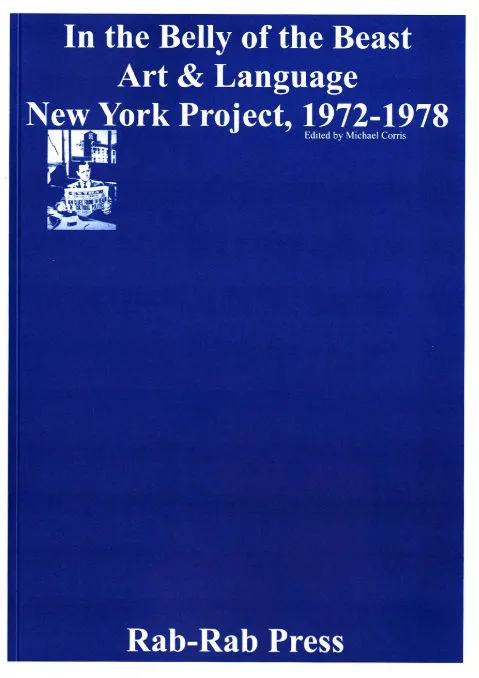
In the Belly of the Beast – Art & Language New York Project 1972-1978
Edited by Michael Corris, the expanded edition of In the Belly of the Beast: Art & Language New York Project 1972-1978 is a survey of the tumultuous years of the political Conceptualism in the mid-seventies New York.
Artists have always experimented with politics, either by organizing themselves or uniting in support of a broader political movement. Today, "activist art" is taught in universities, supported by foundations, and featured in museums and international exhibitions. Is this the only possible way?
In the Belly of the Beast tells a different story, of the work of politically engaged artists and the conflicts they experienced. It is the history of artists wishing to continue working within the boundaries of the artworld and those who were intent on establishing new ideological and class relationships with activists to build a political party.
During the 1970s in New York, the Art & Language collective pioneered institutional critique; published a Marxist-influenced journal; agitated against racism and sexism in museums; challenged the cultural imperialism of international exhibitions; and forged a framework for a socialist organization of artists. This new edition includes previously unpublished documents illuminating the contradictions and disputes that lay at the center of the organization and practices of Art & Language and left-wing groups, such as the Anti-Imperialist Cultural Union and the Artists' Meeting for Cultural Change, mobilizing artists in New York at the time.
The new and expanded edition of In the Belly of the Beast features an extensive interview with Michael Corris, who annotated a collection of previously unavailable documents from the period, including manuscripts, pamphlets, transcripts, and letters.
Art & Language is the name of a group of English artists who choose to work collectively, and the title of a magazine that they founded in 1968. Proposing a critical analysis of the relations between art, society, and politics, Art & Language marks, even in its name, the importance of the “textual turning point” in the 1960s.
Since 1976, Art & Language's project has continued, through Mel Ramsden and Michael Baldwin, with the literary and theoretical collaboration of Charles Harrison. Working with very varied mediums, from painting to rock, these co-founders of Conceptual art remain, even today, attached to observing the consequences of what they themselves call the “depressing collapse of modernism.”

A Psalm for the Third Wind
Book: 11.7 × 18 cm
Book and Glove: 13.5 × 31.5 cm
Presented in a monster glove
Three broken halves of one god walk a city that wants them dead
Their bodies speak in static hunger and rust
Something follows breathing through their mouths
Read it Bleed from it
In A Psalm for the Third Wind, a film script written from 3 perspectives, Damien Troadec is aiming to address in parallel narrative the struggle of having multiples inner voices and the danger of following their distinct desires. One question is raised without any light at the end of the tunnel, confronting the reader to a conflict : THE COMFORT OF MISERY OR THE PAIN OF CHANGE ?

Red Seed: Poems for Luno
Cruz Alejandra Lucas Juárez, Wendy Call and 1 more
Through a voice at once intimate and collective, Lucas Juárez expands the powerful presence of Tutunakú roots to open up territories and to interweave desirous bodies, dream relationships, and the memories of women ancestors. This beautiful translation by Wendy Call and Whitney DeVos, in a precious handmade edition, affirms the trilingual (Tutunakú, Spanish and English) as an ethical strategy of listening to and translating the world. Red Seed collects twelve poems of women's sexualities and spirits in which body, language and territory are political spaces that Indigenous memory expands within and renews.
—Maricela Guerrero, author of The Dream of Every Cell