Books
Books
in random order

Vostok
The theme was built around the idiom “VOSTOK”, the title given by Stéphanie Pécourt to her cycle dedicated to performative semantics, in which carte-blanches signed by guest curators at the Centre Wallonie-Bruxelles are deployed. Buried beneath several kilometers of ice, Lake Vostok acts as an invitation that both fascinates and refuses us. This sub-glacial lake on the edge of Antarctica, the largest identified, becomes the mirror-object of our desires and fears for the abyssal depths. The title of the program, Now I am a Lake, is taken from Sylvia Plath's poem Mirror (1961).
This booklet includes the scripts and texts of the performances, translated exclusively into French for the occasion, as well as images from the videos presented at the eponymous event. The compilation focuses on Sylvia Plath's poem Mirror, and includes an introductory text by curator Pauline Hatzigeorgiou.
edited by SB34
graphic design by Raphaëlle Serres / Solid Éditons
Contributions by Signe Frederiksen, Pauline Hatzigeorgiou, Margaux Schwarz, Hagar Tenenbaum, Sylvia Plath & Eleanor Ivory Weber

Dreaming in the Fault Zone: A Poetics of Healing
A virtuosic inquiry into the forms and uses of healing, from ancient and modern medicine to contemporary literature, ecology, and protest.
In the era of the “chronic acute” long predating COVID-19, Eleni Stecopoulos set out to investigate the imagination, aesthetics, and ideology of healing—its mysteries and mystifications, its many channels and codes. Fusing lyric inquiry with cultural criticism, Dreaming in the Fault Zone explores art’s treatment of our conditions at a time of both increased cynicism about healing and longing for it. Stecopoulos talks to physicians, poets, psychotherapists, disability activists, ethnographers, spiritual seekers; curates performances and takes part in community rituals; documents pilgrimages and visits therapeutic landscapes. Whether writing about the poet H.D.’s psychoanalysis with Freud or madness and apartheid in Bessie Head’s novel A Question of Power, the salve of demagogues or a global alliance of people with contested illnesses, Stecopoulos confronts the poetics and politics of affliction, empathy, memory, and survival. Weaving together esoteric scenes and everyday practice, with flashes of humor, these essays travel in a space of impasse and unending experiment.

Perestroika / Perestroika: Reconstructed
An autobiographical documentary, a fiction that's also an essay and an extended poetic meditation on the ability of the image to represent experience. Sarah Turner's film is a ghost story that explores what we forget and how we remember. The stunning imagery comes solely from the window of the Trans-Siberian train, shot first in 1987-8 and then again in 2007-8. The re-enactment of the journey is a memory work, a re-enactment of the past in the present through the process of filming. But the return journey is haunted by the voices of two dead friends that dominate the soundscape of the 'archive' footage. The film culminates at the haunting expanse of Lake Baikal, the deepest lake in the world.
Perestroika: Reconstructed re-mixes and extends Perestroika, into two sequences. Sequence one constitutes the 2009 version of the film, whilst the second sequence constructs a new framing narrative that reinterprets and reconfigures both the imagery and the experience of the first. Part psycho-geography, part dream and part environmental allegory, both sequences of Perestroika : Reconstructed conclude at Lake Baikal, contrasting experiences of terror and apocalypse with those of beauty and tranquility, the one contaminating the other. In this uncanny return, form stages thee through twinning the instability of memory and re-enacting that within the projective experience of cinema. This extended work delves further into ideas of momentary truth, identity, and how an uncontaminated experience of landscape is literally and metaphorically something that only exists in memory.
Publication contains DVD of Perestroika, which was released theatrically, blu-ray of Perestroika:Reconstructed, first exhibited as a gallery installation at London's Carroll/Fletcher Gallery April-May 2013, and a booklet of three essays by Elizabeth Cowie, Sophie Mayer, and Paul Newland.

Aunonomic Reasoning
Precipitous philosophies. Synaptic-nerve narrations. Syntactic spirals. Hyper-coiled horizons. Will Alexander’s mental range has arrived. An anomalous scripting of the word “automatic,” Aunonomic Reasoning is a whirlwind of lingual torrents triggered by creative mishearing that at once exposes the occupations of orthodox surrealism, summons a voice for the scathed populace of imperial affliction, and forges new paths of phonetic potentiality to mend semantic injury. Pushing prosaic margins beyond their boundaries, these texts take on the etymological condition of the essay as “attempt” with iridescent siege, prepositional frenzy, paratactic provocation, noetic disreckoning, and a critical demand to dismantle: all of which signatures of Alexander’s unilateral poetic innovations.

Exophony
Yoko Tawada's first essay collection in English presents and electrifying new side of the National Book Award-winner as she dives deep into her lifelong fascination with cross-hybridizing languages. The accent here, as in her fiction, is on the art of drawing closer to the world through defamiliarization. Tawada famously writes in both Japanese and German, but her interest in language reached beyond any mere dichotomy.
The term "exophonic," which she first heard in Senegal, has a special allure for the author: "I was already familiar with similar terms. 'immigrant literature,' or 'creole literature,' but 'exophonic' had a much broader meaning, referring to the general experience of existing outside of one's mother tongue." Exophony opens a new vista into Yoko Tawada's world and delivers more of her signature erudite wit—at once cross-grained and generous, laser-focused and multidimensional, slyly ironic and warmly companionable.
A New Yorker Best Book of 2025. Translated from Japanese by Lisa Hofmann-Kuroda.

University of California Press
This Connection of Everyone with Lungs
Part planetary love poem, part 24/7 news flash, the hypnotic poems of This Connection of Everyone with Lungs wrap with equal, angular grace around lovers and battleships. These poems hear the tracer fire in a bird's song and capture cell division and troop deployments in the same expansive thought. They move through concentric levels of association and embrace —from the space between the hands to the mesosphere and back again—touching everything in between. The book's focus shifts between local and global, public and private, individual and social. Everything gets in: through all five senses, through windows, between your sheets, under your skin.

Records of a Cassia-Eater
“I had a dream last night in which I was being escorted across the Styx Bridge by a serpent. The bridge, long and thin and seemingly suspended in space, impressed me, and I asked the serpent who it was that had built it. He said something, but I cannot remember what. Upon awakening, I felt terribly lost. It seemed clear to me that my nights were being controlled by mystic forces.”
This 32-page chapbook is an “occult diary” of sorts.
BRENDAN CONNELL was born in Santa Fe, New Mexico, in 1970. He has had fiction published in numerous places, including McSweeney’s, Adbusters, and the World Fantasy Award winning anthologies Leviathan 3 (The Ministry of Whimsy 2002), and Strange Tales (Tartarus Press 2003). His works of fiction include Unpleasant Tales (Eibonvale Press, 2013), The Architect (PS Publishing, 2012), Lives of Notorious Cooks (Chômu Press, 2012), Miss Homicide Plays the Flute (Eibonvale Press, 2013), Cannibals of West Papua (Zagava, 2015), Jottings from a Far Away Place (Snuggly Books, 2015), and Against the Grain Again: The Further Adventures of Des Esseintes (Tartarus Press, 2021). As editor he has worked on various projects, including The Neo-Decadent Cookbook (Eibonvale Press, 2020), which was co-edited by Justin Isis.
Chapbook of 100 hand-numbered copies, lithographically printed on 95 g/m Italian gesso paper with a “hammered” texture. The cover is lithographically printed on 285 g/m recycled birch-colored Italian paper.

Play-White
The racist term "play-white" comes from the apartheid era, when it connoted a black or mixed race person who lived as a white person: “So and so is a play-white.” South African artist Bianca Baldi draws from studies of biomimicry and her own family history, as well as literary precedents—such as Nella Larsen’s novel Passing (1929)—to reflect on racial passing and the instability of racial identities. Play-White alternates between layers of visualization and moments of discretion in order to explore questions of presence and evasion beyond their representation in black and white.
With contributions by Bianca Baldi, Mika Conradie, Shoniqua Roach, Amy Watson, and others; design by Katharina Tauer & Wolfgang Hückel in collaboration with K. Verlag.
Published 2021

Ordinary Notes
A singular achievement, Ordinary Notes explores profound questions about loss and the shapes of Black life that emerge in the wake. In a series of 248 notes that gather meaning as we read them, Christina Sharpe skillfully weaves artifacts from the past—public ones alongside others that are poignantly personal—with present realities and possible futures, intricately constructing an immersive portrait of everyday Black existence. The themes and tones that echo through these pages—sometimes about language, beauty, memory; sometimes about history, art, photography, and literature—always attend, with exquisite care, to the ordinary-extraordinary dimensions of Black life.
At the heart of Ordinary Notes is the indelible presence of the author’s mother, Ida Wright Sharpe. “I learned to see in my mother’s house,” writes Sharpe. “I learned how not to see in my mother’s house . . . My mother gifted me a love of beauty, a love of words.” Using these gifts and other ways of seeing, Sharpe steadily summons a chorus of voices and experiences to the page. She practices an aesthetic of "beauty as a method,” collects entries from a community of thinkers toward a “Dictionary of Untranslatable Blackness,” and rigorously examines sites of memory and memorial. And in the process, she forges a brilliant new literary form, as multivalent as the ways of Black being it traces.

touxs mes queers sont des poéte·sses
Car archiver nos écrits et nos paroles n'a jamais été aussi important, car il faut rendre compte de nos existences, de ce moment, pour nous et pour les futurs queers en recherche de repères oui, nous avons écrit, donc oui vous pourrez écrire aussi ! oui, nous avons existé, donc oui, vous existerez aussi ! car oui, nous sommes toustes poéte·sses ! car nos vies sont des poèmes et être queer est de la poésie car touxs mes queers sont des poéte·sses!
Because preserving our writings and our words has never been more important, because we must bear witness to our lives, to this moment, for ourselves and for future queers in search of guidance yes, we have written, so yes, you can write too! yes, we have existed, so yes, you will exist too! because yes, we are all poets! because our lives are poems and being queer is poetry because all my queers are poets!

The Moon is Reading us a Book
THE MOON IS READING US A BOOK is the debut collection of poetry from a writer who displays a wide-ranging palette for storytelling and folklore in a suite of narrative poems. The collection is built around an ensemble of characters that range from known to unknown, through which Serubiri crafts visually-inspired poems that combine the photographic, the intensely personal, and the scholarly. In his book, he manages to domesticate larger-than-life figures, including Zanzibari-born singer-songwriter Freddie Mercury and Nigerian-born photographer Rotimi Fani Kayode. Simultaneously pondered and elastic, Serubiri’s poetry lures these figures – and the reader – into an atmosphere that is only as expansive as the interior landscapes he delineates with each succeeding poem. With this he expresses his own doubts and path, from memories of his native Uganda to New York City, through a psychology of decisions and life choices.
Serubiri Moses is a Ugandan curator and author based in New York City. He currently serves as faculty in Art History at Hunter College and visiting faculty at the Center for Curatorial Studies, Bard College. He previously held positions at New York University and the New Centre for Research and Practice, and delivered lectures at Williams College, Yale University, University of Pittsburgh, The New School, basis voor aktuelle kunst, and University of the Arts Helsinki. As a curator, he has organized exhibitions at museums including MoMA PS1, New York; Kunst-Werke Institute for Contemporary Art, Berlin; and the Hessel Museum, Bard College, NY. He previously held a research fellowship at the University of Bayreuth; received his MA in Curatorial Studies at Bard College; and is an alumni of the Àsìkò International Art Programme. He serves on the editorial team of e-flux journal. He has published poetry in the online journals Jalada and Badilisha Poetry Exchange, as well as in print in journals Kwani? 7, Kwani? 8, and READ: A Journal of Inter-Translation (2022). His poetry has been reviewed online in The New Inquiry. THE MOON IS READING US A BOOK is his first book of poetry.
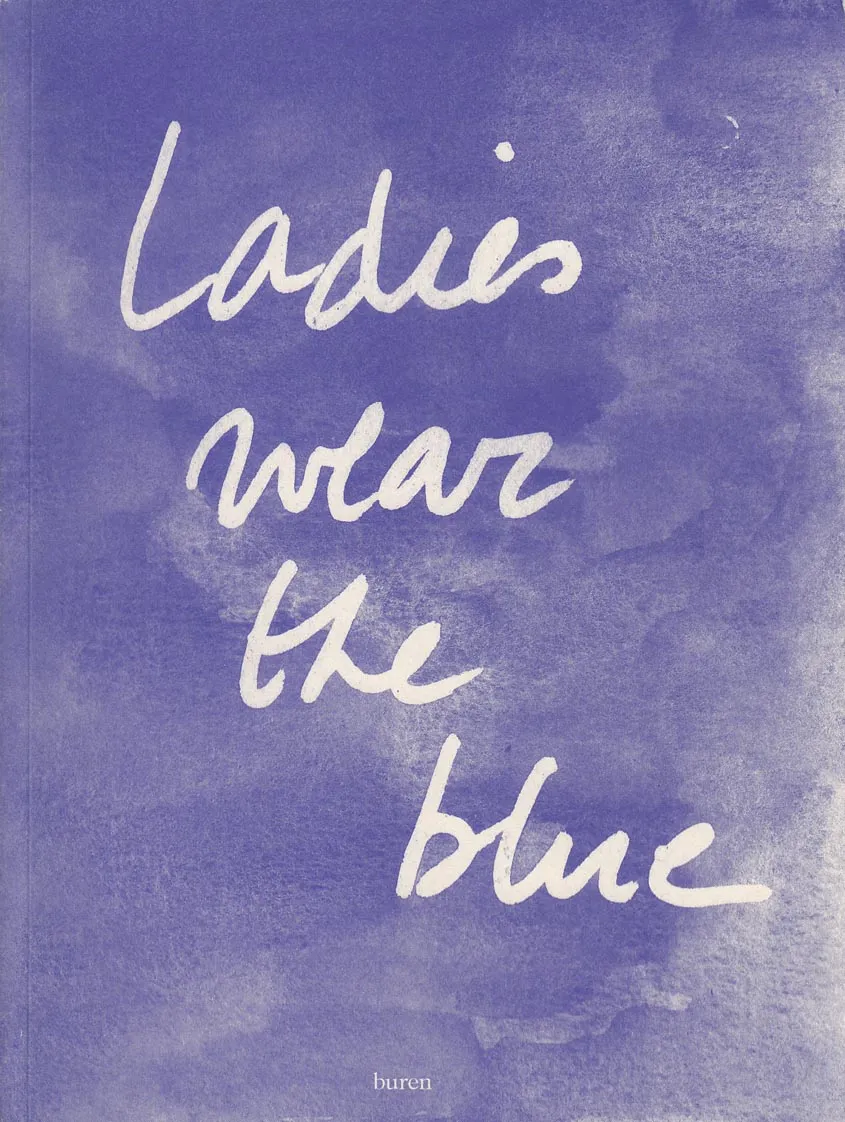
Ladies Wear the Blue
Ladies wear the blue is a collection of watercolour drawings by the hand of Melissa Mabesoone and Oshin Albrecht. The blue watercolours portray women from different moments in time. The adjacent texts describe these women's existence, roles, desires or ideosyncrasies deriving from the 'blue' in their lives. From the first female police officers and Alices all around, to Courtney Love's blue baby dolls and the girl with the blue tattoo Olive Oatman, this publication is an ode to women venturing into the world, and a way to continue telling their herstories.

Broken Villas
Written in response to three “physical” photographs, ‘Broken Villas’ contains and considers how a vessel might clasp tightly to known volumetric identities, but also loom with a set of accentuated clues towards otherness: the excavated seams in the earth and what we fill those holes with, imaginary or otherwise; the glacial erraticism of the boulder; the queer crimping of a hotel pillowcase; the modes via which objects are housed as display, but also packaged away, with sorrow, with fear, with erotism etc.

Qu'est-ce que le sexe ?
La sexualité comme un problème proprement philosophique de la psychanalyse.
La satisfaction de parler contient en soi une clé de la satisfaction sexuelle (et non l'inverse) – une clé de la sexualité et de ses propres contradictions. Alenka Zupančič aborde la question de la sexualité comme un problème proprement philosophique de la psychanalyse – celle de Freud et de Lacan – et non celle des praticiens cliniciens tels que décrits par Lacan « orthopédistes de l'inconscient ». Que se passe-t-il, comme l'affirme Lacan, si nous pouvons obtenir exactement la même satisfaction que le sexe par la parole, l'écriture, la peinture, la prière ou autres activités ? Il ne s'agit pas d'expliquer la satisfaction que procure la parole en indiquant son origine sexuelle, mais bien de souligner que la satisfaction de parler est elle-même sexuelle.
Alenka Zupančič soutient que la sexualité est à la limite d'un « circuit court » entre ontologie et épistémologie. La sexualité et le savoir sont structurés autour d'une négativité fondamentale qui les unit au point de l'inconscient. L'inconscient (en tant que lien avec la sexualité) est le concept d'un lien inhérent entre l'être et la connaissance dans leur négativité même.
Alenka Zupančič est une philosophe lacanienne, spécialiste renommée de Nietzsche, professeure à l'European Graduate School / EGS et à l'Université de Nova Gorica, Slovénie. Elle est également research advisor et professeure à l'Institut de philosophie du Centre de recherche de l'Académie slovène des Sciences et des Arts. Avec Slavoj Žižek et Mladen Dolar, Alenka Zupančič est l'une des figures les plus incontournables de l'Ecole de psychanalyse théorique de Ljubljana dont les travaux s'intéressent aux relations entre sexualité, ontologie et inconscient, à la critique de la théorie du sujet et à l'exploration théorique du concept lacanien du Réel.

Crue
L’Île-de-France a été engloutie. Submergée par de l’eau liquide. C’est à peu près tout ce que l’on sait. Crue est un long poème construit sur un rythme ternaire, une suite de tercets libres entrecoupés de symboles typographiques étranges dont la signification exacte semble avoir été perdue dans l’inondation. Il y a dans le va-et-vient soutenu du texte comme dans celui de la mer, ses gestes répétés, toujours successifs, quelque chose de l’automation ; l’acceptation sans révolte d’une nouvelle nature sous-marine hybride, plus uniquement humaine, à la langue noyée, gorgée de néologismes, méthodique, néanmoins sentimentale. Car ici la cruauté sinistre de la nature fait écho aux émotions du narrateur. Le paysage-état d’âme est désolé, apocalyptique mais comme résigné, nu. Crue sonde les abysses de la civilisation et des comportements humains. Peut-être un des textes les plus personnels de Théo Robine-Langlois.

Time has fallen asleep in the afternoon sunshine
Ik ben Elias of het gevecht met de nachtegalen, door Maurice Gilliams
For the project Time has fallen asleep in the afternoon sunshine a group of people/ performers memorize a book of their choice. Together they form a library collection consisting of living books. After years of learning by heart and reciting for readers, some of the books have now been written down from memory to create new editions, versions resulting from this process. This book is one of those books, chosen by one person, learned by heart and recited many times, and now written down again from memory. This edition is not a re-edition of the original text. It is a re-writing of the text after the process of reading, memorizing and reciting, with all the alterations that might have occured in the course of this process.
![Cover of [...]: Poems](https://rile.space/storage/3222/conversions/01JRFE9N8ZCVXTMHJAS60D283M-webp.webp)
[...]: Poems
From one of our most acclaimed contemporary writers, an urgent and essential collection of poems illuminating the visionary presence of Palestinians.
Fady Joudah’s powerful sixth collection of poems opens with, “I am unfinished business,” articulating the ongoing pathos of the Palestinian people. A rendering of Joudah’s survivance, [...] speaks to Palestine’s daily and historic erasure and insists on presence inside and outside the ancestral land.
Responding to the unspeakable in real time, Joudah offers multiple ways of seeing the world through a Palestinian lens—a world filled with ordinary desires, no matter how grand or tragic the details may be—and asks their reader to be changed by them. The sequences are meditations on a the past returns as the future is foretold. But “Repetition won’t guarantee wisdom,” Joudah writes, demanding that we resuscitate language “before [our] wisdom is an echo.” These poems of urgency and care sing powerfully through a combination of intimate clarity and great dilations of scale, sending the reader on heartrending spins through echelons of time. […] is a wonder. Joudah reminds us “Wonder belongs to all.”

MAKAN #3 / Synthetic Agencies
Building on the foundations of the first two issues, Synthetic Agencies invites a rethinking [and unthinking] of the assumptions, polarities, and discontents surrounding the notion of agency. Traditionally defined in Western thought as the capacity to act and effect change, agency is inseparable from questions of power and the often invisible structures through which power operates. The various contributions interrogate how agency is produced, constrained, or distributed through the systems of knowledge, design, and governance that shape our built environments, technologies, media, and cultures. They were are invited to right (as much as write on) agency, reflecting on how it operates across different scales and contexts, and imagining alternative worlds or configurations. Ultimately, Synthetic Agencies understands agency not as a fixed attribute but as a contested lens through which we might read, reshape, or resist the conditions of the present.
With contributions by Amine Houari, Driss Ksikes, Fehras Publishing Practices, Hamed Sinno, Helga Tawil-Souri, Lada Hršak, Mayada Madbouly, Myriam Ababsa, Nzinga Biegueng Mboup, Ola Hassanain, Omer Shah, OPPA, Salma Barmani, Samia Henni, Tarek El-Ariss, Zaidoun Hajjar.

Sarahland
Sarahland est un ouvrage de fiction américain contemporain qui se découpe en dix nouvelles, toutes reliées par les personnages de Sarahs et leurs parcours initiatiques à la fin de l’adolescence. Sam Cohen, autrice queer et juive, déploie un univers drôle et piquant autour des notions d’identité, de transition, de transformation, d’émancipation et d’apprentissage. Au fil d’histoires inventives, l’autrice explore la manière dont les narratifs qui nous sont assignés, les récits traditionnels, les identités qui nous pré-existent, sont dépassables. Elle construit alors avec ses personnages — presque toutes prénommées Sarah — de nouvelles histoires pour leurs passés ou leurs futurs, de nouvelles façon d’aimer la terre et ceux qui la peuplent, de nouvelles possibilités de vie en soi. Dans le refus pour chaque Sarah d’adhérer à un récit unique et uniformisant, l’autrice propose un lieu potentiellement meilleur pour nous toustes, un espace narratif qui n’exige aucune fixation de soi, aucune injonction consumériste, aucun compromis corporel: un lieu appelé Sarahland.
Née à Detroit aux États-unis, Sam Cohen vit et travaille actuellement à Los Angeles. Elle est une autrice de fiction dont les romans explorent des thèmes à l’intersection du féminisme, des études queers, et des pensées juives. Après avoir publié dans différentes anthologies et revues littéraires (Queer Flora, Fauna, and Funga, Weird Sister Collection, etc.), elle publie en 2021 Sarahland, un recueil de nouvelles. Elle enseigne l’écriture à l’université en tant que professeur d’écriture créative. Elle a été nommée et à gagné à de nombreux prix littéraires, notamment le ALMA Award (Best Jewish Story Collection of 2021), le Jewish Women’s Archive Book List, le Golden Poppy Award in Fiction (finaliste) ou encore le Chautauqua Janus Prize. Elle est en cours d’écriture de son prochain livre.

Nowhere Near
Nowhere Near follows the author’s psychogeographic journey from Los Angeles to Pangasinan to Mexico City after his departure from the United States, where he lived undocumented for twenty-six years. Returning to the Philippines with his grandmother to search for lost land and to confront a “family curse,” Revereza surfaces legacies of Spanish colonialism and US imperialism as they bear out in its continued present. Through film stills, photographs, family archives, and a rapt, first-person narrative, Nowhere Near excavates the amnesias and silences that shape personal and historical memory in the exilic, diasporic impasse.
Miko Revereza's Nowhere Near is the 2021 Open Reading Period Book Prize winner, and was selected by guest judge John Keene.
About the author
Miko Revereza (b. 1988, Manila, Philippines) is an award-winning experimental filmmaker raised in California and currently residing in Oaxaca City. His upbringing as an undocumented immigrant and current exile from the United States informs his relationship to moving images. He has made a series of personal documentaries informed by his experiences with migration and exile: DROGA! (2014), Disintegration 93 – 96 (2017), No Data Plan (2018), Distancing (2019), El Lado Quieto (2021), and Nowhere Near (2023). These works have been screened at festivals and institutions such as Locarno, TIFF, NYFF, and MoMA. No Data Plan is recognized with such honors as the Sheffield Doc Fest Art Award, and was listed in BFI’s Sight & Sound Magazine’s 50 Best Films of 2019, Hyperallergic’s Top 12 Documentary and Experimental Films of 2019, and CNN Philippines’ Best Filipino Films of 2019. Nowhere Near (recipient of Hubert Bals Fund) was among Film Comment’s Best Undistributed Films of 2023 and CNN Philippines’ Best Filipino Films of 2023. Revereza was included in Filmmaker Magazine’s New Faces of Independent Cinema, is a Flaherty Seminar featured filmmaker, and is a recipient of the 2021 Vilcek Prize in Filmmaker. He holds an MFA from Bard College, Milton Avery Graduate School of the Arts. His films are distributed by LUX, London.
Praise
In his powerful and entrancing voice, fueled by irony and critique, Miko Revereza explores neoliberal capitalism, the challenges facing undocumented families, the non-existent “American dream,” and internal and external exile, showing how borders of all kinds (geographical, racial, psychic), though regularly traversed, are policed and criminalized. Nowhere Near is a cri de coeur about twenty-first century American society.
—John Keene
Miko Revereza’s captivating book is a companion to his diaristic 2023 feature of the same title, and it is a pleasure to encounter on the page the resonant literary voice he developed while making that film. Befitting its rich entwining of personal and political histories, Nowhere Near contains a wondrous range of modes and moods: raw and revealing one moment, sharply and humorously observant the next, by turns poetic and plainspoken.
—Dennis Lim
Nowhere Near is a document of lives lived undocumented. Here, form matters: text branches out from image, while dialogue counterpoints an easy, self-reflexive poetic. With the acuity necessitated by a status requiring constant vigilance, negotiating the privatized avenues of America’s dream, Revereza’s words carry a weight that belies their simplicity. Here and now, our attention matters, as America’s icy grip chills us all.
—Alia Syed
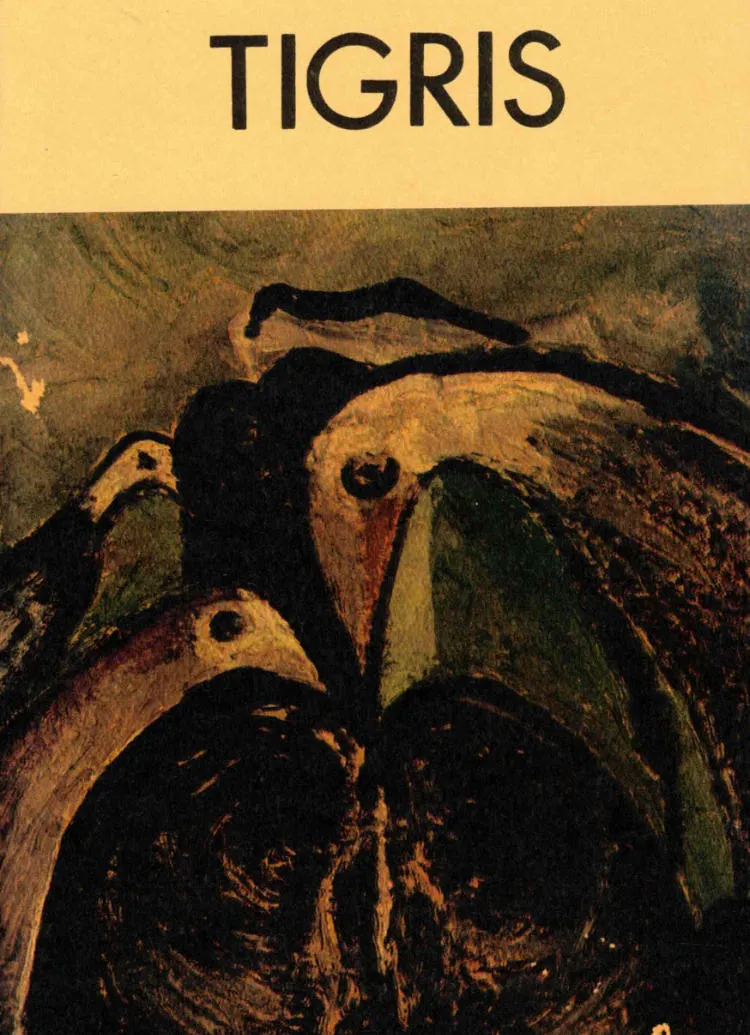
CUNY Center for the Humanities
Tigris Vol. 1
In 1971, the great Iraqi poet Sargon Boulus (1944-2007) published a single issue of an English-language literary anthology that he called Tigris. The magazine—a whisper on the literary landscape that appeared three years after Boulus’s arrival in the US—brings together work by Boulus and several of his literary friends, in translation by Boulus and Etel Adnan.
Tigris was not an end in itself, but rather a temporary solution to the lifelong problem of how to devote oneself to poetry across different countries, eras, and styles: how to live poetry. Yet, in so doing, the small anthology includes significant work: Etel Adnan’s “Jebu,” translated by Adnan, and poetry by Boulus, Fouad Rifkah, Yusuf al-Khal, Mouayad al-Rawi, and Riadh Fakhouri, all in Boulus’s translations, as well as a work by Ankido, a “street-activist poet-café worker of importance to the Palestinian Liberation Movement.”

Maquillage as Meditation: Carmelo Bene and the Undead
Partly a script, partly a personal voyage into the psyche of diseducation, this book happens, has happened and will happen on the 31st of October in a place called ‘The Palace of Melancholy’. In this temporal and spatial loop, the figure of Italian actor, author, director, philosopher, and public persona Carmelo Bene is summoned to hopefully be dismissed once and for all. Bene is looked at by the author reluctantly and yet resolutely through inner voices of dissent, shame and rebellion. He is imagined in gatherings that didn’t happen and read through an epistemology of contradiction. In Giannini’s company and support, Snejanka Mihaylova, Jacopo Miliani, and Arnisa Zeqo probe the walls of the Palace, looking for an exit.

Luna
"Luna" (2021) is a graphic novel by Artist and illustrator Anat Martkovich, developed in collaboration with artist and illustrator Haithem Haddad. It was self published, with support by the Pais Foundation for the Arts.
The novel follows two days in the life of a family, and at its center is a dramatic event which drastically affects the lives of the family members.
The story develops in an a-linear and fantastic fashion, and attempts to present the impossible reality of violence within and outside the home.
The book is comprised of detailed black and white illustrations, with very little text accompanying them.
The little text alternated between different languages: Russian, Hebrew, Arabic, English and Hebrew sign language, depicting a complex and multi layer urban existence. The story is open to the reader's interpretation, though it is firmly set in a mundane everyday reality it opens up and presents us with fantastic possibilities of existence.

Aftershow
A monograph / artists' book that engages with the recent film installations of Pauline Boudry / Renate Lorenz. Installation shots, research material, scripts, and film stills give an insight into the artists' investigation of performance in film and their dense net of references to experimental film, the history of photography, sound, and underground (drag) performances.
The book's title alludes to an interest in opaque events that are belated, left backstage or off-screen. A number of (fictitious) letters to friends and collaborators such as Sharon Hayes, Yvonne Rainer, Ginger Brooks-Takahashi, and Jack Smith place the work of Boudry & Lorenz in a context of debates around temporalities, activism, the archival, decolonizing practices, and queer histories. Published following the exhibition “Patriarchal Poetry” at the Badischer Kunstverein, September 27– November 24, 2013.