rile*books

Search books

Search books by title, author, publisher, keywords...

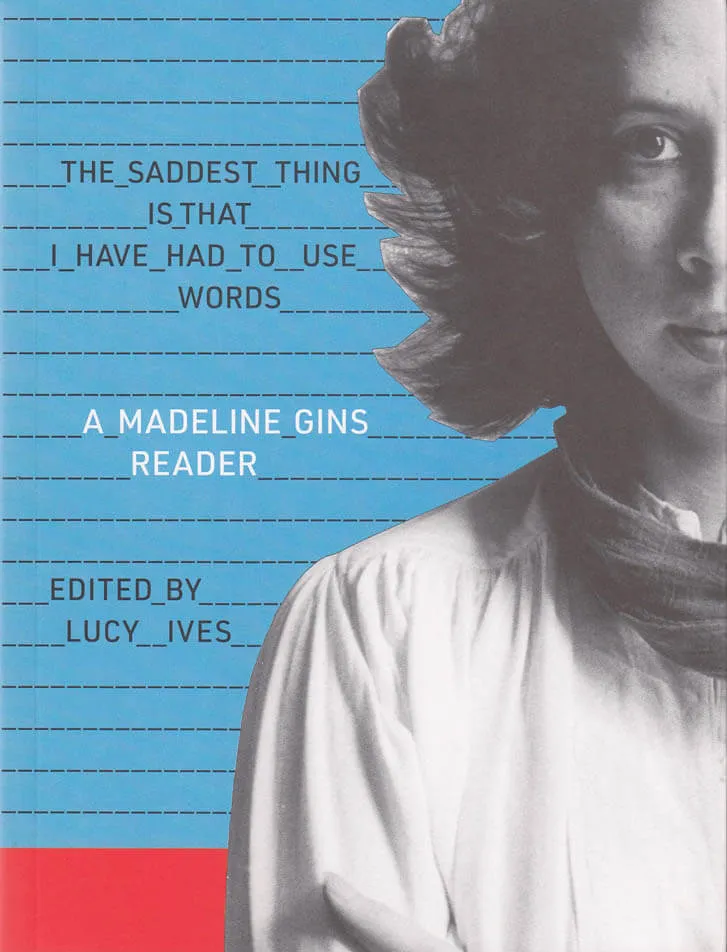
Cover of The Saddest Thing Is That I Have Had to Use Words: A Madeline Gins Reader

Siglio Press

The Saddest Thing Is That I Have Had to Use Words: A Madeline Gins Reader

Madeline Gins

€28.00

Poet, philosopher, speculative architect and transdisciplinary artist, Madeline Gins is well known for her collaborations with her husband, the artist Arakawa, on the experimental architectural project Reversible Destiny, in which they sought to arrest mortality by transforming the built environment. Yet, her own writings — in the form of poetry, essays, experimental prose and philosophical inquiries — represent her most visionary and transformative work. Like Gertrude Stein before her, Gins transfigures grammar and liberates words. Like her contemporaries in conceptual art, her writing is attuned to the energized, collaborative space between reader and page.

The Saddest Thing Is That I Have Had to Use Words: A Madeline Gins Reader is a revelatory anthology, edited and with an introduction by the writer and critic Lucy Ives. It brings never-before-published poems and essays together with a complete facsimile reproduction of Gins' 1969 masterpiece, WORD RAIN (or A Discursive Introduction to the Intimate Philosophical Investigations of G, R, E, T, A, G, A, R, B, O, It Says), along with substantial excerpts from her two later books What the President Will Say and Do!! (1984) and Helen Keller or Arakawa (1994). Long out of print or unpublished, Gins' poems and prose form a powerful corpus of experimental literature, one which is sure to upend existing narratives of American poetics at the close of the 20th century.

Edited by Lucy Ives. 

Published in 2020 ┊ 328 pages ┊ Language: English

recommendations

Cover of Memory

Siglio Press

Memory

Bernadette Mayer

Fiction €45.00

In July 1971, Bernadette Mayer embarked on an experiment: for one month she shot a roll of 35mm film each day and kept a journal. The result was a conceptual work that investigates the nature of memory, its surfaces, textures and material. Memory is both monumental in scope (over 1,100 photographs, two hundred pages of text and six hours of audio recording) and a groundbreaking work by a poet who is widely regarded as one of the most innovative experimental writers of her generation. Presaging Mayer's durational, constraint-based diaristic works of poetry, it also evinces her extraordinary —and often unheralded— contribution to conceptual art.

Mayer has called Memory "an emotional science project," but it is far from confessional. This boldly experimental record follows the poet's eye as she traverses early morning into night, as quotidian minutiae metamorphose into the lyrical, as her stream of consciousness becomes incantatory. In text and image, Mayer constructs the mercurial consciousness of the present moment from which memory is —as she says— "always there, to be entered, like the world of dreams or an ongoing TV show."

This publication brings together the full sequence of images and text for the first time in book form, making space for a work that has been legendary but mostly invisible. Originally exhibited in 1972 by pioneering gallerist Holly Solomon, it was not shown again in its entirety until 2016 at the Poetry Foundation in Chicago and then again in 2017 in New York City at the CANADA Gallery. The text was published without the photographs in 1975 by North Atlantic Books in an edition that has long been out of print.

Bernadette Mayer (born 1945) is the author of over 30 books, including the acclaimed Midwinter Day (1982), a book-length poem written during a single day in Lenox, Massachusetts, The Desires of Mothers to Please Others in Letters (1994) and Work and Days (2016), which was a finalist for the National Book Critics Circle Award. Associated with the New York School as well as the Language poets, Mayer has also been an influential teacher and editor. In the art world, she is best known for her collaboration with Vito Acconci as editors of the influential mimeographed magazine 0 TO 9.

Cover of The Wedding Dress

University of California Press

The Wedding Dress

Fanny Howe

Poetry €28.00

In times of great uncertainty, the urgency of the artist's task is only surpassed by its difficulty. Ours is such a time, and rising to the challenge, novelist and poet Fanny Howe suggests new and fruitful ways of thinking about both the artist's role and the condition of doubt. In these original meditations on bewilderment, motherhood, imagination, and art-making, Howe takes on conventional systems of belief and argues for another, brave way of proceeding. In the essays "Immanence" and "Work and Love" and those on writers such as Carmelite nun Edith Stein, French mystic Simone Weil, Thomas Hardy, and Ilona Karmel—who were particularly affected by political, philosophical, and existential events in the twentieth century—she directly engages questions of race, gender, religion, faith, language, and political thought and, in doing so, expands the field of the literary essay. A richly evocative memoir, "Seeing Is Believing," situates Howe's own domestic and political life in Boston in the late '60s and early '70s within the broader movement for survival and social justice in the face of that city's racism.

Whether discussing Simone Weil, Gertrude Stein, Meister Eckhart, Saint Teresa, Samuel Beckett, or Lady Wilde, Howe writes with consummate authority and grace, turning bewilderment into a lens and a light for finding our way.

Cover of Wrap, History and Syncope

Varamo Press

Wrap, History and Syncope

Isabel de Naverán

Non-fiction €12.00

18 July 1936, Bayonne. After hearing the news of the Fascist uprising, the Spanish dancer and bailaora Antonia Mercé y Luque, known as La Argentina, suffers a syncope and dies in fateful synchrony with the Second Republic. History, and the artist’s body, have been seized and broken by the event.

In close dialogue with images and historical documents, Isabel de Naverán pursues the reverberations of that shock and how it resonates with collective pain and artistic translations (by Federico García Lorca, Gertrude Stein, Kazuo Ohno and others). How does history affect and move through bodies? How do living bodies carry and pass on cultural legacy and collective memory? What do these complex movements reveal about the present? Wrap, History and Syncope is an affective journey that invites the reader into tracing and revisiting other bodies, to ultimately dance their difference and multiplicity for oneself.

Isabel de Naverán is a writer and researcher. Concern with the passage and use of time is the backbone of her work, which focuses on bodily transmission and the examination of the concept of historical time by way of ephemeral and fugitive practices. She holds a PhD in art from the University of the Basque Country.  

Translation from Spanish: Toni Crabb
Graphic design: Michaël Bussaer

Cover of The Lesbian Avenger Handbook

Homocom

The Lesbian Avenger Handbook

Sarah Schulman

LGBTQI+ €10.00

Launched in New York City, in 1992, the Lesbian Avengers rejected the picket line and ordinary demo for media-savvy, nonviolent direct action.

They were superheroes arriving "to make the world safe for baby dykes everywhere;" warriors with capes and shields doing a line dance; dykes "Lusting for Power," pushing a giant bed float down Sixth Avenue in New York (with lesbians on it); nationally-ambitious Avengers eating fire in front of a hostile White House; lovers reuniting a statue of Alice B. Toklas with Gertrude Stein, then waltzing in the snow in Bryant Park. And homos who shamelessly chanted, "Ten percent is not enough, recruit, recruit, recruit."

Originally published in 1993, Homocom edition 2021

Cover of The Autobiography of H. LAN Thao Lam

Dorothy, a publishing project

The Autobiography of H. LAN Thao Lam

Lana Lin

Biography €19.00

Situated between memoir, social criticism, and conceptual art, The Autobiography of H. Lan Thao Lam is an incisive response to a modernist classic and an affecting exploration of the poetics and politics of our times. "We are supposed to know where we are with biography and autobiography, they are the literary equivalents of the portrait and the self-portrait," writes Jeanette Winterson about Gertrude Stein's 1932 classic, The Autobiography of Alice B. Toklas. By narrating her own story from the perspective of her partner, Stein invented a literary form that was both intimate and uncanny, blurring lines of authority and identity as it winds through a story of two women living and loving together through a tumultuous moment in history. Almost a century later, experimental filmmaker and artist Lana Lin has resurrected Stein's project to tell another story of queer love, life, and artistic collaboration in a differently discordant age. At heart a candid chronicle of her partner Lan Thao's life journey from Vietnam during the war and her own troubled history as a gender-queer Taiwanese American, Lin's Autobiography draws in subjects as varied as photography, tropical fruit, New York real estate, and queer theorist Eve Sedgewick's eyeglasses, weaving a landscape of living that is also a critical investigation of race and gender in our time. 

Lana Lin is a writer, artist, and filmmaker based in New York and Connecticut. She is the author of the book Freud's Jaw and Other Lost Objects: Fractured Subjectivity in the Face of Cancer and film and video works including The Cancer Journals Revisited. Her various works and collaborative projects (with Lan Thao Lam as "Lin + Lam") have exhibited at festivals and art and educational spaces throughout the world, including the Museum of Modern Art, Whitney Museum, and New Museum, New York; The National Gallery of Art, Washington, D.C.; Gasworks, London; the Taiwan International Documentary Festival and Taiwan Film and Audiovisual Institute, New Taipei City; Arko Art Center, Korean Arts Council, Seoul; and the 2018 Busan Biennale. Having had three years of psychoanalytic training before dropping out, she sometimes still dreams of becoming a psychoanalyst one day.

Cover of Spells: 21st Century Occult Poetry

Silver Press

Spells: 21st Century Occult Poetry

Sarah Shin, Rebecca Tamas

Poetry €17.00

Spells are poems; poetry is spelling.

Spell-poems take us into a realm where words can influence the universe.

Spells brings together over forty contemporary voices exploring the territory where justice, selfhood and the imagination meet the transformative power of the occult. These poems unmake the world around them, so that it might be remade anew.

Kaveh Akbar, Rachael Allen, Nuar Alsadir, Khairani Barokka, Emily Berry, A.K. Blakemore, Jen Calleja, Anthony V. Capildeo, Elinor Cleghorn, CAConrad, Nia Davies, Paige Emery, Livia Franchini, Alexis Pauline Gumbs, Will Harris, Caspar Heinemann, Lucy Ives, Rebecca May Johnson, Bhanu Kapil, Amy Key, Daisy Lafarge, Dorothea Lasky, Francesca Lisette, Canisia Lubrin, Karen McCarthy Woolf, Lucy Mercer, Hoa Nguyen, Precious Okoyomon, Rebecca Perry, Nat Raha, Nisha Ramayya, Ariana Reines, Sophie Robinson, Erica Scourti, Sarah Shin, Himali Singh Soin, Tai Shani, Rebecca Tamás, Bones Tan Jones, Dolly Turing, Jane Yeh, Flora Yin Wong

Introduced by So Mayer
Afterword by Sarah Shin

Cover of Snow Business

Isollari

Snow Business

Philippa Snow

Essays €17.00

A collection of Philippa Snow's most celebrated writings, articulating with majestic precision the thorny, unbreakable bond between mass media, popular culture and art.
Snow Business marks Philippa Snow's emergence as one of the twenty-first century's greatest cultural critics. From the 2000s into the 2010s, reality television and "second-screen media," designed to play in the background while we look at phones, have proliferated, inaugurating the dumbient age. Celebrities have never been more ordinary; there have never been so many ordinary people who are celebrities.

A collection of her writing from the last half-decade, Snow Business articulates with majestic precision the thorny, unbreakable bond between mass media, popular culture and art. The memoirs of Pamela Anderson and the Kardashian sisters are just as worthy exemplars of "autofiction" as the writing of Olivia Laing and Annie Ernaux; Spring Breakers has succeeded in updating The Great Gatsby; and we are still afraid of Francis Bacon.

Snow has no interest in distinctions of high and low culture. If masterpieces of fiction, painting and cinema reflect back to us some vital and mysterious part of ourselves, mass-distributed popular culture does the same thing, and often with greater clarity and violence—if we are only brave enough to look. Fortunately, Snow does the looking for us.

Alongside her essays are also works of fiction, vignettes whose protagonists are actors, singers, child stars. These are strange, sometimes conspiratorial, and often nightmarish. Just as Snow Business can describe culture with stunning clarity, it can inhabit culture's moving parts, making it again something indescribable, a sensuous vision, a complete fever dream.

Philippa Snow is a writer whose work has redefined contemporary criticism through her analysis of popular culture, art, and media. Her work regularly appears in the Los Angeles Review of Books, ArtReview, The New Republic, The Nation, The White Review, and the Financial Times. She is the author of Which As You Know Means Violence (Repeater, 2022), Trophy Lives (Mack, 2024), and It's Terrible the Things I Have to Do to Be Me (Virago, 2025). Through her keen examination of reality television, celebrity culture, and high art, Snow illuminates the increasingly blurred boundaries between popular entertainment and artistic expression in the twenty-first century.

Cover of Retour

Doubleyoutee Publishing

Retour

Tato Greve

Poetry €14.00

Retour is a book featuring a collection of drawings made on train journeys between Belgium and the Netherlands. It combines hand-written typography and train interiors, subtly highlighting cultural differences forming the countries’ border.