rile*books

Search books

Search books by title, author, publisher, keywords...

Cover of Glaring

Wendy's Subway

Glaring

Benjamin Krusling

€18.00

Glaring: a sustained look of anger, an obvious fact, a situation of such brightness and intensity that vision is obscured. In his debut book of poems, Benjamin Krusling is concerned with reading domination and violence and entering their psychotic motion, the better to do otherwise. Through the thicket of anti-blackness, militarism, surveillance, impoverishment, and interpersonal abuse and violence, Glaring investigates the things that haunt daily life and make love difficult, possible, necessary.

Benjamin Krusling's Glaring is the winner of our 2019 Open Reading Period, and was selected by guest judge Lucy Ives.

Language: English

recommendations

Cover of Some Monologues

Wendy's Subway

Some Monologues

Tyler Coburn

Fiction €25.00

Working at the nexus of performance, art writing, and fiction, Tyler Coburn creates monologues that explore how the “I” is marked in speech. His myriad topics—alternate history, legal personhood, digital labor, and resonant frequency, to name a few—defy straightforward modes of presentation, often insisting on site-specificity and social intimacy at the expense of conventional documentation. 

Some Monologues collects, for the first time, the scripts of Coburn’s work from the past fifteen years, many of which have not previously been published. Accompanying them are texts by eleven artists, writers, curators, and scholars who experienced these performances firsthand, collaborated in their making, conversed with the artist about them, or share an interest in the subjects they engage. Written in theoretical, poetic, and autobiographical registers, these contributions offer new perspectives on the monologue as an expansive and relational form.

Introduction by Elvia Wilk. Contributions by Yu Araki, A.E. Benenson, Mashinka Firunts Hakopian, Sven Lütticken, Kameelah Janan Rasheed, Spyros Papapetros, Camille Richert, Théo Robine-Langlois, Ian Wallace, and Michelle Wun Ting Wong.

Tyler’s scripts refuse to fix an authorial voice; instead, they make the conditions of authorship itself their subject. Blurring the boundaries between fiction and document, the human and the bureaucratic, the self and its doubles, his work thinks through systems from the inside, often using language as both architecture and trap. In their precision and porousness, I recognize a shared pursuit: how to locate agency within constraint, and how to turn the administrative or the technological into a site of intimacy. — Jill Magid

In Tyler Coburn’s Some Monologues, a binary that remains constitutive for the ideological continuity of modern life, in all its colonial and capital forms, is undone: digital vs. physical. In troubling that chasm, Coburn plays out the repercussions of these ideologies of anthropomorphic naturalism, guiding us through their resonances, doubles, codings, and relays. But he also renders himself as the relay of these transferences, in the process expanding art’s premodern calling: to exist as an invocation. Reification suddenly appears as what is situated between embodiment and disembodiment, with both potentially destabilized. Some Monologues, the book, is this destabilization’s ideal format: as much documentation, an echo, of Coburn’s works through their scripts, as it is an instruction manual for denaturalizing our sense/s. — Kerstin Stakemeier

Tyler Coburn is an artist, writer, and professor based in New York. He received a 2024 Andy Warhol Foundation Arts Writers Grant, and his writing has appeared in ArtReview, BOMB, C Magazine, Dis, e-flux journal, frieze, LEAP, Metropolis M, Mousse, and Rhizome. Coburn is the author of four books: I’m that angel (self-published, 2012), Robots Building Robots (CCA Glasgow, 2013), Richard Roe (Sternberg, 2019), and Solitary (Sternberg and Art Sonje Center, 2022). He has presented artwork at such venues as Centre Pompidou, Paris; Bergen Kunsthall; Hayward Gallery, London; Para Site, Hong Kong; and Kunstverein Munich. 

Cover of The Time of the Novel

Wendy's Subway

The Time of the Novel

Lara Mimosa Montes

Fiction €18.00

A disaffected young woman seeking self-estrangement and withdrawal from the world decides to quit her day job as a bookseller to live out, or live in, an experiment: to become a full-time narrator. She moves through sentences, afternoons, a rented apartment, an artist’s studio, a party, the post office with the flowering focus of a realist novel, transposing physical and social life to the space of fiction. As she chronicles the process of becoming a subject in writing, the narrator confronts her fantasy of uninterrupted interiority—and its limits.

What is “fiction” and how does one “enter” into it? Composed in the tense of Literature, Lara Mimosa Montes’s The Time of the Novel is a book about detours, psychic swerves, and surprising encounters with the Real as it converges with the written.

Cover of An Eros Encyclopedia

Wendy's Subway

An Eros Encyclopedia

Rachel James

Poetry €18.00

To want to reveal; to want to reveal enough; to desire; to desire in the right way, the right amount: in her debut book, Rachel James narrates the desiring subject’s nuanced and entangled intimacies with histories of power. How, in other words, under patriarchy, against misogyny, within capitalist strictures, is knowledge shaped, contained, and transferred? Tracing traditions of theater, pedagogy, and faith, An Eros Encyclopedia offers up desire and the attunement to its many objects as the atmosphere of a life—a method to navigate, perceive, and relate against the illusion of separation.

Cover of A Grammar Built with Rocks

Wendy's Subway

A Grammar Built with Rocks

Shoghig Halajian, Suzy Halajian

Ecology €30.00

Featuring writing and artistic practices that trace the racialized and gendered relationship between bodies and land, A Grammar Built with Rocks explores artists’ engagement with sites of physical dispossession and socio-ecological crisis, highlighting how creative research methodologies can serve as radically new place-making practices. The publication brings together a range of feminist-decolonial texts and visual contributions that explore how movement, transience, and improvisation offer alternative ways of being-together while being-in-place.  

Contributions by: Basel Abbas and Ruanne Abou-Rahme with Fawz Kabra, Jheanelle Brown and Julien Creuzet, Carolina Caycedo, Ryan C. Clarke and Cauleen Smith, DAAR—Decolonizing Architecture Art Research with Nicola Perugini, Sandra de la Loza, Demian DinéYazhi’, rafa esparza, Mashinka Firunts Hakopian, Tia-Simone Gardner, Raquel Gutiérrez, Suzanne Kite with Mahpíy̌a Nážinn, Candice Lin, Jumana Manna, K-Sue Park, Christine Rebet, Susan Silton, and Asiya Wadud.

The book also includes a reader, with grounding texts, sources of inspiration, and research references, by Jason Allen-Paisant, Dionne Brand, Suzanne Césaire, Lisa Lowe, Camila Marambio and Cecilia Vicuña, Robyn Maynard and Leanne Betasamosake Simpson, M. NourbeSe Philip, and K. Wayne Yang.

About the editors

Shoghig Halajian is a curator, writer, and artist whose work explores queer and diasporic imaginaries, place-based practices, and experiments in collectivity and collaboration. She is co-editor of the online journal, Georgia, which is supported by a Creative Capital | Andy Warhol Foundation Arts Writers Grant. Select curatorial projects include: A grammar built with rocks (Human Resources LA, One Archives at the USC Libraries, and REDCAT, 2018); At night the states (Hammer Museum, 2017); DISSENT: what they fear is the light (LACE, 2016); and rafa esparza: I have never been here before (LACE, 2015). She was a TBA21 Ocean Space Fellow in Venice (2021) and a curatorial fellow at École du Magasin in Grenoble (2011), where she co-curated the exhibition, The Whole World is Watching, on the the collective Vidéogazette (1973–76), which organized a public access television program in the city. She received her PhD in Art History, Theory, and Criticism with a specialization in Critical Gender Studies from the University of California, San Diego in 2024. 

Suzy Halajian is a curator and writer based in Los Angeles, where she serves as the Executive Director and Curator at JOAN. Her practice is invested in long-term collaborations with artists, critically engaging with the intersections of art, politics, and social histories. She explores strategies of image-making through the lens of colonial histories and contemporary surveillance states. Halajian has curated exhibitions and public programs at institutions such as Los Angeles Contemporary Exhibitions (LACE), ONE Archives at the USC Libraries, the Hammer Museum, and Human Resources Los Angeles, as well as Tanya Bonakdar Gallery (New York), Oregon Contemporary (Portland), Kunstverein (Amsterdam), UKS (Oslo), Galerie Hubert Winter (Vienna), and the Sursock Museum (Beirut). She also serves on the Programming Committee at Human Resources and has worked with nonprofit organizations including the MAK Center for Art and Architecture (Los Angeles) and Ashkal Alwan (Beirut). Her curatorial work and writing have been supported by the Graham Foundation, the Andy Warhol Foundation Arts Writers Grant—for Georgia, a journal she co-founded and co-edits with Anthony Carfello and Shoghig Halajian—and a Curatorial Research Fellowship from the Andy Warhol Foundation for the Visual Arts. Halajian’s writing has appeared in ArteEast, BOMB, X-TRA, Ibraaz, and other publications. She holds an MA from the Center for Curatorial Studies at Bard College and is currently a PhD candidate in the Film and Digital Media program at the University of California, Santa Cruz.

Cover of Strange Biology

Wendy's Subway

Strange Biology

Charlotte Strange

Poetry €14.00

Strange Biology, Charlotte Strange’s first chapbook, opens with a social media advertisement marketing a probiotic as an alternative to the “nuclear bomb” of antibacterial acne medication. As Strange investigates the treatment of the human body as a landscape submissive to medical intervention, they ruminate on the contemporary relationship between microbes, gut-directed medical technologies, and capitalism’s encroachment on life. Drawing on the vernacular of social media marketing, they deftly oscillate between instructive and personal registers, stretching the private across a nexus of microbial interminglings. Strange Biology reflects on the semiotic science of the gut: how the language of medicine defines the mutating edges of the human body. 

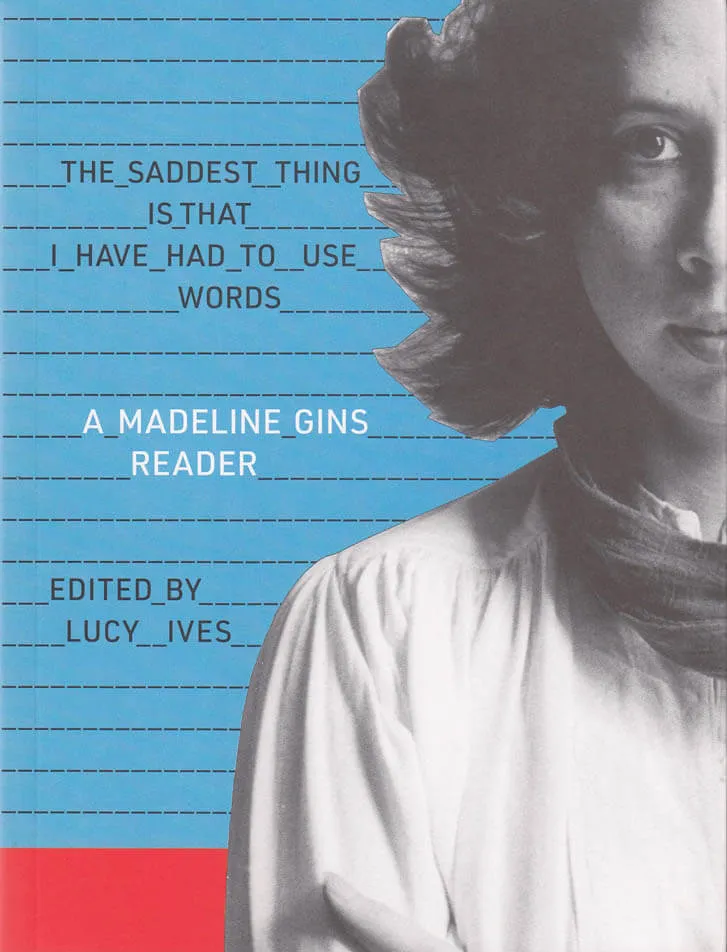
Cover of The Saddest Thing Is That I Have Had to Use Words: A Madeline Gins Reader

Siglio Press

The Saddest Thing Is That I Have Had to Use Words: A Madeline Gins Reader

Madeline Gins

Poetry €28.00

Poet, philosopher, speculative architect and transdisciplinary artist, Madeline Gins is well known for her collaborations with her husband, the artist Arakawa, on the experimental architectural project Reversible Destiny, in which they sought to arrest mortality by transforming the built environment. Yet, her own writings — in the form of poetry, essays, experimental prose and philosophical inquiries — represent her most visionary and transformative work. Like Gertrude Stein before her, Gins transfigures grammar and liberates words. Like her contemporaries in conceptual art, her writing is attuned to the energized, collaborative space between reader and page.

The Saddest Thing Is That I Have Had to Use Words: A Madeline Gins Reader is a revelatory anthology, edited and with an introduction by the writer and critic Lucy Ives. It brings never-before-published poems and essays together with a complete facsimile reproduction of Gins' 1969 masterpiece, WORD RAIN (or A Discursive Introduction to the Intimate Philosophical Investigations of G, R, E, T, A, G, A, R, B, O, It Says), along with substantial excerpts from her two later books What the President Will Say and Do!! (1984) and Helen Keller or Arakawa (1994). Long out of print or unpublished, Gins' poems and prose form a powerful corpus of experimental literature, one which is sure to upend existing narratives of American poetics at the close of the 20th century.

Edited by Lucy Ives. 

Cover of Fuel

Nightboat Books

Fuel

Rosie Stockton

Poetry €18.00

Traversing multivalent intimacies from the underworld of California’s Central Valley oil fields to the quotidian domestic and love’s painful retraction, Stockton’s poems articulate the blurry modes of extraction, fantasy, loss, gender, and labor as they interact and overlap in the shadow of environmental and personal collapse. Between gas station gifts, Venmo requests, and nocturnal love letters, Fuel unravels the self and violent systems of domination, longing for a togetherness that transcends its own ending.

In these poems, Stockton plunges into petrologic, long drives, the beginnings of ends—whatever enters into love between people and makes it so abstract, or common. In other words, its great subject is the edge, and Fuel is a book of horizons. - Benjamin Krusling

Rosie Stockton is the author of Permanent Volta (Nightboat Books 2021) which was the recipient of the Sawtooth Prize as well as being a finalist for the California Book Awards in Poetry and the Publishing Triangle’s Audre Lorde Award for Lesbian Poetry. Their poems have been published by Social Text Journal, VOLT, Jubilat, Apogee, Mask Magazine, Tripwire and WONDER PRESS. They hold an M.A. in Creative Writing from Eastern Michigan University and are currently a Ph.D. Candidate in the Gender Studies Department at UCLA. Rosie lives and works in Los Angeles.

Cover of The Men

Book*hug Press

The Men

Lisa Robertson

Poetry €16.00

The Men explores a territory between the poet and a lyric lineage among men. Following a tradition that includes Petrarch's Sonnets, Dante's work on the vernacular, Montaigne, and even Kant, Robertson is compelled towards the construction of the textual subjectivity these authors convey-a subjectivity that honors all the ambivalence, doubt and tenderness of the human. Yet she remains angered by the structure of gender these works advance, and it is this troubled texture of identity that she examines in The Men.