rile*books

Search books

Search books by title, author, publisher, keywords...

Cover of Fuel

Nightboat Books

Fuel

Rosie Stockton

€18.00

Traversing multivalent intimacies from the underworld of California’s Central Valley oil fields to the quotidian domestic and love’s painful retraction, Stockton’s poems articulate the blurry modes of extraction, fantasy, loss, gender, and labor as they interact and overlap in the shadow of environmental and personal collapse. Between gas station gifts, Venmo requests, and nocturnal love letters, Fuel unravels the self and violent systems of domination, longing for a togetherness that transcends its own ending.

In these poems, Stockton plunges into petrologic, long drives, the beginnings of ends—whatever enters into love between people and makes it so abstract, or common. In other words, its great subject is the edge, and Fuel is a book of horizons. - Benjamin Krusling

Rosie Stockton is the author of Permanent Volta (Nightboat Books 2021) which was the recipient of the Sawtooth Prize as well as being a finalist for the California Book Awards in Poetry and the Publishing Triangle’s Audre Lorde Award for Lesbian Poetry. Their poems have been published by Social Text Journal, VOLT, Jubilat, Apogee, Mask Magazine, Tripwire and WONDER PRESS. They hold an M.A. in Creative Writing from Eastern Michigan University and are currently a Ph.D. Candidate in the Gender Studies Department at UCLA. Rosie lives and works in Los Angeles.

Published in 2025 ┊ 92 pages ┊ Language: English

recommendations

Cover of Nothing at All

Nightboat Books

Nothing at All

Olivia Tapiero, Kit Schluter

Non-fiction €18.00

An atmospheric rumination on gendered violence, cosmic collapse, and colonialism.

From deep inside a black hole, comes Nothing at All—the space where everything collapses: form, genre, gender, and being. Olivia Tapiero’s poetic  and essayistic fragments overflow with lyric beauty as they explore how colonialism, illness, and desire intertwine amidst personal and collective suffering. Generations, geographies, and desires mingle, contaminating one another in these anarchic, insubordinate texts. Here, the written word disrupts foundations and nations, claiming its own survival.

Olivia Tapiero is a writer, translator and musician. She is the author Les murs (Robert-Cliche Award, Prix Senghor finalist), Espaces (2012), Chairs (2019), Phototaxie / Phototaxis (Nightboat Books, 2017 / 2021, Lambda Literary Awards finalist), and Rien du tout (2021, Grand Prix du livre de Montréal Finalist, Governor General’s Literary Awards finalist). She is editor-in-chief for the literary magazine Moebius, and has contributed poems and essays to various publications in Canada, France, and Korea. She has also translated works of contemporary authors such as Roxane Gay, Anne Boyer and Billy-Ray Belcourt. She lives between Marseille and Montréal.

Foreword by Anne Boyer.

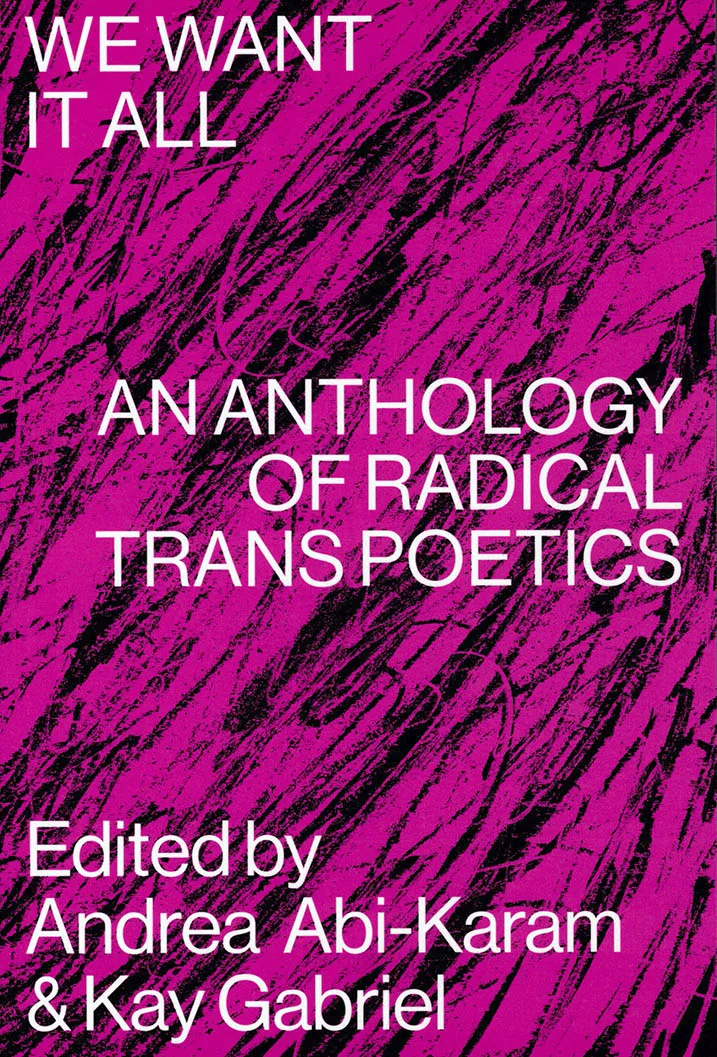
Cover of We Want It All: An Anthology of Radical Transpoetics

Nightboat Books

We Want It All: An Anthology of Radical Transpoetics

Kay Gabriel, Andrea Abi-Karam

Poetry €23.00

An anthology of formally inventive writing by trans poets against capital and empire.

With texts by: Andrea Abi-Karam, New York City Sam Ace, South Hadley, MA Bahaar Ahsan, Berkeley, CA jasper avery, Philadelphia, PA Ari Banias, Berkeley, CA Jo Barchi, Chicago, IL Joss Barton, St. Louis, MO Levi Bentley, Philadelphia, PA Jessica Bet, Baltimore, MA Rocket Caleshu, Los Angeles, CA Ching-in Chen, Seattle, WA listen chen, Vancouver, BC Faye Chevalier, Philadelphia, PA Cody-Rose Clevidence, Arkansas Miles Collins-Sibley, Easthampton, MA Valentine Conaty, New York City CA Conrad, Philadelphia, PA Jimmy Cooper, Rochester, MI Maxe Crandall, Oakland, CA José Díaz, Boston, MA Aaron El Sabrout, New Mexico Ian Khara Ellasante, Lewiston, ME Caelan Ernest, New York City, NY NM Esc, San Diego, CA joshua jennifer espinoza, Los Angeles, CA Logan February, Ibadan, Nigeria Ray Filar, Brighton, UK Nora Collen Fulton, Montreal, Canada Kay Gabriel, New York City Callie Gardner, Cardiff, Wales Jesi Gaston, Chicago, IL Harry Josephine Giles, Edinburgh, Scotland Aeon Ginsberg, Baltimore, MD Caspar Heinemann, Berlin, Germany Kamden Hilliard, Greenville, SC Stephen Ira, New York City Cyrée Jarelle Johnson, New York City Peach Kander, New York City Jayson Keery, Western, MA Evan Kleekamp, Los Angeles, CA Noah LeBien, New York City Ty Little, Richmond, VA Zavé Martohardjono, New York City Amy Marvin, Philadelphia, PA Natalie Mesnard, New York City Bianca Rae Messinger, Iowa City, IA Liam O'Brien, New York City Xandria Phillips, Madison, WI Rowan Powell, Santa Cruz, CA Nat Raha, Edinburgh, Scotland Holly Raymond, Philadelphia, PA Jackie S, New York City Trish Salah, Toronto, Canada Raquel Salas Rivera, Philadelphia, PA Mai Schwartz, New York City Kashif Sharma-Patel, London, UK Julian Talamantez Brolaski, Oakland, CA Charles Theonia, New York City Jamie Townsend, Oakland, CA Nora Treatbaby Laurel Uziell, London, UK Rachel Franklin Wood, Boulder, CO Clara Zornado Akasha-Mitra xtian w. and Anaïs Duplan, NYC.

Kay Gabriel is a poet and essayist. She's the author of Elegy Department Spring / Candy Sonnets 1 (BOAAT Press, 2017), the recipient of fellowships from Lambda Literary and the Poetry Project, and recently completed her PhD at Princeton University.

Andrea Abi-Karam is an arab-american genderqueer punk poet-performer cyborg, writing on the art of killing bros, the intricacies of cyborg bodies, trauma & delayed healing. Their chapbook, THE AFTERMATH (Commune Editions), attempts to queer Fanon's vision of how poetry fails to inspire revolution. Andrea's first book, EXTRATRANSMISSION (Kelsey Street Press, 2019), is a poetic critique of the U.S. military's role in the War on Terror.

Cover of Permanent Record

Nightboat Books

Permanent Record

Naima Yael Tokunow

Poetry €20.00

A visionary anthology that examines and reimagines the archive as a form of collective record-keeping, featuring work by Alexis Pauline Gumbs, Douglas Kearney, Brenda Shaughnessy, Mahogany L. Brown, and many new and emerging voices. 

Inspired by Naima Yael Tokunow's research into the Black American record (and its purposeful scarceness), Permanent Record asks, what do we gain when we engage with our flawed cultural systems of remembrance? How does questioning and creating a deep relationship to the archive, and in some cases, spinning thread from air where there is none, allow us to prefigure the world that we want? Including reflections on identity and language, diasporic and first generation lived experiences, and responses to the ways the record upholds harm and provides incomplete understandings, Permanent Record hopes to reframe what gets to be a part of collective remembrance, exploring "possibilities for speculating beyond recorded multiplicity."

Cover of I Love Shopping

Nightboat Books

I Love Shopping

Lauren Cook

Fiction €16.00

Chickens have a collective soul. Heaven is full of the skateboarders you kissed in middle school. If the algorithm is its own hell, Lauren Cook, author of the critically (and uncritically) acclaimed Sex Goblin, stands in front of it fully armored. I Love Shopping invites its readers to inhabit a world just like ours, reflected through a big, benevolent funhouse mirror.

First published in a limited edition, this is the first trade edition of the cult classic.

Cover of Don't Leave Me This Way

Nightboat Books

Don't Leave Me This Way

Eric Sneathen

Poetry €18.00

A textual and historigraphical odyssey imbued with queer intergenerational yearning and loss.

Don't Leave Me This Way blends archival research with sexual fantasy to produce a series of sonnets inspired by Gaétan Dugas, named by Randy Shilts as "Patient Zero" of the AIDS epidemic in North America. Committed to the utopian possibilities of elegy and pornography, Don't Leave Me This Way exploits the absurdist beauty of the cut-up technique to voice a chorus of lost spirits: poignant, vengeful, and ready to ball.

Cover of Permanent Volta

Nightboat Books

Permanent Volta

Rosie Stockton

Poetry €17.00

Permanent Volta is a book of poems about constraint and debt, as much as it is about excess, credit, loving luxury, and hating work. These are love poems about how queer intimacies invent political and poetic forms, how gender deviance imagines post-sovereign presents and futures.

Taking cues from Rosa Luxemburg's birdsongs and the syntax of invasive flowers, these poems strive to love lack. If history sees writers as tops and muses as bottoms, these poems are motivated by refusal, inversion, and evading representation. In Permanent Volta, the muses demand wages, and then they demand the world. Full of bad grammar, strange sonnets, and truncated sestinas, these poems are melancholy and militant, lazy and anti-state, greedy and collective.

Permanent Volta is for anyone motivated by the homoerotic and intimate etymology of comrade: one who shares the same room.

Cover of SAPPHO TERROR

PRROBLEM

SAPPHO TERROR

Maura Modeya

Poetry €20.00

Maura Modeya’s SAPPHO TERROR is a book haunted—by empire, by sleeplessness, by Sappho herself. In it, queerness becomes both the agent of terror and its object. “I want to be consumed. I want to disappear twice.” Extending the experiments of Mayer, Lonidier, and Stein, Modeya’s poems are as much about desire as they are about violence. They let us in on a secret: “Logic sometimes is so disgusting.” At once delirious and hyperalert, performance and document of a performance, SAPPHO TERROR disrupts the routines of everyday life from within. “Tending to the eros of writing something down.”

A fist is something that blooms inside a lover, a hand held up in revolutionary camaraderie, and the weapon of bare-knuckle combat. In Maura Modeya’s SAPPHO TERROR, the poet probes, in a language that possesses an addictive deliquescence, the body as policy and the devotional as daily, where intimacy is all at once risked, tenderized, and disciplined. We begin in a space of betweenness—between street and bed, between conquest and abandon—and are then submerged into tidal pools of sleeplessness where the poet is overtaken, exquisitely, by forces beyond themselves. Sculpted into vigilant word-reliquaries, these poems exalt the femi-themme of the night while holding fast to danger. Inside this edge-space lives the chasm—the danger that lives in the distance from one edge to another—where sex, politics, and liminal states of consciousness collide, exposing how power is enforced, negotiated, and sometimes utterly undone through the body. —Valerie Hsiung

In SAPPHO TERROR Maura Modeya drifts with eros between the “war intestine,” and a restless dreamscape where desire demands disorientation and the rapture of invasion teeters in tension between queer love and the horrors of militaristic and domestic terrorism. Modeya offers us a vulnerable and familiar sorrow: “Why when I want to speak of love, violence surfaces?” In communion with Sappho’s fragments—those invocations of desire intensified by their historical devastation—Modeya’s poems project that eros is to want is to risk.

Leaning into the “deathless language” of queer love, Modeya allows herself to be haunted by the unreasonable logic of eros and finds herself caught between an insomnia that threatens the poet’s coherence of self, and a sleep that risks waking to the repulsive logics adorning our daily violences.In striking and visceral exhaustion, this book performs the desire of possession—by a lover, by language, by loss. SAPPHO TERROR brings us into the poet’s rapture, one that is profoundly balanced between the paradoxical and perilous forces of eros. —Serena Chopra

What arises out of sleeplessness? In SAPPHO TERROR, all boundaries fall away into ritual. There is a permeability, an eros, a freedom from all structures and institutions, even from our own self. Our human guardrails fall away to a place where we forget the boots on our necks, that our money buys weapons for the state, or even that we are separate unique beings. Is it wrong to forget, or is it a healing? Perhaps both. Modeya says that in sleeplessness, “to submit means to surrender into what is wanted so badly.” In the face of terror, our letting go is a kind of purity. It tells us we can travel beyond repression, not to escape, but to reach the most natural state of our being, even before survival. It is a reminder of life. —Samuel Ace

Maura Modeya’s SAPPHO TERROR takes back Plato’s Cave for the dykes. In these poems eros’ shadows reign sovereign: language is chained and casts haptic forms onto Modeya’s bedroom wall lit by Sappho’s famous fires. These poems join her chorus of “You Burn Me” with the desperate velocity only the insomniac knows. Modeya’s verse is exquisite and relentless, creaking out of the dead of night, bargaining for the possibility of touch. An assembly of aching towardness, SAPPHO TERROR is part elegy, part manifesto, part love letter that sabotages the war intestines we live in order to undivide us from our desire. —Rosie Stockton

Cover of Tosquelles: Healing Institutions

Divided Publishing

Tosquelles: Healing Institutions

Joana Masó

Non-fiction €24.00

Having fled to France in the aftermath of the Spanish Civil War, the Catalan psychiatrist Francesc Tosquelles joined the Saint-Alban psychiatric hospital, where he carried out a transformative clinical practice for over twenty years, in part under the Vichy regime. 

Saint-Alban was an extraordinary event, a commune, an informal refuge in a time of extreme danger, a sort of upwelling spread through word of mouth. Those entering the asylum were welcomed, and that welcome never stopped. Care happened through a broad range of communal activities for staff and patients: theater, cinema, collective writing, horticulture, the sorting of colored pearls, gymnastics, singing, a monthly newspaper. The dignity of every patient was of foremost importance. 

Now, as then, warmongers are willing to poison and slaughter without blinking, making all of life difficult if not impossible: the pull of such asylums is obvious. Tosquelles is a ground-breaking record of the life and work of the founder of institutional psychotherapy. Assembled by Joana Masó, with many texts translated to English for the first time, it is a direct encounter with Tosquelles’s clinical, intellectual, and political writings. 

“Tosquelles’s work serves as a model for dismantling capitalist institutions, a revolutionary venture whose essence Joana Masó captures.”
Paul B. Preciado 

“This remarkable collection allows us to experience the genius of Tosquelles in all its dimensions for the first time. We accompany him through his early work in Reus and Barcelona, the development of his therapeutic ideas and inventive practices in war-torn Catalonia and in exile at the Septfonds Camp, his legendary years at Saint Alban and his lesser-known later years in Melun, Nouvelle Forge and La Candélie. Joana Masó guides us to the creative heart of a man whose counter-cultural, counter-intuitive thinking excited generations of intellectuals in France and now inspires the world.”
Rosie Stockton 

“Resistance hero, anti-Stalinist Marxist, Surrealist, revolutionary practitioner of social therapy, mentor to Frantz Fanon: Francesc Tosquelles was one of the most innovative thinkers in modern psychiatry, a visionary whose moment may finally have arrived.”
Adam Shatz

With texts by Francesc Tosquelles, trans. Robert Hurley and Mara Faye Lethem