Anne Carson
Anne Carson

Men in the Off Hours
In Men in the Off Hours, Carson offers further proof of her tantalizing gifts. Reinventing figures as diverse as Oedipus, Emily Dickinson, and Audubon, Carson sets up startling juxtapositions: Lazarus among video paraphernalia, Virginia Woolf and Thucydides discussing war, Edward Hopper paintings illuminated by St. Augustine. And in a final prose poem, she meditates movingly on the recent death of her mother. With its quiet, acute spirituality and its fearless wit and sensuality, Men in the Off Hours shows us a fiercely individual poet at her best.

Short Talks
In Anne Carson's Short Talks the reader is bombarded with short prose poems that resound with the fullness of meditations on lyric sermons, riddle-poems that consist only of answers, Lou Reed meets Claude Monet and converts to Zen, the pure hilarious ache of ontology. SHORT TALKS, the first book-length collection by this accomplished, original voice, is elegiac, perceptive, and droll.

The Gender of Sound
Human history is filled with unacceptable sounds: high-pitched voices, gossip, talkativeness, hysteria, wailing and ritual shouts. Who makes them? Those deviant from or deficient in the masculine ideal of self-control: women, catamites, eunuchs and androgynes all fall into this category.
From the myths of antiquity to Margaret Thatcher via Sigmund Freud and Gertrude Stein, The Gender of Sound charts the gendering of sound in Western culture. Carson invites us to listen again, and in doing so to reimagine our conceptions of human order, virtue and selfhood.
Putting a door on the female mouth has been an important project of patriarchal culture from antiquity to the present day. Its chief tactic is an ideological association of female sound with monstrosity, disorder and death.

Nox
Nox is an epitaph in the form of a book, a facsimile of a handmade book Anne Carson wrote and created after the death of her brother. The poem describes coming to terms with his loss through the lens of her translation of “Poem 101” by Catallus “for his brother who died in the Troad.” Nox is a work of poetry, but arrives as a fascinating and unique physical object. Carson pasted old letters, family photos, collages and sketches on pages. The poems, typed on a computer, were added to this illustrated “book” creating a visual and reading experience so amazing as to open up our concept of poetry.

The Beauty of the Husband: A Fictional Essay in 29 Tangos
The Beauty Of The Husband is an essay on Keats’s idea that beauty is truth, and is also the story of a marriage. It is told in 29 tangos. A tango (like a marriage) is something you have to dance to the end.
This clear-eyed, brutal, moving, darkly funny book tells a single story in an immediate, accessible voice–29 “tangos” of narrative verse that take us vividly through erotic, painful, and heartbreaking scenes from a long-time marriage that falls apart. Only award-winning poet Anne Carson could create a work that takes on the oldest of lyrical subjects–love–and make it this powerful, this fresh, this devastating.

Wrong Norma
Published here in a stunning edition with images created by Carson, several of the twenty-five startling poetic prose pieces have appeared in magazines and journals like The New Yorker and The Paris Review.
As Carson writes: “Wrong Norma is a collection of writings about different things, like Joseph Conrad, Guantánamo, Flaubert, snow, poverty, Roget’s Thesaurus, my Dad, Saturday night. The pieces are not linked. That’s why I’ve called them ‘wrong.’”

Eros the Bittersweet: An Essay
Anne Carson's remarkable first book about the paradoxical nature of romantic love. Since it was first published, Eros the Bittersweet, Anne Carson's lyrical meditation on love in ancient Greek literature and philosophy, has established itself as a favorite among an unusually broad audience, including classicists, essayists, poets, and general readers.
Beginning with the poet Sappho's invention of the word "bittersweet" to describe Eros, Carson's original and beautifully written book is a wide-ranging reflection on the conflicted nature of romantic love, which is both "miserable" and "one of the greatest pleasures we have."

Eros the Bittersweet
A book about romantic love, Eros the Bittersweet is Anne Carson's exploration of the concept of "eros" in both classical philosophy and literature. Beginning with, "It was Sappho who first called eros 'bittersweet.' No one who has been in love disputes her," Carson examines her subject from numerous points of view, creating a lyrical meditation in the tradition of William Carlos Williams's Spring and All and William H. Gass's On Being Blue.

The Albertine Workout
The Albertine Workout contains fifty-nine paragraphs, with appendices, summarizing Anne Carson's research on Albertine, the principal love interest of Marcel in Proust's Á la recherche du temps perdu.

The Trojan Women
A fantastic comic-book collaboration between the artist Rosanna Bruno and the poet Anne Carson, based on Euripides’s famous tragedy.
The Trojan Women, follows the fates of Hekabe, Andromache, and Kassandra after Troy has been sacked and all its men killed. This collaboration between the visual artist Rosanna Bruno and the poet and classicist Anne Carson attempts to give a genuine representation of how human beings are affected by warfare. Therefore, all the characters take the form of animals (except Kassandra, whose mind is in another world).

If Not, Winter
Of the nine books of lyrics the ancient Greek poet Sappho is said to have composed, only one poem has survived complete. The rest are fragments. In this miraculous new translation, acclaimed poet and classicist Anne Carson presents all of Sappho's fragments, in Greek and in English, as if on the ragged scraps of papyrus that preserve them, inviting a thrill of discovery and conjecture that can be described only as electric, or, to use Sappho's words, as "thin fire . . . racing under skin."
By combining the ancient mysteries of Sappho with the contemporary wizardry of one of our most fearless and original poets, If Not, Winter provides a tantalizing window onto the genius of a woman whose lyric power spans millennia.

Autobiography of Red
Geryon, a young boy who is also a winged red monster, reveals the volcanic terrain of his fragile, tormented soul in an autobiography he begins at the age of five. As he grows older, Geryon escapes his abusive brother and affectionate but ineffectual mother, finding solace behind the lens of his camera and in the arms of a young man named Herakles, a cavalier drifter who leaves him at the peak of infatuation. When Herakles reappears years later, Geryon confronts again the pain of his desire and embarks on a journey that will unleash his creative imagination to its fullest extent.
By turns whimsical and haunting, erudite and accessible, richly layered and deceptively simple, Autobiography of Red is a profoundly moving portrait of an artist coming to terms with the fantastic accident of who he is.

Glass, Irony & God
Known as a remarkable classicist, Anne Carson weaves contemporary and ancient poetic strands with stunning style in Glass, Irony and God. This collection includes: "The Glass Essay," a powerful poem about the end of a love affair, told in the context of Carson's reading of the Bronte sisters; "Book of Isaiah," a poem evoking the deeply primitive feel of ancient Judaism; and "The Fall of Rome," about her trip to "find" Rome and her struggle to overcome feelings of a terrible alienation there.
Anne Carson was born in Canada and teaches ancient Greek for a living.

Red Doc
"Some years ago I wrote a book about a boy named Geryon who was red and had wings and fell in love with Herakles. Recently I began to wonder what happened to them in later life. Red Doc> continues their adventures in a very different style and with changed names. To live past the end of your myth is a perilous thing." Anne Carson
Anne Carson was born in Canada and has been a professor of Classics for over thirty years. Her awards and honors include the Lannan Award, the Pushcart Prize, the Griffin Trust Award for Excellence in Poetry, and fellowships from the Guggenheim and MacArthur Foundations.
Published 2014.
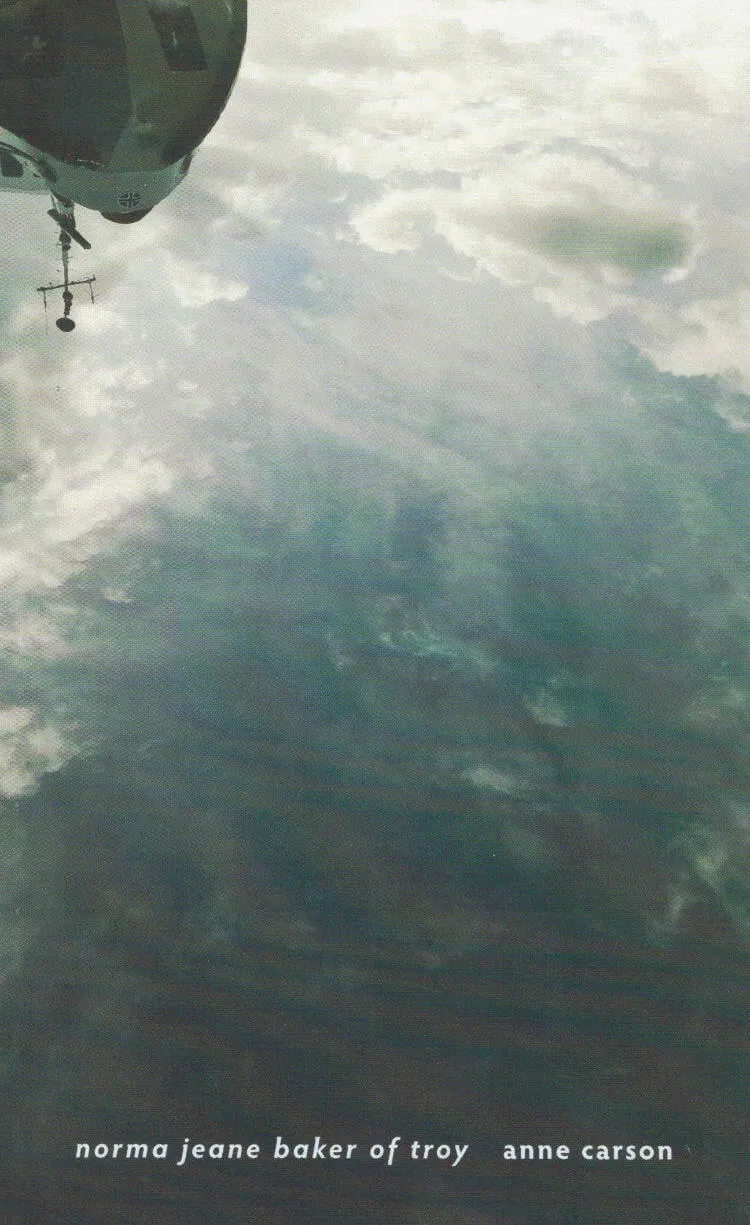
Norma Jeane Baker of Troy
Mentioned in

New Infinity
New Infinity is an experimental novella that follows a woman as she lives and dreams her way through the philosophical implications of autoimmune disease. Met by a labyrinth of closing doors, she searches for meaning and connection among fragmented realities and failed relationships, finding infinitude in the healing process of bibliomancy.
Bára Hladík’s New Infinity is a glittering cross-genre debut. Weaving surrealist stories with meditative poetics, Hladík invites you into a dream world of degenerative illness, left disordered by the failures of ableism, medical professionals, and late-stage capitalism. Here, everything runs on sick time. Where physical health and financial resources grow scarce, the restorative possibilities of queer love, divination, and self-reclamation grant a defiant, yet often tenuous, abundance. Alive with Hladík’s boundless insight and wit, New Infinity is a powerful addition to the collective body of disability literature.
“I have been waiting for a book like New Infinity for years: a story of disability that oozes over the edges of ‘personal narrative’ into the surreal logics of bodies that will not be made useful under capitalism. Bára Hladík’s prose delights me with its 21st-century metamorphoses, its waiting-room dream logics, and its mystical invocations of a body in pain. Her poetry is a channel to another dimension, but one that is grounded inside our everyday sensoria—’cracking, pushing, pulsing’ like a spine writhing with snakes. Here, embodiment is never extractable from the institutions and economies whose profits are predicated on the question ‘do I matter if / I am only a pulse’? New Infinity insists upon a different kind of mattering, in which missed connections, improper fusions, and fleeting moments command the careful, caring attention that is too often denied them.” – Liz Bowen, author of Compassion Fountain (Trembling Pillow Press) and Sugarblood (Metatron Press)
“New Infinity is the most incredible fiction. It explodes the boundaries of this form so as to get to the heart of important truths about the phenomenon of physical pain and of human existence itself. While Bára Hladík’s story draws from a personal experience of survival through a struggle unlike any other, it is an entirely universal tale. In taking us into the most intimate spaces of suffering and narrating a story of a woman navigating a true labyrinth, Hladík shows us a way to face life, with the uncertainties it presents to us all. This novel is at once a profoundly moving story, a brilliant act of creativity, and an existential philosophy. It’s a book I will keep close, so as to revisit— for the thrilling inspiration of its liberated uses of form and style, as well as to learn from Hladík’s honest language, her resilient sense of humour, and her ability to capture the surreal beauty of being alive at all. I felt like I was reading Franz Kafka crossed with a fully unconstrained Anne Carson. I haven’t been so impacted by a book in a long time. It has changed my ways of seeing, feeling, and thinking about what it means to be alive.” – Molly Lynch, author of The Forbidden Territory of a Terrifying Woman (Catapult Books, 2023)
“Bára Hladík’s debut book is a blend of poetry and prose that seeks to make sense of a world that is flagrantly hostile and impatient with bodies that neither perform nor conform to the manic impatience of capitalist acceleration. An honest, vibrant, and very real account of a young writer finding a voice.” – Sina Queyras, writer, editor, professor, curator
“Bára Hladík’s New Infinity is a stirring pedagogy, philosophy, and witness. This offering of sick hybridity coils in a long, calm, and exhilarating breath while asking, ‘Do the doctors know how to breathe?’ Yes, Hladík’s prose and poems prompt, pain cosmologies are at once funny and incantatory. Each of New Infinity’s oneiric turns reads the body as an oracle and mirror, reminds us we are atmospheric. I would rather live here in this book, relearn how to breathe, than return to the ‘impossible crank’ of normal.” – Jane Shi, writer, poet, editor, organizer
Bára Hladík is a Czech-Canadian writer, editor and multimedia artist. Born in Ktunaxa Territory, she began her literary studies in the Creative Writing program at Capilano University in 2011. After studying Technical Writing at the British Columbia Institute of Technology, she received her Bachelor of Arts in Literature and Communications from the University of British Columbia in 2016. Her work can be found in Briarpatch Magazine, THIS Magazine, Contemporary Verse 2, Carte Blanche, EVENT Mag, Hamilton Arts and Letters, Bed Zine, Empty Mirror, Cosmonauts Avenue and elsewhere. Bára’s microchapbook Book of Mirrors was selected for the 2019 Ghost City Press Summer Micro-Chap Series and her collaborative artist book Behind the Curtain (Publication Studio, 2018) was an honourable mention for the Scorpion and Felix Prize (2017). New Infinity is Bára’s first book. She is now a guest in Esquimalt, BC.

The Cosmic Oval
The Cosmic Oval is a nocturnal entrance into an exploration of feminist cosmologies, storytelling and the many ways of knowing and imagining the hot blue beginnings of time. By turn dreaming and waking, Ella Finer enters history and imagination from the sleep side, taking her cue from Anne Carson. Finer attends to cultural memory as composition, gathering cosmic guides with whom to listen beyond what is given to hear.
In west London, the entrance to architect and theorist Charles Jencks’ Cosmic House is overlooked by The Cosmic Oval, a representation of the origin of the universe referencing both contemporary scientific discoveries about its elliptical shape and ancient cosmogonic myths. Finer’s imagined conversation between the figures who inhabit the frieze surrounding the Oval, such as Hannah Arendt, Imhotep and John Donne, re-orchestrates cultural history to explore social scenes of study and the way knowledge moves through bodies and time.
Commissioned by the Jencks Foundation at The Cosmic House.

Appendix Project
Written in the course of the year following the publication of Book of Mutter, and inspired by the lectures of Roland Barthes, Anne Carson, and Jorge Luis Borges, Appendix Project collects eleven talks and essays. These surprising and moving performances, underscored by the sleeplessness of the first year of their child’s life, contain their dazzling thinking through the work of On Kawara, Roland Barthes, W.G. Sebald, Bhanu Kapil, Walter Benjamin, Theresa Hak Kyung Cha, Marguerite Duras, Marlene Dumas, Louise Bourgeois, Doris Salcedo, Jenny Holzer, and more.

Death by Landscape
From the acclaimed author of the novel Oval comes a book of "fan nonfiction" about living and writing in the age of extinction.
In this constellation of essays, Elvia Wilk asks what kinds of narratives will help us rethink our human perspective toward Earth. The book begins as an exploration of the role of fiction today and becomes a deep interrogation of the writing process and the self.
Wilk examines creative works across time and genre in order to break down binaries between dystopia and utopia, real and imagined, self and world. She makes connections between works by such wide-ranging writers as Mark Fisher, Karen Russell, Han Kang, Doris Lessing, Anne Carson, Octavia E. Butler, Michelle Tea, Helen Phillips, Kathe Koja, Jeff and Ann VanderMeer, and Hildegard von Bingen.
What happens when research becomes personal, when the observer breaks through the glass? Through the eye of the fan, this collection delves into literal and literary world-building projects—medieval monasteries, solarpunk futures, vampire role plays, environments devoid of humans—bridging the micro and the macro and revealing how our relationship to narrative shapes our relationships to the natural world and to one another.

Appendix Project: Talks and Essays
Inspired by the lectures of Roland Barthes, Anne Carson, and Jorge Luis Borges, Kate Zambreno's Appendix Project collects eleven talks and essays written in the course of the year following the publication of Book of Mutter, Zambreno's book on her mother that took her over a decade to write. These surprising and moving performances, underscored by the sleeplessness of the first year of her child's life, contain Zambreno's most original and dazzling thinking and writing to date.
In Appendix Project Zambreno thinks through the work of On Kawara, Roland Barthes, W.G. Sebald, Bhanu Kapil, Walter Benjamin, Theresa Hak Kyung Cha, Marguerite Duras, Marlene Dumas, Louise Bourgeois, Doris Salcedo, Jenny Holzer, and more.

Tinted Window #2 : Verbivocovisual
This issue is dedicated to 'Materializzazione del Linguaggio', a 1978 Venice Biennale exhibition curated by Mirella Bentivoglio. The exhibition comprised of work by over eighty women artists working in a huge range of media, but united in their interrogation of text, voice and language. After the smashing hit of their Hervé Guibert No.1 issue, Tinted Window continues its focus on a single subject with issue No.2: Verbivocovisual. In No.2, Tinted Window brings much of this work back to the fore where many artists have slipped into the footnotes of an exciting period in art history. But much beyond our focus on this iconic exhibition, the issue features new essays and art projects by some of the best artists working with text, voice and poetry today.
No.2 features new commissions, translations and reprints from: Holly Antrum, Jeremy Atherton Lin, Mirella Bentivoglio, Angela Bianchini, Daniela Cascella, Anne Carson, Paula Claire, Paul Clinton, William Cobbing, Constance DeJong, Karen Di Franco, Sholto Dobie, Gustavo Grandal Montero, Katalin Ladik, Daisy Lafarge, Rosanna Mclaughlin, Silvia Mejía, Hannah Regal, Giovanna Sandri and Sue Tompkins.