rile*books

Search books

Search books by title, author, publisher, keywords...

Cover of Death by Landscape

Soft Skull Press

Death by Landscape

Elvia Wilk

€17.00

From the acclaimed author of the novel Oval comes a book of "fan nonfiction" about living and writing in the age of extinction.

In this constellation of essays, Elvia Wilk asks what kinds of narratives will help us rethink our human perspective toward Earth. The book begins as an exploration of the role of fiction today and becomes a deep interrogation of the writing process and the self.  

Wilk examines creative works across time and genre in order to break down binaries between dystopia and utopia, real and imagined, self and world. She makes connections between works by such wide-ranging writers as Mark Fisher, Karen Russell, Han Kang, Doris Lessing, Anne Carson, Octavia E. Butler, Michelle Tea, Helen Phillips, Kathe Koja, Jeff and Ann VanderMeer, and Hildegard von Bingen.  

What happens when research becomes personal, when the observer breaks through the glass? Through the eye of the fan, this collection delves into literal and literary world-building projects—medieval monasteries, solarpunk futures, vampire role plays, environments devoid of humans—bridging the micro and the macro and revealing how our relationship to narrative shapes our relationships to the natural world and to one another.

Published in 2022 ┊ 320 pages ┊ Language: English

recommendations

Cover of Subduing Demons in America: Selected Poems 1962-2007

Soft Skull Press

Subduing Demons in America: Selected Poems 1962-2007

John Giorno

Poetry €20.00

Associated with key 1960s avant garde figures such as Ginsberg, Burroughs, Rauschenberg, and Johns, John Giorno was an early pioneer of multimedia poetry through Giorno Poetry Systems, which also distributed a who’s who of the American underground from Patti Smith to Sonic Youth. Giorno’s use of transgressive material and in-your-face, amplified delivery was also a key influence on punk/new wave pioneers such as Suicide, Throbbing Gristle, and Black Flag. Not just a poet but a sexual, spiritual, and political radical, Giorno helped pioneer the open celebration of queer sexuality in poetry in the 1960s.

Subduing Demons in America offers the best of Giorno’s revolutionary poetry, from his striking Pop Art–influenced poems of the 1960s to the psychedelic, echo-laden, multitracked cut-ups of the 1970s with their explosive configurations of queer sex, spiritual practice, and the bohemian Good Life. Also here are the pared-down punk/hip-hop performance poems that Giorno performed in the 1980s.

Cover of Plastic: A Poem

Soft Skull Press

Plastic: A Poem

Matthew Rice

Poetry €16.00

Set during a single twelve-hour night shift in an injection molding factory, plastic is a book-length poem exploring the life of the industrial worker turned poet.

Bringing together memoir, ekphrasis, and satire, plastic is based on Matthew Rice’s experience working in a plastic molding factory for ten years. Illustrating alienated twenty-first-century Irish labor in poetic form, plastic engages with the inflictions and implications of a “post-industrial,” “post-Troubles” society, all while weaving in depictions of factory work from literature, film, and the visual arts.

Time-stamped to highlight the claustrophobia of the worker’s experience, Rice meditates on masculinity, sectarianism, and intergenerational trauma. But at its core is a poem about feeling a calling while being submerged in the world of menial labor—making plastic airplane parts by night, making poetry by day.

Invoking the brevity of Seamus Heaney, plastic is an expansive and imaginative poem that offers the working class a grace, dignity, and truth not often found in contemporary literature.

MATTHEW RICE was born in Belfast. He holds an MA in poetry from Queen’s University Belfast and is currently undertaking a PhD at the Seamus Heaney Centre at Queen’s. His debut collection, The Last Weather Observer, was published in 2021 to critical acclaim, highly commended for the Forward Prize for Best First Collection, and included in the Arts Council of Northern Ireland’s top ten books of the year.

Cover of Eros the Bittersweet: An Essay

Princeton University Press

Eros the Bittersweet: An Essay

Anne Carson

Essays €17.00

Anne Carson's remarkable first book about the paradoxical nature of romantic love. Since it was first published, Eros the Bittersweet, Anne Carson's lyrical meditation on love in ancient Greek literature and philosophy, has established itself as a favorite among an unusually broad audience, including classicists, essayists, poets, and general readers.

Beginning with the poet Sappho's invention of the word "bittersweet" to describe Eros, Carson's original and beautifully written book is a wide-ranging reflection on the conflicted nature of romantic love, which is both "miserable" and "one of the greatest pleasures we have."

Cover of Some Monologues

Wendy's Subway

Some Monologues

Tyler Coburn

Fiction €25.00

Working at the nexus of performance, art writing, and fiction, Tyler Coburn creates monologues that explore how the “I” is marked in speech. His myriad topics—alternate history, legal personhood, digital labor, and resonant frequency, to name a few—defy straightforward modes of presentation, often insisting on site-specificity and social intimacy at the expense of conventional documentation. 

Some Monologues collects, for the first time, the scripts of Coburn’s work from the past fifteen years, many of which have not previously been published. Accompanying them are texts by eleven artists, writers, curators, and scholars who experienced these performances firsthand, collaborated in their making, conversed with the artist about them, or share an interest in the subjects they engage. Written in theoretical, poetic, and autobiographical registers, these contributions offer new perspectives on the monologue as an expansive and relational form.

Introduction by Elvia Wilk. Contributions by Yu Araki, A.E. Benenson, Mashinka Firunts Hakopian, Sven Lütticken, Kameelah Janan Rasheed, Spyros Papapetros, Camille Richert, Théo Robine-Langlois, Ian Wallace, and Michelle Wun Ting Wong.

Tyler’s scripts refuse to fix an authorial voice; instead, they make the conditions of authorship itself their subject. Blurring the boundaries between fiction and document, the human and the bureaucratic, the self and its doubles, his work thinks through systems from the inside, often using language as both architecture and trap. In their precision and porousness, I recognize a shared pursuit: how to locate agency within constraint, and how to turn the administrative or the technological into a site of intimacy. — Jill Magid

In Tyler Coburn’s Some Monologues, a binary that remains constitutive for the ideological continuity of modern life, in all its colonial and capital forms, is undone: digital vs. physical. In troubling that chasm, Coburn plays out the repercussions of these ideologies of anthropomorphic naturalism, guiding us through their resonances, doubles, codings, and relays. But he also renders himself as the relay of these transferences, in the process expanding art’s premodern calling: to exist as an invocation. Reification suddenly appears as what is situated between embodiment and disembodiment, with both potentially destabilized. Some Monologues, the book, is this destabilization’s ideal format: as much documentation, an echo, of Coburn’s works through their scripts, as it is an instruction manual for denaturalizing our sense/s. — Kerstin Stakemeier

Tyler Coburn is an artist, writer, and professor based in New York. He received a 2024 Andy Warhol Foundation Arts Writers Grant, and his writing has appeared in ArtReview, BOMB, C Magazine, Dis, e-flux journal, frieze, LEAP, Metropolis M, Mousse, and Rhizome. Coburn is the author of four books: I’m that angel (self-published, 2012), Robots Building Robots (CCA Glasgow, 2013), Richard Roe (Sternberg, 2019), and Solitary (Sternberg and Art Sonje Center, 2022). He has presented artwork at such venues as Centre Pompidou, Paris; Bergen Kunsthall; Hayward Gallery, London; Para Site, Hong Kong; and Kunstverein Munich. 

Cover of Par-delà étrange et familier

Éditions Sans Soleil

Par-delà étrange et familier

Mark Fisher

Essays €16.00

Dans cet ouvrage, malheureusement son dernier, Mark Fisher revisite des artefacts culturels familiers afin de cartographier les variétés de l’étrange dont ils sont porteurs. Longtemps sensible aux dimensions bizarre et omineuse qu’il devinait, sans les nommer, entre autres dans les œuvres de Lovecraft, les films de David Lynch ou les albums de The Fall, M. Fisher tente ici la synthèse essentielle d’un questionnement qui l’avait hanté, jusqu’à ce livre.

Avec son regard si particulier, celui du critique culturel tout à la fois pop et moderniste, puisant aux sources de la psychanalyse et du marxisme, Fisher se penche sur des objets sensibles pour y saisir les rapports entre présence et absence, entre ce qui devrait être mais n’est pas, ce qui ne devrait pas se présenter mais survient. C’est en compagnie de ces spectres — du titre d’un autre ouvrage — que nous sommes invités à voyager, pour questionner les formes mêmes de nos existences sociales, jusqu’aux frontières de l’étrange.

Cover of Appendix Project

Prototype Publishing

Appendix Project

Kate Zambreno

Essays €16.00

Written in the course of the year following the publication of Book of Mutter, and inspired by the lectures of Roland Barthes, Anne Carson, and Jorge Luis Borges, Appendix Project collects eleven talks and essays. These surprising and moving performances, underscored by the sleeplessness of the first year of their child’s life, contain their dazzling thinking through the work of On Kawara, Roland Barthes, W.G. Sebald, Bhanu Kapil, Walter Benjamin, Theresa Hak Kyung Cha, Marguerite Duras, Marlene Dumas, Louise Bourgeois, Doris Salcedo, Jenny Holzer, and more.

Cover of Men in the Off Hours

Vintage Contemporaries

Men in the Off Hours

Anne Carson

Poetry €16.00

In Men in the Off Hours, Carson offers further proof of her tantalizing gifts. Reinventing figures as diverse as Oedipus, Emily Dickinson, and Audubon, Carson sets up startling juxtapositions: Lazarus among video paraphernalia, Virginia Woolf and Thucydides discussing war, Edward Hopper paintings illuminated by St. Augustine. And in a final prose poem, she meditates movingly on the recent death of her mother. With its quiet, acute spirituality and its fearless wit and sensuality, Men in the Off Hours shows us a fiercely individual poet at her best.

Cover of Language Arts

Wendy's Subway

Language Arts

Justin Allen

Poetry €18.00

Justin Allen’s Language Arts takes up writing as an integral part of an interdisciplinary art practice. Across poems, essays, lyrics, screenwriting, and drawings, works touch on themes of music and subculture, African diasporic language, visual art, and more, bringing together Allen's numerous influences into one collection.

Justin Allen's Language Arts is the 2022 Open Reading Period Editors' Pick.

About the author
Justin Allen is a writer and performer from Northern Virginia. With a background in tap dancing and creative writing, his work often combines a variety of art forms. He has been commissioned by The Chocolate Factory Theater and The Shed and has held residencies at ISSUE Project Room and the Center for Afrofuturist Studies. He has received support from Franklin Furnace, Foundation for Contemporary Arts, and the Jerome Foundation, and shared his work both stateside and abroad.

"In Hatnaha, Justin Allen has reinvented the myth of Atlantis for our postlapsarian age. His art of language cannibalizes the American grammar book, spawning gorgeous new idiolects. Through the buzz and rumble of Afro-diasporic sound clash, Allen hears the frequency of bodies becoming ungovernable. Set to a soundtrack of punk phonotactics, Language Arts is just the book to toss over the barbed wire fences that cordon us off from our post-Reparations future." —Tavia Nyong’o

"Language Arts shares a name with an elementary school class I always wished was more “art” and less rote memorization, and it fully delivers on that desire with its spellbinding assortment of prose poetry, screamo lyricism, screenplay, conlang, and Black political fiction as vibrant as any comp on physical media or stream. nunats nen-tuk nutaks dipa. Justin Allen creates an executable file, one that's bound to spread like Soulja Boy's "Crank That" renamed “britney_spears-hitmebabyonemoretimeremix.mp3," but without the need for tricknology." —Devin Kenny

Cover of A Book for Disappearance

cthulhu books

A Book for Disappearance

Yuri Tuma, Gabriel Alonso and 2 more

Essays €24.00

A Book for Disappearance explores themes of extinction and ecology through the lens of contemporary technology and using AI and image-generation platforms as collective tools. It grapples with the contradictions of living in this world full of worlds and full of crises, while revindicating processes of nomadic becoming, transcending fixed identities, and collective emergence. While disappearance may seem abstract or esoteric, it has tangible implications for both individual and collective action. In this book, the concept of disappearance emerges as an alternative, including a variety of short poetic and experimental texts on the multiple possibilities that surface from our engagement with AI alter-egos and a collective artistic exercise with image generation technologies.

Texts by Laura Tripaldi, Institute of Queer Ecologies, and Stacy Alaimo provide further food for thought, and invite readers into recondite explorations—of parasitic spaces and ghost bodies through materialist feminisms; of oak archives and the previous lives that forests can narrate to us; of acid oceans and the psychedelic trips they might afford.

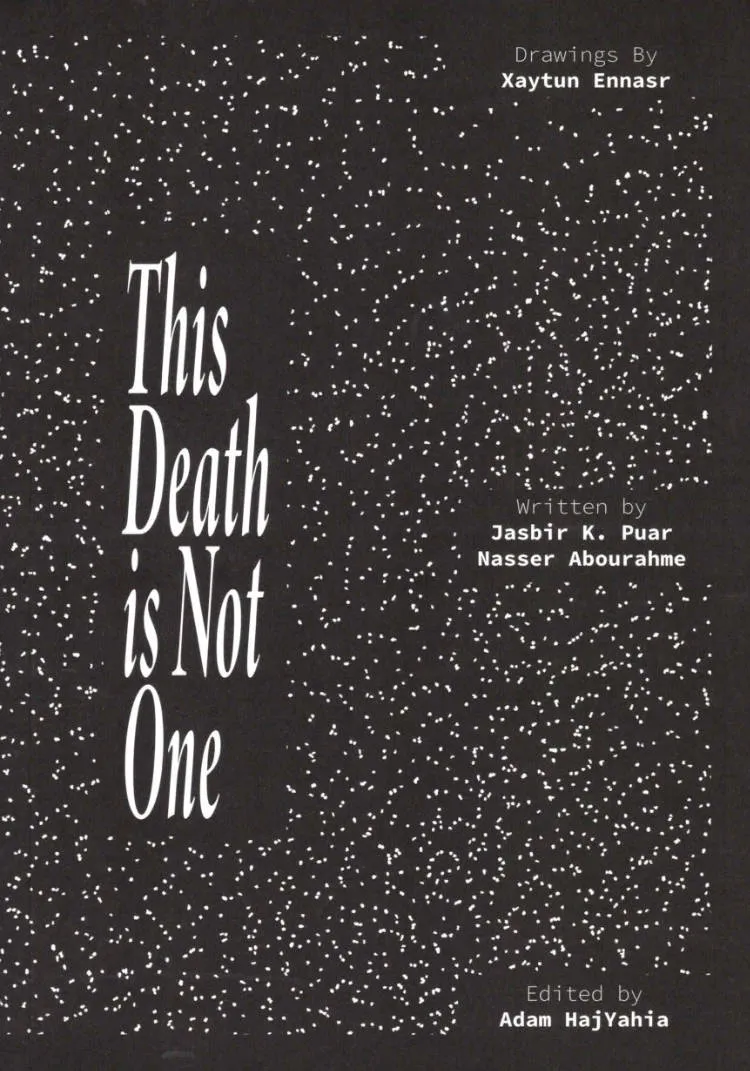
Cover of This Death is Not One

Bilna'es

This Death is Not One

Jasbir K. Puar, Nasser Abourahme and 1 more

Essays €20.00

The publication of The Right to Maim by Jasbir K. Puar in 2017 was critical to advancing studies on disability and to further articulating how the body figures in the nexus of capacity and debility across racializing and extractive neoliberal lines. It offered a complex and rigorous anti-capitalist account of disability that is useful to both scholarly work and political and social organizing. However, despite its paramount contribution to scholarship on Palestine, delivered by its scathing analysis of the Israeli biopolitical policy—its right to maim—in how the injured Palestinian body is produced and reproduced, its reception was difficult, and hard to stomach. It cohered a political logic in writing before it was visibly evident on the ground. In the moment and aftermath of the Great March of Return (2018-19), Puar’s offerings became much harder to ignore, as the event crystallized a mass maiming campaign of Palestinian protesters inside the edges of the militarized borders of Gaza.

The occasion of this publication by Bilna’es marks the first translation into Arabic of the chapter “Will Not Let Die”: Debilitation and Inhuman Biopolitics in Palestine, alongside the postscript of The Right to Maim. Not simply a reissue of previously published work or a translation, This Death is Not One includes a new preface from Jasbir K. Puar revisiting the right to maim from within this moment of genocide in Gaza that interrogates the new vectors of living and dying under settler-colonialism, and how maiming, in fact, speaks of extermination; an introduction by Nasser Abourahme reflecting on the book’s stakes in the present and its reception in the past, alongside searing analysis of genocide in excess of the law, and what this reveals and forecloses in how we understand the juridical body and militancy in the wake of Zionism; and original drawings by Xaytun Ennasr that inscribe a relation between land and body mapped through cosmological patterns tracing the relation between martyrs, who are referred to as moons, and the moon, a symbol for martyrdom in Palestine.

Jasbir K. Puar is Distinguished Faculty of Arts Professor in the Social Justice Institute at the University of British Columbia, Extraordinary Professor in the Women’s and Gender Studies Department at the University of the Western Cape in Cape Town, South Africa, and Professor Emerita at Rutgers University where she was faculty in the Women’s, Gender, and Sexuality Studies Department for 23 years. Puar is the author of the award-winning books: The Right to Maim: Debility, Capacity, Disability (2017), and Terrorist Assemblages: Homonationalism in Queer Times (2007).

Nasser Abourahme is a writer and teacher, and is currently assistant professor at Bowdoin College. He’s the author of The Time beneath the Concrete: Palestine between Camp and Colony (Duke University Press, 2025), which was awarded the 2025 Palestine Book Award.

Xaytun Ennasr is an artist and designer. She works across experimental video games, paintings, prints, ceramics, installations, and text. She often uses science fiction, folklore, and radical softness as affective tools for revolutionary cultural production, specifically Palestinian liberation and sovereignty. Her work often deals with questions of land, cartography, transness, gender, and the living environment.

Drawings by Xaytun Ennasr

Translation to Arabic:

“Living in Genocide” by Jasbir K. Puar, translated by The Archilogue

“Our names, our remains” by Nasser Abourahme, translated by The Archilogue

The Right to Maim, Chapter 4: “Will not let die: Debilitation and Inhuman Biopolitics in Palestine ” and the The Right to Maim Postscript by Jasbir K. Puar, translated by Bekriah Mawasi

Cover of How to speak dead

Kayfa ta

How to speak dead

Walid Sadek

A meditative reflection on language and its loss.

How does one language inherit another? Defeat, erase or live through another? How to speak dead is Walid Sadek's meditative reflection on language, dead or victorious. At heart, beyond defeat and victory, it is a reflection on how one can approach a speaking that is of neither a living language nor a dead one. A speaking that knows loss and knows it is woven into every uttered word, every spoken sentence. A loss that becomes syntax.

"There, where the battle is lost and won and where, after the hurly-burly is done, we may approach a speaking that is of neither a living language nor a dead one. A speaking that knows loss and knows it is woven into every uttered word, every spoken sentence. A loss that becomes syntax."
Walid Sadek

Walid Sadek (born 1966 in Beirut) is a Lebanese artist and writer. He is a professor at the Department of Fine Arts and Art History of the American University of Beirut.

Cover of Imperfect Solidarities

Floating Opera Press

Imperfect Solidarities

Aruna D'Souza

Essays €18.00

Art, empathy and political solidarity.

Can empathy deliver political change? Does art that elicits emotional identification with others take us where we need to go? In Imperfect Solidarities, writer and art historian Aruna D'Souza offers observations pulled from current events as well as contemporary art that suggest that a feeling of understanding or closeness based on emotion is an imperfect ground for solidarity. Empathy—and its correlate, love—is a distraction from the hard work that needs to be done to achieve justice. Rather, D'Souza contends, we need to imagine a form of political solidarity that is not based on empathy, but on the much more difficult obligation of care. When we can respect the unknowability of the other and still care for and with them, without translating ourselves into their terms, perhaps we will fare better at building political bridges.

Aruna D'Souza is a writer and critic based in New York. She is a regular contributor to The New York Times and 4Columns.org, where she is a member of the editorial advisory board. Her writing has also appeared in The Wall Street Journal, CNN.com, Bookforum, Frieze, Momus, and Art in America, among other places. Her book, Whitewalling: Art, Race, and Protest in 3 Acts (Badlands Unlimited), was named one of the best art books of 2018 by The New York Times. She is the recipient of the 2021 Rabkin Prize for art journalism and a 2019 Andy Warhol Foundation Art Writers Grant.