rile*books

Search books

Search books by title, author, publisher, keywords...

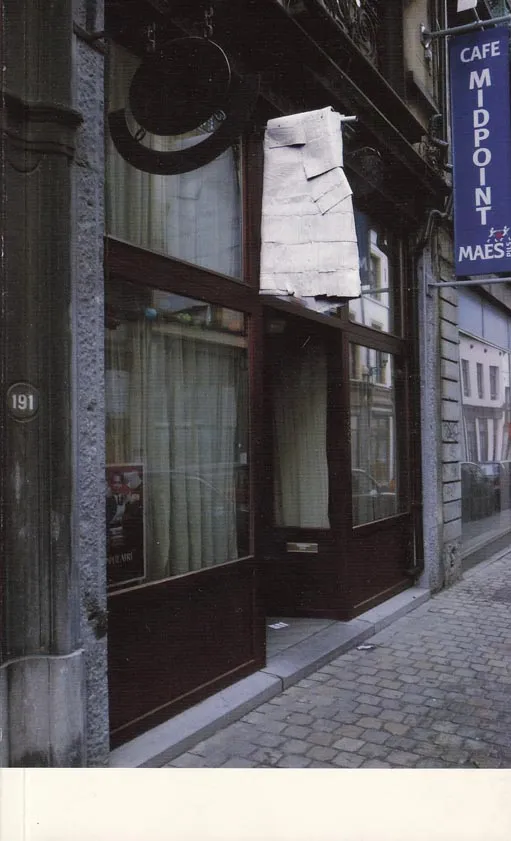
Cover of Midpoint Cafe

Théophile

Midpoint Cafe

Various

€10.00

This book portrays a slice of the history of Midpoint Café and Bar in Brussels from 2011 until today, through interviews with one of its owners and a few of the regulars.

Midpoint is a book of interviews with Fatma Arar, Nick Bastis, Carles Congost, Gro Gravås, Jean-Paul Jacquet, Lars Laumann, Stefanie Snoeck, Harald Thys and Margot Vanheusden.

Edited by Laure Charles, Alberto García del Castillo, Louise Osieka and Marnie Slater.

Language: English

recommendations

Cover of Artistes typographes

Tombolo Press

Artistes typographes

Various

Artistes typographes (Artists as typographers) is a visual corpus that brings together one hundred and thirty-two artists' books collected and reproduced as part of an artistic residency conducted at the Centre des livres d'artistes (Saint-Yrieix-la-Perche). This compilation of images demonstrate the interest of some figures of the art field for the substances of the book object. They show singular compositions and other typographic details: handwritten letters, character designs, stamps, logotypes.

Featuring Jean-Michel Alberola, John Baldessari, Christian Boltanski, Jean-François Bory, Broutin, Pol Bury, Philippe Cazal, Ulises Carrión, Henri Chopin, Claude Closky, Joëlle de la Casinière, herman de vries, Hamish Fulton, Jochen Gerz, Raoul Hausmann, Simone Forti, Paul-Armand Gette, Dick Higgins, Isidore Isou, Joseph Kosuth, Edmund Kuppel, La Monte Young, Pascal Le Coq, Jean Le Gac, Lefevre Jean Claude, Claude Lévêque, Mario Merz, Annette Messager, Jean-Claude Moineau, Matt Mullican, Maurizio Nannucci, Clemente Padín, Dieter Roth, Claude Rutault, Seth Siegelaub, Roman Signer, Harald Szeemann, Ernest T., Ben Vautier, Bernard Villers, Wolf Vostell, Martha Wilson...

Cover of Miam 08 : Artefact

Miam Editions

Miam 08 : Artefact

Various

"Cet ouvrage est un magazine participatif regroupant les oeuvres de 48 artistes autour d'un thème commun, l'artefact. Vertige du passé ou projection contemporaine, l'artefact nous parle. Il raconte les cultures, en façonne le souvenir et promet ainsi un voyage à travers les créations humaines. Ce sont ces témoignages tangibles de l'existence que nous souhaitons vous offrir grâce aux interprétations captivantes de l'artefact. Chaque page de ce nouveau numéro est une invitation à plonger dans les méandres de l'histoire ou de la fiction, à explorer les différentes strates de l'humanité à travers le primes de ses réalisations matérielles."

Alexandre Daram, Alice Royer, Audrey Poujoula, Audrey Ramos, Basile, Bordel j’ai glissé, Cel, Charlie Udave, Collectif IPN, Elliott Sanchez, Emilia Pesty, Marie Derrien, Fils Kurylak, Flora Rushiti, Hélène Berlemon, Inès Day, Julie Plantefeve, Kaspar kaspar.wtf, Kawani DS, Kiara Patry, Laura Zanti, Lauriane Rolo, Le Bayou Club Graphique, Lea Canovas, Lili Archer, Lily Terrible, Lisa Dehove, Lola Marty, Louis Kervel, Lutine Cabarrou, Maeva Iorio, Maké, Martin Régnier, Maxoy, Meuneurol, Nathanael Brelin, Nurzen & Jack Montaly, Oscar, Pierre Touron, Ptit Lylou, Rachel Roland, Rose Meybeck, Sarah Josserand, Theo Grandchamp. 

Cover of How to Sleep Faster 2

Arcadia Missa

How to Sleep Faster 2

Various

Periodicals €12.00

How to Sleep Faster 2 is the second of our biannually published journals that form the backbone of Arcadia Missa’ critical collaborative discourse on participation, post-digital visual-production and institutional subjectivity.This issue explores moments of collapse, shift and potential in a cultural moment framed by economic, political and societal disturbance.

Arcadia Missa Publication; eds Rozsa Farkas, Tom Clark et al.

Cover of Miam 09 : Les oiseaux ne chantent pas : ils crient de douleur

Miam Editions

Miam 09 : Les oiseaux ne chantent pas : ils crient de douleur

Various

4SPIKE & howawfulallanis, Alex Less, Alice Royer, Alligataure, Amelie Clicquot, Anjol, Arañada, Axel Fievet , Axelle Bourguignon, Baron & Tosma, Charlie Cooper, Charlotte Sallan Gémard, Délora Abbal, Elliott Sanchez, Erimoczi, femo, Fleur Douglas, Gaia Bergelin & Inès Camrla, Justine Bouvet, Kara, Kiara Patry, Lilian Magardeau & Elisa Grondin, Loreleï, Lucile Moreau, Manon Souza, Marie Martin Design, Mira, Migraine, Nathan Peron, Nathanael Brelin, Nomaison, Ema Tomas, Othilie Jourde Ledoux, Piquico , Rémy Bellariva, Séraphin Degroote Ferrera et Arthur Diguet, Syan Fischer, Tanikawa Sari, Vanessa Kintzel, Virginie Contier, Viviane Le Borgne, Zoé Vincent. 

Cover of How To Sleep Faster 9

Arcadia Missa

How To Sleep Faster 9

Various

Periodicals €10.00

The platform, free speech and contempt

Cover of The German Library Pyongyang

Sternberg Press

The German Library Pyongyang

Sara Sejin Chang

From December 11, 2015, until April 10, 2016, the German Library in Guangzhou, China, became The German Library Pyongyang, a reimagining of an initiative of the Goethe-Institut that originally operated in North Korea between 2004 and 2009. This temporary intervention by Sara van der Heide is an imaginary transformation of the current geography of the German Library in Guangzhou. Van der Heide’s project is a contemporary version of the Goethe-Institut’s original library initiative in North Korea, devised as a vessel to discuss national cultural policy in a post-Cold War and postcolonial era that looks critically toward the parallel histories of Germany and the two Koreas. The German Library Pyongyang offers a space for critical questions, but it also functions as a context for transcending thinking that is prescribed by the lines of the nation-state, language, and geography. The several artistic, linguistic, and graphic interventions in the library merge with the continuing activities of the German learning center in Guangzhou, and all institutional printed matter in Chinese is replaced by Korean.

This publication brings together the four original exhibition booklets in German, Korean, English, and Chinese. An additional reader is included with critical reflections as well as documentation of the exhibition and the organized seminar.

Design by Dongyoung Lee
English/German/Korean/Chinese

Cover of PRESCRIPTIONS: A Collection for Many Evils of the Body and the Mind, Also for Witchcraft

Hildegard Press

PRESCRIPTIONS: A Collection for Many Evils of the Body and the Mind, Also for Witchcraft

Lyndl Hall

PRESCRIPTIONS is a transcription of a handwritten manuscript, dated to approximately 1650, containing a wide range of medicinal and magical remedies. Currently housed in the Cornell University Witchcraft Collection, it is assumed this practical handbook was a reference for healing, midwifery, and other medical/magical advice. Recipes and instruction cover various methods of purging, ointments for swellings, fevers, and pain reduction, lotions for venereal disease, advice for childbirth, and dilemmas such as “worms in the ear.” Accompanying these medicinal prescriptions are a series of magical prescriptions: charms, rituals, and spells recorded to fortify the ailing body, induce amorous desire, or seek revenge.

With its mix of Latin words, Early Modern English parlance, colloquial plant names, apothecary weights, and archaic medical terms, the recipes can at first appear opaque, but with sustained engagement one can begin to decipher the logics and structures within the writer(s)' shorthand. The original manuscript, in having its own detailed glossary, index, and citations, exhibits a meticulous cataloging of knowledge and resources, and reveals an earnest desire to hold onto the integrity and sanctity of the body in the face of 'many evils.'

The transcription is accompanied by a glossary of terms, an explanation of the various apothecary measurements used, and expanded citations of the medicinal/magical treatises that were abbreviated within the original text.

Cover of I Am Abandoned

Primary Information

I Am Abandoned

Barbara T. Smith

Poetry €20.00

I Am Abandoned documents a little-known, but visionary performance by Barbara T. Smith. Taking place in 1976, it featured a conversation in real time between two psychoanalytic computer programs (known today as two of the earliest chatbots) alongside a staging of Francisco Goya’s The Naked Maja (1795–1800) and The Clothed Maja (1800–1807), in which the artist projected an image of the famous painting on top of a female model. The publication includes a full transcript of the “conversation” between the two programs; documentation and ephemera from the performance; Smith’s reflections on the night; and an afterword by scholar and artist Mashinka Firunts Hakopian.

I Am Abandoned was part of the exhibition The Many Arts and Sciences at the California Institute of Technology (Caltech) and rather than simply celebrate new technology, Smith also sought to challenge what she saw as a “built-in problem” that “computers were only a new example of the male hypnosis.” In collaboration with computer scientist Dick Rubinstein, she enlisted the computer science teams at Caltech and the Massachusetts Institute of Technology to mount a conversation between a program named DOCTOR, which was designed to be a surrogate therapist, and another named PARRY, which was trained to mimic a paranoid schizophrenic patient.

While the computer operator worked in the next room, each new page of the conversation was projected on the wall where a model dressed as The Clothed Maja reclined beneath the text, with a slide of the nude version of the same painting, The Naked Maja, projected onto her. The audience was rapt with attention for the livestreamed conversation. The performance went on for nearly two hours, before the model eventually grew furious from being ignored (abandoned) by the computer operator, stormed over, and attempted to seduce him. Shortly after, the gallery director pulled the plug on the entire event, claiming it distracted the audience for too long from the other works on view.

To revisit I Am Abandoned today is to see the artistic and truly liberatory potential that art can have when it intervenes in new technologies. Much like the original performance, in which the model grew alienated from the proceedings, what gradually emerges are the stakes these new technologies present. Against today’s backdrop of AI and a still male-dominated tech field, Smith’s early work with emerging technologies, and in this case chatbots, is prophetic and hints at the contemporary conversation around the gendered and racialized machinic biases of our current computational landscape. Though Smith, like many women of her generation, was overlooked by the landmark surveys of art and technology during the 1960s and 70s, her career incisively probed new technologies, using them to question gender dynamics, community, and self. Her projects from the Coffin books (1966–67), created with a 914 Xerox copier in her dining room, to performances like Outside Chance (1975), which created a small snow squall in Las Vegas out of 3,000 unique, computer-generated snowflakes, and the interactive Field Piece (1971), where participants’ movements altered the soundscape of a fiberglass forest, all exemplify her open-ended approach to art and tech. “Each person lit their own way,” Smith remembers, “And produced their own soundtrack.”

Barbara T. Smith is an important figure in the history of feminist and performance art in Southern California. Her work—which spans media and often involves her own body—explores themes of sexuality, traditional gender roles, physical and spiritual sustenance, technology, communication, love, and death. Smith received a BA from Pomona College in 1953, and an MFA in 1971 from the University of California, Irvine. There she met fellow artists Chris Burden and Nancy Buchanan, with whom she co-founded F-Space in Santa Ana, the experimental art space where many of her performances were staged. Smith’s work has been exhibited since the 1960s in solo exhibitions, at the Institute of Contemporary Art, Los Angeles (2024), the Getty Research Institute, Los Angeles (2023), and Pomona College Museum of Art (2005), and featured in group exhibitions, including how we are in time and space: Nancy Buchanan, Marcia Hafif, Barbara T. Smith, Armory Center for the Arts, Pasadena (2022), State of Mind: New California Art Circa 1970, Orange County Museum of Art, Santa Ana (2012); WACK! Art and the Feminist Revolution, Museum of Contemporary Art, Los Angeles (2007); and Out of Actions: Between Performance and the Object, 1949–1979, Museum of Contemporary Art, Los Angeles (1998). Smith is the recipient of the Nelbert Chouinard Award (2020), Civitella Ranieri Visual Arts Fellowship, Umbria, Italy (2014); Durfee Foundation’s Artists’ Resource for Completion (2005, 2009); Women’s Caucus for Art, Lifetime Achievement Award (1999); and several National Endowment for the Arts Grants (1973, 1974, 1979, 1985). The Getty Research Institute acquired Smith’s archive in 2014 and published her memoir, The Way to Be, in 2023. Her survey catalog, Proof: Barbara T. Smith was published by the Institute of Contemporary Art, Los Angeles in 2024.