Books
Books
in random order

Koreografi
Koreografi / Choreography is a magazine initiated and edited by Solveig Styve Holte, Runa Borch Skolseg and Ann-Christin Berg Kongsness. The magazine consists of texts written by Nordic artists within the field of dance and choreography.

Gardener of Stars
Carla Harryman describes GARDENER OF STARS as "an experimental novel that explores the paradise and wastelands of utopian desire." The book offers a mythic history of a post-historical city situated in a garden landscape whose inhabitants are engaged in perpetual tending, limitless generation. Their generatings and tendings take place in speculation and dream, practical and impractical invention, desire and copious sex - all facets of a politicized eros and an erotic politics. The utopia in question ("the unruly utopia of the senses that is not in conflict with the world's current") must be understood first not in terms of place but in terms of personage. M, Serena, Gardener (the eponymous heroine of the novel) are themselves utopias (as distinct from utopians) surviving in a painfully fraught (though sometimes beautiful) milieu. Negotiating this milieu, the various characters come into contact (or, more precisely, throw themselves into contact) with events that are in a ceaseless process.

Alphabet Soup
"Alphabet Soup" collects the sayings of two multilingual girls as written down by their poet father. As their Turkish-German-Russian-American family moves from New York to Berlin, the girls communicate in a witty and colorful language of their own, effortlessly mixing words of different origin. Does who we are determine the way we speak — or is it the other way around? Alphabet Soup shows us the girls’ language as it changes, letting us witness their metamorphoses from toddlers to teenagers.
With an essay and poems by the author.
A co-publication with Rab-Rab Press (Helsinki).

The Mollino Set
New York-based professor Lytle Shaw journeys to Italy in this adventurous exploration of the life and work of architect, designer, and photographer Carlo Mollino (1905–1973). In 1933 the young Mollino received a commission from Mussolini’s regime for his first building: an administrative centre in Piedmont. Later works include furniture and interior design, a book on photography, and an asymmetrical car that raced at Le Mans in 1955.
The book centres around Shaw’s realisation that this prolific talent’s conflicted legacy offers a unique window on the role that post-war Italian politics and culture played in the country’s reimagining of itself as a victim, rather than a proponent, of fascism.

Entangled – Texts On Textiles
What does it mean to be a curator who writes, and, more specifically, how can curators write about textiles? This publication steps outside the framework of the typical exhibition catalogue to occupy "the space between literature and criticism".
The Community of writers was set up to create time and space to retreat from these outside opinions and demands and to let curiosity and the joy of writing be the driving forces of the writing process. This book has been realised under the auspice of Interweaving Structures: Fabric as Material, Method, and Message, and specifically through collaboration between the Faculty of Fine Art, Music and Design at the University of Bergen and the Central Museum of Textiles in Łódź. The two partners have strong positions of specialisation—the museum acts as a caretaker of material textile traditions and art in Poland, and the faculty has a strong textile art tradition and offers the only education programme for curators in Norway.
Edited by Anne Szefer Karlsen.
Contributions by Andreas Hoffmann, Heather Jones, Martina Petrelli, Anne Szefer Karlsen, Lea Vene, Johanna Zanon.

Moi
The straplines of a number of advertisements drawn from magazines of the 1950s are turned into drawings, as though a particularly vain and narcissistic woman speaks (as of course she does), She is ‘en pleine forme’ of her beauty. (2016).

Life with Fifi
Kris Dittel, Angelica Falkeling
A children’s book without a specific age category, offering a glimpse into the small rituals and shared moments that shape a day with Fifi Paris.
Fifi, a Pomeranian-Chihuahua mix, came into the lives of Angelica and Kris a few years ago. Taking care of a puppy is taking responsibility for building their world and letting the small animal transform yours. As her human caretakers, the authors created Fifi’s world with toys, cuddles, rules, snacks and walks in the park. In return, she transforms our world by bringing our community together and reminding us of the importance of caring for one another. In this book, Kris and Angelica narrate a day in the life of Fifi, from the moment she wakes up to when she falls asleep at night. Along the way, they share how they connect with her, how they see her understanding her surroundings and what she has taught them about companionship.
Design by Amy Suo Wu
Copy-editing by Clem Edwards
Photography by Lili Huston-Hertreich

Wanderlust
Soufiane Ababri's sketchbooks.
Soufiane Ababri (b. 1985, Rabat) is a Moroccan artist based in France. His protean work (drawings, installations, performances) explores questions of gender, homosexuality, racism and colonialism.

Spike #86 – Salad Days!
Spike #86 is turning to the wild season of youth – life’s Salad Days.
Forget all the Boomer panic about a generational crisis; the kids are alright, living out our hyperconnected present to its strangest limits. New kinds of aesthetics, of activism, of entrepreneurship; new images as much as new perspectives on what images are; and, above all, a new, very quantum attitude towards fact and fiction, history and the future: young people are modeling how to be in our very confused times – and producing some of the most interesting forms of culture we’ve ever seen.
Featuring a Zoomer’s guide to the Slopgeneration; an essay of on being young at art in the Instagram age; a rundown of contemporary art’s nepo babies; reality checks on culture’s obsessions with youth and dying young; portraits of couture-sculptor Tenant of Culture, Turner Prize-nominated photographer Rene Matić, e-waste sculptor Brian Oakes, and Austrian painter Lukas Posch; send-ups of teenage fiction’s ecstatic weirdness and youth-quakers’ political promise; a critique from Silicon Valley of the industrialization of young risk-taking; art’s perfect Los Angeles metaphor; and a splash of back-page advice: “You shouldn’t be fun at twenty-one. You should be tortured.”

À perte de mère – Sur les routes atlantiques de l'esclavage
Saidiya Hartman traces the history of the Atlantic slave trade by recounting a journey she took along a slave route in Ghana. Following the trail of captives from the hinterland to the Atlantic coast, she reckons with the blank slate of her own genealogy and vividly dramatizes the effects of slavery on three centuries of African and African American history.
Saidiya Hartman, professor of English and comparative literature at Columbia University, is a scholar of African American literature and cultural history.
Preface by Maboula Soumahoro.
Translated from the English (American) by Maboula Soumahoro (original title: Lose Your Mother. A Journey Along The Atlantic Slave Route, Farrar, Straus and Giroux, 2007).

The Witch Studies Reader
Stories about witches are by their nature stories about the most basic and profound of human experiences—healing, sex, violence, tragedies, aging, death, and encountering the mystery and magic of the unknown. It is no surprise, then, that witches loom large in our cultural imaginations. In academia, studies of witches rarely emerge from scholars who are themselves witches and/or embedded in communities of witchcraft practitioners. The Witch Studies Reader brings together a diverse group of scholars, practitioners, and scholar-practitioners who examine witchcraft from a critical decolonial feminist perspective that decenters Europe and departs from exoticizing and pathologizing writing on witchcraft in the global South. The authors show how witches are keepers of suppressed knowledges, builders of new futures, exemplars of praxis, and theorists in their own right. Throughout, they account for the vastly different national, political-economic, and cultural contexts in which “the witch” is currently being claimed and repudiated. Offering a pathbreaking transnational feminist examination of witches and witchcraft that upends white supremacist, colonial, patriarchal knowledge regimes, this volume brings into being the interdisciplinary field of feminist witch studies.
Contributors: Maria Amir, Ruth Asiimwe, Bernadette Barton, Ethel Brooks, Shelina Brown, Ruth Charnock, Soma Chaudhuri, Carolyn Chernoff, Saira Chhibber, Simon Clay, Krystal Cleary, Adrianna L. Ernstberger, Tina Escaja, Laurie Essig, Marcelitte Failla, D Ferrett, Marion Goldman, Jaime Hartless, Margaretha Haughwout, Patricia Humura, Apoorvaa Joshi, Govind Kelkar, Oliver Kellhammer, Ayça Kurtoğlu, Helen Macdonald, Isabel Machado, Brandy Renee McCann, Dev Nathan, Mary Jo Neitz, Amy Nichols-Belo, Allison (or AP) Pierce, Emma Quilty, Anna Rogel, Karen Schaller, Jacquelyn Marie Shannon, Shashank Shekhar Sinha, Gabriella V. Smith, Nathan Snaza, Shannon Hughes Spence, Eric Steinhart, Morena Tartari, Nicole Trigg, Katie Von Wald, Tushabe wa Tushabe, Jane Ward

Honey Volume 2
Mars Dietz, Opashona Ghosh and 1 more
HONEY is a zine meditating on the experiences of friendship.
Volume 2 was edited by Mars Dietz, Opashona Ghosh and Dylan Spencer-Davidson—each inviting contributions from friends.
Following vol. 1’s optimism about the underappreciated potentials of friendship, vol. 2 marks a noticeable turn towards friendship's messier sides. Letters to deceased friends, childhood social complexities, unrealised sexual desire, pushback against the overfetishisation of queer kinship, and more.
Contributions from Azul De Monte, Ana Božičević, D Mortimer, Adriana Disman, Pelumi Adejumo, Iggy Robinson, Clay AD, To Doan, Edward Herring, marum, Lou Drago, Aisha Mirza, Iga Świeściak, Roya Amirsoleymani, George Lynch, Emily Pope and Kari Rosenfeld.
Original artworks by Opashona Ghosh and Iga Świeściak, and featuring artworks by Azul De Monte and Emily Pope.
Riso printed on recycled paper with Pagemasters (London).

The Stone House
A vivid, haunting tale of intergenerational trauma and survival under Israeli occupation.
A New Arab Book of the Year 2021.
The year is 1968. The recent Arab defeat in the Naksa has led to the loss of all of historic Palestine. In the midst of violent political upheaval, Mahmoud, a young Palestinian boy living in the Galilee, embarks on a school trip to visit the West Bank for the first time.
For Mahmoud, his mother and his grandmother, the journey sets off a flood of memories, tracing moments that bond three generations together. How do these personal experiences become collective history? Why do some feel guilty for surviving war? Is it strange to long for a time never lived?
In this groundbreaking novella, Yara Hawari harnesses the enduring power of memory in defiance of the constrictions on Palestinian life. Against a system bent on the erasure of their people, the family’s perseverance is unbroken in the decades-long struggle for their stone house.
Yara Hawari is a Palestinian writer and political commentator. She completed her PhD in Middle East Politics at the University of Exeter, where her research focused on oral history and Indigenous Studies. She currently works as a senior analyst at Al-Shabaka, a Palestinian think tank. The Stone House is her first book.

Things Bigger Than What Can Be Seen
Things Bigger Than What Can Be Seen is a collection of Oraib Toukan’s essays, translated to Arabic for the first time. In close dialogue with Palestinian pedagogue Munir Fasheh on the topic of turbeh (local soil in Arabic), Toukan crafts a haptic perspective on images from what she terms their ‘soil grain’.

The Error is Regretted
‘Corrections and Clarifications’ is an ongoing newsprint project by Anita Di Bianco, an edited compilation of daily revisions, retractions, re-wordings, distinctions, and apologies to print news from September 2001 to the present. In essence, a reverse chronological catalogue of lapses in naming and classification, tangled catchphrases, and patterns of misspeak and inflection.
Previous editions have examined the printed news media in the United States and United Kingdom, Germany, Austria and Switzerland, and other international press from Asia, Turkey, and the Balkans printed in English. The publication includes text contributions by Di Bianco and Francesco Gagliardi.
108 p, ills bw, 24 x 32 cm, hb, German/English

The Hajar Book of Rage
Rage is not just a feeling—it’s fuel.
The Hajar Book of Rage ignites the first spark in the elements anthology series, harnessing the primordial force of fire as a fury that destroys and transforms. Bringing together fiction, poetry and essays by writers of colour, this Fire-themed collection delves into the fierce, animating power of rage as a catalyst for revolutionary change.
Here, rage teaches. It reveals what we’re fighting against and what we’re fighting for. It mobilises us into action, rouses our ideals and refuses to let us compromise. And it is unruly and consuming—a blaze that resists containment.
This is a searing tribute to the fires of anger that fuel our resistance and burn down the worlds that cannot hold us.
The Hajar Book of Rage is the first book in elements, a series by Hajar Press on the politically transformative power of Fire, Earth, Water and Air.

Pervert or Detective?
Artists Reba Maybury and Lucy McKenzie dissect power and desire in a provocative conversation that probes the material erotic, appropriation, and sex.
In Pervert or Detective?, artists Reba Maybury and Lucy McKenzie dissect power, desire, and subversion in a provocative conversation. Maybury, who integrates her work as a political dominatrix into her artistic practice, manipulates dynamics of control, compelling her male submissives to create art under her direction, only to claim it as her own. Through confession and humiliation, she dismantles notions of authorship, masculinity, and labor. McKenzie, known for her intricate trompe l’oeil paintings and conceptual installations, similarly blurs boundaries—between art and commerce, and authenticity and illusion. Her work challenges power structures and exposes the unstable nature of representation.
Maybury and McKenzie, through an expansive discussion with French art critic Marie Canet, interrogate the logic of seduction and domination, pushing against rigid binaries to probe the material erotic, appropriation, and transformation. With an introduction by curators Fredi Fischli and Niels Olsen, an afterword by writer Susan Finlay, and extensive reading and viewing lists, Pervert or Detective? offers a compelling exchange between artists committed to unsettling the familiar and redefining artistic agency.
Introduction by Fredi Fischli and Niels Olsen
Afterword by Susan Finlay

TIME
TIME by Spencer Longo is a collection of printed work depicting government raids, religious visions, environmental catastrophe, and extremist fundamentalism tangled together in a narrative web of salvation, annihilation, and transcendence. Using pen plotter graphics directly on uncollated pages of Time magazine, Longo explores the conspiratorial trope that messages are secretly embedded in mass media, coaxing our millenarian anxieties out through an additive printing process using graphics from survivalist publications, end-times evangelical cartoons, and marginalia from the borders of underground occult material, all sprinkled with ecstatic bursts of star-spangled clipart. A must-have for your fallout shelter's library.

Country Lesbians
A bootleg of the first edition of Country Lesbians, published by WomanShare Books in 1976. It was printed in the context of a 2024 exhibition at Shmorévaz, a Paris-based independent art space, dedicated to the WomanShare collective, taking the book as its starting point, and borrowing its title.
WomanShare Collective is Sue Deevy, Billie Miracle, Nelly Kaufer, Carol Newhouse and Dian Wagner.
Co-published by Ness Books and Shmooks
Graphic design: Espace Ness
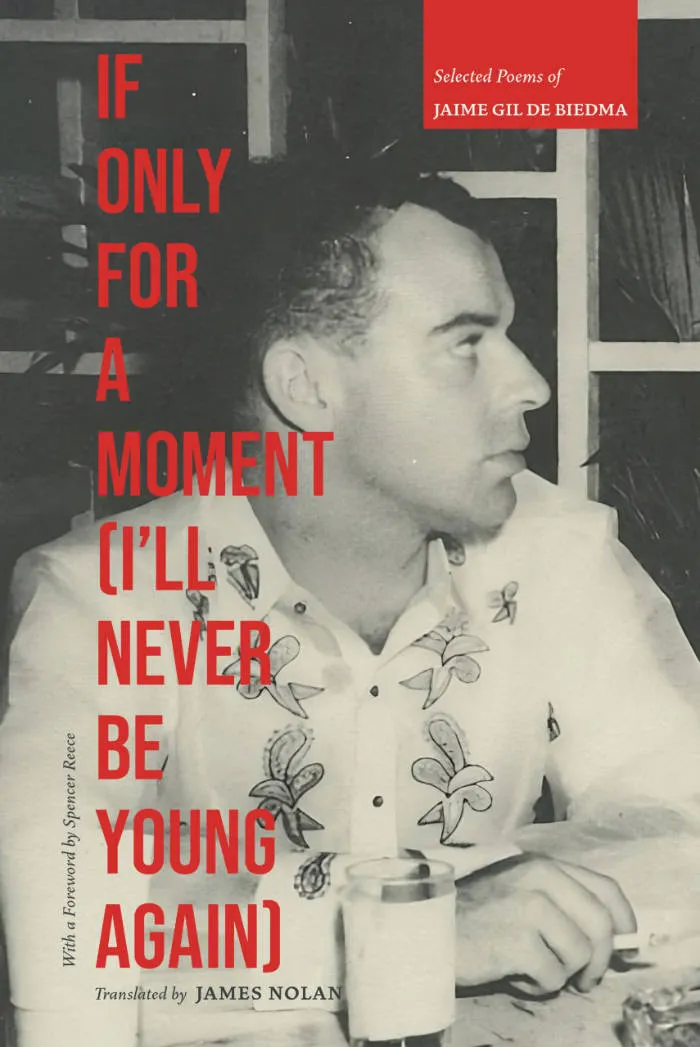
If Only For a Moment (I’ll Never Be Young Again)
Jaime Gil de Biedma, James Nolan
Jaime Gil de Biedma is the most original and influential among the poets known as the ‘50’s Generation in Spain, and is considered the greatest Spanish poet to emerge in the second half of the 20th century. His life and literary career were bracketed almost entirely by the rise and fall of Generalissimo Francisco Franco, notorious for the suppression of literature. Born in 1929, Gil de Biedma was six years old when García Lorca was murdered in Granada at the outbreak of the Civil War, and his collected poems, Las personas del verbo, first appeared in 1975, the year Franco died. What is surprising is that Gil de Biedma was a leftist, homosexual poet from the Catalan capitol, Barcelona – all of Franco’s favorite things – who not only published books of autobiographical poetry in Spain but was known as a poet of social conscience as well as erotic lyricism. Like other Spanish poets of his time, he chose his words carefully. Gil de Biedma died of AIDS in 1990.
If Only For a Moment (I’ll Never Be Young Again) consists of an extensive bilingual selection of Gil de Biedma’s poetry, including all of his most well-known work. The book additionally consists of a Foreword by Spencer Reece, Jaime Gil de Biedma’s short essay “I wanted to be the poem,” and two different essays on Gil de Biedma and the art of translation by James Nolan, the volume’s translator.

Time has fallen asleep in the afternoon sunshine
Appendix #2 - How to organize a library
Mette Edvardsen, Léa Poiré and 1 more
The Appendixes #1–4 is an editorial series by Mette Edvardsen, Léa Poiré and Victoria Pérez Royo that developed out of the project Time has fallen asleep in the afternoon sunshine. For a two-year residency at Les Laboratoires d’Aubervilliers* (2022–23), they came together as a small work group, shaping the work process, hosting presentation formats and making this publication series on paper as four cahiers.
The cahiers comprise a collection of commissioned texts and contributions created for this context, selected documents and traces from work sessions and encounters organized during their residency, texts read together and republished for this occasion, a collection of references, notes in progress, unfinished thoughts and loose fragments – on paper, between pages.
The Appendixes are organized around four themes: (1) The gesture of writing, (2) How to organize a library, (3) Orality and (4) Translation. In addition to being published on paper, the editorial series also consisted of other formats of presentations, exchanges and meetings organized as workshops, fieldwork, performances, conferences, collective readings and oral publications, taking place during their residency at Les Laboratoires d’Aubervilliers and in the vicinity.

Salvage: Readings from the Wreck
Dionne Brand explores English and American literature, and the colonial aesthetic that shaped her sense of self and the world, of what was possible and what was not.
In Salvage: Readings from the Wreck, Dionne Brand’s first major book of nonfiction since her classic A Map to the Door of No Return, the acclaimed poet and novelist offers a bracing look at the intersections of reading and life, and what remains in the wreck of empire. Blending literary criticism and autobiography-as-artifact, Brand reads Aphra Behn’s Oroonoko, Daniel Defoe’s Robinson Crusoe, and Jane Austen’s Mansfield Park, among other still widely studied works, to explore encounters with colonial, imperialist, and racist tropes from the seventeenth to the nineteenth centuries—tropes that continue in new forms today. Brand vividly shows how contemporary practices of reading and writing are shaped by the narrative structures of these and related works, and explores how, in the face of this, one writes a narrative of Black life that attends to its own consciousness and expression.
With the power and eloquence of a great poet coupled with the rigor of a deep and subtle thinker, Brand reveals how she learned to read the literature of two empires, British and American, in an anticolonial light—in order to survive, and in order to live.
This is the library, the wreck, and the potential for salvage she offers us now, in a brilliant, groundbreaking, and essential work.

Textes à lire à voix haute
A collection of texts by fifteen contemporary Brazilian authors who approach the notions of care and privilege from a transfeminist, anti-racist and decolonialcritical perspective.
Edited by Diane Lima, Cíntia Guedes, abigail Campos Leal.
Texts by Ricardo Aleixo, Pacha Ana, Castiel Vitorino Brasileiro, Monna Brutal, Rebeca Carapiá, Pêdra Costa, Ingrid Martins, muSa Michelle Mattiuzzi, Jota Mombaça, tatiana nascimento, Elton Panamby, Grace Passô, Miro Spinelli, Preto Téo, Lucas Veiga.
Translated from the Portuguese (Brasil) by Luana Almeida, Valentina D'Avenia, Léa Meier, aurore/a zachayus.

Local Warming
For Sebastian Black, 2020 was a year like no other: a pandemic; three exhibitions; a move to Los Angeles; a presidential election; a baby, too. Local Warming is Black's tale of it all, as recorded in his diary.
One million years ago, when I started making the paintings compiled here, I was listening to lots of audiobooks and recorded philosophy lectures. It was the winter of 2019, my paintings were about this and about that, and every brushstroke drifted safely over a net of ideas. I was gathering a list of things that I knew to be true because I was sick of having nothing to say when people asked me to explain myself. Then a professor, who to me is now a holy exegete, said that difference precedes identity as the substance of reality. I'd been eavesdropping on YouTube as he taught a continuing-ed class on Deleuze for a claque of narrative therapists. Difference before identity. I couldn't grasp the idea— only touch it. That's okay, said the professor, as though speaking directly to me, the point of thinking isn't to grasp things that are true but rather to prod things that are interesting. — Sebastian Black
Sebastian Black is an artist/writer. He was born in New York City in 1985. He lives and works in Los Angeles.