rile*books

Search books

Search books by title, author, publisher, keywords...

Cover of Things Bigger Than What Can Be Seen

Archive Books

Things Bigger Than What Can Be Seen

Oraib Toukan

€20.00

Things Bigger Than What Can Be Seen is a collection of Oraib Toukan’s essays, translated to Arabic for the first time. In close dialogue with Palestinian pedagogue Munir Fasheh on the topic of turbeh (local soil in Arabic), Toukan crafts a haptic perspective on images from what she terms their ‘soil grain’.

Published in 2026 ┊ 256 pages ┊ Language: English, Arabic

recommendations

Cover of Mud … and the Earth System

Archive Books

Mud … and the Earth System

Rikke Luther

Non-fiction €22.00

Mud … and the Earth System explores groundbreaking research in Earth system sciences and highlights the challenges of communicating these findings to the public.

As once-stable “mudscapes” transform, they become both symptoms and symbols of a rapidly warming planet. This book delves into humanity’s connection to these changes through the study of ancient organic and inorganic compounds that have come alive after millennia. It poses essential questions about what these evolving ‘mud’ compounds reveal about Earth’s deep past and our imminent future.

Born from collaborative research led by artist Rikke Luther at the Interdisciplinary Research of Ocean, Climate and Society (ROCS) at the University of Copenhagen in collaboration with Earth scientist, Professor Katherine Richardson, this publication showcases how artistic practices – such as image-making, conceptual mapping, and filmmaking – enhance scientific representation.

Mud… and the Earth System features commissioned essays from experts in Earth Science, Political Aesthetics, and Molecular Geobiology. The book pairs their insights with compelling artwork, including large-scale maps of emerging ‘mudscapes’ in Svalbard, Iceland, Greenland, and Gotland.

The essays give perspectives on the DNA that is collected and stored in mud, which connects life across timescales as an evolutionary resource framing the interactions of human societies with the extreme complexities of the Earth system. Esther Leslie’s “Mud Crystal and Polar Thinking” sets the scene, followed by Karina K. Sand’s “Death and Life:  in Mud: Two Million Years in a Split Second,” and Earth scientist Katherine Richardson’s contribution “A Muddy Diary.”

As Richardson sums up, “Mud is an important medium for storing the archives that describe the history of both life and climate on Earth, and we are only just beginning to understand the fantastic stories that mud can tell.”

Contributions by Esther Leslie, Rikke Luther, Katherine Richardson, Karina Sand

Cover of How to Die – Inopiné

Archive Books

How to Die – Inopiné

Ashkan Sepahvand

Ecology €28.00

A transdisciplinary investigation and a choreographic performance, between Umeå and Oslo, about ecological grief, cultural panic, and a feeling of collapse.

How to Die – Inopiné is a performance and a practice. It thinks through, in an embodied manner, the prevailing contemporary moods of ecological grief, cultural panic, and collapse. As a performance in a theater or outdoors, an audience encounters five dancers who are constantly building, unbuilding, and rebuilding. Afterwards, stories are told around a bonfire. As a practice in the studio, school, or street, a group of dancers, artists, writers, and architects meet for a year of residencies between Oslo and Umeå. They host a working process and encounter external informants. The goal is to displace oneself into the unexpected. This publication, two years in the making, engages with the challenges of translating a choreographic process into the space of a book. It both documents the project's development as well as offering the reader-doer different modes of thinking-doing, from somatic practices to proposals for a curriculum. Experiments in writing, mapping, and moving are played with, all engaging with the question, "what is the future of displaced thinking?"

Published following the series of eponymous events held in Umeå, Oslo, Bergen, Trondheim and Reykjavik in 2019-2020.

Contributions by Harald Becharie, Mia Habib, Jassem Hindi, Asher Lev, Marie Kraft Selze, Namik Mačkić, Ingeborg Olerud, Anna Pehrsson, Ashkan Sepahvand, Nina Wollny.

Cover of Sustaining the Otherwise

Archive Books

Sustaining the Otherwise

Amal Alhaag, Selene Wendt

Non-fiction €25.00

Sustaining the Otherwise is a collaborative research and artistic project about restitution, reparation and transformation taking place in multiple locations over several years. Initiated and conceptualized by researchers and curators Amal Alhaag & Selene Wendt, it offers a space for artists, activists, scholars and writers to be in dialogue and to explore the topic of restitution in relation to both material and immaterial culture, through a program that frames restitution within the context of contemporary art practice.

Edited by Amal Alhaag & Selene Wendt

Featuring an introduction by Amal Alhaag & Selene Wendt as well as provocations, reflections, and essays by Barby Asante, Michael Barrett, Quinsy Gario, Sana Ginwalla, Aude Christel Mgba, Lennon Mhsishi, Ogutu Muraya, in addition to a sonic contribution by Robert Machiri. 

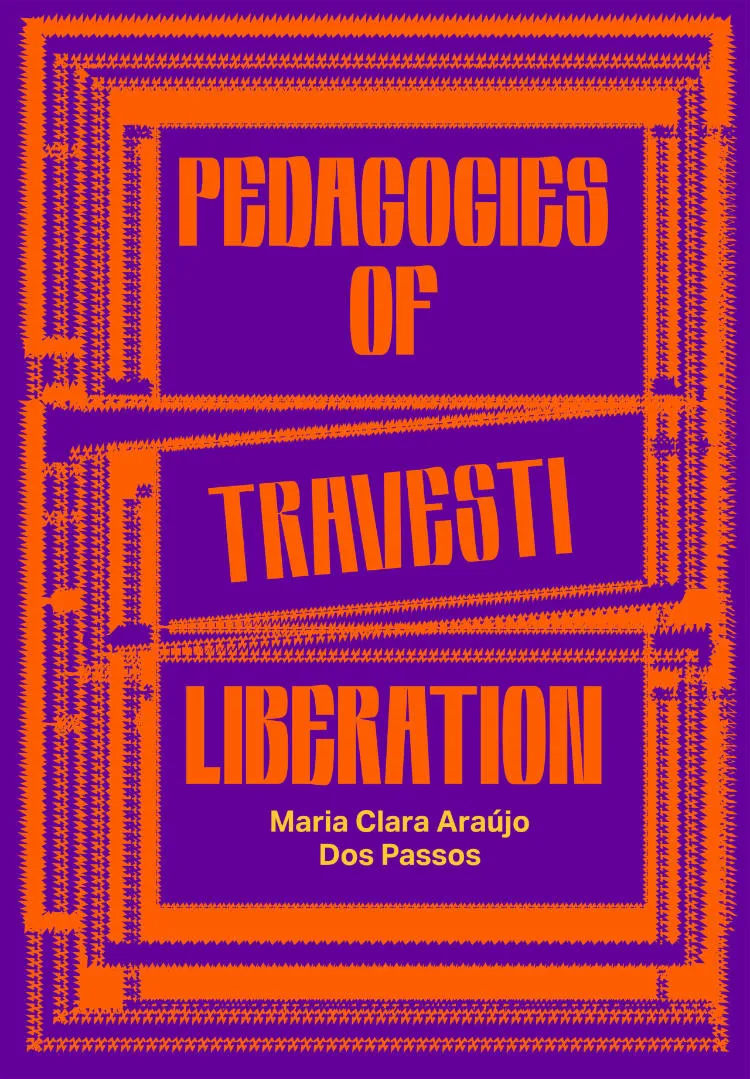
Cover of Pedagogies of Travesti Liberation

Archive Books

Pedagogies of Travesti Liberation

Maria Clara Araújo dos Passos

Essays €15.00

Maria Clara Araújo dos Passos examines the interplay of education, identity, and liberation in Brazil's travesti community.

In Pedagogies of Travesti Liberation, Maria Clara Araújo dos Passos critiques traditional pedagogical frameworks that marginalize gender nonconforming narratives and highlights the effects of systemic discrimination on travestis' psychosocial well-being. The book advocates for inclusive educational practices and emphasizes the need for affirmative curricula.
Newly translated from Portuguese, this work contributes towards connecting political struggles globally and navigating the complexities of translation—particularly of the term "travesti"—across various geographical and political contexts, featuring a conversation between Araújo dos Passos and translator Natália Affonso.

Maria Clara Araújo dos Passos (born 1996 in Recife) is a Brazilian Afro-transfeminist educator and sociologist, and an activist for LGBT rights.

Cover of Afghanistan

Archive Books

Afghanistan

Farid Rahimi, Luca Cerizza

Afghanistan is my father’s homeland. He was born in Kabul in 1945 and later moved first to France, then to Switzerland in the 1970s. In my mind, Afghanistan exists as a geography with blurred edges, something I feel the need to reconcile with. It’s a place I’ve only ever known through stories, a source of memories that, over time, have shifted and become distorted.

Contributors: Luca Cerizza, Farid Rahimi, Said Rahimi, Susanna Ravelli, Francesca Recchia, Zafar Sayan, and Dawood Tawana

Cover of Of Planters; an Herbarium

Birthday, Felony & Fuss

Of Planters; an Herbarium

COUR

Ecology €28.00

Published in tumult of “Planters, a garden show” by COUR: with Noëmi Orgaer, Orson Van Beek, Charlotte Bombel, Moreno Schweikle, Shun Yoon, Yen Proesmans, Benny Van den Meulengracht-Vrancx, HansWuyts, Malte van der Meyden, Fritz Adamski, Hannah Kuhlmann, Delphine Lejeune, Grażyna Mielech and Giseok Kim. 

Cover of Look at Hazards Look at Losses

Mute

Look at Hazards Look at Losses

Marina Vischmidt, Danny Hayward and 1 more

Look at Hazards, Look at Losses developed out of a series of conversations, exchanges and visits between kuda.org, Anthony Iles and Marina Vishmidt over 2015-2017 through which different approaches to common problems of cultural production in early-21st century Europe and its peripheries were debated and conceptually probed. Setting out from Theodor W. Adorno’s concept of ‘the aesthetic relations of production’ these discussions proceeded to explore problems bearing upon organisation in small groups in the field of culture, philosophical idealism and materialism, poetry, error and crisis.

The anthology assembled reflects these concerns through engagement with the writing of others who have helped orientate us through these discussions. The book which is the outcome consists of seven original contributions by poets and theorists which attempt to move toward new political interventions in culture and beyond ‘crisis as a way of life’.

Cover of For the Sun After Long Nights: The Story of Iran's Women-Led Uprising

Pantheon Books

For the Sun After Long Nights: The Story of Iran's Women-Led Uprising

Fatemeh Jamalpour, Nilo Tabrizy

Non-fiction €30.00

In September 2022, a young Kurdish woman, Mahsa Jîna Amini, died after being beaten by police officers who arrested her for not adhering to the Islamic Republic’s dress code. Her death galvanized thousands of Iranians—mostly women—who took to the streets in one of the country’s largest uprisings in decades: the Woman, Life, Freedom movement. 

Despite the threat of imprisonment or death for her work as a journalist covering political unrest, state repression, and grassroots activism in Iran—which has led to multiple interrogation sessions and arrests—Fatemeh Jamalpour joined the throngs of people fighting to topple Iran’s religious extremist regime. And across the globe, Nilo Tabrizy, who emigrated from Iran with her family as a child, covered the protests and state violence, knowing that spotlighting the women on the front lines and the systemic injustice of the Iranian government meant she would not be able to safely return to Iran in the future. 

Though they had met only once in person, Nilo and Fatemeh corresponded constantly, often through encrypted platforms to protect Fatemeh. As the protests continued to unfold, the sense of sisterhood they shared led them to embark on an effort to document the spirit and legacy of the movement, and the history, geopolitics, and influences that led to this point. At once deeply personal and assiduously reported, For the Sun After Long Nights offers two perspectives on what it means to cover the stories that are closest to one’s heart—both in the forefront and from afar.

Cover of Discipline Park

Wendy's Subway

Discipline Park

Toby Altman

Non-fiction €18.00

Toby Altman’s Discipline Park documents the demolition of Prentice Women's Hospital in Chicago, a landmark of architectural brutalism designed by Bertrand Goldberg in the 1970s. Altman was born in the building, and years later, was employed by Northwestern University when they tore it down. His personal proximity to the site leads to a wider critical evaluation of the cruelty of a neoliberalism that asks us to draw sustenance from the very institutions that poison and erase our bodies, habitats, and histories. But, as it indicts the present and its claustrophobic, ruinous politics, Discipline Park also recovers or reinvents utopian vistas through an extended engagement with Goldberg's architectural practices.

Cover of Lovebug

Peninsula Press

Lovebug

Daisy Lafarge

Non-fiction €17.00

In Lovebug, Daisy Lafarge explores metaphors of love and disease as she seeks to understand human vulnerability and our intimacy with microbial life.

Turning to microbiology, mysticism, and psychoanalysis – as well as the raw materials of love and life – Lafarge navigates the uncomfortable intimacy between the human body and the many bacteria, viruses, and parasites to which it is host.

Lovebug is a book about the poetics of infection, and about how we can learn to live with multispecies ambivalence. How might we forge non-phobic relationships to our ‘little beasts’? How might we rewild our imaginations? In weaving the personal with the pathological, Lovebug complicates the idea of coherent selfhood, revealing life as a site of radical vulnerability and an ongoing negotiation with limit.

"The pathogen arrives anyway and takes a seat at the table. Conditioned to welcome damage, I am curious about this uninvited guest. You must sit down, says Love, and taste my meat".