Books
Books
in random order

At the Full and Change of the Moon
Written with lyrical fire in a chorus of vividly rendered voices, Dionne Brand's second novel is an epic of the African diaspora across the globe.
It begins in 1824 on Trinidad, where Marie-Ursule, queen of a secret slave society called the Sans Peur Regiment, plots a mass suicide. The end of the Sans Peur is also the beginning of a new world, for Marie-Ursule cannot kill her young daughter, Bola, who escapes to live free and bear a dynasty of descendants who spill out across the Caribbean, North America, and Europe.
Haunted by a legacy of passion and oppression, the children of Bola pass through two world wars and into the confusion, estrangement, and violence of the late twentieth century.
"[Brand has] a lush and exuberant style that may put some readers in mind of Toni Morrison or Edwidge Danticat." — William Ferguson, The New York Times Book Review

Studies on Squats
Studies on Squats is an evocative exploration of embodied resistance and political movement that uses the multifaceted posture of the “Asian Squat” as a lens through which broader concepts of migration, illness, and resilience are examined. In Studies on Squats, the body—in its most vulnerable and potent states—becomes a speculative site for reclaiming agency by crafting new forms of protest that draw from ancestral strength, humor and eroticism. This posture, rich with cultural resonance, offers as an entry point to imagine ways in which the body can engage in acts of defiance against systems of oppression. Studies on Squats invites the audience to consider how dance and choreographic thinking can serve as tools for envisioning alternative futures, where artistry empowers those enduring systemic social injustices to transform their realities.

Stop Thief!: Anarchism and Philosophy
Many contemporary philosophers – including Michel Foucault, Jacques Derrida, and Giorgio Agamben – ascribe an ethical or political value to anarchy, but none ever called themselves an “anarchist.” It is as if anarchism were unmentionable and had to be concealed, even though its critique of domination and of government is poached by the philosophers.
Stop Thief! calls out the plundering of anarchism by philosophy. It’s a call that is all the more resonant today as the planetary demand for an alternative political realm raises a deafening cry. It also alerts us to a new philosophical awakening. Catherine Malabou proposes to answer the cry by re-elaborating a concept of anarchy articulated around a notion of the “non-governable” far beyond an inciting of disobedience or common critiques of capitalism. Anarchism is the only way out, the only pathway that allows us to question the legitimacy of political domination and thereby wfree up the confidence that we need if we are to survive.

Massive Massive Oil Slick
Expect anger. Expect joy, joy interspersed with anger, anger with joy, anger and joy in equal proportions, till joy is eclipsed by anger, or anger by joy. Expect decline. Expect steady and sudden decline, in fortune and wellbeing, a decline in wellbeing in places as far afield as Corby and Inverness, London, Manchester, and Yorkshire.
Massive Massive Oil Slick is a monologue written in sentences that begin with the verbs expect, suppose, and avoid, delivered in a seminar room of an unnamed institution. The audience is invited to participate in imagined scenarios: predicaments, thought-experiments, moral quandaries. Themes range from profound to mundane, serious to absurd: homelessness, drug trials, social exclusion, traffic, Brazil nuts, carveries, contact with extra-terrestrial life. The result is a prophecy, and the reader the central character through whom multiple futures are posited, dismissed, and revived.

Mela Roda Da Fortuna / Half Wheel of Fortune
An inscription of time at the coast, singing crows, albatrosses and seagulls. STOP. Extracted from the earth a whole alphabet. The waves uplifted countries and washed mountains until the storm came undone. The plantation of tobacco was maintained among the meadows and cafes flourished as the core of erudition, the power was theirs - you could see it in cinema- the actors spoke feverishly with enthusiasm, rather than breathless, meticulous and austere. The scars healed on mysterious skin that came out of the shadow to cross the day.


Dreaming Water
Dreaming Water is the most thorough monograph dedicated to the work of Chilean artist Cecilia Vicuña to date. Vicuña coined the term “Arte Precario” in the mid-1960s as a new category for her works composed of debris and structures that disappear in the landscape, and which also include her quipus (“knot” in Quechua), envisioned as poems in space.
Dreaming Water brings together over 200 works—including paintings, drawings, screenprints, collages, textiles, videos, photographs, installations, poetry, artist books and performances—created throughout the artist’s remarkable career. It also features several stimulating texts—a lengthy epistolary piece by curator and editor Miguel A. López as well as new essays by anthropologist Elizabeth A. Povinelli, curator Catherine de Zegher and art historian José de Nordenflycht. Vicuña herself contributes two texts, reflecting on her drawings from the “Palabrarmas” project and the activism of the group Artists for Democracy, which she cofounded in 1974. A rousing conversation between Vicuña, anthropologist Marisol de la Cadena and curator Camila Marambio also figures in the book, blending the artist’s voice with those who are experts in fields pertinent to her practice.

New Forms of Art and Contagious Mental Illness
Over the years 1919–20, the celebrated medical scientist and doctor Carl Julius Salomonsen began giving public lectures and publishing pamphlets regarding a new “epidemic” that had begun to affect the European populace: the increasing ubiquity of modernist art.
In a 1919 pamphlet titled New Forms of Art and Contagious Mental Illness, he wrote: “We stand, at this moment, before a movement in art which is psychopathic in character, and whose victorious journey through all countries is probably caused by the same spiritual disease that gave the older, religious spiritual epidemic such a powerful spread.” This pamphlet and the accompanying talks were countered by a retaliatory pamphlet published by members of Grønningen, a Copenhagen modernist painters group, to which Salomonsen responded with a further pamphlet.
Translated into English for the first time by literary theorist Andrew Hodgson, the entire altercation is gathered in this book, documenting one of the earliest rejections of modernist art.
Edited & Translated by Andrew Hodgson.

Les sous-communs – Planification fugitive et étude noire
A political and aesthetic critique of racial capitalism and modes of social experimentation in the form of resistance to the colonial commons.
Stefano Harney (born 1962) is Honorary Professor at The Institute of Gender, Race, Sexuality and Social Justice at the University of British Columbia and a Visiting Critic at Yale School of Art. He has held teaching positions in New York, Leicester, London, and Singapore. He now teaches at the Dutch Art Institute. An interdisciplinary scholar, his research spans (the intersections of) social sciences, arts and humanities, as well as the fields of business and management.
Preface by Jack Halberstam.
Collective translation (original title: The Undercommons: Fugitive Planning & Black Study, Minor Compositions, 2013).
Graphic design: Sophie Demay & Maël Fournier-Comte (In the Shade of a Tree).
published in February 2022
French edition
12,5 x 19,5 cm (softcover)
208 pages

Homie
Homie is Danez Smith’s magnificent anthem about the saving grace of friendship. Rooted in the loss of one of Smith’s close friends, this book comes out of the search for joy and intimacy within a nation where both can seem scarce and getting scarcer. In poems of rare power and generosity, Smith acknowledges that in a country overrun by violence, xenophobia, and disparity, and in a body defined by race, queerness, and diagnosis, it can be hard to survive, even harder to remember reasons for living. But then the phone lights up, or a shout comes up to the window, and family—blood and chosen—arrives with just the right food and some redemption.
Part friendship diary, part bright elegy, part war cry, Homie is the exuberant new book written for Danez and for Danez’s friends and for you and for yours.
& colin kaepernick is my president, who kneels on the air
bent toward a branch, throwing apples down to the children
& vets & rihanna is my president, walking out of global summitswith wine glass in hand, our taxes returned in goldto dust our faces into coins
& my mama is my president, her grace stuntson amazing, brown hands breaking brown bread overmouths of the hungry until there are none unfed & my grandma is my president
& her cabinet is her cabinetcause she knows to trust what the pan knowshow the skillet wins the war
—from “my president”

Index of Operational and Code Names
Le titre du livre « Index of operational and code names » reprend l'intitulé d'un document trouvé sur Internet constitué d'une liste de 437 mots anglais classés par ordre alphabétique et accompagnés de brèves indications concernant les opérations militaires pour lesquelles ces mots ont servi de noms de code.
Ce document a inspiré à Diane Guyot la série « Index War » réalisée selon un protocole simple consistant à produire un dessin pour chaque mot de la liste.
Composé de 86 dessins issus de cette série, certains reproduits pour le support du livre, d'autres présentés au sein d'un cahier photographique tels qu'ils sont aujourd'hui accrochés dans les intérieurs de leurs propriétaires, et d'une partie textuelle placée en fin de volume qui restitue l'intégralité du document source, le livre, comme le suggère la mention volume 1 qui accompagne son titre, ne marque pas le point d'achèvement de l'œuvre mais témoigne au contraire d'un processus en cours.
L'articulation des composantes de l'œuvre dans l'espace du livre en constitue en mème temps une nouvelle version, à la fois spécifique et autonome. L'activation du dispositif codex/index invite le lecteur à une méditation sur la notion de code, où s'entrecroisent sémiotique de l'image, technique de propagande et technologie de l'information.

Having a party (hope you will be there)
"Having a party (hope you will be there)", is a catalogue of an exhibition organized by Mickael Marman and D&TLG at CFAlive in Milan with artists from the black European diaspora, including original contributions, photos of the show, as well as a brand new intro text by Olamiju Fajemisin.
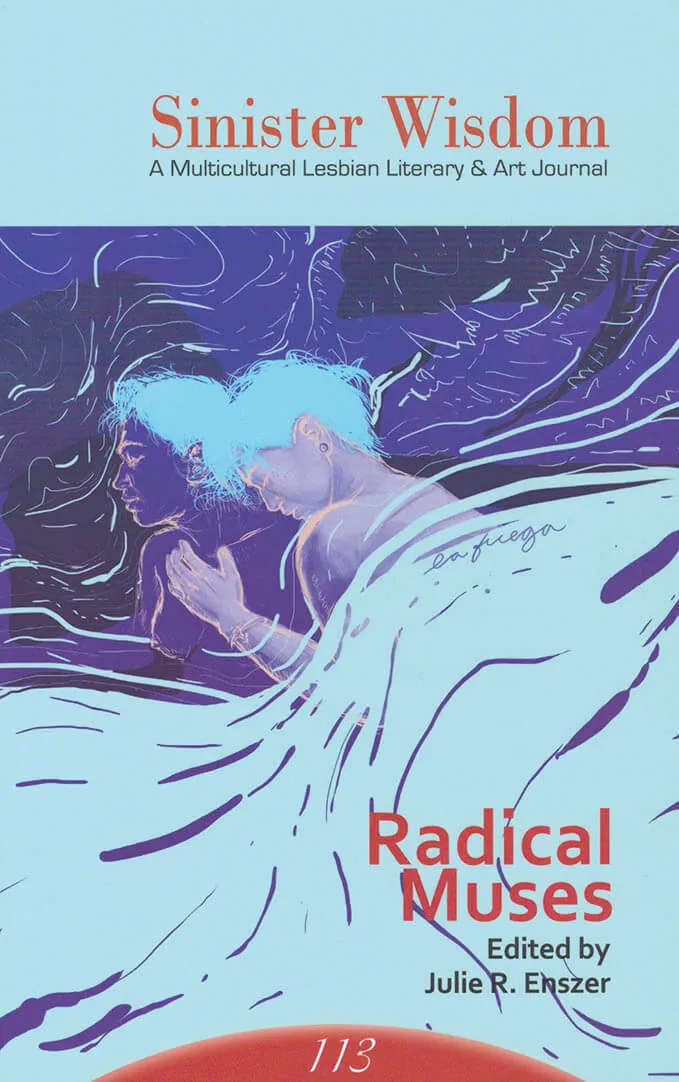
Radical Muses (Sinister Wisdom nr. 113)
Sinister Wisdom 113: Radical Muses features an eclectic array of contemporary poetry, prose, and art by lesbians from around the world, including new work by: Andrea Assaf, Tara Shea Burke, Cheryl Clarke, Marina Chirkova, Estela González, Barbara Haas, Nancy E. Lake, Vi Khi Nao, H. Ní Aódagaín and much more!

The Hormone of Darkness: A Playlist
In Tilsa Otta’s The Hormone of Darkness, we find a queer, Latinx person who has lived through iterations of authoritarian rule, and who answers these conditions by creating poetry that doubles down on a life force that precedes and exceeds received notions of the poetic. Here poetry is bawdy, fabulist, and spiritual—in short, it is alive. Otta has created a heaven where readers can go after they die.
Drawing from four volumes spanning Otta’s career, translator-poet Farid Matuk has curated a playlist we can dance and dream to, one that honors Otta’s drive toward liberation through both perreo in the club and transdimensional wandering among the stars.
We can go on like that forever
building paradise from our urges
out of our fetishes our loves our vices
How lucky
We’ll wait for you then
Don’t be too long
Bookmark the page
We’ll be Here
—From “The New Heaven”
Translated from the Spanish by Farid Matuk.

The History Of Breathing
In the tradition of poets such as Charles Olsen, Alice Notley and Sappho, Allison Grimaldi Donahues poetry connects the history of breath and language with narratives about the discovery and loss of our own voice.
The Etruscan language knew no blank spaces, no breaks between words—its texture resembled an uninterrupted flow of speech; more singing than speaking, form rather than content. Only in the dictum of the pause, the meaningful fragmentation of the breath and the staccato of the Atemwende (Paul Celan) does language become comprehensible rhythmic expression.
In a world full of slogans and catchphrases, Allison Grimaldi Donahue defends the poetological demand of Sound over Content! The History of Breathing weaves linguistics and poetry, verse and song, meaning and sound into a dense narrative about breathing, rhythm, and the gaps in language that allow words to take on meaning in the first place.
Allison Grimaldi Donahue (born 1984 in Middletown, Connecticut, USA, lives and works in Bologna, Italy) works in text and performance exploring modes in which language and text can move between individual and collective experience. She is author of Body to Mineral and On Endings, and translator of Blown Away by vito m. bonito and Self-portrait by Carla Lonzi. She has given performances at Short Theatre, Almanac Turin, MACRO, MAMbo, Fondazione Giuliani, Kunsthalle Bern, Hangar Biccoca, and Flip Napoli.

Archival Textures - (Re)claiming
The book (Re)claiming presents ways in which various queer and feminist communities and initiatives in the Netherlands have (re)claimed the triangle—along with other symbols, words and stories—and in doing so take up an empowering position in a hostile society.
Besides a collection of buttons, archival materials featured in this book include short statements and flyers by queer groups such as SUHO, Sjalhomo, Roze Front, Roze Driehoek, Roze Gebaar, Van Doofpot tot Mankepoot, Interpot/ILIS, Lesbisch Archief Amsterdam, Strange Fruit Vrouwen and Groep Zwarte Vrouwen Nijmegen, as well as a text by Karin Daan, the designer of the Homomonument in Amsterdam. With this selection, this book brings together queer, trans, crip, feminist, Jewish and Black perspectives on (re)claiming as an activist strategy.
Most of these materials were researched at IHLIA LGBTI Heritage in Amsterdam, with additions found at the International Institute of Social History and the International Archive for the Women’s Movement (IAV-Atria) in Amsterdam, and LAN Lesbisch Archief Nijmegen.

Glaring
Glaring: a sustained look of anger, an obvious fact, a situation of such brightness and intensity that vision is obscured. In his debut book of poems, Benjamin Krusling is concerned with reading domination and violence and entering their psychotic motion, the better to do otherwise. Through the thicket of anti-blackness, militarism, surveillance, impoverishment, and interpersonal abuse and violence, Glaring investigates the things that haunt daily life and make love difficult, possible, necessary.
Benjamin Krusling's Glaring is the winner of our 2019 Open Reading Period, and was selected by guest judge Lucy Ives.

Americón
Nico Vela Page’s Americón is a collection of poems in Spanglish that weaves a space for the queer, trans body to know the land, and itself, as extensions of each other. The land is the desert of Northern New Mexico, the forgotten Pan-American Highway, the space between our thighs, the quaking cordillera of Chile, the moans of elk, and the ripe fruit waiting to be picked. Through archive, attention, and erotic ecopoetics, Page’s debut collection of poems extends far across the page, the gender binary, language, and the Americas to find out who we are by asking where we are.

Fleshed Out For All The Corners Of The Slip
This major new work is thought, spirit and sense (in every sense) ‘fleshed out’ in ‘all the corners’ by being unmade – as poetry, as music, as (black and white) images, and as attention to the interconnected circuitries the One has with the social, historical and environmental ‘to / link us outside’. These elements are no sooner embodied than they slip, shift, carousel and spin away. As Goodwin puts it: ‘no longer a bodily reference to an individual subject’s presence; not obliterated but made into an element, air or breath, as black poetry’s condition of im/possibility for, and refusal of subjecthood.’ Hence it is that this poetry achieves ‘flightacross precipitous intransigence’ (Will Alexander), perhaps flights of manifestations of spirit, ‘ghostly crowned / apogees’, like duppies, which is to say, sacred. Hence too the work’s urgent task to avoid ‘thingification’: the conscription and exploitation of thought &/or body for neo-colonialist, which is to say, neo-liberal ends. Goodwin eschews identity politics for a phenomenology that is more properly radical in both the etymological sense of the term – rooted and vital to life – as well as situated within a history of experimental black thought which, simultaneously, rejects normative traditions of meaning, signification and value. Both meanings are central to the anti-racist core of this important work – ‘when i don’t know you but you must know who i am’ – in a poetry that’s as breath-taking as it is breath-making. ‘Inexpressibly full with what words can do’.
— Emily Critchley, author of Home (London: Protoype, 2021), Arrangements (Shearsman Books, 2018) and Ten Thousand Things (UEA: Boiler House Press, 2017)
James Goodwin is a poet doing a PhD in English and Humanities at Birkbeck, University of London with a thesis on the blacksociopoetics of marronage, breath, sacrality and emanation. His pamphlet, aspects caught in the headspace we’re in: composition for friends, was published by Face Press; and his debut book, Fleshed Out For All The Corners Of The Slip, is forthcoming with the87press. He serves on the Editorial Advisory Board for the Journal of British and Irish Innovative Poetry.

A Room of One's Own
In A Room of One's Own, Virginia Woolf imagines that Shakespeare had a sister—a sister equal to Shakespeare in talent, and equal in genius, but whose legacy is radically different. This imaginary woman never writes a word and dies by her own hand, her genius unexpressed. If only she had found the means to create, argues Woolf, she would have reached the same heights as her immortal sibling.
In this classic essay, Woolf takes on the establishment, using her gift of language to dissect the world around her and give voice to those who are without. Her message is a simple one: women must have a steady income and a room of their own in order to have the freedom to create.
With a Foreword by Mary Gordon

After Sex
Who decides what happens after sex? The last decade has seen many significant changes to the laws governing women’s reproductive rights around the world, from liberalisation in Ireland to new restrictions in the USA. After Sex offers personal and political perspectives from the mid-20th century to the present day, setting feminist classics alongside contemporary accounts. These essays, short stories and poems trace the debates and tell the stories; together, they ask us to consider what reproductive justice might look like, and how it could reshape sex.
The writers pay special attention to people — both fictional and real — who have sought control over their sexual lives, and the joy, comedy, difficulties and disappointments that entails. But above all, After Sex testifies to the power of great writing to show us why that freedom is worth pursuing — without shame and without apology.
With contributions from:
Lauren Berlant, Joanna Biggs, Edna Bonhomme, Gwendolyn Brooks, Beverley Bryan, Stella Dadzie and Suzanne Scafe, Storm Cecile, Lucille Clifton, Rachel Connolly, T.L. Cowan, ’Jane Does’, Maggie Doherty, Nell Dunn, Andrea Dworkin, Anne Enright, Deborah Friedell, Tracy Fuad, Kristen Ghodsee, Vivian Gornick, Donna Haraway, bell hooks, Barbara Johnson, Jayne Kavanagh, Lisa Hallgarten and Angela Poulter, Jamaica Kincaid, Patricia Knight, R.O. Kwon, Ursula K. Le Guin, Natasha Lennard, Sophie Lewis, Audre Lorde, Amelia Loulli, Erin Maglaque, Holly Pester, Adrienne Rich, Denise Riley, Sally Rooney, Loretta J. Ross, Madeleine Schwartz, SisterSong, Sophie Smith, Annabel Sowemimo, Amia Srinivasan, Keeanga-Yamahtta Taylor, Judith Jarvis Thomson, Alice Walker and Bernard Williams.

From The Prop To The Inside
FROM THE PROP TO THE INSIDE gathers texts on the concept of the prop—as object, requisite and support—on stage and in the exhibition space. The starting points of this book are objects and installations of the artist Michaela Schweighofer, which deal with the stage as a platform and the sculpture as a prop.
The authors are friends: artists, critics and curators whom she has invited to write a text at the interface of their and her practice. The contributions within take on multiple forms; letters, essays and interviews—they are intended to create a theoretical-subjective anthology that makes visible the phenomena of the private as symptoms of the structural, as well as to provide a direct insight into contemporary artistic creation.
Text: Juliane Bischoff, Veronika Eberhart, Cornelia Lein, Cathrin Mayer, Gianna Virgina Prein, Agnieszka Roguski, Juliane Saupe, Michaela Schweighofer & Chloe Stead

Passage to the Plaza
In Bab Al-Saha, a quarter of Nablus, Palestine, sits a house of ill repute. In it lives Nuzha, a young woman ostracized from and shamed by her community. When the Intifada breaks out, Nuzha’s abode unexpectedly becomes a sanctuary for those in the quarter: Hussam, an injured resistance fighter; Samar, a university researcher exploring the impact of the Intifada on women’s lives; and Sitt Zakia, the pious midwife.
In the furnace of conflict at the heart of the 1987 Intifada, notions of freedom, love, respectability, nationhood, the rights of women, and Palestinian identity—both among the reluctant residents of the house and the inhabitants of the quarter at large—will be melted and re-forged. Vividly recounted through the eyes of its female protagonists, Passage to the Plaza is a groundbreaking story that shatters the myth of a uniform gendered experience of conflict.

EURO—VISION: Undergrounding the Critical Mineral
'EURO—VISION: Undergrounding the Critical Material' explores extraction beyond the removal of minerals, delving into their financialization, management, and policy-driven circulation through the lens of the EU’s Critical Raw Materials Act. This volume examines resource extraction’s genealogies, valuation paradigms, and structural entanglements, offering a critical reassessment of extractive practices. Part of K. Verlag’s Processing Process series, the book features interviews with scholars, activists, and journalists, alongside commissioned texts and visual essays from FRAUD’s research. By interrogating the “extractive gaze” embedded in EUpolicies, it unveils the material poetics and transformative potential of minerals, fostering reflections on their complex entanglements.
Lithium, copper, uranium, child labor, and the bed of the deep sea—the mining sector is one of the most contested and problematic arenas of consumer complicity today. EURO—VISION: Undergrounding the Critical Mineral begins not with a location or a specific resource, but with a fundamental question: what counts as extraction today? While we might picture drills and quarries, the deeper story unfolds across financial markets, trade policies, legal frameworks, and the metrics used to define what is “critical” in the first place. Taking the EU’s Critical Raw Materials Act as a point of departure, this richly layered volume traces the hidden infrastructures and governing logics that shape how the mining industry moves substances from and across the Earth—and what these minerals, in turn, move with them.
Developed by the artist duo FRAUD (Francisco Gallardo & Audrey Samson) in close collaboration with environmental humanities scholar Michaela Büsse, the book gathers a wide range of voices—artists, scholars, economists, activists, lawyers, and journalists—to reflect on the long genealogies of resource extraction, the valuation paradigms that uphold them, and the terminologies that give them legitimacy. But the story doesn’t stop there. In the context of EURO–VISION, “undergrounding” becomes a tactic: a means of unsettling the structural violence concealed behind seemingly neutral data, and of turning toward the mineral itself—its material presence, its histories, its speculative potential.
Published in K. Verlag’s Processing Process series, EURO—VISION draws on FRAUD’s ongoing, research-led inquiry into critical mineral governance. Combining interviews, visual essays, and commissioned texts, it opens new pathways for thinking about the entanglements between geology, economy, and power. At once analytical and imaginative, the book invites us to see the subterranean anew—not simply as a resource, but as a site of resistance, relation, and possible futures.
Edited by Francisco Gallardo & Audrey Samson (FRAUD) in collaboration with Michaela Büsse. With essays and visual contributions by Adekeye Adebajo, Michaela Büsse, Liam Campling, Stephen Cornford, Jeff Diamanti, FRAUD, Matthew Fuller, Iman Ganji, Peo Hansen, Stefan Jonsson, Bahar Noorizadeh, Sophia Pickles, Ndongo Samba Sylla, Jennifer Telesca, Aleksandra Wojewska, and Mi You. Design by K. Verlag with Wolfgang Hückel & Katharina Tauer. Processing Process series editors: Anna-Sophie Springer & Etienne Turpin.