Books
Books
in random order

Good Looking Pomes
"Joseph Matick is a former poet, now bird. He flies over pastures and eats chemtrails as his karmic sentence for spending so many years without flying. (You still have time, kids). Remarkably, he wrote this book in Paris with Jack before his transformation into Frank 0' Hara for the front cover. This book is dedicated to his father and his son. And to all the gum chewing geniuses of the lower canal. He wrote this in the 9éme and was inspired by baseball, flowers, and getting money so as not to die. These are his simplest and most penetrating words."
KATE FOR AVEC JACK VERA INTL
Joseph Matick is an American poet and filmmaker based in Paris. He grew up on a farm in small-town America, moved to Chicago, and eventually to Paris, where he stayed. He studied at the Jack Kerouac School of Disembodied Poetics at Naropa University — of which he has said: “that place ripped the rug from under my feet” — and has been writing ever since. He is the author of four books: three published by Far West Press — The Baba Books (New American Babble, Post Meridiem Seasick Fuzz, Animal My Soul), Cherry Wagon, and Good Looking Pomes (March 31, 2026). His work appears in King Kong Magazine and is held in the collection of the American Library in Paris.
Translated to English for the first time.

Angst
A woman replays her abandonment by her mother, who is sometimes addressed as a male mother-god. She is also abandoned by her lover, to whom she is in thrall. She tries repeatedly to make or receive phone calls with the beloved figures, without success. She waits for their letters and imagines their contents. In a dream-like, torrid sequence, suffering, fear, fatigue and imperfection are apostrophised. Forgetting is examined and toyed with from every angle. Mythical hybrid creatures are invoked: a snake-headed lion, wolf-snakes, a wolf-peacock. How did this come to be? In a cunningly, wittily wrought rush, the unique, unpredictable voice of the narrator speaks from multiple perspectives to express powerful anguish and, ultimately, catharsis.
‘Cixous reminds us that women have long spoken from a wound… To be is already to be abandoned, already to have lost, and still to love. To read Cixous is to tarry with this open wound, to hear how writing becomes testimony to its own possibility.’ Jamieson Webster
‘Language in Cixous’s hands is molten, constantly opening onto fresh possibilities.’ Maggie Nelson
‘With Hélène Cixous you must close your eyes and open your mouth. Wider. So open your throat opens. Your esophagus. Your lungs. Wider. So open your spine unclatters. Your hips swim loose. Your womb worlds itself. Wider. Open the well of your sex. Now speak your body from your other mouth. Yell corporeal prayer. This is writing.’ Lidia Yuknavitch
Foreword by Jamieson Webster

The Moon is Reading us a Book
THE MOON IS READING US A BOOK is the debut collection of poetry from a writer who displays a wide-ranging palette for storytelling and folklore in a suite of narrative poems. The collection is built around an ensemble of characters that range from known to unknown, through which Serubiri crafts visually-inspired poems that combine the photographic, the intensely personal, and the scholarly. In his book, he manages to domesticate larger-than-life figures, including Zanzibari-born singer-songwriter Freddie Mercury and Nigerian-born photographer Rotimi Fani Kayode. Simultaneously pondered and elastic, Serubiri’s poetry lures these figures – and the reader – into an atmosphere that is only as expansive as the interior landscapes he delineates with each succeeding poem. With this he expresses his own doubts and path, from memories of his native Uganda to New York City, through a psychology of decisions and life choices.
Serubiri Moses is a Ugandan curator and author based in New York City. He currently serves as faculty in Art History at Hunter College and visiting faculty at the Center for Curatorial Studies, Bard College. He previously held positions at New York University and the New Centre for Research and Practice, and delivered lectures at Williams College, Yale University, University of Pittsburgh, The New School, basis voor aktuelle kunst, and University of the Arts Helsinki. As a curator, he has organized exhibitions at museums including MoMA PS1, New York; Kunst-Werke Institute for Contemporary Art, Berlin; and the Hessel Museum, Bard College, NY. He previously held a research fellowship at the University of Bayreuth; received his MA in Curatorial Studies at Bard College; and is an alumni of the Àsìkò International Art Programme. He serves on the editorial team of e-flux journal. He has published poetry in the online journals Jalada and Badilisha Poetry Exchange, as well as in print in journals Kwani? 7, Kwani? 8, and READ: A Journal of Inter-Translation (2022). His poetry has been reviewed online in The New Inquiry. THE MOON IS READING US A BOOK is his first book of poetry.

Verlag der Buchhandlung Walther König
Ian Burn: Collected Writings 1966–1993
Ian Burn has been described as many things: an activist, a trade-unionist, a journalist, an art critic, a curator and an art historian—or, as he once described himself in a moment of self-deprecating alienation, ‘an ex-conceptual artist’. Born in Geelong in 1939, Burn studied painting in Melbourne and went on to live and work in London and New York. Burn moved back to Australia in 1977 and passed away in 1993 at the age of 53. Burn sought to grapple with how art history intersects and engages with contemporary art and political debate, arguing for a decentred view of the world.
His legacy is international and can be seen in retrospective exhibitions as recent as 2022, and his work remains a key touchstone in art history. Edited by Burn’s friend, frequent collaborator and eminent art historian, Dr Ann Stephen, this volume brings together 49 pieces of Burn’s own agile and expansive writings alongside a vast collection of his artworks. The collection concludes with reflections on Burn’s life and work from prominent figures and past collaborators in the form of memorial lectures.
Ian Burn: COLLECTED WRITINGS 1966–1993 is edited by Ann Stephen and designed by Robert Milne, with contributions by Art & Language, Adrian Piper, Paul Wood, Allan Sekula, and Mel Ramsden.


A Tone or Two
‘A Tone or Two’ comes in the form of a text score and a melodic voice work. Noticing a shift in her voice in recent years, Thams tracks how within the last decades female voices have lowered 23hz in pitch. Tuning into the shift toward more gender equality, vocal pitch is explored in relation to authority, electability, courage and rhythmicity.
With link to online sound work.

A Map of Absence: An Anthology of Palestinian Writing on the Nakba
A Map of Absence presents the finest poetry and prose by Palestinian writers over the last seventy years. Featuring writers in the diaspora and those living under occupation, these striking entries pay testament to one of the most pivotal events in modern history – the 1948 Nakba.
This unique, landmark anthology includes translated excerpts of works by major authors such as Mahmoud Darwish, Ghassan Kanafani and Fadwa Tuqan alongside those of emerging writers, published here in English for the first time. Depicting the varied aspects of Palestinian life both before and after 1948, their writings highlight the ongoing resonances of the Nakba.
An intimate companion for all lovers of world literature, A Map of Absence reveals the depth and breadth of Palestinian writing.

Grammar of the Cage
What words made this world of captivity and extinction? If written language is a biological adaptation, how can a text reshape the environment? These are the questions at the heart of Grammar of the Cage, a startling first collection of poetry by Pam Ore. The Compulsive Reader calls Ore "a poet of great promise," and poet Eloise Klein Healy says she has found Ore's book "haunting but necessary...a stunning debut collection."
Grammar of the Cage is clean and heartbreaking as a bone, and yet, as poet Ingrid Wendt writes in her Introduction, "[like] Emily Dickinson, Ore's 'business' is 'to sing.' And sing she does."

UNIVERSAL PRODUCT CODE
"Like the Elizabeth Bishop painting “Interior with Extension Cord,” Kelly Clare’s helical, light-filled Universal Product Code delicately traces a bewildering infrastructure. This incantatory song, “busy in green,” points its reader to the disturbing beauty in stripey checksum barcodes, to arrays of imported figs at the grocer, to words like cloud or lime that now mean too much. Humorous, musical, perspicacious, this chapbook rocks."
- Katherine Gibbel, April 2026
Includes 3 poems by Dre Roelandt.
Published as part of Paraphernalia and Addenda 2.2 of Tabloid Publications.

Trophy Logic
We stand at the edge of the world’s mercy, as subjects destined to fall. Instead, we posit: what might unfurl when we discard the uniform of the individual, and instead orient towards tinkering with the fluctuating dynamics of desire, value, infrastructure, touch, and language. Don’t be fooled, for the dynamics are brittle. Unrestricted interplay has a limit, and method is to be found at its rim. That a tangible or decorative item may serve as recognition or evidence of merit might somehow become a logic of itself. This publication presents a collection of explorations of excess, limitation, dehydrated thought, proclivity, sublimation, debauchery, and the narrowly-defined. Indeed, the subject is destined to fall, but ultimately does not! As we reckon with the illegibility of merit, we are beckoned to reconsider our relationship to one another, the unseen settings of nostalgia, the monolithic, and the stifling hold that comes not from the absence of violence, but the sheer overabundance of it. The winner just might take it all,but we’re all destined to some sort of trophy.
with Brandon Chow, Jody Aikman, Kessy Paller-Bain, Maximilian Pellizzari, Milda Valiulytė, António Manso, Preto Macarena, Magaña Villar, Sara Vallis, Cecilie Jensen, Iris Verge Ferrer, Mia You, Mehmet Süzgün, Emma Adjari, gervaise alexis savvias, Emanuella Cunt, Greta þorkelsdóttir. Designed by Miglė Lukoševičiūtė

Burn & Gloom! Glow & Moon!
Retrospective monograph: a journey through over two decades of intersectional and queering practices in film, performance, sculpture, community work, and textiles.
In Daschner's textile-based works, threads are minimal yet highly visible, akin to the pinch needed to wake up from a dream. These works—as well as her collages—merge with her confronting yet inviting image politics: she cuts and pastes stories of love and pleasure, violence and resilience, death and rebirth.
The written contributions reflect on Katrina Daschner as part of a hardworking generation of queer artists and makers who have been responding to the major conceptual shifts and gender upheavals happening in contemporary art since the 1990s, especially in New York and London. They highlight Katrina Daschner's longstanding line of intersectional queer interest that continues to undermine (neo-)liberal, heteropatriarchal conceptions of sexuality, gender, subjectivity, and relationships
Edited by Övül Ö. Durmuşoğlu.
Texts by Amelia Groom, Tim Stüttgen; foreword by Övül Ö. Durmuşoğlu; interviews by Rike Frank.

Adorno's Noise
Adorno’s Noise is a collection of experimental, poetic, and conceptual essays. Adorno’s Noise takes a stunning plunge into a kaleidoscopic world of globalization, female sexuality, the place of art and artist, and the looming power of the state. Phrases from Theodor Adorno’s aphoristic philosophical text, Minima Moralia, serve as catalysts for an explosion of thought and language that quickly breaks Adorno’s orbit.
“This work by Carla Harryman, startlingly astute, once again proves how necessary an encounter with her writing has become for us today. Her grasp of theoretical and poetic exigencies is unbypassable, and she moves lightly, lifting the prose poem into the amplitude of a new articulation.” — AVITAL RONELL
“Adorno’s ‘noise’ may be nothing more than the consonance of late modern capital talking to itself, but Carla Harryman listens to Adorno listening, and what she hears is a very different sort of dissonance, something Adorno himself may have been deaf to. Listening for a noise that can’t be heard, Harryman attends to the disruption of signal the aesthetic artifact called a corpse at the limit of Adorno’s magisterial eloquence, where thought steps over the body. Atonally faithful to his negativity the afterglow of torment passing through figures of speech while refusing the authority of a masterful dialectic, Harryman makes our unthought horizon “normality is death” audible, presencing a body that can’t be redeemed by aesthetics the bosy wants tobe art and fails at it. From Gender the Status of Dogs to works by Sun Ra, Anais Nin, Robert Smithson, and Kenzaburo Oe, this radically asynthetic writing moves thru polyphonic configuration of word, image and concept. Synthesia? Emotional truth? The intersection between abstraction and narration? Practicing a militant ethic of non-mastery as every one of its sentences sounds like a sensory organ in the process of becoming its own theoretician. Adorno’s Noise reinvents the “essay as form,” but it doesn’t stop short of reinventing thinking.” — ROB HALPERN
Carla Harryman is the author of twenty-four books of poetry, prose, plays, and essays. Harryman is widely acknowledged as an innovator in poetry, prose, and inter-disciplinary performance. An active collaborator, she is one of ten co-authors of The Grand Piano, an Experiment in Collective Autobiography: San Francisco, 1975-1980 (2006-2010). Open Box, a CD of music and spoken text performance created with composer and musician Jon Raskin was released on the Tzadik label in 2012. Her Poets Theater plays and music/text collaborations have been performed nationally and internationally, including at dOCUMENTA 13, where she presented the closing keynote performance Occupying Theodor W. Adorno’s “Music and New Music,” a music/text work that folds segments of Adorno’s Noise into her poetic adaptation of Adorno’s lecture. She is the editor of two critical volumes: Non/Narrative, a special issue of the Journal of Narrative Theory ( 2012) and Lust for Life: On the Writings of Kathy Acker (with Avital Ronell and Amy Scholder, Verso, 2006).
Other books by Carla Harryman include the collection of poetry and performance writings published in French and English editions Sue in Berlin and Sue á Berlin (2017); A Voice to Perform (Split/Level 2020); the epistolary essay, Artifact of Hope (2017); the diptych W—/M— (2013), Gardener of Stars: A Novel (2001), and two volumes of selected writing: Animal Instincts: Prose, Plays, Essays (1989) and There Never Was a Rose without a Thorn (1995). Her grants and awards include The Foundation of Contemporary Art, New York, Opera America Next Stage (with Erling Wold), and The Ronald W. Collins Distinguished Faculty in Creative Activity Award from Eastern Michigan University, where she serves on the faculty of an interdisciplinary creative writing program.

You Can Vibe Me On My Femmephone
You Can Vibe Me On My FemmePhone follows three friends, in a near-future Los Angeles, who are trying to improve themselves using a phone with a feminist operating system. Join Veronica, Phoebe, and Remy on their absurd adventures to seduce artists, entrap local Proud Boys, and enter a kinky queer horse-play scene. Their FemmePhones, programmed with their personal values, guide them toward the transformative love and professional passions they seek. But what choices will they make when they disagree with their phones and what does this mean about their feminist values? Kamala Puligandla’s heartfelt, humorous novella takes you on a wild ride about queer love, self-knowledge and growth.
Size: 4.5" x 7", 108 pages, perfect bound
Self-published by Co—Conspirator Press with the support of Feminist Center for Creative Work. Copy edited by Pratishtha Kohli. Illustrations by Phoebe Unter. Designed by MJ Balvanera, Riso-printed by Neko Natalia.

Subduing Demons in America: Selected Poems 1962-2007
Associated with key 1960s avant garde figures such as Ginsberg, Burroughs, Rauschenberg, and Johns, John Giorno was an early pioneer of multimedia poetry through Giorno Poetry Systems, which also distributed a who’s who of the American underground from Patti Smith to Sonic Youth. Giorno’s use of transgressive material and in-your-face, amplified delivery was also a key influence on punk/new wave pioneers such as Suicide, Throbbing Gristle, and Black Flag. Not just a poet but a sexual, spiritual, and political radical, Giorno helped pioneer the open celebration of queer sexuality in poetry in the 1960s.
Subduing Demons in America offers the best of Giorno’s revolutionary poetry, from his striking Pop Art–influenced poems of the 1960s to the psychedelic, echo-laden, multitracked cut-ups of the 1970s with their explosive configurations of queer sex, spiritual practice, and the bohemian Good Life. Also here are the pared-down punk/hip-hop performance poems that Giorno performed in the 1980s.

Palma Africana
Dans Palma africana, l’anthropologue australien Michael Taussig explore la production d’huile de palme en Colombie. Alors que cette dernière envahit tout, des chips au vernis à ongles, l’auteur examine les conséquences écologiques, politiques et sociales de cette exploitation.
Bien que la liste des horreurs induites par la culture du palmier à huile soit longue, nos terminologies habituelles ne permettent plus de rendre compte des réalités qu’elles décrivent. À travers cette déambulation anthropo-poétique au cœur des marécages colombiens, c’est donc la question du langage que l’auteur interroge. Comme William Burroughs, pour qui les mots sont aussi vivants que des animaux et n’aiment pas être maintenus en pages – Michael Taussig souhaite couper ces dernières, et les rendre à leur liberté.
Pensé à partir d’une vie d’exploration philosophique et ethnographique, Palma africana cherche à contrecarrer la banalité de la destruction du monde et offre une vision pénétrante de notre condition humaine. Illustré de photographies prises par l’auteur et écrit avec la verve expérimentale propre à l’anthropologue, ce livre est le Tristes Tropiques de Michael Taussig pour le XXIe siècle.
Traduit de l’anglais par Marc Saint-Upéry.

This Poor Book
For decades, Fanny Howe has been the great poet of spirit and conscience, dislocation and bewilderment. In This Poor Book, completed just before her death, she assembled a selection of her writing from the last thirty years into a single, astonishing work.
Fanny Howe is a titan. Absolutely nobody writes like her. Nobody sounds like her. This Poor Book is a miracle she left for us. —Kaveh Akbar
This Poor Book is revelatory and casts Howe’s poetry in a new light, and for those who don’t know her work already, this is a perfect introduction. Fanny Howe is an essential poet. —Rae Armantrout
Fanny Howe spoke about “the difficulty of reconciling multiple registers of consciousness and language. Soul and sticky atoms.” In This Poor Book she delineates and shifts between these layers to conjure a bewildering yet ultimately galvanizing evocation of the human psyche. We are being warned every day that robots and software will soon replace us. Howe’s poetry makes clear that such a notion is based upon a very limited conception of what it is to be a human. We are complex. We are mysterious. We don’t make sense. We do make sense. You will lose and you will find yourself in her words. — Claire-Louise Bennett
This Poor Book is a testament to Fanny Howe’s life and writing. In it, she wields her powers of perception for a long poem that turns inward on the self and out at the world and in every other direction the poet can imagine with lines that speak directly and always suggest more than they say: “There is a little trouble in my eye.” The irony and beauty of its final line—“There was no more reason to die”—will be with me for as long as my memory of Fanny Howe herself. — Jericho Brown
In her final act of literary alchemy, Fanny Howe gathers the scattered constellations of her astonishing life work and forges them into a single unwavering spiritual reckoning. At the dynamic center of the poem, a live beating heart moves through a fractured world—haunted by power, estranged from institutions, yet fiercely open to mystery. There’s a radical humility here, paired with a radiant understanding—that doubt can be a form of faith, and that hope, when unflinching, is the most defiant music of all. This Poor Book is for the ages. — Peter Gizzi
This Poor Book is an astonishing document by an irreplaceable poet. A palimpsest of decades’ worth of writing, assembled here into a long poem as fractured and multitudinous as life itself, Fanny Howe’s last work captures the brutality and beauty of the modern world better than almost anything else I’ve read: “The structure failed to cohere at the end of the struggle. / It had some music in it.” — Maggie Millner
Through Fanny Howe's eyes we look at life differently. She makes us understand that we are part of a mysterious and complex world; one which we urgently need to be receptive to. Beauty appears in unexpectedness, as in “flowers attract scissors” and “why does an eye evolve in the dark?” Who else could turn things upside down with such a sleight of hand? This Poor Book reads like the testament of a newly discovered life-form, offering vital messages from the past and into the future. — Celia Paul
At once evocative and subtly incisive Howe’s writing seems almost like a new language, a language that has been in hiding. She can make the familiar haunting and the ordinary a provocation. — Adam Phillips
This gorgeous final statement by one of our most perceptual writers is a work of accrued understanding. ... Fanny Howe leaves us with profound investigations into the capacity of words, of juxtaposition, what a line, a page, and a book can give. — Sarah Schulman

CUNY Center for the Humanities
Lost & Found: The CUNY Poetics Document Initiative, Series VI
Lost & Found: The CUNY Poetics Document Initiative publishes unexpected, genre-bending works by important 20th century writers. Unearthed from personal and institutional archives in the United States and abroad, these materials are edited by doctoral students at the Graduate Center, CUNY.
LOST & FOUND SERIES VI presents work by Gregory Corso, Judy Grahn, Bobbie Louise Hawkins, and Ted Joans. While the styles and experiences of these writers are radically different, each project presented here enacts a commitment to the exploration of knowledge unbound by disciplinary constraints.
Gregory Corso: Naropa Lectures 1981, introduced by Anne Waldman, includes two transcribed and annotated lectures that illustrate Corso's vast storehouse of cultural knowledge, animating his poetics both on the page and in the classroom.
Bobbie Louise Hawkins: The Sounding Word presents two very different lectures from the Jack Kerouac School of Disembodied Poetics, and a new interview with the author. Whether looking at iconic French novelist Colette or examining the poetics of prose, The Sounding Word describes an unflinching empirical approach to knowledge and its transmission through direct experience.
Judy Grahn: Selections from Blood, Bread, and Roses explores mythic, societal, and personal relationships to menstruation throughout time, and is accompanied by a recent interview with the legendary poet, teacher, scholar, and activist.
Ted Joans: Poet Painter / Former Villager Now / World Traveller, introduced by Diane di Prima, presents an array of previously unpublished texts on jazz, surrealism, travel guides to Africa and Paris, his inimitable Negative Cowboy, and photographs from his life and times. As writers, each considers and refigures the malleable conditions of historical truth and the pursuit of knowledge as part of their creative process. And as readers, we are encouraged to do the same.
SERIES VI includes:
Gregory Corso: Naropa Lectures 1981 (Part I & II) (ed. William Camponovo, Mary Catherine Kinniburgh, Öykü Tekten)
Bobbie Louise Hawkins: The Sounding Word (ed. Iris Cushing)
Judy Grahn: Selections from Blood, Bread, and Roses (ed. Iemanjá Brown & Iris Cushing)
Ted Joans: Poet Painter / Former Villager Now / World Traveller (Part I & II) (ed. Wendy Tronrud & Ammiel Alcalay)

The Hearing Trumpet
An old woman enters into a fantastical world of dreams and nightmares in this surrealist classic admired by Björk and Luis Buñuel.
Leonora Carrington, painter, playwright, and novelist, was a surrealist trickster par excellence, and The Hearing Trumpet is the witty, celebratory key to her anarchic and allusive body of work. The novel begins in the bourgeois comfort of a residential corner of a Mexican city and ends with a man-made apocalypse that promises to usher in the earth's rebirth. In between we are swept off to a most curious old-age home run by a self-improvement cult and drawn several centuries back in time with a cross-dressing Abbess who is on a quest to restore the Holy Grail to its rightful owner, the Goddess Venus. Guiding us is one of the most unexpected heroines in twentieth-century literature, a nonagenarian vegetarian named Marian Leatherby, who, as Olga Tokarczuk writes in her afterword, is "hard of hearing" but "full of life."

Hemisferio Cuir: an anthology of young Queer Latin American Poetry.
Edited and selected by the brilliant Leo Boix and with poems in Spanish and English from across Latin America. There’s more than 30 poets featured, covering poems about what it is to be queer in contemporary Latin America. These poems cover gender, sexuality, politics, nature, and everything in between.

All About Love: New Visions
The acclaimed first volume in feminist icon bell hooks' Love Song to the Nation, All About Love is a revelation about what causes a polarized society and how to heal the divisions that cause suffering. Here is the truth about love, and inspiration to help us instill caring, compassion, and strength in our homes, schools, and workplaces.
"The word 'love' is most often defined as a noun, yet we would all love better if we used it as a verb," writes bell hooks as she comes out fighting and on fire in All About Love. Here, at her most provocative and intensely personal, renowned scholar, cultural critic and feminist bell hooks offers a proactive new ethic for a society bereft with lovelessness—not the lack of romance, but the lack of care, compassion, and unity. People are divided, she declares, by society's failure to provide a model for learning to love.
As bell hooks uses her incisive mind to explore the question "What is love?" her answers strike at both the mind and heart. Razing the cultural paradigm that the ideal love is infused with sex and desire, she provides a new path to love that is sacred, redemptive, and healing for individuals and for a nation. The Utne Reader declared bell hooks one of the "100 Visionaries Who Can Change Your Life." All About Love is a powerful, timely affirmation of just how profoundly her revelations can change hearts and minds for the better.

Men in Aïda
David J. Melnick published the first book of Men in Aida, a homophonic, but also homoeroticized translation of Homer's epic Iliad, in December 1983 in an edition of 450 at Tuumba Press. After appearing in many guises and fragments, Book Two was published online in 2002 as part of the Eclipse Archive. Book Three appears for the first time in the present publication, which brings together all three books of one of the most important American avant-garde poems.
According to Sean Gurd, who wrote the introduction to this unified edition: "The labor of more than 20 years, Men in Aïda filters the sound of Homer's Iliad through the words and phraseology of English. Far more than an exercise in homophonic translation, David J. Melnick's epoch-marking poem packs thousands of years of linguistic history into three riotous books."

Revue Phylactere n°2 - Oh là là !
Roxanne Maillet, Auriane Preud'homme
Phylactère est une revue annuelle à voix multiples, née du désir d’explorer l’écriture de l’oralité et les possibilités de retranscription de performance, à travers des visions authentiques, subjectives et spontanées. Donnant la parole à des amateur·ice·s, artiste·s, designer·s et penseur·se·s, la revue Phylactère regroupe des écrits de transition, assumant tous les glissements entre un script, l’action réalisée et sa traduction, avec une attention extrême et aventureuse pour la manière dont les contextes, gestes, émotions et espaces sont mis en jeu lors de cette retranscription.
Initiée par Roxanne Maillet et Auriane Preud’homme à l’invitation de Camille Videcoq lors de la résidence Entrée Principale (Marseille), Phylactère conjugue pratique graphique et éditoriale et démarche curatoriale en intégrant au processus de publication l’organisation de différents événements.
Pour son deuxième numéro, Phylactère prend pour titre l’onomatopée Oh là là !
Avec les contributions de : Anne Lise Le Gac, Benoît Le Boulicaut, Camille Videcoq, Cecil Serres, Claudia Pagès, Considered to be Allies (Margaux Parillaud & Mie Frederikke Fischer Christensen), Ghita Skali, Giuliana Zefferi, Lauren Tortil, Loreto Martínez Troncoso, Louise Hervé & Clovis Maillet, Mona Gérardin-Laverge, Nygel Panasco, pauline l. boulba, Sarah Browne, Susie Green (with Kim Coleman, Simon Bayliss & Rory Pilgrim), Tahnee, L’autre and Tiziana La Melia.
Conception graphique : Auriane Preud'homme et Roxanne Maillet.
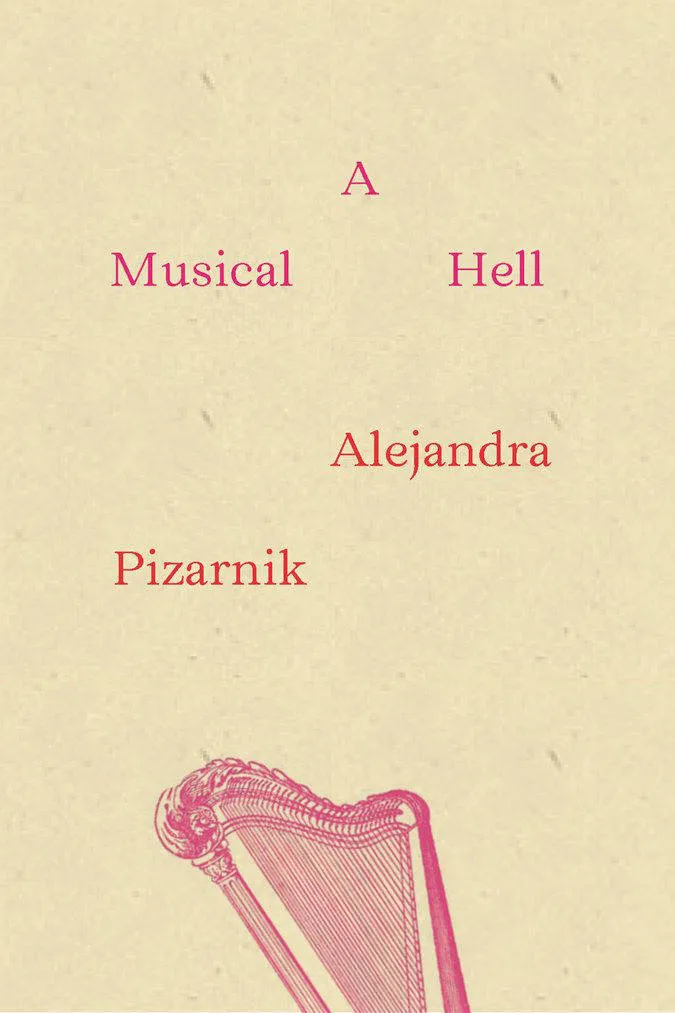
A Musical Hell
Alejandra Pizarnik, Yvette Siegert
“An aura of legendary prestige surrounds the work of Alejandra Pizarnik,” writes César Aira. Her last collection to be published before her suicide in 1972, A Musical Hell is the first book of poems by Pizarnik to be published in its entirety in the U.S. Pizarnik writes at the edge of poetic impossibility, opening with a blues singer, expanding into silence, and closing into a theater of shadows and songs of the drowned.

The Grimace of Eden, Now
The playful, inventive, and lyrically quick poems comprising The Grimace of Eden, Now orbit the strange space halfway between Tennyson and the Metaverse, veering between the natural world and a sci-fi universe, between inner feelings and outward observations, with questions of divinity alongside domestic life, spiders, dishes, and spaceships. The roving eye of these poems wanders through spacetime carrying irreverent theologies and exploring what it could mean to be living, sensate, and awake in this weird moment in time, exposing a mixture half of awe and half of madness.
Cody-Rose Clevidence is the author of Aux Arc / Trypt Ich (Nightboat Books, 2021), Listen My Friend, This is the Dream I Dreamed Last Night (The Song Cave, 2021), Flung/Throne (Ahsahta, 2018), and BEAST FEAST (Ahsahta Press, 2014), as well as several chapbooks (Fonograf Editions, flowers and cream, NION, garden door press, Auric). Occasionally a visiting poetry professor at the Iowa Writers Workshop, they live in the Arkansas Ozarks alongside three loyal, sentient pets, and the continuous void.