Books
Books
in random order

Your Silence Will Not Protect You
With a preface by Reni Eddo-Lodge and an introduction by Sara Ahmed.
Audre Lorde (1934-92) described herself as ‘Black, lesbian, mother, warrior, poet’. Born in New York, she had her first poem published while still at school and her last the year she died of cancer. Her extraordinary belief in the power of language – of speaking – to articulate selfhood, confront injustice and bring about change in the world remains as transformative today as it was then, and no less urgent. This edition brings Lorde’s essential poetry, speeches and essays, including ‘The Master’s Tools Will Never Dismantle the Master’s House’, together in one volume for the first time.

Girl With a Bullet
Ukrainian poet Anna Malihon’s English-language debut gathers daring, resilient, open-eyed poems written before and after Russia’s full-scale invasion. The difficult fates voiced by the protagonists of Malihon’s poems intertwine with her own experience, weaving an alarming but beautiful world where the young grow old and love is met with war. This world, at first shocking, holds the reader in suspension, compelling a desire to rethink and reread. With deft allegory and startling metaphor, Malihon crafts a poetry that seeks to influence the course of events, to reroute history.

Prairie, Dresses, Art, Other
In Prairie, Dresses, Art, Other Danielle Dutton imagines new models for how literature might work in our fractured times. Dutton’s writing is as protean as it is beguiling, using the different styles and different spaces of experience to create a collage of the depths and strangeness of contemporary life.
This hybrid literary collection covers an inventive selection of subjects in four eponymous sections which contrast and echo one another, challenging our expectations and pushing the limits of the dream-like worlds and moods that language might create.
‘Danielle Dutton is a writer whose work I wait for. When a new book comes, I keep it very close… Her growing body of work is among the most formally inventive (and therefore essential) I can think of, and Prairie, Dresses, Art, Other is a vital, enlivening addition to it.’ – Kate Briggs
Danielle Dutton is the author of the novels Margaret the First and SPRAWL, the prose collection Attempts at a Life, the illustrated nonfiction chapbook A Picture Held Us Captive, and she wrote the text interpolations for Richard Kraft’s Here Comes Kitty: A Comic Opera. Her fiction has appeared in magazines and journals including The New Yorker, The Paris Review, The White Review, Harper’s, BOMB, and NOON. Dutton teaches at Washington University in St. Louis and is cofounder and editor of the award-winning feminist press Dorothy, a publishing project. Born and raised in California, she has lived on the (former) prairie now for roughly twenty years.
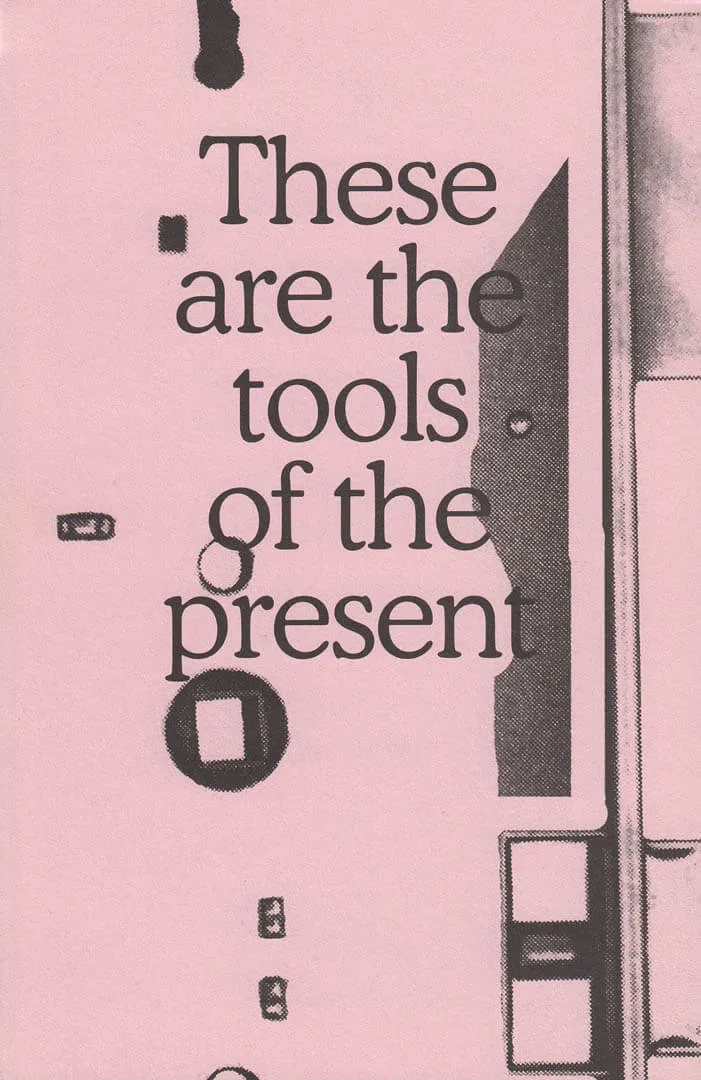
These are the tools of the present
Mai Abu ElDahab, November Paynter and 1 more
This publication comprises a series of interviews with contemporary artists, musicians, and writers who are in dialogue with Beirut and Cairo. While not purporting to be an overview of the art scenes in these cities, this book begins to draw a picture of how artists think about what it means to be active in the contexts of these cities. It offers insight into the circumstances that structured these artists’ stories, and the often accidental influences that have shaped how their practices have developed.

as the non-world falls away
as the non-world falls away is set of fragmented poetic compositions, created through iPhone scans of the artists notebook that have then been worked over digitally, testing the boundaries between image and text in a palimpsestic manner
WITHOUT THE E is a series of pamphlets responding to a presence or an absence felt in contemporary digital culture.

Ten Non-Binary Hertz – Going Virile
This publication brings together a text by Dagmar Dirkx and reproductions of Ot Lemmens' installation Going Virile.
Prior to starting to work on their public installation Going Virile, two of the eight display windows were vandalized and cracked. Having intended to work around the idea of passing in a trans-masculine context, Ot turned their gaze to the relationship of masculinity to violence, questioning the reproduction of ideas around masculinity through transmasculine embodiment. They designed and screenprinted 6 patterns of which a few are reproduced in this publication.
During that process they invited Dagmar Dirkx to experiment with writing a text in parallel to their work. The text Ten Non-Binary Hertz arose from a conversation between the Dagmar and Ot about trans-masculinity in relation to desire, violence and the idea of passing.
Text by Dagmar Dirkx
Translation by Titane Michiels
Design by Ot Lemmens
Made possible by VGC Brussel and Nadine vzw

Bargain Witch: Essays in Self-Initiation
An occult history that grounds the sacred yearning for magic in real life.
In these essays by scholar and self-initiated witch Brooke Palmieri, occult history, the eternal now, and our magickal queer futures align, connecting us to an enchantment both contemporary and classic. Drawing upon the knowledge and influence of practitioners from Rachel Pollack to Tituba, Palmieri grounds the sacred yearning for magic in real life, whether exploring the gossip of feuding Salem witches, paying the rent by playing "wizard" for news cameras, or detailing the psychic ups and downs of working in an occult bookshop. Written in a voice electrified with love for the craft and its lineage of eccentrics, Bargain Witch shows us witch life in all its quotidian humor and splendor, taking its place amongst the magickal classics that inspired it, a literary ouroboros.
Brooke Palmieri is a writer and artist based in Joshua Tree. His writing considers the past as a supernatural encounter, spanning hundreds of years of queer and trans history, and the magic, mystery, and erotics of working in archives. Bargain Witch: Essays on Self-Initiation is his first book.

BFTK — Issue 4: On Translation, Transmission & Transposition
Andrew Walsh‐Lister, Matthew Stuart and 2 more
Bricks from the Kiln is an irregular journal edited by Andrew Lister and Matthew Stuart, sometimes with guest editors, that presents graphic design and typography as disciplines activated by and through other disciplines and lenses such as language, archives, collage, and more. It borrows its title from the glossary notes of Ret Marut’s "Der Ziegelbrenner," which was the ‘size, shape and colour of a brick’, and ran for 13 issues between 1917 and 1921.
The latest installment, "#4: On Translation, Transmission & Transposition," was published as an event (and now) a publication, with events at London College of Communication, Burley Fisher Books & Pig Rock bothy, Socttish National Gallery of Modern Art, and Inga (in November, 2019).
GREENING
Helen Marten
(front / back flaps)
JOY & HAPPINESS, FIDELITY
& INTIMACY IN TRANSLATION
Sophie Collins
(pp.4–13)
PLANETARY TRANSLATION
Don Mee Choi
(pp.15–19)
TRANSLATION AND A LIPOGRAM:
OR, ON FORMS OF AGAIN-WRITING
AND NO- (OR NOT THAT-) WRITING
Kate Briggs
(pp.23–33)
UNHOMING (1 of 4):
FOLLOWING HÖLDERLIN’S ‘HEIMAT’
Phil Baber
(pp.35–47)
SNOW WHITE AND THE WHITE
OF THE HUMAN EYEBALLS
Joyce Dixon
(pp.51–62)
ALTAMIRALTAMIRALTAMIRA
Florian Roithmayr
(pp.65–116)
LEVEL UP, LEVEL DOWN
Jen Calleja
(pp.119–124)
TRANS.MISSION [A.DIALOGUE]:
A JAVASCRIPT FOR THREE VOICES
J.R. Carpenter
(pp.127–134)
THE MECHANISATION OF ART
Edgar Wind
(glosses / annotations / insertions by
Natalie Ferris & Bryony Quinn)
(pp.137–144)
UNHOMING (2 of 4)
Phil Baber
(p.147)
COMMISSION FOR A NOIR MOVIE
B IN THE BAY OF BISCAY
Rebecca Collins
(pp.151–157)
UNHOMING (3 of 4)
Phil Baber
(pp.150–162)
EVERY CONTACT LEAVES A TRACE;
TRANSCRIBING OSTEON
Naomi Pearce
(pp.165–170)
HOW DOES A WORK END?
Karen Di Franco
(pp.173–193)
METONYMY Op.1 & Op.2
James Bulley
(pp.197–201)
AFRIKAN ALPHABETS EXTENDED
Saki Mafundikwa
(pp.204–207)
SUSAN HILLER: 1983
Natalie Ferris
(pp.209–217)
EVERY TELLING HAS A TALING /
EVERY STORY HAS AN ENDING
Matthew Stuart
(pp.220–233)
GRAPHIC PROPRIOCEPTION
James Langdon
(pp.235–254)
UNHOMING (4 of 4)
Phil Baber
(pp.257–263)
TUNNELLING AND AGGREGATING
FOR DESIGN RESEARCH
Bryony Quinn (text) &
Peter Nencini (images)
(pp.265–272)
LET IT PERCOLATE:
A MANIFESTO FOR READING
Sophie Seita
(pp.275–280)
288 pgs, 22.4 × 17 cm, Softcover, 2020

TIME
TIME by Spencer Longo is a collection of printed work depicting government raids, religious visions, environmental catastrophe, and extremist fundamentalism tangled together in a narrative web of salvation, annihilation, and transcendence. Using pen plotter graphics directly on uncollated pages of Time magazine, Longo explores the conspiratorial trope that messages are secretly embedded in mass media, coaxing our millenarian anxieties out through an additive printing process using graphics from survivalist publications, end-times evangelical cartoons, and marginalia from the borders of underground occult material, all sprinkled with ecstatic bursts of star-spangled clipart. A must-have for your fallout shelter's library.

Pfeil Magazine #18 – Body
From its anatomy and autonomy to its death and diet, this issue focuses on the motif Body and all its meanings, direct and indirect, for instance as in relation to human and non-human bearers of bodies, its inhabitants like bacteria and organs, its social, medical and juridical conditions, its intoxications, chemical processes, traumas, transitions, well-being, replacements, weaknesses, and its opposites.
Contributors: Adam Dickinson, Andrea Éva Győri, A.L. Steiner, Alexandra Ivanciu, Barak Zemer, Bernhard Willhelm, Clara Lena Langenbach, Clémentine Bedos, Constance DeJong, Daisy Hildyard, Fanny Howe, Hanne Loreck, Hasti, Holly Hunter, Ingrid Jäger, Jannis Marwitz, Jess Arndt, Johannes Kuczera, Jolanta Nowaczyk, Henriette Maier, Mag Gabbert, Maja Smrekar, Manuel Vason, R.I.P. Germain, Rebekka Endler, Sonja Yakovleva
Within the format of a magazine, each page of Pfeil represents the floor, walls, or ceiling which together create an imagined room displaying a printed exhibition. Each issue is dedicated to a specific word, and artists are invited and given space to work on and with this term, and to construct or deconstruct the architecture around it. Combined, the contributions transform into an organic display surrounding the leitmotif.

My Lesbian Novel
The latest in writer and visual artist Renee Gladman's ever-expanding body of imaginative investigation is a sui generis novel of queerness and art-making, philosophy and sex.
The narrator of My Lesbian Novel is Renee Gladman, an artist and writer who has produced the same acclaimed body of experimental art and prose as real-life Renee Gladman, and who is now being interviewed by an unnamed interlocutor about a project in process, a seeming departure from her other works, a lesbian romance.
Between reflections on art making and on the genre of lesbian romance - "though aspects of the formula drive me crazy... people who write these stories understand how beautiful women are" - a romance novel of her own takes shape on the page, written alongside the interview, which sometimes skips whole years between questions, so that time and aging become part of the process.
The result is a beautifully orchestrated dialogue between reflection and desire, or clarity and confusion, between the pleasures of form and the pleasures of freedom in the unspooling of sentences over time.
Renee Gladman is a writer and artist preoccupied with crossings, thresholds, and geographies as they play out at the intersections of poetry, prose, drawing, and architecture. She is the author of fourteen published works, including a cycle of novels about the city-state Ravicka and its inhabitants, the Ravickians, all published by Dorothy— Event Factory, The Ravickians, Ana Patova Crosses a Bridge, and Houses of Ravicka. She has been awarded fellowships, artist grants, and residencies from the Radcliffe Institute for Advanced Study at Harvard, Foundation for Contemporary Arts, the Lannan Foundation, and KW Institute for Contemporary Art (Berlin), and was a 2021 Windham-Campbell Prize winner in fiction. She makes her home in New England with poet-ceremonialist Danielle Vogel.

Movement Research Performance Journal
Issue #60 - Gender Disarray
Kay Gabriel, Amalle Dublon and 2 more
Under the direction of four contributing editors—Amalle Dublon, Kay Gabriel, Keioui Keijaun Thomas, and Anh Vo— we’ve assembled a new body of work by mostly trans and queer artists reflecting on the keyword “gender” and its relation to contemporary performance. Their work moves across multiple genres of writing, from analytic essays to poetry to performance scripts.
“Read My Lips” is a phrase that will be familiar to longtime readers of the Movement Research Performance Journal—so familiar that the mere reference will bring to mind an image posted by the artist collective GANG, an image that lies at the heart of one of the journal’s most spectacular moments. Issue #3, with its focus “Gender Performance,” was published in 1991 amid that era’s Culture Wars, receiving almost immediately negative reception from government officials (the NEA threatened to withdraw funding from Movement Research) and many members of the dance community (who considered Issue #3 to be deliberately provoking the so-called “war,” intentionally taking a political position that some worried might comprise future funding of the field). In the thirty-three years since its publication, Issue #3 has developed a patina familiar to many artist-activist histories that are looked upon with romance and nostalgia, often by those for whom that history is only a fantasy (rather than a lived experience).

The Cows
Lydia Davis is mathematician, philosopher, sculptor, jeweler, and scholar of the minute. Few writers map the process of thought as well as she, few perceive with such charged intelligence. The Cows is a close study of the three much-loved cows that live across the road from her. This chapbook, written with understated humor and empathy, is a series of detailed observations of the cows on different days and in different positions, moods, and times of the day.

The Organ is the World's Greatest Synthesizer (vinyl LP)
Recorded live at Amsterdam's Oude Kerk during the 2024 Sonic Acts Festival, The Organ is the World's Greatest Synthesizer finds Charlemagne Palestine returning to the Staalplaat catalog after many years. Taking its title and cover from a drawing made by Palestine during the performance, the work expands his singular mythology of sound and spirit. Opening with resonating bells and falsetto overtones before surrendering to the vast sonic tides of the church organ, the 40-minute piece unfolds as an ecstatic continuum—tones intertwining, frequencies colliding, and space itself becoming an instrument. A testament to the living dialogue between artist, instrument, and place, this is Palestine at his most immersive and transcendent.
For over six decades, Charlemagne Palestine has been a pioneering composer, performer, and multimedia artist, celebrated for his ecstatic sonic explorations and ritualistic, metaphysical performances. Emerging from the cross-disciplinary New York art scene of the 1960s and '70s, he helped shape a heretical edge of minimalism alongside figures like Conrad, Riley, Niblock, and Glass. Trained as a Jewish cantor and later as the carillonneur at St. Thomas Church, Palestine cultivated a deep fascination with resonance and overtone—an obsession that evolved through his use of percussion, early synthesizers, and monumental piano works, influencing artists from John Cale to Nick Cave.

Ordinary Notes
A singular achievement, Ordinary Notes explores profound questions about loss and the shapes of Black life that emerge in the wake. In a series of 248 notes that gather meaning as we read them, Christina Sharpe skillfully weaves artifacts from the past—public ones alongside others that are poignantly personal—with present realities and possible futures, intricately constructing an immersive portrait of everyday Black existence. The themes and tones that echo through these pages—sometimes about language, beauty, memory; sometimes about history, art, photography, and literature—always attend, with exquisite care, to the ordinary-extraordinary dimensions of Black life.
At the heart of Ordinary Notes is the indelible presence of the author’s mother, Ida Wright Sharpe. “I learned to see in my mother’s house,” writes Sharpe. “I learned how not to see in my mother’s house . . . My mother gifted me a love of beauty, a love of words.” Using these gifts and other ways of seeing, Sharpe steadily summons a chorus of voices and experiences to the page. She practices an aesthetic of "beauty as a method,” collects entries from a community of thinkers toward a “Dictionary of Untranslatable Blackness,” and rigorously examines sites of memory and memorial. And in the process, she forges a brilliant new literary form, as multivalent as the ways of Black being it traces.

Invisible Oligarchs
Bill Berkson's Invisible Oligarchs is like a book jotted on the back of a poet's hand—a hand that picks up everything that sings to it, from gold-leaf proverb to chopstick sheath, on its quick trip through a few places in urban Russia, 2006. Across faintly ruled Japanese paper, many pages reproduced here in facsimile, snapshots change hands, new poems blink, and poetry politics meet political gossip over lunch in St. Petersburg. Berkson's educated guesswork about that elusive quality once known the Great Russian Soul, is framed here by letters from his friend Kate Sutton and encompassing encounters with poets and cab drivers, Moscow conceptualists and a White Night at the Mariinsky Ballet. As a sharply observant poet and the most soulful art critic alive, Berkson knows how to get us behind the set, and reading this book is as nice as taking a high dive with him into a perfectly mixed White Russian.
Bill Berkson was born in New York in 1939. He moved to Northern California in 1970 and now divides his time between San Francisco and New York. He is a poet, critic, sometime curator, and professor emeritus at the San Francisco Art Institute, where he taught art history and literature for many years. A corresponding editor for Art in America, he has contributed to such other journals as Artforum, Aperture, Modern Painters, and artcritical.com. His recent books include PORTRAIT AND DREAM: NEW & SELECTED POEMS (Coffee House Press, 2009); BILL, a words-and-images collaboration with Colter Jacobsen; Lady Air; Not an Exit with drawings by Léonie Guyer; REPEAT AFTER ME (Gallery Paule Anglim, 2011), with watercolors by John Zurier; and a collection of his art writings, FOR THE ORDINARY ARTIST (BlazeVOX books, 2010), as well as a new collection of his poems, Expect Delays, from Coffee House Press in 2014 and INVISIBLE ORLIGARCHS out from Ugly Duckloing Presse in 2016.
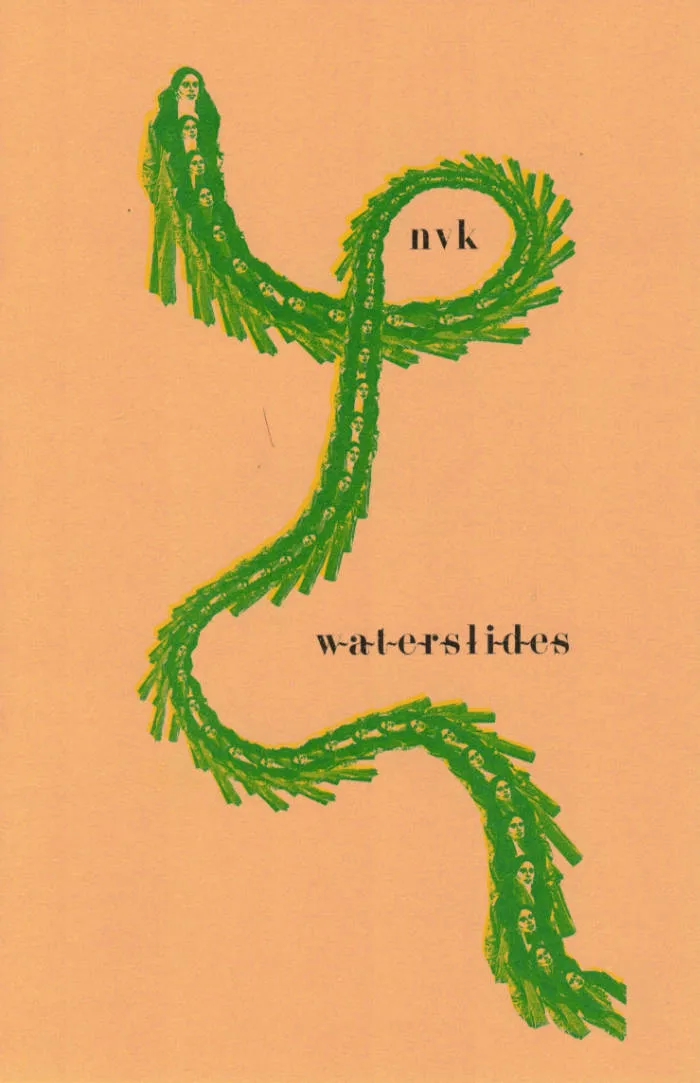
Waterslides
"Waterslides is a falling and plunging, short starts and stops aided by movement, until we splash, climb and plunge again. Each sliding is the same but different—with each descent new expectations and thoughts swirl, shifting focus and gaining new insights or blockages. Waterslides are brief moments of remembering, remembering as a present tense activity, one that happens as we think of it, projected on our now. The waterslide is the moment of past and present working in tandem, a movement of repeating, revisiting and remembering all at once.”
Written by nvk 2021-2023. Dedicated to Judi, MM & TNN.
A version of these poems was published as an audio work through Ignota Press’ The Mountain (2023) and included in a reading with James Loop on Montez Press Radio (2023). nvk would like to thank Jan Matthé, Stine Sampers and Michelangelo Miccolis for their patience & love.
This book was first presented at Kransen in Antwerp, May 6th 2023, with a performance by Sassy (costume by Rosa Schützendorf). Printed and bound at Risiko Press, Borgerhout. Cover image by nvk. Fonts: Adonis, Garamond Pro. Limited to 150 copies.
128x195mm, 16p., stapled, cover: green, yellow and black risoprint on 160gsm caramel paper, inside: black and blue riso on 120gsm Munken Pure paper.
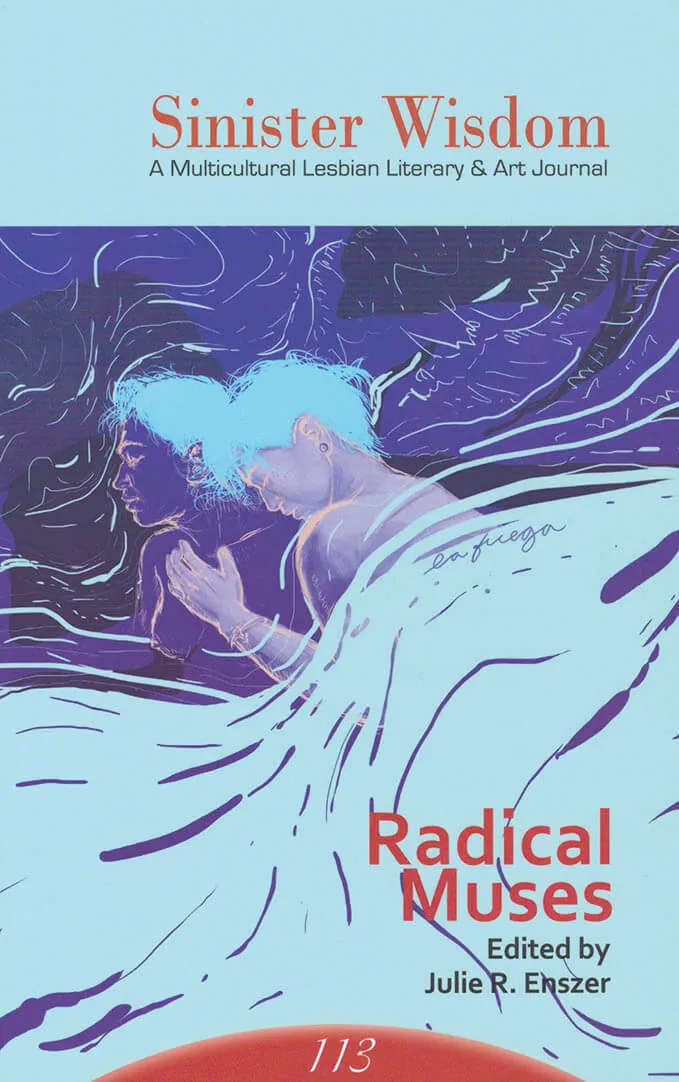
Radical Muses (Sinister Wisdom nr. 113)
Sinister Wisdom 113: Radical Muses features an eclectic array of contemporary poetry, prose, and art by lesbians from around the world, including new work by: Andrea Assaf, Tara Shea Burke, Cheryl Clarke, Marina Chirkova, Estela González, Barbara Haas, Nancy E. Lake, Vi Khi Nao, H. Ní Aódagaín and much more!

Tripwire 16 - Performance/Writing
A special issue focused on performance writing, with work by Tanya Lukin Linklater (with Michael Nardone), Jibade-Khalil Huffman & Simone White, Jean-Thomas Tremblay, Claudina Domingo (trans. Ryan Greene), Kim Rosenfield, Nathan Walker, Liz Knox, Rona Lorimer, Léo Richard, & Hector Uniacke, Mohamed A. Gawad & Dalia Neis, Mei-mei Berssenbrugge & Teddy Yoshikami, interviewed by Michelle N. Huang, Kyoo Lee and Jocelyn Saidenberg, Adriana Garriga-López, Gabrielle Civil, plus a Kevin Killian Tribute, with Eileen Myles * Scott Hewicker * Cliff Hengst * Karla Milosevich * Craig Goodman * Michelle Rollman * Anne McGuire * Wayne Smith * Tanya Hollis * Steve Orth * Lindsey Boldt * Maxe Crandall * Arnold J. Kemp * Carla Harryman, Lee Ann Brown & Tony Torn * Susan Gevirtz * Laynie Browne * Patrick Durgin * Norma Cole * Jo Giardini. & reviews: Jessica Lopez Lyman & Jocelyn E. Marshall on Gabrielle Civil, alex cruse on Merce Cunningham, Rob Stanton on Anne Boyer, Jack Chelgren on Miyó Vestrini, David Grundy on Stephen Jonas, Virginia Konchan on Sarah Vap.

Oracular Transmissions
Oracular Transmissions weaves together three of the most recent collaborative projects Etel Adnan and Lynn Marie Kirby have completed through processes of exchange and translation: Back, Back Again to Paris (2013), The Alhambra (2016), and Transmissions (2017).
The book also includes poems by Denise Newman, a friend to both Adnan and Kirby, and an introduction by Kadist Foundation curator Jordan Stein presenting their works and performances.

Diversity of Aesthetics
Jose Rosales, Andreas Petrossiants
Critical conversations and reflections about lessons learned at the intersection of social movements and artist production.
Diversity of Aesthetics collects powerful and timely conversations among leading cultural critics, artists, and organizers to connect the threads between some of the most pressing social struggles and conflicts of our time: policing, war, borders and migration, economic crisis.
Across three themes—infrastructure, migration, and riots—militant thinkers, artists, educators, and others discuss aesthetic production, forms of social organization, modes of struggle against gendered and racialized capitalism, and revolutionary theory. Common to all three conversations is a commitment to rethinking the relationship between forms of critique and forms of struggle undertaken by collective social practices, offering lessons for tactics, strategies, and practices.
With contributions by Claire Fontaine, Iman Ganji, Saidiya Hartman, Vicky Osterweil, Andreas Petrossiants, Christina Sharpe, Stevphen Shukaitis, Michael Rakowtiz, Shellyne Rodriguez, Jose Rosales, Rinaldo Walcott, Andreas Petrossiants, Jose Rosales
Andreas Petrossiants is a writer and associate editor of e-flux journal. His work has appeared in Historical Materialism, Social Text, New Inquiry, AJ+ Subtext, Frieze, Bookforum.com, Roar Magazine, the Verso blog, the Brooklyn Rail, Hyperallergic. He is a PhD candidate in performance studies at NYU where he is researching anti-eviction, squatting, and tenants’ movements as they relate to the production of social space.
Jose Rosales is an independent researcher and journalist based in Lisbon, Portugal. His work has appeared in e-flux notes, Lumpen: A Journal of Poor and Working Class Writers, and has contributed a chapter called “Communism As the Riddle Posed to History” in Double Binds of Neoliberalism (2022).

Pleasure Erased: The Clitoris Unthought
The clitoris was absent in anatomy books, in paintings and sculptures, absent in spirit and even body; it has long been the organ of erased pleasure. We assume that this oversight has been repaired in our times: today, the clitoris is not forgotten but honoured. Conferences, books, manifestos, works of art are all devoted to it. The autonomy of clitoral jouissance is recognized. The boundaries of feminism have also moved: queer, intersex and trans approaches claim that the clitoris is perhaps no longer the exclusive preserve of the woman. And yet, there remains a wounded space. Because genital mutilation is still common practice. Because millions of women are still denied pleasure.
The clitoris continues to mark the enigmatic space of the feminine. Constrained by the extreme difficulty and the extreme urgency of returning to this scorched earth, it is time to give voice to an organ of pleasure which has still not become an organ of thought.
“A project whose glaring absence has been hiding in plain sight, clitoral pleasure has finally found its philosopher. Malabou tells us what we can do with our clitoral brain, uncloaking its agency and anarchic politics. Essential reading for anyone interested in interpreting sex otherwise than phallic and in relation to philosophy’s power to shape the soma.” - Emily Apter, New York University

Self-portrait
Allison Grimaldi Donahue, Carla Lonzi
Recorded and transcribed throughout the 1960s, Carla Lonzi’s Self-portrait ruptures the narration of post-war modern art in Italy and beyond. Artmaking struck Lonzi as an invitation to be together in a ‘humanly satisfying way’, and this experiment in art-historical writing is a testament to her belief. Lonzi abolishes the role of the critic, her own, seeking change over self-preservation by theorising against the act of theorising.
The life and work of Carla Lonzi (1931–1982) is inseparable from the cultural, political, and social history of Italy in the decades following the Second World War; she occupies a singular position, which today merits reevaluation. A reputed art critic of the 1960s artistic scene, both friend and collaborator of such figures as Carla Accardi, Luciano Fabro, Giulio Paolini, and Jannis Kounellis, she wrote “Autoportrait” in 1969, a “love letter” to the artists and to creation, but also a farewell chorus to art criticism and the art world. The following year she founded Rivolta Femminile, an active feminist collective, thus becoming the central figure of Italian feminism.
Interviews with Carla Accardi, Getulio Alviani, Enrico Castellani, Pietro Consagra, Luciano Fabro, Lucio Fontana, Jannis Kounellis, Mario Nigro, Guilio Paolini, Pino Pascali, Mimmo Rotella, Salvatore Scarpita, Guilio Turcato, Cy Twombly.
Afterword by Claire Fontaine.
Translated by Allison Grimaldi Donahue.
978-1916425088
105 b&w illustrations
21.6 x 13.9 cm
364 p.
Paperback
November 2021

Johnny Would You Love Me If My Dick Were Bigger
A dirty cult-classic put out in a small batch by an underground publisher (Rudos and Rubes) in 2015, Johnny Would You Love Me If My Dick Were Bigger recounts the life of an artist and "old school homosexual" who bears a big resemblance to author Brontez Purnell.
Our hero doesn't trust the new breed of fags taking over San Francisco, though. They wear bicycle helmets, seat belts, and condoms. Meanwhile, he sabotages his relationships, hallucinating affection while cruising in late night parks, bath-houses, and other nooks and crannies of a newly-conservative, ruined city.
Furiously original, vital, and messy, this funny "non-memoir" uncovers a revelatory truth for the age: there are things far scarier than HIV.