Books
Books
in random order

Five Stars: Selected Amazon Reviews, Vol 4
Five Stars: Selected Amazon Reviews, Volume 4 by Kevin Killian, selected by Ted Rees & David Buuck, with introductory words from Kevin edited by Dodie Bellamy. Curated from the over 2500 reviews that William Hall has lovingly archived, this latest edition showcases Kevin’s incomparable mix of wit and sincerity, pleasure and playfulness, his deep love of popular culture, and his unique critical voice.

Terra Cosmica / Traces of Georealism
An ‘end-times’ philosophical enquiry in which the author argues with stones and geological time to compose a suite of interlinked fragments. An act of lapidary; a five-part antagonisation of the elements; an essay on representation, visualisation and prediction; an ecologue on ecology.
Our age is characterised by the increasing humanisation of a planet that is more and more subject to metaphoric representation and visualisation.
The memorialisation, anthropomorphism, and narratological charge of time has birthed an intellectual industry in which the summation of history plays out like a hand of cards. A game in which retrospect and hindsight informs our present and sits us ever at the mercy of prediction and chance in a time increasingly defined by catastrophe, and as emergent crises affect every stratum of life and lived experience. We are currently witnessing a mutation of our thinking that disrupts the mythical imaginary that had hitherto confined viruses, climate change and atmospheric turbulence to an unalterable background in the all-too-human narrative of the struggle against nature.
Tusa’s Terra Cosmica / Traces of Georealism is the result of a series of lectures and essays—a quintet of pieces published over the course of a four-year period—that, woven together into a new collation of interlinked fragments, calls time on time to consider the new form of planetary realism resultant of this restructuring of the imagination. Tusa presents a cosmic remapping of our modes of thinking that assumes that our contemporary moment is absented from its representability, its history of representations, and all means of explanation, thus remaining open to a sense of its own infinity… Open to an encounter with that which remains absent and unknowable, with neither horizon nor memory available as any weathervane for comprehension and action. Tusa’s work is a scrutiny of our exosystemic condition; a suite of exploratory antagonisms on the need for a new philosophical perspectivism of time, of earth, and a new charter for the foundations of thought and thinking.

A Mouth Holds Many Things: A De-Canon Hybrid Literary Anthology
A Mouth Holds Many Things collects hybrid-literary works from 36 women and nonbinary BIPOC writer-artists. Spanning experimental poetry and prose, image-text, collage, performance text, AI-generated writing, and more, this ground-breaking full-color print volume illuminates and expands the interstitial spaces where text blends, blurs, and morphs with visual and other media.
At the restless heart of this collection is a challenge to some fundamental questions: What is reading? What is writing? Lifting language beyond the domain of the letter, the works collected here present language in other forms: visual, embodied, sonic, asemic, tactile. Language, after all, is multi-textu(r)al, interwoven, punctured, fragmented, grafted, possessing power to construct and deconstruct, fed into by many rivers of experience: marginalizations and migrations, diasporas and displacements, invisibilities and hyper-visibilities.
A project of the Portland-based literary-social art project, De-Canon, which creates unique spaces and experiments to center works by writers of color, this collection is edited by Dao Strom and Jyothi Natarajan.
A Mouth Holds Many Things was, in the short stories/poetry/anthologies category, the winner of a 2024 PubWest Book Design Award.
Full list of contributors
Stephanie Adams-Santos, Kimberly Alidio, Samiya Bashir, Aya Bram, Victoria Chang, Jennifer S. Cheng, Gabrielle Civil, desveladas (Macarena Hernández, Sheila Maldonado, Nelly Rosario), Carolina Ebeid, Nadia Haji Omar, Christine Shan Shan Hou, Imani Elizabeth Jackson, Vi Khi Nao, Diana Khoi Nguyen, Quyên Nguyễn-Hoàng, Cindy Juyoung Ok, Monica Ong, Shin Yu Pai, Jenne Hsien Patrick, Jennifer Perrine, Alley Pezanoski-Browne, Kelly Puig, Ayesha Raees, Jhani Randhawa, Paisley Rekdal, Daisuke Shen, Sasha Stiles, Sandy Tanaka, Arianne True, Addie Tsai, Vauhini Vara, Divya Victor, Anna Martine Whitehead, Kathy Wu

Playboy
The prequel to Love Me Tender, narrating Debré's transformation from affluent career woman to broke single lesbian and writer.
I see all her beauty, I see the beauty of women. I see my own body, new. I tell myself there are so many things that are possible.
First published in France in 2018, Playboy is the first volume of Constance Debré's renowned autobiographical trilogy that describes her decision, at age forty-three, to abandon her marriage, her legal career, and her bourgeois Parisian life to become a lesbian and a writer.
The novel unfolds in a series of short, sharp vignettes. The narrator's descriptions of her first female lovers—a married woman fifteen years older than her, a model ten years her junior—are punctuated by encounters with her ex-husband, her father, and her son.
As Debré recently told Granta: “It was a bit like Saint Augustine and his conversion. In the same week, I had sex with a girl and I had the feeling that I could write. I had this incredible feeling that I could catch things, that life was there to be caught.”
Looking at the world through fresh eyes, the narrator of Playboy questions everything that once lay beneath the surface of her well-managed life. Laconic, aggressive, and radically truthful, she examines gender and marriage, selfishness and sacrifice, money and family, even the privilege inherent in her downward mobility.
Writing her way toward her own liberation, Debré chronicles the process that made her one of the most brilliant, important French writers today.

Afghanistan
Afghanistan is my father’s homeland. He was born in Kabul in 1945 and later moved first to France, then to Switzerland in the 1970s. In my mind, Afghanistan exists as a geography with blurred edges, something I feel the need to reconcile with. It’s a place I’ve only ever known through stories, a source of memories that, over time, have shifted and become distorted.
Contributors: Luca Cerizza, Farid Rahimi, Said Rahimi, Susanna Ravelli, Francesca Recchia, Zafar Sayan, and Dawood Tawana

Women in Concrete Poetry: 1959-1979
Mónica de la Torre, Alex Balgiu
An expansive anthology focused on concrete poetry written by women in the groundbreaking movement’s early history. It features 50 writers and artists from Europe, Japan, Latin America, and the United States selected by editors Alex Balgiu and Mónica de la Torre.
Women in Concrete Poetry: 1959-1979 takes as its point of departure Materializzazione del linguaggio—the groundbreaking exhibition of visual and concrete poetry by women curated by Italian feminist artist Mirella Bentivoglio for the Venice Biennale in 1978. Through this exhibition and others she curated, Bentivoglio traced constellations of women artists working at the intersection of the verbal and visual who sought to “reactivate the atrophied tools of communication” and liberate words from the conventions of genre, gender, and the strictures of the patriarchy and normative syntax.
The works in this volume evolved from previous manifestations of concrete poetry as defined in foundational manifestos by Öyvind Fahlström, Eugen Gomringer, and the Brazilian Noigandres Group. While some works are easily recognized as concrete poetry, as documented in canonical anthologies edited by Mary Ellen Solt and Emmett Williams in the late ’60s, it also features expansive, serial works that are overtly feminist and often trouble legibility. Women in Concrete Poetry: 1959-1979 revisits the figures in Bentivoglio’s orbit and includes works by women practicing in other milieus in the United States, Eastern Europe, and South America who were similarly concerned with activating the visual and sonic properties of language and experimenting with poetry’s spatial syntax.
Artists and writers include Lenora de Barros, Ana Bella Geiger, and Mira Schendel from Brazil; Mirella Bentivoglio, Tomaso Binga, Liliana Landi, Anna Oberto, and Giovanna Sandri from Italy; Amanda Berenguer from Uruguay; Suzanne Bernard and Ilse Garnier from France; Blanca Calparsoro from Spain; Paula Claire and Jennifer Pike from the UK; Betty Danon from Turkey; Mirtha Dermisache from Argentina; Bohumila Grögerová from the Czech Republic; Ana Hatherly and Salette Tavares from Portugal; Madeline Gins, Mary Ellen Solt, Susan Howe, Liliane Lijn, and Rosmarie Waldrop from the US; Irma Blank and Ruth Wolf-Rehfeldt from Germany; Chima Sunada from Japan; and Katalin Ladik and Bogdanka Poznanović from the former Yugoslavia.

How to speak dead
A meditative reflection on language and its loss.
How does one language inherit another? Defeat, erase or live through another? How to speak dead is Walid Sadek's meditative reflection on language, dead or victorious. At heart, beyond defeat and victory, it is a reflection on how one can approach a speaking that is of neither a living language nor a dead one. A speaking that knows loss and knows it is woven into every uttered word, every spoken sentence. A loss that becomes syntax.
"There, where the battle is lost and won and where, after the hurly-burly is done, we may approach a speaking that is of neither a living language nor a dead one. A speaking that knows loss and knows it is woven into every uttered word, every spoken sentence. A loss that becomes syntax."
Walid Sadek
Walid Sadek (born 1966 in Beirut) is a Lebanese artist and writer. He is a professor at the Department of Fine Arts and Art History of the American University of Beirut.
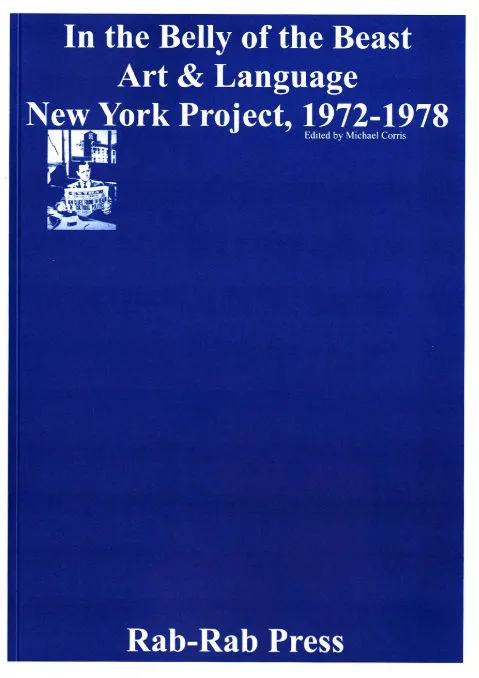
In the Belly of the Beast – Art & Language New York Project 1972-1978
Edited by Michael Corris, the expanded edition of In the Belly of the Beast: Art & Language New York Project 1972-1978 is a survey of the tumultuous years of the political Conceptualism in the mid-seventies New York.
Artists have always experimented with politics, either by organizing themselves or uniting in support of a broader political movement. Today, "activist art" is taught in universities, supported by foundations, and featured in museums and international exhibitions. Is this the only possible way?
In the Belly of the Beast tells a different story, of the work of politically engaged artists and the conflicts they experienced. It is the history of artists wishing to continue working within the boundaries of the artworld and those who were intent on establishing new ideological and class relationships with activists to build a political party.
During the 1970s in New York, the Art & Language collective pioneered institutional critique; published a Marxist-influenced journal; agitated against racism and sexism in museums; challenged the cultural imperialism of international exhibitions; and forged a framework for a socialist organization of artists. This new edition includes previously unpublished documents illuminating the contradictions and disputes that lay at the center of the organization and practices of Art & Language and left-wing groups, such as the Anti-Imperialist Cultural Union and the Artists' Meeting for Cultural Change, mobilizing artists in New York at the time.
The new and expanded edition of In the Belly of the Beast features an extensive interview with Michael Corris, who annotated a collection of previously unavailable documents from the period, including manuscripts, pamphlets, transcripts, and letters.
Art & Language is the name of a group of English artists who choose to work collectively, and the title of a magazine that they founded in 1968. Proposing a critical analysis of the relations between art, society, and politics, Art & Language marks, even in its name, the importance of the “textual turning point” in the 1960s.
Since 1976, Art & Language's project has continued, through Mel Ramsden and Michael Baldwin, with the literary and theoretical collaboration of Charles Harrison. Working with very varied mediums, from painting to rock, these co-founders of Conceptual art remain, even today, attached to observing the consequences of what they themselves call the “depressing collapse of modernism.”

The Queer Art of Failure
The Queer Art of Failure is about finding alternatives—to conventional understandings of success in a heteronormative, capitalist society; to academic disciplines that confirm what is already known according to approved methods of knowing; and to cultural criticism that claims to break new ground but cleaves to conventional archives.
Jack Halberstam proposes “low theory” as a mode of thinking and writing that operates at many different levels at once. Low theory is derived from eccentric archives. It runs the risk of not being taken seriously. It entails a willingness to fail and to lose one’s way, to pursue difficult questions about complicity, and to find counterintuitive forms of resistance.
Tacking back and forth between high theory and low theory, high culture and low culture, Halberstam looks for the unexpected and subversive in popular culture, avant-garde performance, and queer art. Halberstam pays particular attention to animated children’s films, revealing narratives filled with unexpected encounters between the childish, the transformative, and the queer. Failure sometimes offers more creative, cooperative, and surprising ways of being in the world, even as it forces us to face the dark side of life, love, and libido.

Affiliation
Mira Mattar, Judith Abensour and 1 more
Affiliation, de Mira Mattar, autrice londonienne issue de la diaspora palestinienne, explore des thèmes tels que le genre, la famille, la religion, la guerre, l’écologie, le colonialisme et l’amour, en lien avec des lieux comme la Jordanie, le Liban, la Palestine et le Royaume-Uni. Interrogeant nos affiliations personnelles et collectives, et la manière dont les systèmes de pouvoir influencent nos désirs et nos identités, le livre s’ouvre sur quatre Lettres d’Amman qui propulsent le texte poétique dans le mouvement du monde et attestent de la dynamique de l’exil palestinien, où l’éclatement, l’effacement et l’appropriation se mêlent avec les effets contemporains de la mondialisation.
La deuxième partie du livre, intitulée Affiliation (pour mon père) est un long poème rétrospectif qui court sur une trentaine de pages. L’écriture à la première personne de Mira Mattar met en tension des contextes politiques, domestiques, intimes, économiques où se déploient des affiliations coloniales, capitalistes, patriarcales, nationalistes. Elle en restitue les violents processus internes, passant du refus de se soumettre à l’impossible échappée. Dans Affiliation, on fait l’expérience d’être en dehors: en dehors de son corps, en dehors d’un pays, en dehors d’une pièce. Il n’y a aucune position stable, et le sujet se construit dans un éclatement constant. Peu de livres articulent aussi finement expérimentation formelle et nécessité de l’expression verbale. Affiliation est un flux de langage dont on peut sentir l’urgence à chaque vers.

Oostende
Oostende is a book about displacement and the sometimes-overwhelming internal monologue we live with. In between poetry, diary and novel, the book reflects on Zicari’s life in Buenos Aires and Belgium, as he navigates work fragility, friendship, sex and love, migration and the fiction laying behind everyday actions and life changing decisions.
Zícari's portrayal of his private life is far from the domain of the concrete, instead he ventures into the uncontrollable production of fantasies that sustain his inner discourse. It is around this dichotomy between the real and the imaginary, the tension between the experienced and the illusion, that Martín Zícari builds a book sustained in orality and proximity.
Martín Zícari, PhD, is a writer and producer based in Brussels. He has published poetry collections such as "Oostende" (Paripé Books, Madrid, 2023), "Del Príncipe Azul al Hombre Invisible en una Semana" (Editorial Municipal de Rosario, Argentina, 2018), and "Pequellpu" (LUMA Foundation, Switzerland, 2015), as well as the short novel "Scalabritney" (Entropia, Argentina, 2014), among others. His research has been featured in scientific journals such as Performance Research, Memory Studies, and the Journal of Latin American Cultural Studies.

Something Medieval
James Kirtland Randall (1929 - ) was born in Cleveland, Ohio. He studied at the Cleveland Institute of Music from 1934 to 1947, and subsequently attended Columbia University (B.A., 1955), Harvard (M.A., 1956) and Princeton (M.F.A., 1958). He studied piano with Leonard Shure and composition with Herbert Elwell, Thad Jones, Roger Sessions and Milton Babbitt. From 1958 to 1991 he taught at Princeton, where he was professor of music. He was a founding member of the American Society of University Composers and has written articles on composing and music theory for several journals, notably Perspectives of New Music (some of these were collected in the monograph Compose Yourself: A Manual for the Young (Open Space, 1995)). He also collaborated with Benjamin Boretz on the book Being About Music: Textworks 1960-2003 (Open Space, 2003).
From the early 1960s into the 1970s, Randall engaged principally in computer synthesis of sound and, with Godfrey Winham, developed facilities for this at Princeton University. His tape compositions were generated by the MUSIC IV B program, a version of MUSIC IV introduced at Princeton. He designed his own software "instruments," which enabled him to specify every aspect of every sound and structure developments within single notes in ways that reflect principles of development used in whole compositions as, for example in Lyric Variations for Violin and Computer (1966-1968).
In 1980 he turned his attention to improvised musical performance and began a series of explorations of spontaneous group performance, or "real-time co-creation," involving many kinds of musicians and other artists (painters, dancers) as well. The ongoing efforts, preserved on hundreds of sound recordings and videotapes (under the project name Inter/Play), document the emergence of idiosyncratic group styles and performing conventions. Randall is himself a regular participant in these performances. In 1990, Randall, along with Elaine Barkin and Benjamin Boretz, started the publications series Open Space.

Barge Life: On Jean Vigo's L'Atalante
How to live together in cramped quarters? How to create a microcosm against hostile surroundings? In Barge Life, Florian Deroo tackles these questions by looking at a mythical classic of French cinema: Jean Vigo’s 1934 film L’Atalante. A work brimming with the energies of surrealism and anarchism, L’Atalante follows a young couple, two shipmates, and a clowder of cats who dwell in the belly of a river barge. Deroo offers a wide-ranging essay on the film, revealing how it lovingly delineates a small group that withdraws from the rhythms of modern life to establish a different kind of existence elsewhere. In L’Atalante’s most riveting moments, the river barge becomes a vehicle for a powerful fantasy: a supple and mobile collective life, lived in sensuous interdependence.
Combining film criticism, philosophy, and biography, Deroo’s Barge Life reconsiders an important forerunner to the French New Wave and the early death of its director. Drawing readers into the intimately cramped living spaces of L’Atalante, Deroo explores the allure of retreating into a self-sufficient shelter, along with its intractable problems.

Faux Ice
James Goodwin’s Faux Ice contains six poems: ‘Roman Street Sweeper’, ‘Technomarine’, ‘Meridian Walk’, ‘Astroturf’, ‘Star Bright Ice’, and ‘Faux Ice, or The Same as Fantasy?’ Goodwin writes:
“A constrained economy of expression is the formative approach I’ve taken with these poems. I was motivated, in my early attempts, to reproduce, as a crystallised element of black lyric expressivity, the condensed form of the grime lyric, and its invocations of blackness as a poetic description of being immersed in and by indistinction. Or aspects of the black life of poetry which do not derive their origins, causes, or relations from communicative modes of clarification in language. And so the poems in Faux Ice are oblique expressions and articulations of the ways reality is refracted by [the] questions of what is real, informing, say, the experience of seeing without being seen on the one hand and having no others on the other.”
Inheriting from eskibeat and drill and from other sources of experimental Black sociopoetics, these poems, with their dispersed and insistently plural voices, aren’t interested in building up, but in dismantling a stable subject, their icy conditions always displaced and subject to change.
“shot of this glean of jewel with the
force of a technomarine to
connect the more looks around the
pressure-encrusted, iced out skip and
lack of any protection”
JAMES GOODWIN is the author of Fleshed out For All the Corners of the Slip (the87press, 2021), and Aspects Caught in The Headspace We’re In: Composition for Friends (Face Press, 2020). He is currently completing a PhD at Birkbeck College, University of London.

A Letter from a Tehran Prison
This story was written by a Chinese activist/writer about her arrest and detention during the waves of resistance in China in late 2022. To evade censorship, she disguised it as a translation—told through the voice of an Iranian Kurdish woman amid the “Woman, Life, Freedom” uprising happening at the same time.
After fleeing China, the author reclaimed the story through footnotes—uncovering hidden meanings and restoring its Chinese context. What first read as an Iranian story became, on re-reading, a coded Chinese narrative. Iran stood as both real and metaphorical—a displaced symbol, through which the interconnected struggles in different movements echoed.
The two waves of reading, months apart, became part of the story’s form. This “non-nonfiction” reveals a paradox: in China, truth must appear as fiction or elsewhere to be told—making the fiction more real than reality itself.
Two years later, the piece was translated “back” into Persian by an Iranian Kurdish activist. And now, it arrives here, in this zine of tripped, layered languages.
Author: Wu Qin
English Translation: Aaris WOO and Yixi
Farsi Translation: Somayeh Rostampour
Visual & Layout: Maoyi, If A, Hu Jiamin
Interior illustrations: Hu Jiamin
Published by Tofu Stand (Tofulogy 002)

Other Forms of Presence
When he was prevented from guiding a writing workshop, Quim Pujol resorted to collecting exercises for the participants to work with by themselves, either alone or in small groups. These exercises, suggestions and scores draw on a wide variety of sources, such as poetry, experimental literature, dance, popular performance practices, visual art and all kinds of text populating everyday life. Now expanded into a book, they are invitations to read, write and daydream, to ‘complicate our relationship to language’ and imagine texts in multiple guises. Potential literatures that give pause, redirect the attention or, at times, simply ‘produce a comforting doodle in the volatile palimpsest of human flesh’.
Quim Pujol is an experimental artist and curator working at the crossroads of language and live arts.
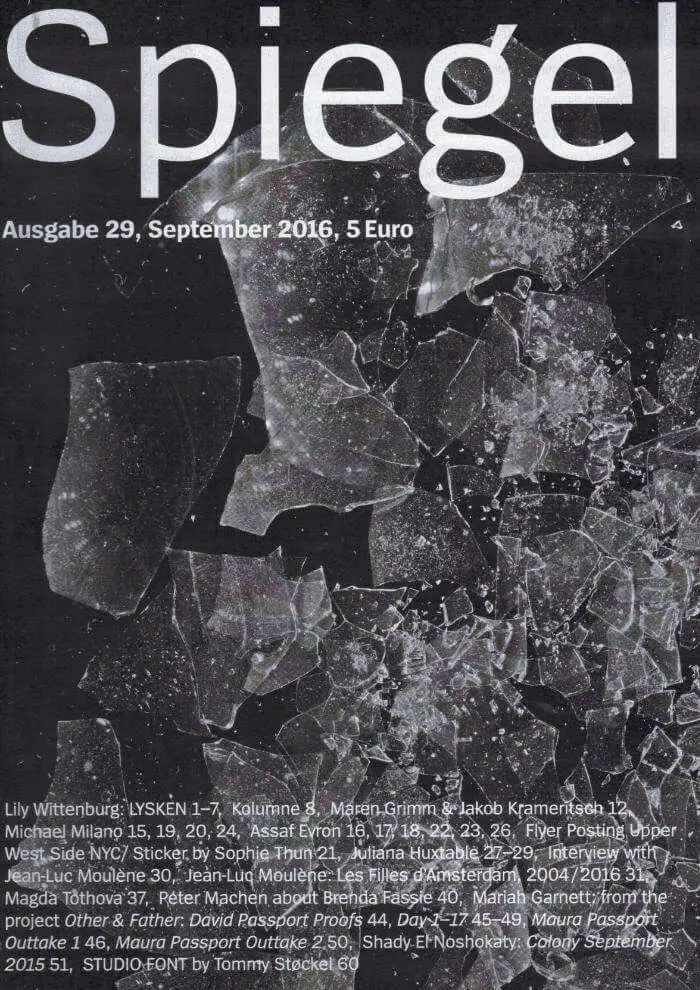
ztscript 29 : Spiegel
This issue uses the font designed for german news magazine Spiegel by amazing Lucas de Groot. The color poster is part of the full print of the series “Les Filles d’Amsterdam” by photographer Jean-Luc Moulène. It is the first time this series is printed in book form and in an exclusive interview the artist tells the story of that work.
Contributors: Lily Wittenburg, Maren Grimm & Jakob Krameritsch, Michael Milano, Assaf-Evron, Sophie Thun, Juliana Huxtable, Interview with Jean-Luc Moulène, poster by Jean-Luc Moulène, Magda Tóthová, Peter Machen on Brenda Fassie, Mariah Garnett, Shady El NoshokatyTommy Støckel

The Seers
The Seers follows the first weeks of a homeless Eritrean refugee in London. Set around a foster home in Kilburn and in the squares of Bloomsbury, where its protagonist Hannah sleeps, the novel grapples with how agency is given to the sexual lives of refugees, insisting that the erotic and intimate side of life is as much a part of someone’s story as ‘land and nations’ are.
Hannah arrives in London with her mother’s diary, containing a disturbing sexual story taking place in Keren, Eritrea, where the Allies defeated the Italians in the Second World War. In a gripping, continuous paragraph, The Seers moves between the present day and the past to explore intergenerational histories and colonial trauma alongside the psychological and erotic lives of its characters as their identities are shaped, but refused to be suppressed, by the bureaucratic processes of the UK asylum system.
Sulaiman Addonia is an Eritrean-Ethiopian-British novelist. He spent his early life in a refugee camp in Sudan, and his early teens in Jeddah, Saudi Arabia. He arrived in London as an underage unaccompanied refugee without a word of English and went on to earn an MA in Development Studies from SOAS and a BSc in Economics from UCL. His first novel, The Consequences of Love (Chatto & Windus, 2008), was shortlisted for the Commonwealth Writers’ Prize and was translated into more than 20 languages. His second novel, Silence is My Mother Tongue (Indigo Press, 2019; Graywolf, 2020), was a Finalist for the Lambda Literary Awards 2021, the Firecracker (CLMP) Awards, the inaugural African Literary Award from The Museum of the African Diaspora (MoAD) in San Francisco, and longlisted for the 2019 Orwell Prize for Fiction. Addonia’s essays appear in LitHub, Granta, Freeman’s, The New York Times, De Standaard and Passa Porta. He is a contributor to Tales of Two Planets (Penguin, 2020) and Addis Ababa Noir (Akashic Books, 2020).

The Debutante and other stories
A debutante frees a hyena from the zoo so that it might take her place at her coming-out ball; an artist paints a portrait of a man’s dead wife, but finds she has painted herself instead; a woman makes love to a boar underneath a mountain of cats; a chicken is roasted with the brains and livers of thrushes, truffles, crushed sweet almonds, rose conserve and drops of divine liqueur; two noble sisters wonder whether anybody can be ‘a person of quality if they wash away their ghosts with common sense’; a psychoanalyst must decide what to do with the gift of a team of Russian rats trained to operate on humans. In this first complete edition of Leonora Carrington’s short stories, written throughout her life from her early years in Surrealist Paris to her late period in Dirty War-era Mexico City, the world is by turns subversive, funny, sly, wise and disarming.

Afterimages 3: Lis Rhodes Volume 1
This DVD contains:
Light Reading, 1978, 20 min.
Pictures on Pink Paper, 1982, 35 min.
Cold Draft, 1988, 28 min.
Lis Rhodes has been at the forefront of British experimental filmmaking since the early 1970s. She studied at the North East London Polytechnic and the Royal College of Art. A strong formal aesthetic has been developed in her films, reflecting her involvement with the debates and practice which emerged from the London Filmmakers' Co-operative, where she was Cinema Curator 1975-6. Early 'expanded' works such as Light Music (1975) fused performance and multi-screen projection with an exploration of the visual qualities of sound. Her analysis of broader political and social questions can be traced to her later films, which combine formal rigour with a passionate critique of issues from nuclear power to domestic violence. As an active campaigner for women's rights, Rhodes was a founder member of Circles, the first women's artist film and video (1979) and was an Arts Advisor to the Greater London Council between 1982 and 1985. She lives and works in London and teaches at Slade School of Fine Art, University College, London.

That They Were at the Beach
For this collection of poems and prose, Leslie Scalapino has gathered four sequences into what she calls an “aeolotropic series.” The poems reflect each other like crystals and change like highly polished glass illuminated by a shifting light. They follow the mind from thought and observation to afterthought, reflection, and obsession.
Leslie Scalapino (1947-2010) is the author of thirty books of poetry, prose, inter-genre fiction, plays, and essays, including numerous collaborations with artists, writers, and dancers. Her long poem way (North Point Press, 1988) won the Poetry Center Award, the Lawrence Lipton Prize, and the American Book Award from the Before Columbus Foundation. Scalapino taught at the Naropa Institute, Bard College, Mills College, and UC San Diego. She was the editor and founder of O Books.

Unbidden Tongues #10: Professional Agitator
From the beginning, Unbidden Tongues has claimed to publish 'previously produced yet relatively uncirculated work by cultural practitioners busy with questions surrounding civility and civic life-particularly in relation to language and its administration.' However, over the course of the first nine issues, the 'civic' aspect has been relatively less pronounced, though undeniably subtextual. As such, Professional Agitator-a publication that includes two landmark feminist articles by Jo Freeman-is an attempt to bring civic responsibility more overtly to the surface. While first penned in the 1970s, the articles have a timely relevance, not only because, shockingly, many of the issues on the bill for the women's movement at Freeman's time of writing-employment discrimination, affordable childcare, reproductive rights and sexuality- are back on the table in the U.S. and elsewhere with full force, but also because, in thinking intersectionally as the movement taught me to do, we find ourselves in a moment of necessary and urgent mobilisation for Palestine; with speaking up and out being reprimanded with various forms of organised silencing.
(From the foreword)

Life with Fifi
Kris Dittel, Angelica Falkeling
A children’s book without a specific age category, offering a glimpse into the small rituals and shared moments that shape a day with Fifi Paris.
Fifi, a Pomeranian-Chihuahua mix, came into the lives of Angelica and Kris a few years ago. Taking care of a puppy is taking responsibility for building their world and letting the small animal transform yours. As her human caretakers, the authors created Fifi’s world with toys, cuddles, rules, snacks and walks in the park. In return, she transforms our world by bringing our community together and reminding us of the importance of caring for one another. In this book, Kris and Angelica narrate a day in the life of Fifi, from the moment she wakes up to when she falls asleep at night. Along the way, they share how they connect with her, how they see her understanding her surroundings and what she has taught them about companionship.
Design by Amy Suo Wu
Copy-editing by Clem Edwards
Photography by Lili Huston-Hertreich
Nasleep
Nasleep neemt de protesten rondom het Gezi Park in 2013 als vertrekpunt en verkent gaandeweg wat er is overgebleven van dit historische moment waarin een andere wereld voor het grijpen leek. Het zijn gedichten die laveren tussen ritmische, conceptuele en kritische noise enerzijds en postrevolutionaire affecten anderzijds, tussen politisering enerzijds en onmacht en radeloosheid anderzijds.