rile*books

Search books

Search books by title, author, publisher, keywords...

Cover of The Highest Apple: Sappho and the Lesbian Poetic Tradition

Sinister Wisdom

The Highest Apple: Sappho and the Lesbian Poetic Tradition

Judy Grahn

€23.00

In 1985, Judy Grahn boldly declared that lesbians have a poetic tradition and mapped it from Sappho to the present day in the groundbreaking book, The Highest Apple. In this new and updated edition of The Highest Apple: Sappho and the Lesbian Poetic Tradition, Grahn revisits the original text with her characteristic ferocious intellect, passion for historical research, careful close readings, and dynamic storytelling. Grahn situates poetry by Sappho, Emily Dickinson, Amy Lowell, H.D., Gertrude Stein, Adrienne Rich Paula Gunn Allen, Audre Lorde, Pat Parker, and Olga Broumas as central to lesbian culture—and more radically as central to society as a whole.

This new edition of The Highest Apple: Sappho and the Lesbian Poetic Tradition includes Grahn’s in depth analysis of poetic work by her friend and comrade Pat Parker and suggests a transactional approach to poetry as uncovering layers of the self. Grahn assembled this text in conversation with two younger lesbian poets, Alicia Mountain and Alyse Knorr, demonstrating the continued relevance and dynamism of The Highest Apple for contemporary readers. A new introduction by Grahn, a foreword by Alyse Knorr, and editor notes by Alicia Mountain along with six responses by contemporary poets Donika Kelly, Kim Shuck, Serena Chopra, Zoe Tuck, Saretta Morgan, and Khadijah Queen highlight the on-going significance of The Highest Apple to readers, writers, and thinkers.

Published in 2023 ┊ 304 pages ┊ Language: English

recommendations

Cover of Celebrating the Michigan Womyn's Music Festival

Sinister Wisdom

Celebrating the Michigan Womyn's Music Festival

Sinister Wisdom

Sinister Wisdom 103: Celebrating the Michigan Womyn's Music Festival honors the forty-year legacy of the Michigan Womyn’s Music Festival (1976–2015). Sinister Wisdom 103: Celebrating the Michigan Womyn's Music Festival celebrates this embodiment of radical feminist separatist collaboration, transformational self-defined autonomous spaces, a commitment to sisterhood and matriarchal culture, and a musical city sprung from the earth for one week in the woods.

A collective of five womyn each with a deep connection to Fest operated by consensus to create this issue. Striving to represent a range of womyn’s voices, values, traditions, and experiences of Fest, the collective highlighted what Fest has meant to generations of womyn, documented its chronology, and bore witness to the power of this community. Sinister Wisdom 103: Celebrating the Michigan Womyn's Music Festival includes womyn from multiple races, geographies, sexualities, generations, and gender and other social identities. Just as Fest brought together womyn from various backgrounds, our collection includes a range of artistic experience, from seasoned authors and photographers to those womyn new to publishing.
Sinister Wisdom 103: Celebrating the Michigan Womyn's Music Festival remembers the transformations, possibilities, and hopes for spaces cultivating the ongoing empowerment of womyn.

Cover of Sister Love: The Letters of Audre Lorde and Pat Parker 1974-1989

Sinister Wisdom

Sister Love: The Letters of Audre Lorde and Pat Parker 1974-1989

Julie R. Enszer

Poets Audre Lorde and Pat Parker first met in 1969; they began exchanging letters regularly five years later. Over the next fifteen years, Lorde and Parker shared ideas, advice, and confidences through the mail. They sent each other handwritten and typewritten letters and postcards often with inserted items including articles, money, and video tapes.

Sister Love: The Letters of Audre Lorde and Pat Parker 1974-1989 gathers this correspondence for readers to eavesdrop on Lorde and Parker. They discuss their work as writers as well as intimate details of their lives, including periods when each lived with cancer. Sister Love is a rare opportunity to glimpse inside the minds and friendship of two great twentieth century poets.

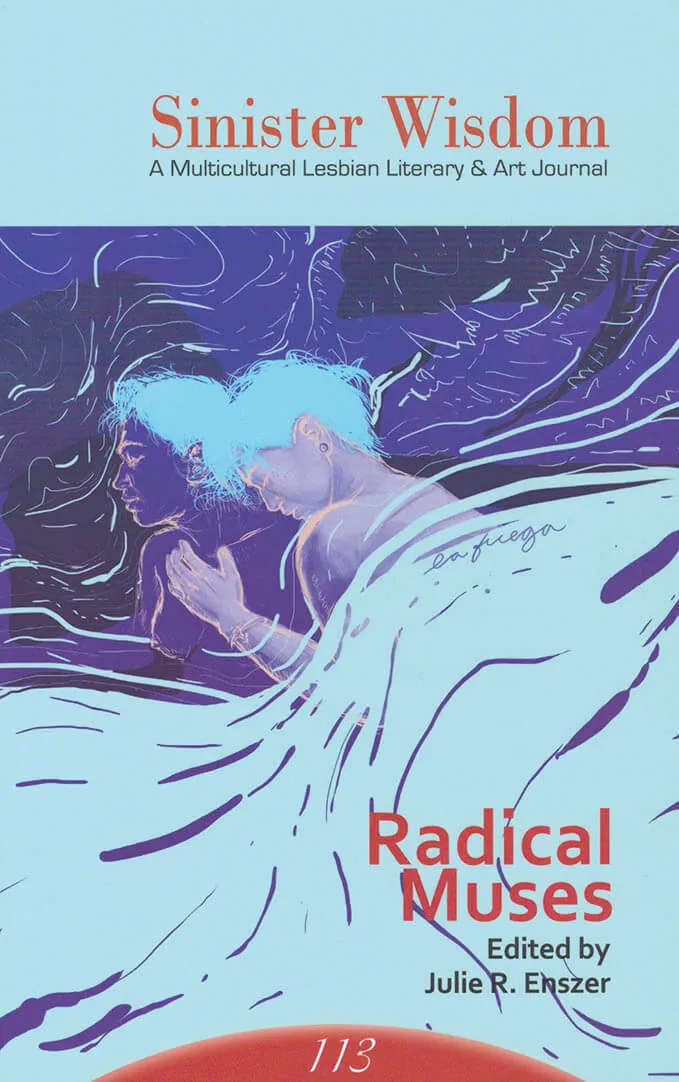
Cover of Radical Muses (Sinister Wisdom nr. 113)

Sinister Wisdom

Radical Muses (Sinister Wisdom nr. 113)

Julie R. Enszer

Sinister Wisdom 113: Radical Muses features an eclectic array of contemporary poetry, prose, and art by lesbians from around the world, including new work by: Andrea Assaf, Tara Shea Burke, Cheryl Clarke, Marina Chirkova, Estela González, Barbara Haas, Nancy E. Lake, Vi Khi Nao, H. Ní Aódagaín and much more!

Cover of Slips of the Mind: Poetry as Forgetting

University of Chicago Press

Slips of the Mind: Poetry as Forgetting

Jennifer Soong

An audacious account of what happens when forgetting becomes a way of writing and writing becomes a way of forgetting.  

In Slips of the Mind, poet and critic Jennifer Soong turns away from forgetting’s long-standing associations with suppression, privation, and error to argue that the absence or failure of memory has often functioned as a generative creative principle. Exploring forgetting not as the mere rejection of a literary past or a form of negative poetics, Soong puts to the test its very aesthetic meaning. What new structures, forms of desires, styles, and long and short feelings do lapses in time allow? What is oblivion’s relationship to composition? And how does the twentieth-century poet come to figure as the quintessential embodiment of such questions? 

Soong uncovers forgetting’s influence on Gertrude Stein, Lyn Hejinian, Tan Lin, Harryette Mullen, Lissa Wolsak, and New York School poets John Ashbery, James Schuyler, Bernadette Mayer, and Ted Berrigan, among others. She reveals that forgetting’s shapeshifting produces differences in poetic genre, interest, and degrees of intentionality—and that such malleability is part of forgetting’s nature. Most provocatively, Soong shows how losing track of things, leaving them behind, or finding them already gone resists overdetermination and causality in the name of surprise, as poets leverage forgetting in order to replace identity with style. Slips of the Mind is the kind of literary criticism that will reward all readers of modern and contemporary poetry.

Cover of Pasts, Futures, and Aftermaths: Revisiting the Black Dada Reader

DABA

Pasts, Futures, and Aftermaths: Revisiting the Black Dada Reader

Adam Pendleton

The sequel to Pendleton's acclaimed Black Dada Reader, compiling an anti-canon of radical experimentation and thought.

In 2011, artist Adam Pendleton (born 1984) assembled Black Dada Reader, a compendium of texts, documents and positions that elucidated a practice and ethos of Black Dada. Resembling a school course reader, the book was a spiral-bound series of photocopies and collages, originally intended only for personal reference, and eventually distributed informally to friends and colleagues. The contents - an unlikely mix of Hugo Ball, W.E.B. Du Bois, Adrian Piper, Gertrude Stein, Sun Ra, Stokely Carmichael, Gilles Deleuze -formed a kind of experimental canon, realized through what Pendleton calls radical juxtaposition. In 2017, Koenig Books published the Reader in a hardcover edition, with newly commissioned essays and additional writings by the artist. A decade later, Pendleton has composed another reader, building upon the constellation of writers, artists, filmmakers, philosophers and critics that emerged in the first volume.

Source texts by Sara Ahmed, Mikhail Bakhtin, Toni Cade Bambara, Amiri Baraka, Augusto de Campos, Hardoldo de Campos, and Décio Pignatari, Angela Davis, Gilles Deleuze, Julius Eastman, Adrienne Edwards, Clarice Lispector, Achille Mbembe, Philippe-Alain Michaud, Charles Mingus, Piet Mondrian, Leslie Scalapino, Leonard Schwartz and Michael Hardt, Juliana Spahr, Cecil Taylor and Malcolm X.

Cover of The Autobiography of H. LAN Thao Lam

Dorothy, a publishing project

The Autobiography of H. LAN Thao Lam

Lana Lin

LGBTQI+ €19.00

Situated between memoir, social criticism, and conceptual art, The Autobiography of H. Lan Thao Lam is an incisive response to a modernist classic and an affecting exploration of the poetics and politics of our times. "We are supposed to know where we are with biography and autobiography, they are the literary equivalents of the portrait and the self-portrait," writes Jeanette Winterson about Gertrude Stein's 1932 classic, The Autobiography of Alice B. Toklas. By narrating her own story from the perspective of her partner, Stein invented a literary form that was both intimate and uncanny, blurring lines of authority and identity as it winds through a story of two women living and loving together through a tumultuous moment in history. Almost a century later, experimental filmmaker and artist Lana Lin has resurrected Stein's project to tell another story of queer love, life, and artistic collaboration in a differently discordant age. At heart a candid chronicle of her partner Lan Thao's life journey from Vietnam during the war and her own troubled history as a gender-queer Taiwanese American, Lin's Autobiography draws in subjects as varied as photography, tropical fruit, New York real estate, and queer theorist Eve Sedgewick's eyeglasses, weaving a landscape of living that is also a critical investigation of race and gender in our time. 

Lana Lin is a writer, artist, and filmmaker based in New York and Connecticut. She is the author of the book Freud's Jaw and Other Lost Objects: Fractured Subjectivity in the Face of Cancer and film and video works including The Cancer Journals Revisited. Her various works and collaborative projects (with Lan Thao Lam as "Lin + Lam") have exhibited at festivals and art and educational spaces throughout the world, including the Museum of Modern Art, Whitney Museum, and New Museum, New York; The National Gallery of Art, Washington, D.C.; Gasworks, London; the Taiwan International Documentary Festival and Taiwan Film and Audiovisual Institute, New Taipei City; Arko Art Center, Korean Arts Council, Seoul; and the 2018 Busan Biennale. Having had three years of psychoanalytic training before dropping out, she sometimes still dreams of becoming a psychoanalyst one day.

Cover of The Power of Adrienne Rich: A Biography

Nan A. Talese

The Power of Adrienne Rich: A Biography

Hillary Holladay

Poetry €30.00

The first comprehensive biography of Adrienne Rich, feminist and queer icon and internationally revered National Book Award winning poet.

Adrienne Rich was the female face of American poetry for decades. Her forceful, uncompromising writing has more than stood the test of time, and the life of the woman behind the words is equally impressive. Motivated by personal revelations, Rich transformed herself from a traditional, Radcliffe-educated lyric poet and married mother of three sons into a path-breaking lesbian-feminist author of prose as well as poetry. In doing so, she emerged as both architect and exemplar of the modern feminist movement, breaking ranks to denounce the male-dominated literary establishment and paving the way for the many queer women of letters to take their places in the cultural mainstream. Drawing on a wealth of unpublished materials, including Rich's correspondence and in-depth interviews with numerous people who knew her, Hilary Holladay digs deep into never-before-accessed sources to portray Rich in full dimension and vivid, human detail.

Cover of Wrap, History and Syncope

Varamo Press

Wrap, History and Syncope

Isabel de Naverán

Non-fiction €12.00

18 July 1936, Bayonne. After hearing the news of the Fascist uprising, the Spanish dancer and bailaora Antonia Mercé y Luque, known as La Argentina, suffers a syncope and dies in fateful synchrony with the Second Republic. History, and the artist’s body, have been seized and broken by the event.

In close dialogue with images and historical documents, Isabel de Naverán pursues the reverberations of that shock and how it resonates with collective pain and artistic translations (by Federico García Lorca, Gertrude Stein, Kazuo Ohno and others). How does history affect and move through bodies? How do living bodies carry and pass on cultural legacy and collective memory? What do these complex movements reveal about the present? Wrap, History and Syncope is an affective journey that invites the reader into tracing and revisiting other bodies, to ultimately dance their difference and multiplicity for oneself.

Isabel de Naverán is a writer and researcher. Concern with the passage and use of time is the backbone of her work, which focuses on bodily transmission and the examination of the concept of historical time by way of ephemeral and fugitive practices. She holds a PhD in art from the University of the Basque Country.  

Translation from Spanish: Toni Crabb
Graphic design: Michaël Bussaer