rile*books

Search books

Search books by title, author, publisher, keywords...

Cover of Celebrating the Michigan Womyn's Music Festival

Sinister Wisdom

Celebrating the Michigan Womyn's Music Festival

Sinister Wisdom

€10.00

Sinister Wisdom 103: Celebrating the Michigan Womyn's Music Festival honors the forty-year legacy of the Michigan Womyn’s Music Festival (1976–2015). Sinister Wisdom 103: Celebrating the Michigan Womyn's Music Festival celebrates this embodiment of radical feminist separatist collaboration, transformational self-defined autonomous spaces, a commitment to sisterhood and matriarchal culture, and a musical city sprung from the earth for one week in the woods.

A collective of five womyn each with a deep connection to Fest operated by consensus to create this issue. Striving to represent a range of womyn’s voices, values, traditions, and experiences of Fest, the collective highlighted what Fest has meant to generations of womyn, documented its chronology, and bore witness to the power of this community. Sinister Wisdom 103: Celebrating the Michigan Womyn's Music Festival includes womyn from multiple races, geographies, sexualities, generations, and gender and other social identities. Just as Fest brought together womyn from various backgrounds, our collection includes a range of artistic experience, from seasoned authors and photographers to those womyn new to publishing.
Sinister Wisdom 103: Celebrating the Michigan Womyn's Music Festival remembers the transformations, possibilities, and hopes for spaces cultivating the ongoing empowerment of womyn.

Language: English
recommendations

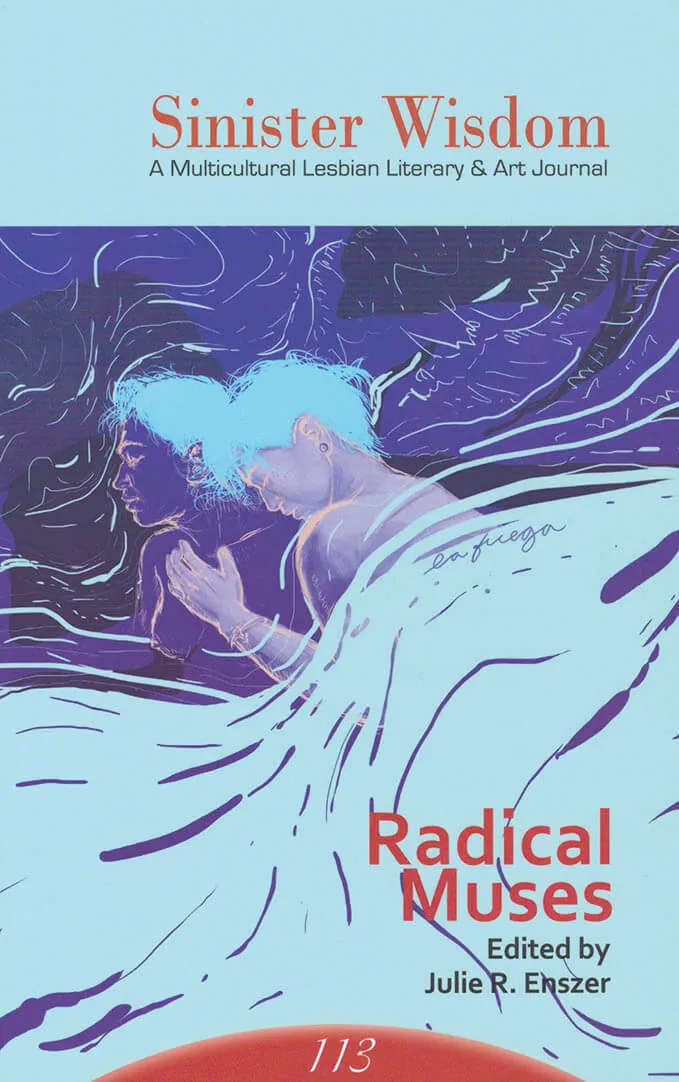
Cover of Radical Muses (Sinister Wisdom nr. 113)

Sinister Wisdom

Radical Muses (Sinister Wisdom nr. 113)

Julie R. Enszer

Sinister Wisdom 113: Radical Muses features an eclectic array of contemporary poetry, prose, and art by lesbians from around the world, including new work by: Andrea Assaf, Tara Shea Burke, Cheryl Clarke, Marina Chirkova, Estela González, Barbara Haas, Nancy E. Lake, Vi Khi Nao, H. Ní Aódagaín and much more!

Cover of Pages 9 - Seep

Pages Magazine

Pages 9 - Seep

Babak Afrassiabi, Nasrin Tabatabai

Periodicals €12.00

This issue of Pages assumes seep as a post archival mode: in the Merriam-Webster dictionary the verb 'seep' is translated as follows: to flow or pass slowly through fine pores or small openings, to enter or penetrate slowly, to become diffused or spread.

The biology or politics of seeping is like that of raw petroleum oozing at natural oil seeps. Unlike refined oil which has sponsored modernization and its aligned archives, crude oil pours beyond historical purpose and defies structural elevations. It instead disfigures the ground through which it dubiously spreads.

Seeping is a posthumous affair. It is the gradual leaking of a long withdrawn interior. Like the bleeding of a punctured corpse, when the pumping of the heart has stopped, when the body is lifeless and apathetic to any 'hail', yet continuing to bleed. Seep as archive is an eternally post-apocalyptic expansion, retraction, deviation, subtraction, or simply the arrival of (non-)things.

With contributions by:

- Mariam Motamedi Fraser / Geo-Archive
- Richard Goldstein / Dennis Oppenheim's Dilemma: Should he Sell Art to the Shah?
- Babak Afrassiabi, Nasrin Tabatabai / Contemporary Hole / Unfilmable
/ Seep
- Saleh Najafi / Wounds of Archive¹
- Mark von Schlegell / The Artist Abstract #6
- Nima Parzham / The underground
- Adam Kleinman / Vanished Theories
- Suzanne Treister / Algorithm
- Alexi Kukuljevic / The Dissolute Subject
- Matts Leiderstam / Andy Warhol, Suicide (Purple Jumping Man), 1963
- Eugene Thacker / Black Infinity; or, Oil Discovers Humans
- Vivian Ziherl, Natasha Ginwala / Infrastructural Suspensions: Global Spanning, Atmospheric Seepage and Measures of the Undecidable

Cover of Heatwave #2

Self-Published

Heatwave #2

Periodicals €17.00

 In an era when many “radical” theorists were seeking out the peaceable expression of politics in “everyday utopias,” Joshua Clover stressed that politics was always, at root, a fiery confrontation with the powers that be. To these ends, he not only helped bring together a new generation of young communists but also pushed them to engage directly with the rising tide of class conflict, understanding full well that the street and the shopfloor are the true classrooms of the partisan.

Heatwave is, in a sense, an attempt to embody this spirit at a larger scale. Like Joshua, we hope to serve as an engine of engagement, linking our readers to their own history and to one another. Like Joshua, we adopt a principle of ecumenicism, refusing the false dividing lines inherited from the long dissolution of the last global communist movement. At the same time, like Joshua, we also insist on a theoretically rigorous approach that invokes the real complexity of revolutionary theory and history, actively seeks evidence for its claims, and engages in good faith with opposing positions. And, like Joshua, we maintain that the partisan project is inherently incendiary, requiring confrontation with the rulers of the world, rather than gradualist compromise or secessionist retreat. Finally, communism requires an unambiguous commitment to internationalism. Although our project is currently anglophone, we recognize that elaborating a partisan politics requires learning from the self-activity of the dispossessed at the global scale.

The name "Heatwave" echoes that of an old Situationist magazine ("Britain's most incandescent journal" of 1966), but with added urgency in an era where every summer is the hottest on record. While the statistical certainty of catastrophe is inescapable, "revolt" names many species of conflagration, including that peculiar variety we call communism. We must sift through the ashes to find it.

Cover of Efemmera Reissue #3: Saving Seeds: Metaphors of Lesbian Growth

Alder & Frankia

Efemmera Reissue #3: Saving Seeds: Metaphors of Lesbian Growth

Jennifer Weston

Originally published in 1987, Saving Seeds: Metaphors of Lesbian Growth, a special issue of Maize: A Lesbian Country Magazine, was created by artist and writer Jenna Weston as a tribute to "magical female-oriented gardens."

From her Introduction: "I have found that, generally speaking, lesbian gardens are works of art. We make intricate designs with twine between sapling posts. Later, these weavings support tomato vines. Bright colored ribbons flutter from the tops of tall bean poles. Raised vegetable beds are sculpted into various graceful shapes. The winding paths are edged in pieces of broken pottery and stones we've found. We build altars in the centers of our gardens, and hold rituals between the onions and the lettuce."

"I asked wimmin to send me drawings and photos and descriptions of their magical female-oriented gardens. The replies came from near and far, and make up a part of this book. The rest of the book contains poems and prose that came directly from my experiences as a gardener and a lesbian."

This reissue reimagines the black and white stapled original in a bounty of earth tones: different colored French Papers are risograph printed in green, brown, and orange ink. The book is handsewn with gradient thread. Also included is a recent interview with Jenna Weston printed as an 11x17 leaflet, reversed with a poster of one of the garden diagrams in the book.

Cover of Issue 7: Daffodils

Pleasant Place

Issue 7: Daffodils

Periodicals €14.00

Many bulbous plants have been dubbed ‘heralds of spring’, but none is more deserving of the title than those carrying actual megaphones to spread the word – daffodils. To know a daffodil is to love a daffodil. Come join our cult.

Including:
I Like the Daffodils – An introduction by Lou-Lou van Staaveren to the genus Narcissus, with amazing photographs by Elspeth Diederix from her garden.
Dafs in Art History – Painters, poets and writers all over the world, have been inspired by the daffodils’ dual aura of macabre and threatening elegance.
The Daffodil Society – The members of The Daffodil Society in the UK promote the genus Narcissus for everyone’s greater pleasure. Photographer Luke Stephenson followed them to various shows where their flowers are reviewed.
How to follow your nose – Philosopher Christopher F. Julien invites us into his fragrant garden where scent mixes with memories with drawings by Pom Koolen.
Artist Tina Farifteh digs into her personal archive and writes a beautiful account of her memories growing up in Iran, and how daffodils have become a staple for New Year’s celebrations and a symbol of hope.

Cover and inside cover by Lou Buche
Centrefold miniatures by Jesse Fischer

Cover of Matters of Feminist Practice

Belladonna* Collaborative

Matters of Feminist Practice

Karla Kelsey, Poupeh Missaghi

Matters of Feminist Practice, edited by Poupeh Missaghi and Karla Kelsey, brings together scholars, writers, poets, and artists of different identities and backgrounds to confer on the urgent topic of “feminist practice” through seven topics: the body, the quotidian, hybridity, language, documentation, environment, and conflict.

In the twenty-five scholarly and creative-critical pieces included in our introductory volume, each contributor brings unique visions, insights, approaches, voices, and forms to launch the conversation, which will continue to unfold online at mfpjournal.com. 

Contributors to the inaugural issue include: Alexis Almeida, Mary-Kim Arnold, Mildred Barya, Teresa Carmody, Julie Carr, Serena Chopra, Caroline Crumpacker, Lynne DeSilva-Johnson, Marcella Durand, Jennifer Firestone, Yanara Friedland, Carla Harryman, Madhu Kaza, Petra Kuppers, Jean Lee, Rachel Levitsky, Megan Madden, Saretta Morgan, Lida Nosrati, Adrienne Perry, Frances Richard, Kat Savino, Celina Su, and Rachael Guynn Wilson.