rile*books

Search books

Search books by title, author, publisher, keywords...

Cover of Pfeil Magazine #19 – Rest

Montez Press

Pfeil Magazine #19 – Rest

Anja Dietmann ed., Nina Kuttler ed.

€15.00

There is no pause without prior exertion, and this issue of the magazine explores rest and all its associated contexts and contradictions. Amidst increasing environmental pollution, a tenuous global political climate, and a performance-oriented society demanding ever greater productivity, the balance between rest and labour becomes skewed. Pausing carries the risk of falling behind, but this risk can be mitigated by knowing when to rest. This issue examines rest as activity and as resistance. It questions how the individual body, in cohesion with a community, can generate weight through relaxation and distribute it. 

Contributors: Asma Ben Slama, Camila Cañeque, Christiane Blattmann, Eileen Myles, Federico Tosi, Gelare Khoshgozaran, Hanne Loreck, Hans-Christian Dany, Hyemin Yang, Ingrid Jäger, Jenni Bohn, Jochen Lempert, Julia Schulze Darup, Mariona Berenguer, Matthias Schubert, Mikołaj Sobczak, Mirene Arsanios, Nat Raha, Nicholas Grafia, Niclas Riepshoff, Omar Hahad, Sarah Drath, Stacy Skolnik, Thomas Laprade, Vir Andres Hera

Within the format of a magazine, each page of Pfeil represents the floor, walls, or ceiling which together create an imagined room displaying a printed exhibition. Each issue is dedicated to a specific word, and artists are invited and given space to work on and with this term, and to construct or deconstruct the architecture around it. Combined, the contributions transform into an organic display surrounding the leitmotif.

Published in 2026 ┊ 68 pages ┊ Language: English

recommendations

Cover of Prepositions

Montez Press

Prepositions

Aaron Lehman, Timmy Simonds

Prepositions enacts a distinction between what language says and what it does. A catalogue of exercises, interviews, essays and creative explorations, this workbook-compendium invites the reader to investigate how we practise empathy, understanding, and contact, by learning and teaching all at once. Building on the archive of Montez Press Radio show Tongue and Cheek, and featuring work from a stellar cast of previous participants in the broader project, Prepositions asks us what active and embodied participation really means, not just in teaching, but across a whole life.

This book will change your body—and your mind. Prepositions is a set of bite-sized propositions for being and thinking otherwise. Put it under your tongue and see what happens.
— Leah Pires

This compendium of witty exercises, moving personal reflections, curious propositions, and carefully selected graphics invites readers to explore what it means to inhabit a book. It is the product of many hands, a polyphonic choir, filled with immense care and a deep sense of friendship. As one feels its weight, moves around it, folds its pages, breaths with it, or reads it out aloud, one begins to wonder: what does the book need to be completed?
Prepositions—inscribed in the tradition of works as disparate as Robert Filliou’s Teaching and Learning as Performing Arts and CAConrad’s poetry rituals—is an exercise of radical pedagogy and readership. Everyone who enters this book becomes part of its contents.
— Alice Centamore

Cover of The Interjection Calendar 005

Montez Press

The Interjection Calendar 005

Emily Pope, Christiane Blattmann

For the Interjection Calendar each month Montez Press invites an artist, a writer, a poet or a doer of some sorts to say things. All 12 pieces have introspection and reflection in common. They are a subjective overview of writing in the expanded field of contemporary art and writing in the year 2019. This is the Interjection Calendar 2019, the fifth collection in this series. 

With contributions by sabrina soyer, Lisa Robertson, Hatty Nestor, Adrianna Whittingham, Sondria, Claudia Pagès, Laetitia Paviani, Bella Milroy, Georgina Tyson, Son Kit, Alix Jean Vollum, Rene Matic and bleubaglife. 

Find the last 12 PDF's on montezpress.com.

Cover of Jaw Filler

Montez Press

Jaw Filler

Maz Murray, Charlie Markbreiter

Fiction €22.00

'You don't need dysphoria to be trans. You don't need a body at all.’

When Sean Hastings, (the first) transgender private detective, is asked to investigate the disappearance of Character, he enters the First Trans Commune in Sim World, a virtual reality community imagineered by transfluencer Kevin and bankrolled by VSI, a mysterious tech company.

At VSI, representation matters, which is why Taylor, the token QTPOC face, runs their latest project. Haunted by the death of his cis gayguy college bestie and their shared diasporic dilemmas, Taylor sees potential in Kevin’s ability to Release trauma into the virtual world, while Casey, Sean’s ex, seeks Releasing as the latest Long Plague miracle cure. Then femme fatale Mitchelle reappears, and the plot thickens.

A pulpy neo-noir romp through the anxiously assimilated transmasculine id, Jaw Filler asks: who is VSI, and what do they really want? Can you be your own dad? And if Character’s mind is trapped in Sim World, then where is his body?

Cover of This Is Not a Memoir

Montez Press

This Is Not a Memoir

Janette Parris

What do you call a memoir that isn’t? In This Is Not a Memoir, Janette Parris incisively narrates a journey through lost high street landmarks of East and South London in a series of detailed artworks blending map, archive and anecdote with deadpan humour. Part graphic novel, part recollection, and accompanied by an in-conversation between Janette Parris and Gilane Tawadros, this is an intimate exploration of what it means to have ownership of public space, from Wimpy to Woolworth’s via Canning Town. And somewhere in the gaps, in absent moments caught gazing at the sky or a kerbside, an impression of a life emerges–or is that just what she wants you to think?

“This book by Janette Parris tells a deflationary yet expressive coming-of-age story in the East End of London. While it may seem fun and superficial, its considerable power lies in how it moves through memories and moments in a witty and light-footed way presented as a roman-à-clef. This Is Not a Memoir is particular in the way it conjures a world of the 1970s and 1980s that is lost to most of London, yet still resonates with what it means to grow up as a working class young woman who ends up at art school and becomes an artist. It is a brave book to make, but one that will be remembered.”
Rachel Garfield, artist, Professor of Fine Art at the Royal College of Art and author of Experimental Filmmaking and Punk: Feminist Audio Visual Culture in the 1970s and 1980s (2021)

Janette Parris is an artist who investigates the contemporary urban experience, using narrative, humour and popular formats including soap opera, stand-up comedy, musical theatre, pop mu-sic, cartoons, comics and animation. Parris has exhibited widely nationally and internationally for 25 years at spaces including TATE, The New Art Gallery Walsall, ICA, Kunsthaus Zürich, Hay-ward Gallery Touring, Art on the Underground and Royal Academy of Arts.

Cover of A Nazi Word for a Nazi Thing

Peninsula Press

A Nazi Word for a Nazi Thing

So Mayer

Essays €12.00

An essay on art, bodies and fascism.

In an era where identity politics is being weaponised against the very people it has sought to make visible, how can we reclaim complexity?

In 1937 the Nazis staged an exhibition of seized modernist artworks. Named Entartete ‘Kunst’ – Degenerate ‘Art’ – it sought to define degeneracy, display it and destroy it.This act of violent appropriation is one episode in a long and ongoing history of the erasure of queer and non-normative cultures.

A Nazi Word for a Nazi Thing works against this erasure; it is a manifesto – a catalogue for an exhibition that could never take place. Drawing on work from dissident sexologist Magnus Hirschfeld to South African artist Zanele Muholi, as well as a century of queer cinema from Sergei Eisenstein to Pedro Almodóvar, So Mayer creates an archive of resistance.

‘This book is a small revolution that becomes a party that you won’t be leaving soon. I believe we’re living in a time of fresh erasures, systemic violences working that global pandemic to take some other bodies out. Looking so freshly at the history of queerness, sexual deviance and the long long coordinated erasures of colonialism, bigotry and transphobia the essential non binary nature of art opens up right here like the wildly singing flower it is and So Mayer’s compelling version makes sense, makes me listen.’
Eileen Myles

‘A Nazi Word for a Nazi Thing is a reflective, creative walk through some of the worst – and best – people of the last hundred years, looking at the power of images and their relationship(s) with text. In a time of rising fascism, So Mayer highlights ways that artists have found strategies of resistance, and offers hope in historical analysis.’
Juliet Jacques

Cover of Pfeil Magazine #18 – Body

Montez Press

Pfeil Magazine #18 – Body

Anja Dietmann, Nina Kuttler

Periodicals €15.00

From its anatomy and autonomy to its death and diet, this issue focuses on the motif Body and all its meanings, direct and indirect, for instance as in relation to human and non-human bearers of bodies, its inhabitants like bacteria and organs, its social, medical and juridical conditions, its intoxications, chemical processes, traumas, transitions, well-being, replacements, weaknesses, and its opposites.

Contributors: Adam Dickinson, Andrea Éva Győri, A.L. Steiner, Alexandra Ivanciu, Barak Zemer, Bernhard Willhelm, Clara Lena Langenbach, Clémentine Bedos, Constance DeJong, Daisy Hildyard, Fanny Howe, Hanne Loreck, Hasti, Holly Hunter, Ingrid Jäger, Jannis Marwitz, Jess Arndt, Johannes Kuczera, Jolanta Nowaczyk, Henriette Maier, Mag Gabbert, Maja Smrekar, Manuel Vason, R.I.P. Germain, Rebekka Endler, Sonja Yakovleva 

Within the format of a magazine, each page of Pfeil represents the floor, walls, or ceiling which together create an imagined room displaying a printed exhibition. Each issue is dedicated to a specific word, and artists are invited and given space to work on and with this term, and to construct or deconstruct the architecture around it. Combined, the contributions transform into an organic display surrounding the leitmotif.

Cover of Bird Watching and Their First Three Books of Poetry

Fonograf Editions

Bird Watching and Their First Three Books of Poetry

Eileen Myles

Poetry €24.00

Any future film director planning to make a movie of Myles's iconic novel Chelsea Girls (it's always just about to happen) would be wise to read Bird Watching first. Written in 1978 and unpublished until now, the central character of the book is a twenty-something that is already filled with memories. Living in New York City, resplendent, full of both grandeur and awkwardness, they are about to embark on a life fully invested in art. Bliss happens, as does uncertainty. Everything is here and now.

The Irony of the Leash, A Fresh Young Voice from the Plains, and Sappho's Boat, the other collections contained in the volume, comprise the first three books that Myles published, when their promise as one of the most important writers of their generation was just coming into view. Immensely readable, raw, and slightly unhinged, the poetry that comprises these three texts is post young. Slight creaky but fully functional, all of these poems are beautiful and funky.Bird Watching and Their First Three Books of Poetry contains a critical foreword by poet and scholar Rosa Campbell, along with a preface by Eileen Myles contextualizing the book within our contemporary moment.

Eileen Myles (them/them, b. 1949) is a poet, novelist and art journalist whose practice of vernacular first-person writing has made them one of the most recognized writers around town (globally). They live in New York & in Marfa, TX.

Cover of The Autobiography of a Language

Futurepoem

The Autobiography of a Language

Mirene Arsanios

Poetry €22.00

Here the mirror image of the almost hallucinatory, heart-rending loss of the familiar is literary defamiliarization. Arsanios both mourns and blasts apart the notion of the mother tongue, reminding us that for each “mother tongue” at least another tongue is silenced. Desire propels her genre-defying writing, which grief notwithstanding still manages to tongue languages, and that is her genius. — Mónica de la Torre

Mirene Arsanios is the author of the short story collection The City Outside the Sentence (Ashkal Alwan). She has contributed essays and short stories to e-flux journal, Vida, The Brooklyn Rail, The Rumpus, and Guernica, among others. Arsanios co-founded the collective 98weeks Research Project in Beirut and is the founding editor of Makhzin, a bilingual English/Arabic magazine for innovative writing. She teaches at Pratt Institute and holds an MFA in Writing from the Milton Avery Graduate School for the Arts at Bard College. Arsanios currently lives in New York where she was a 2016 LMCC Workspace fellow, and an ART OMI resident in fall 2017. With Rachel Valinsky, she coordinated the Friday night reading series at the Poetry Project from 2017–19.

Cover of My Mother Laughs (UK Edition)

Silver Press

My Mother Laughs (UK Edition)

Chantal Akerman

In 2013, the filmmaker Chantal Akerman's mother was dying. She flew back from New York to Brussels to care for her, and between dressing her, feeding her and putting her to bed, she wrote. She wrote about her childhood, the escape her mother made from Auschwitz but didn't talk about, the difficulty of loving her girlfriend, C., her fear of what she would do when her mother did die. Among these imperfectly perfect fragments of writing about her life, she placed stills from her films. My Mother Laughs is both the distillation of the themes Akerman pursued throughout her creative life, and a version of the simplest and most complicated love story of all: that between a mother and a daughter.

Translated by Daniella Shreir with an introduction by Eileen Myles and afterword by Frances Morgan.

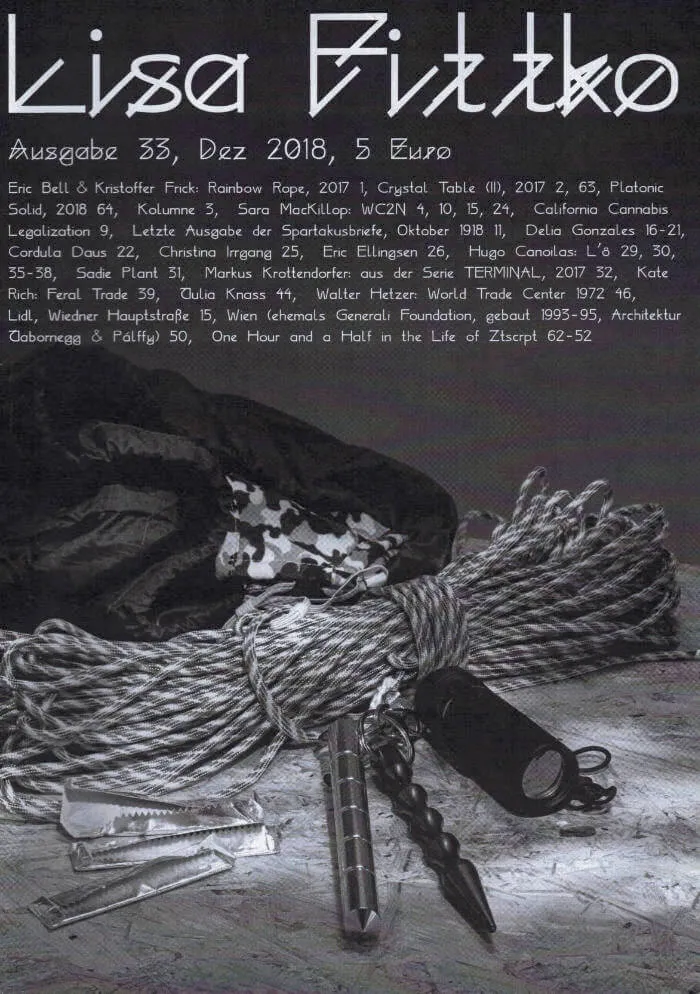
Cover of ztscript 33 : Lisa Fittko

ztscript

ztscript 33 : Lisa Fittko

ztscript

Typeface by Bea Schlingelhoff, from the Project "Women against Hitler"

Eric Bell & Kristoffer Frick: Rainbow Rope, 2017 1, Crystal Table (II), 2017 2, 63, Platonic Solid, 2018 64, Kolumne 3, Sara MacKillop: WC2N 4, 10, 15, 24, California Cannabis Legalization 9, Letzte Ausgabe der Spartakusbriefe, Oktober 1918 11, Delia Gonzales 16-21, Cordula Daus 22, Christina Irrgang 25, Eric Ellingsen 26, Hugo Canoilas: L’ô 29, 30, 35-38, Sadie Plant 31, Markus Krottendorfer: aus der Serie TERMINAL, 2017 32, Kate Rich: Feral Trade 39, Julia Knass 44, Walter Hetzer: World Trade Center 1972 46, Lidl, Wiedner Hauptstraße 15, Wien (ehemals Generali Foundation, gebaut 1993-95, Architektur Jabornegg & Pálffy) 50, One Hour and a Half in the Life of Ztscrpt 62-52

Cover of BOMB 176 / Summer 2026

BOMB Magazine

BOMB 176 / Summer 2026

Periodicals €15.00

INTERVIEWS Dave Eggers by Jim James Jun Kaneko by Mark Mack Lotus L. Kang by Lara Mimosa Montes Reverend Joyce McDonald by Katherine Cheairs Rodney McMillian by Dave McKenzie Ruth Ozeki by Hannah Tinti Samora Pinderhughes by Jason Moran Debra Priestly by Nancy Grossman Elaine Reichek by Sabrina Gschwandtner

FICTION Isabelle Fang, Yuri Herrera, Claire Vaye Watkins
NONFICTION Shaan Sachdev
POETRY Adedayo Agarau, Elena Alexander, Kelsey Day
PORTFOLIO Shraddha Ramani and William Villalongo
COMIC Margaret Barry
EDITOR’S CHOICE Reflections on new works from Horse Lords, Valeria Luiselli, Nicolás Pereda, Julian Radlmaier, and Paul Yoon and a monograph on Theresa Hak Kyung Cha

On the cover: Detail of Rodney McMillian, shaft, 2021–22, latex, acrylic, Flashe, ink, and paper on canvas, six panels, 80 × 4 feet diameter. Photo by Jason Mandella. Courtesy of the artist, Vielmetter Los Angeles, and Petzel, New York City.

BOMB Magazine is a quarterly of artists in conversation begun in 1981 in New York. BOMB publishes interviews across disciplines like visual art, literature, performance, music, dance, film, and is founded on mission of delivering the artist's voice. Publishing print seasonally, BOMB also publishes interviews, flash fiction, studio visits, excerpts, and essays five times a week on our website. 

Cover of MAKAN #3 / Synthetic Agencies

Think Tanger

MAKAN #3 / Synthetic Agencies

Hicham Bouzid, Ali T. As'ad

Periodicals €18.00

Building on the foundations of the first two issues, Synthetic Agencies invites a rethinking [and unthinking] of the assumptions, polarities, and discontents surrounding the notion of agency. Traditionally defined in Western thought as the capacity to act and effect change, agency is inseparable from questions of power and the often invisible structures through which power operates. The various contributions interrogate how agency is produced, constrained, or distributed through the systems of knowledge, design, and governance that shape our built environments, technologies, media, and cultures. They were are invited to right (as much as write on) agency, reflecting on how it operates across different scales and contexts, and imagining alternative worlds or configurations. Ultimately, Synthetic Agencies understands agency not as a fixed attribute but as a contested lens through which we might read, reshape, or resist the conditions of the present.

With contributions by Amine Houari, Driss Ksikes, Fehras Publishing Practices, Hamed Sinno, Helga Tawil-Souri, Lada Hršak, Mayada Madbouly, Myriam Ababsa, Nzinga Biegueng Mboup, Ola Hassanain, Omer Shah, OPPA, Salma Barmani, Samia Henni, Tarek El-Ariss, Zaidoun Hajjar.