rile*books

Search books

Search books by title, author, publisher, keywords...

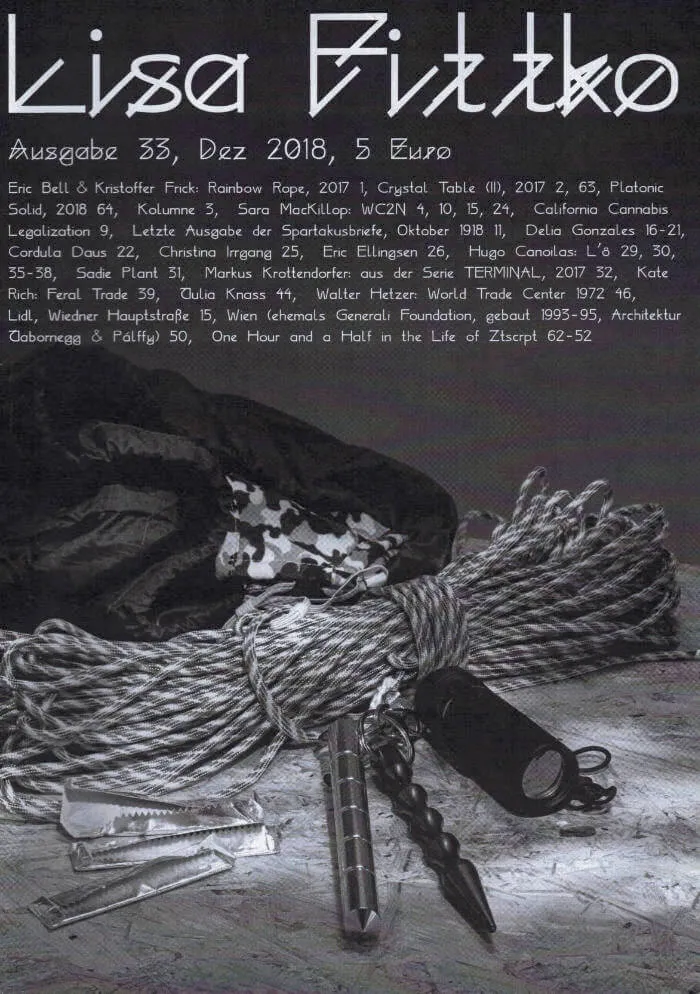
Cover of ztscript 33 : Lisa Fittko

ztscript

ztscript 33 : Lisa Fittko

ztscript

€5.00

Typeface by Bea Schlingelhoff, from the Project "Women against Hitler"

Eric Bell & Kristoffer Frick: Rainbow Rope, 2017 1, Crystal Table (II), 2017 2, 63, Platonic Solid, 2018 64, Kolumne 3, Sara MacKillop: WC2N 4, 10, 15, 24, California Cannabis Legalization 9, Letzte Ausgabe der Spartakusbriefe, Oktober 1918 11, Delia Gonzales 16-21, Cordula Daus 22, Christina Irrgang 25, Eric Ellingsen 26, Hugo Canoilas: L’ô 29, 30, 35-38, Sadie Plant 31, Markus Krottendorfer: aus der Serie TERMINAL, 2017 32, Kate Rich: Feral Trade 39, Julia Knass 44, Walter Hetzer: World Trade Center 1972 46, Lidl, Wiedner Hauptstraße 15, Wien (ehemals Generali Foundation, gebaut 1993-95, Architektur Jabornegg & Pálffy) 50, One Hour and a Half in the Life of Ztscrpt 62-52

Language: English

recommendations

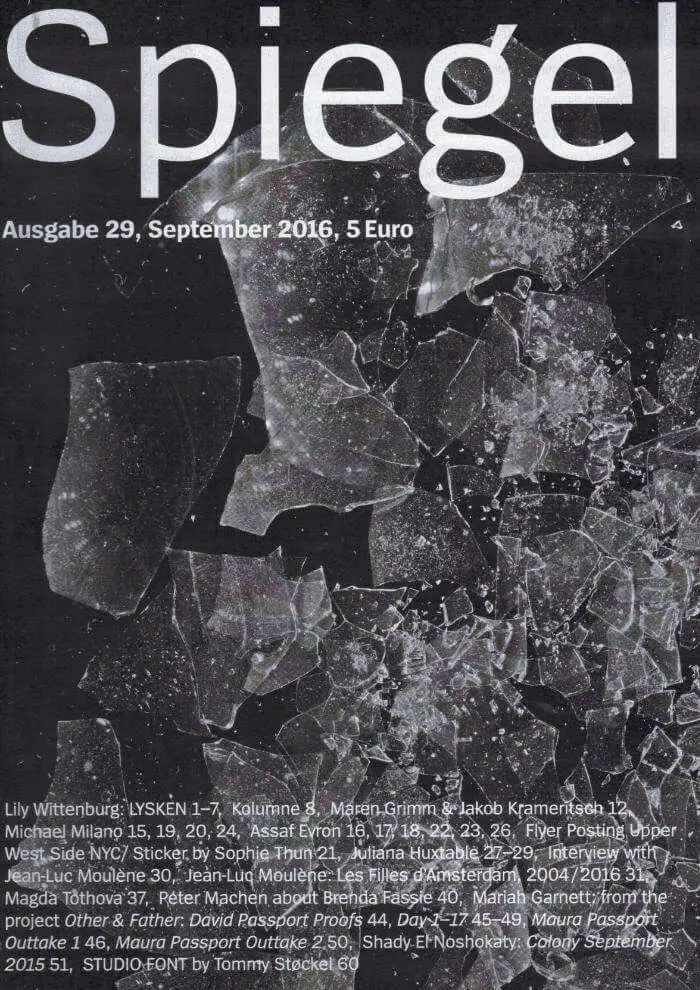
Cover of ztscript  29 : Spiegel

ztscript

ztscript 29 : Spiegel

ztscript

This issue uses the font designed for german news magazine Spiegel by amazing Lucas de Groot. The color poster is part of the full print of the series “Les Filles d’Amsterdam” by photographer Jean-Luc Moulène. It is the first time this series is printed in book form and in an exclusive interview the artist tells the story of that work.

Contributors: Lily Wittenburg, Maren Grimm & Jakob Krameritsch, Michael Milano, Assaf-Evron, Sophie Thun, Juliana Huxtable, Interview with Jean-Luc Moulène, poster by Jean-Luc Moulène, Magda Tóthová, Peter Machen on Brenda Fassie, Mariah Garnett, Shady El NoshokatyTommy Støckel

Cover of sawing a plank is like going for a walk

Posture Editions

sawing a plank is like going for a walk

Kato Six

With texts by Phillip Van den Bossche, Filarowska and a conversation between Eva Wittocx and the artist (NL/EN)


Nº 48 / October 2022

sawing a plank is like going for a walk by Kato Six (b. 1986) is published on the occasion of Kato’s solo exhibition at M Leuven this autumn. This book encapsulates 10 years of her quest as an artist.


The work of Kato Six (b. 1986) balances between abstract and figurative art. She works on different themes which she develops into series or ensembles. Architecture, design, domesticity and utensils all act as important references. Starting there, she uses recognisable and everyday materials such as MDF, stone, plastic or textiles.
Kato wants to question certain affinities and let the viewer look at familiar objects or images from a different perspective. As a viewer, you feel connected to the object or image but the actual meaning or function no longer applies.

Some of my works refer to the domestic, especially the most recent ones, such as ‘Carpet Beater Carpet’ and ‘Striped Knitwear’. The invisible work done by “housewives”, but also by workers or maintenance staff, is certainly one of the themes addressed in ‘Carpet Beater Carpet’. The above works are textile works, created with so-called “soft skills”. In the arts, these “soft skills” are often attributed to female artists — women often being assigned a certain medium.
Kato Six in conversation with Eva Wittocx in “sawing a plank is like going for a walk”

Cover of The Glover Group – A Los Angeles Story

Nero Editions

The Glover Group – A Los Angeles Story

The Glover Group

A portrait of the cohesive community of women artists in Frogtown, Los Angeles, including Ruby Neri, Hilary Pecis, Megan Reed, Lily Stockman, and Austyn Weiner.

The Glover Group: A Los Angeles Story narrates the journey of an extraordinary group of artists who have nurtured their unique artistic voices within the same studio complex in Frogtown, Los Angeles. The Glover Group includes Ruby Neri, Hilary Pecis, Megan Reed, Lily Stockman, and Austyn Weiner, a coincidental yet cohesive community of women artists sharing a unique bond through their interconnected workspace.

This catalog, designed to document their collaborative exhibition held at MASSIMODECARLO in Milan during July and August 2023, features interviews to the artists by Cecilia Alemani, Alison M. Gingeras, Justine Ludwig, Marta Papini, and Heidi Zuckerman, together with photographs by Tracy Nguyen.

Contributions by Ruby Neri & Alison M. Gingeras, Hilary Pecis & Cecilia Alemani, Megan Reed & Marta Papini, Lily Stockman & Heidi Zuckerman, Austyn Weiner & Justine Ludwig.

Cover of The Almond

1080 Press

The Almond

Theadora Walsh

Poetry €25.00

“Today is the day with the letter,” Celan writes to Bachmann on October 30, 1957. Theadora Walsh’s essay-poem, The Almond concerns, for I hesitate to write “about” or “is in relation to”, the love between Paul Celan and Ingeborg Bachmann. Two Austrian writers flung across Europe by the atrocities of the Holocaust, excavating the narrows of a language not theirs, or taken from them. An almond is the closest two people can be, and becomes the binding structural conceit of the book, two segments reaching across the blank page to each other, across history, time and language.

Cover of Deer Book/Libro Venado

Radius Books

Deer Book/Libro Venado

Cecilia Vicuña

Inspired initially by Jerome Rothenberg’s translation Flower World Variations, which Cecilia Vicuña first encountered in 1985, Deer Book brings together nearly forty years of the artist’s poetry, “poethical” translations, and drawings related to cosmologies and mythologies surrounding the deer, and sacrificial dance in cultures around the world.

Woven like one of her quipu installations, Vicuña’s texts—which include original compositions in Spanish as well as English translations by Daniel Borzutzky—become meditations on translation, not just of the sacred nature of this animal but on how our understandings of ceremony and ritual are transformed, by this ongoing process. Taken as inspiration rather than conundrum, the impossibility of translation opens up poetic possibilities for Vicuña as she continues her lifelong exploration into the nature of communication across eras and distant lands, languages and shared symbols within Indigenous spiritualities.

Cover of Le Chauffage #3 - Day Job

Le Chauffage

Le Chauffage #3 - Day Job

Francesca Percival, Felix Rapp and 1 more

Periodicals €20.00

The third issue of Le Chauffage is an inquiry into the relationship between the practices of artists/ writers and their day jobs. This subject stems from a question fundamental to the existing mandate of Le Chauffage: 'how do you keep warm?' and subsequently, 'how do you pay the bills?' As these perennial concerns occupy our everyday lives, we ask artists/writers to consider the influence that their day jobs, side hustles, creative or non- creative forms of employment have on their respective practices.

This issue tries to account for the significant ways in which complex economic realities come to shape the art we produce, look at, and discuss. How do we deal with limited time and resources? How do we reclaim and steal time back? How do our day jobs shape and influence what we make? How do we subvert the means of production of the workplace? Can the constraint of a day job also be a way to alleviate the pressure of professionalising?

With contributions by Daniel Bozhkov, Nathan Crompton Pippa Garner, Chauncey Hare Marisa Kriangwiwat Holmes, Garrett Lockhart, Jannis Marwitz Reba Maybury, Tiziana La Melia, Dan Miller, Ragen Moss, Jean Luc Moulène, Jean Katambayi Mukendi Paul Niedermayer, Sophie Nys, Megan Plunkett, Chris Reinecke, Jacquelyn Zong Li Ross On Gabrielle L Hirondelle Hill Margaux Schwarz, Eleanor Ivory Weber James Welling, Werker, The Wig.