rile*books

Search books

Search books by title, author, publisher, keywords...

Cover of In the Mirror of Care Work

Tabloid Publications

In the Mirror of Care Work

Ar Utke Acs ed., Inga Gerner Nielsen ed.

€28.00

In the Mirror of Care Work was initiated by Inga Gerner Nielsen and Ar Utke Acs, two Danish artists whose work spans immersive performance, dance, choreography, curation and sociology. At two events in 2021 and 2022 that hosted dialogues between nurses and interactive performers, Nielsen and Acs began collecting stories and responses to conversational exercises, the latter of which revolved around questions such as – What can performance artists learn from nurses? How does the interactive performer's engagement with the audience correlate with the nurse's work with a patient? What skills, techniques, and strategies might these two fields share?

The exchange of knowledge from these two gatherings formed the basis of an ongoing dialogic project, as well as the content of this publication, which has been supplemented with seven essays by nurses, educators, performance theorists and performers. The book includes a series of drawings commissioned from artist Marit Benthe Norheim, graphics by TABLOID Press co-director Nat Marcus, and photographs of a performance installation staged by Nielsen and Acs in the Department of Nursing Education at University College of Northern Denmark – Hjørring.

Edited by Inga Gerner Nielsen and Ar Utke Acs, editorial assistance from Nat Marcus.

With essays by Elvira Crois, Majula Drammeh, Vienne Chan, Helle Kronborg Krogsgaard, Tyra Wigg, Rikke Steen Mapstone and Ar Utke Acs.

Published in 2023 ┊ 209 pages ┊ Language: English

recommendations

Cover of The Flesh

Tabloid Publications

The Flesh

Yves B. Golden

Poetry €18.00

The Flesh is a collection of Yves B. Golden's poems, lyric essays and social criticism – and often these generic distinctions become blurred. Published by Ediciones La Escocesa (Barcelona, ES), TABLOID facilitated this book's production as editors and book designers. A selection of Golden's texts are also translated by Leto Ybarra, rendering the author's work into Spanish for the first time.

“Respectfully! The Flesh feels like a conjuring and a force of nature—unyieldingly raw, full of delectable sensitivity that shapes a world Yves B. Golden deliveries with formidable honesty—where her word is the journey, the body and the bond. Yves writes: ‘not one bird is declined entry into heaven’. The Flesh is succulent in the mouth of the mother— Yves is a steward of time machines, celestial bliss and untethered healing. The Flesh unties the tongue, waters the mouth and the garden. Within Yves’ 5th book she offers us a timeline in recognizing that all birds and angels alike can touch the sky. We are always, already, held and drenched in glory and deserving of love and safety. The Flesh is Black like obsidian. May our love bloom like the flesh in every lifetime.”
- keioui keijaun thomas

“Yves B Golden has given us a protection spell against tyranny; a Blue Guide for the conscious and the daydream; raw free jazz that knows the standards as well. Golden’s linguistically liberated fantasies can transmute into a body of politically imperturbable ethoses in the same sentence. This book offers information for an evolutionary sensitivity, for the next level of sense-making and particularity of the human being. Though the poet urges us to de-realize the flesh, to split our own heads open, we must also accommodate the flesh’s intangibles that interlock, conjoin, negate, and negotiate: such ‘outward and inward facing conundrums’ go on and on. Welcome this ‘bearer of turbulent news.’”
- Losarc Raal

Cover of Ferns and Foam Rubber

Tabloid Publications

Ferns and Foam Rubber

Juniper

Ecology €16.00

A speculative, psychedelic ecology of a text, with echoes of Aase Berg, Ursula K Le Guin and Fern Gully.

"Shiny shiny beetle beings,
please open up your bellies to me
Shiny shiny beetle beings,
may I gently pat you on your silver shield
Shine shiny beetle beings,
I beg you to stay with me in my pea pod at night
to scare away the thunder from the low-hanging clouds
and their secret conspiracy with the bear claws."

Illustrations by Anna Sofia Bregnehave Windum.
Risograph printed with We Make It Berlin and Cover Crop.
Graphic design and layout by Zak Bergmann.
Copyright © 2024 Juniper.
Published in Berlin, Germany by TABLOID Press in an edition of 100.

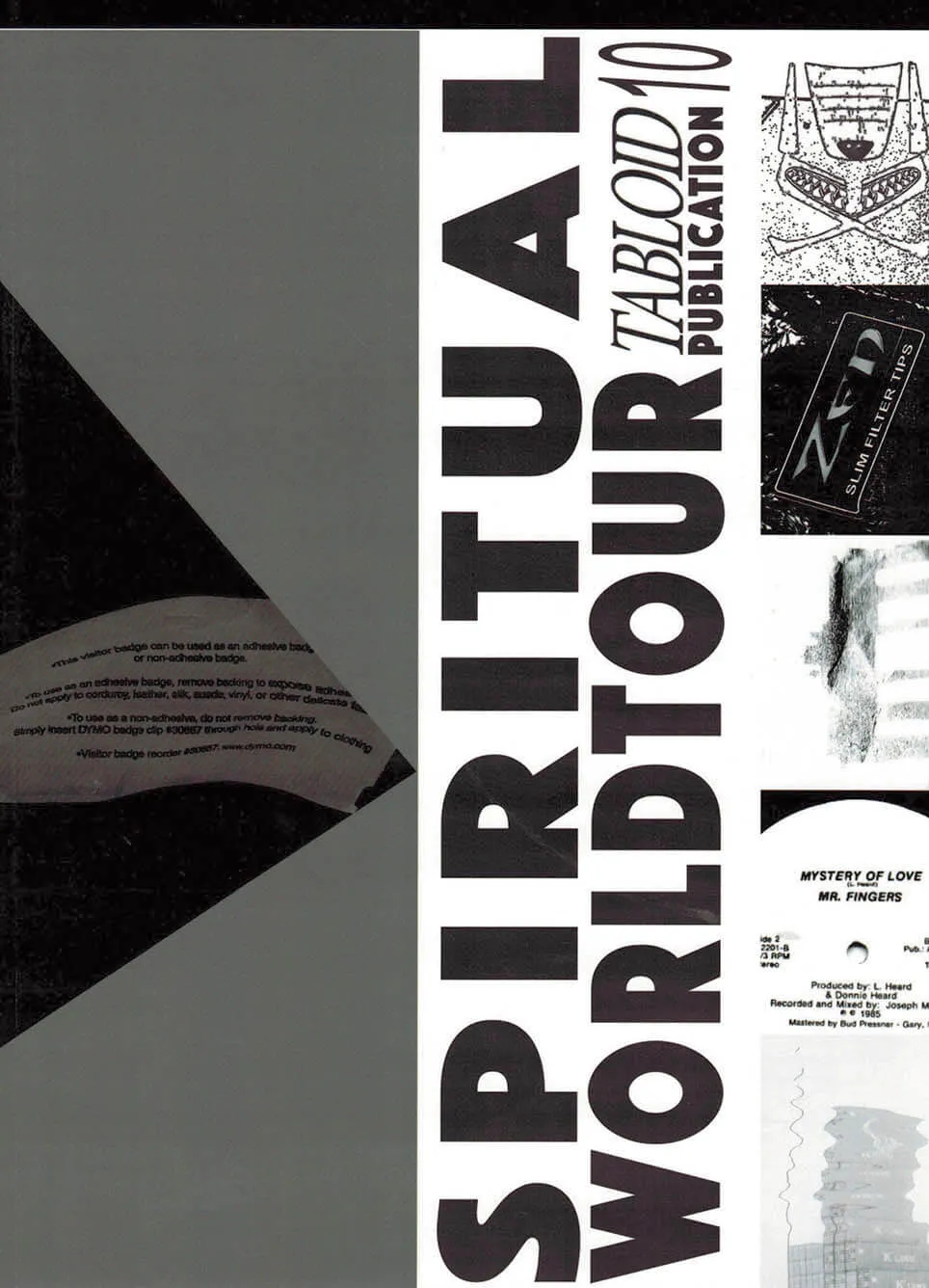
Cover of Spiritual World Tour

Tabloid Publications

Spiritual World Tour

Nat Marcus

Spiritual World Tour by Nat Marcus.
Cover of Aisopika Aesopica

Ariel Ink

Aisopika Aesopica

Rūta Junevičiūtė

The bilingual book ‘Aesopica’ documents and extends Rūta Junevičiūtė’s research on the Aesopian language and the influence of political censorship to contemporary collective body, first presented in 2020 as the eponymous solo exhibition at the National Gallery of Art and as a permanent outdoor installation at the Rupert Art Center, Vilnius. 

Taking as a starting point the historical phenomenon of Aesopian language, which was widespread in Lithuanian culture during the Soviet era, and in parts of the Russian Empire as early as the 19th century, Junevičiūtė aims to investigate the interrelationship between generations, the gray zones of collective identity creation and the processes of (un)censoring the archives of our bodies.

Aesopian language – a term coined after Ancient Greek fabulist Aesop (gr. Aísōpos), is a type of cryptic communication system, where a text has several layers of meaning often contradictory to each other and which seek to convey official and subversive hidden meanings simultaneously. It is usually employed under conditions of omnipresent state censorship to communicate officially forbidden or taboo subjects and opinions. As a system it contains three members – an author, a censor, and a reader. It uses various modes of circumlocution and euphemisation, innuendo and poetic paraphrasing, which can also be seen as an aesthetic style. It has been advocated for artistic benefits as poetics of omissions, concealment, and travesty. On the other hand, it has been criticized as a sign of conformity and humiliation. In Lithuania, after the fall of the Soviet Union, it has been popularly regarded as a position of dissent, but such an interpretation received criticism from contemporary scholars. “Such a mode of expression is probably as old as censorship itself” – a historian told us.

Text contributors: Alfonsas Andriuškevičius, Edgaras Gerasimovičius, Rūta Junevičiūtė, Goshka Macuga, Anastasia Sosunova, Grėtė Šmitaitė, Tomas Venclova, Ana Vujanović

Language editors: Dangė Vitkienė, Aira Niauronytė, Gemma Lloyd

Translators: Alexandra Bondarev, Erika Lastovskytė, Justinas Šuliokas, Mantė Zagurskytė-Tamulevičienė, Aistis Žekevičius.

Illustrations: Rūta Junevičiūtė.

Cover of Encounters – Embodied Practices

Archive Books

Encounters – Embodied Practices

Sandhya Daemgen, Raphael Hillebrandt and 2 more

Conversations about embodied strategies of knowledge production and knowledge transmission based on the choreographic and curatorial practices of about fifteen international choreographers, performers, dramaturges and curators.

In the context of the numerous ethical-political challenges of the global present, actors from the dance and choreography scene both in Berlin and internationally talk about forms of knowledge production beyond the prevailing conception found in Western modernity. They counter the mind-body separation and the notion of a universality of knowledge with multiplicities of knowledge production that emerge with and from the reality of differently situated bodies.

What potential do embodied practices offer for emancipatory movements? How can community be created through these practices, and what responsibilities does this entail? What role does the body play in the preservation and transmission of knowledge?

In this publication, edited by the choreographers and curators Martha Hincapié Charry, Sandhya Daemgen, Raphael Moussa Hillebrand and Matthias Mohr; Lukas Avendaño, Wagner Carvalho, Sandhya Daemgen, Ismail Fayed, Alex Hennig, Raphael Moussa Hillebrand, Martha Hincapié Charry, Isabel Lewis, Matthias Mohr, Prince Ofori, Mother "Leo" Saint Laurent, Léna Szirmay-Kalos, Thiago Granato and July Weber conduct conversations about embodied strategies of knowledge production and knowledge transmission based on their respective choreographic and curatorial practices.

Cover of How to Die – Inopiné

Archive Books

How to Die – Inopiné

Ashkan Sepahvand

A transdisciplinary investigation and a choreographic performance, between Umeå and Oslo, about ecological grief, cultural panic, and a feeling of collapse.

How to Die – Inopiné is a performance and a practice. It thinks through, in an embodied manner, the prevailing contemporary moods of ecological grief, cultural panic, and collapse. As a performance in a theater or outdoors, an audience encounters five dancers who are constantly building, unbuilding, and rebuilding. Afterwards, stories are told around a bonfire. As a practice in the studio, school, or street, a group of dancers, artists, writers, and architects meet for a year of residencies between Oslo and Umeå. They host a working process and encounter external informants. The goal is to displace oneself into the unexpected. This publication, two years in the making, engages with the challenges of translating a choreographic process into the space of a book. It both documents the project's development as well as offering the reader-doer different modes of thinking-doing, from somatic practices to proposals for a curriculum. Experiments in writing, mapping, and moving are played with, all engaging with the question, "what is the future of displaced thinking?"

Published following the series of eponymous events held in Umeå, Oslo, Bergen, Trondheim and Reykjavik in 2019-2020.

Contributions by Harald Becharie, Mia Habib, Jassem Hindi, Asher Lev, Marie Kraft Selze, Namik Mačkić, Ingeborg Olerud, Anna Pehrsson, Ashkan Sepahvand, Nina Wollny.

Cover of Not Not Nothing

Varamo Press

Not Not Nothing

Mette Edvardsen

Performance €18.00

This publication brings together the texts from the pieces Black (2011), No Title (2014), We to be (2015) and oslo (2017) created and performed by Mette Edvardsen. These pieces have been developed using language as material, looking into the relationship between writing and speaking, between language and voice. Mette Edvardsen is working on the verge of the visible, considering choreography as writing.

Cover of Devenir minéral | L’éditeur du dimanche

Avarie Publishing

Devenir minéral | L’éditeur du dimanche

Giuliana Prucca

Essays €38.00

Echoing Jean Dubuffet's idea that thought must arise from material in artistic practice, Giuliana Prucca, through this essay, reinterprets a moment in the history of 20th-century art using materials such as stone, sand, earth, and dust. She employs the mineral to illustrate that the creative act would be a trace of the body's disappearance. The loss of humanity and the deconstruction of the subject objectify themselves in the image. In other words, art resides in the tension between representation and its loss, ultimately leaving nothing but an image.

Drawing from the influential figure of Antonin Artaud, she weaves critical and poetic connections between the texts and works of various artists, writers, and thinkers, ranging from Jean Dubuffet to Jan Fabre and Anselm Kiefer, Yves Klein and Gutaï, Joë Bousquet to Camille Bryen and Francis Ponge, Gaston Bachelard to Gilles Deleuze, and Georges Bataille to Aby Warburg.

The material is not merely a thematic pretext; it is an active and explosive catapult that questions the arbitrary linearity of a conventionally assimilated art history. Following Ponge's example, Prucca applies the principles of poetry to criticism, starting from Artaud's material, the most undisciplined of poet-artist-thinkers of the modern era. This results in a critically inventive approach dangerously suited to its object, celebrating an anti-critique. The chosen writing materials, stonepaper for the cover and recycled paper for the pages, is consistent, intending to give the impression of being covered in dust.

The essay disrupts traditional reading habits and shatters the conservatism of art criticism by inhabiting writing space differently, presenting a physically engaging interaction. This is an essay in the literal sense, an experience where form never contradicts content, urging readers to take the risk of thinking deeply and embracing a new rhythm. A complex and challenging design invites them to choose different reading options, ultimately treating criticism as one would poetry.

Giuliana Prucca [Paris | Berlin] is an independent curator, researcher, and writer. She is the founder and art director of the publishing house AVARIE, specialising in contemporary art books that explore the relationships between text and image, body and space.

Graphic design, art direction by Vito Raimondi