rile*books

Search books

Search books by title, author, publisher, keywords...

Cover of On Healing

Sinister Wisdom

On Healing

Sinister Wisdom

€7.00

Sinister Wisdom 57: On Healing is about unequivocal survival, courage, creativity, vision, alchemy and, unfortunately, the systematic matter-of-fact violence most girls and wimmin are born into. The Courage these wimmin found to speak, to continue living and loving gives all Lesbians so much strength to pull from.

Creative Works By

April Citizen Kane
Chrystos
Cheryl Jones
Joan Annsfire
Rivka Mason and Jan Thomas
Elizabeth N. Evasdaughter
Mariah L. Richardson
A. Miriasiem Barnes
Laura C. Luna
Christina Springer
Adrienne Y. Nelson
Marianne Hewitt
K. Linda Kivi
Debby Earthdaughter
and more!

Language: English

recommendations

Cover of Celebrating the Michigan Womyn's Music Festival

Sinister Wisdom

Celebrating the Michigan Womyn's Music Festival

Sinister Wisdom

Sinister Wisdom 103: Celebrating the Michigan Womyn's Music Festival honors the forty-year legacy of the Michigan Womyn’s Music Festival (1976–2015). Sinister Wisdom 103: Celebrating the Michigan Womyn's Music Festival celebrates this embodiment of radical feminist separatist collaboration, transformational self-defined autonomous spaces, a commitment to sisterhood and matriarchal culture, and a musical city sprung from the earth for one week in the woods.

A collective of five womyn each with a deep connection to Fest operated by consensus to create this issue. Striving to represent a range of womyn’s voices, values, traditions, and experiences of Fest, the collective highlighted what Fest has meant to generations of womyn, documented its chronology, and bore witness to the power of this community. Sinister Wisdom 103: Celebrating the Michigan Womyn's Music Festival includes womyn from multiple races, geographies, sexualities, generations, and gender and other social identities. Just as Fest brought together womyn from various backgrounds, our collection includes a range of artistic experience, from seasoned authors and photographers to those womyn new to publishing.
Sinister Wisdom 103: Celebrating the Michigan Womyn's Music Festival remembers the transformations, possibilities, and hopes for spaces cultivating the ongoing empowerment of womyn.

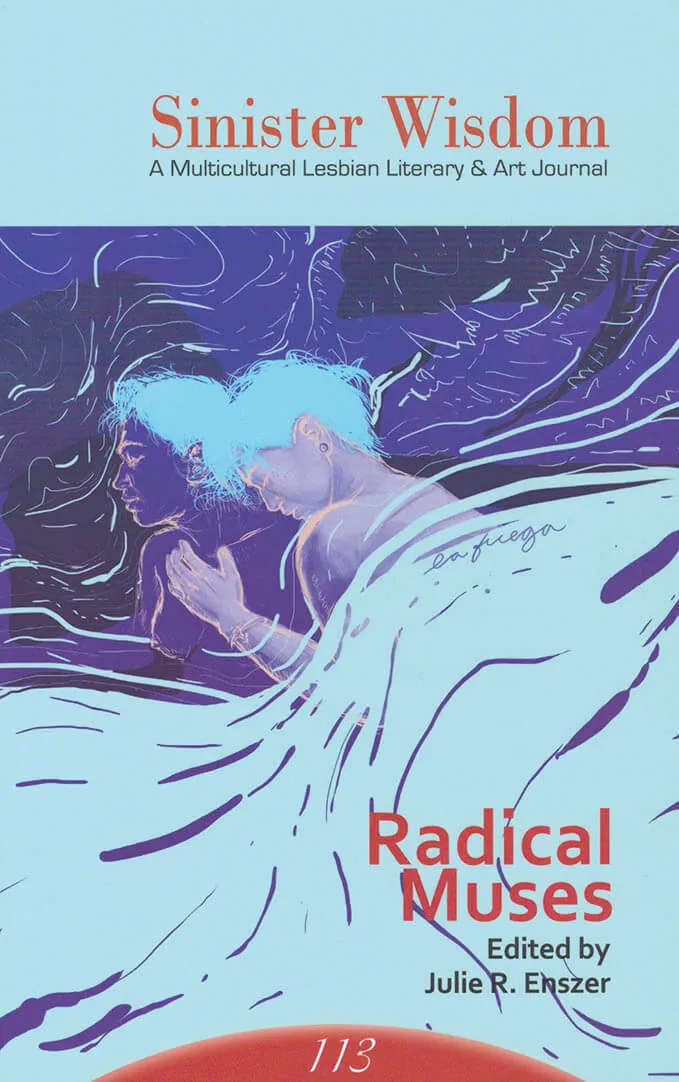
Cover of Radical Muses (Sinister Wisdom nr. 113)

Sinister Wisdom

Radical Muses (Sinister Wisdom nr. 113)

Julie R. Enszer

Sinister Wisdom 113: Radical Muses features an eclectic array of contemporary poetry, prose, and art by lesbians from around the world, including new work by: Andrea Assaf, Tara Shea Burke, Cheryl Clarke, Marina Chirkova, Estela González, Barbara Haas, Nancy E. Lake, Vi Khi Nao, H. Ní Aódagaín and much more!

Cover of  Viscose 08: SOUND

Viscose Journal

Viscose 08: SOUND

Jeppe Ugelvig, Bill Kouligas and 2 more

Periodicals €30.00

The eighth issue of Viscose examines the myriad of music and sound cultures of fashion. Entirely untethered from materiality and image, sound is the proof that fashion operates just as vividly in the purely atmospheric. From the artfully curated musical narratives of the runway to the ambient sonic environment of shops, fashion both emits sounds and seeks to associate itself with it for its own advancement. 

Music in particular asserts fashion’s existential relationship to time: it aesthetically time-keeps fashion media and confirms sartorial novelty by mirroring it rhythmically. To a public consciousness, the intimate relationship between fashion and music is obvious and at times even understood as one and the same. Sound glues material such as clothes to wider zeitgeists and mediated lifestyles, and as such, to cultural memory itself. As Mary E. Davis has illuminated, the alliance is profoundly historic: as far back as 1672, fashion periodicals have covered clothes and music as equally essential components of an elegant, fashionable lifestyle. 

Music, in fact, surrounds fashion: it enwraps makers, mediators, and consumers alike in ephemeral, yet intensely meaningful, signifiers of taste. Countless designers have come to fashion through musical subcultures, and labors in ateliers to particular playlists. Indeed, style most often has a soundtrack of its own, or dances to a specific tune.  Fashion emits sounds before and after the musical. The clicking of heels, the rustling of a sweater, the hissing of a zipper. The ambient humming of a sewing machine; the conclusive “beep” from a store cashier. 

For the 8th issue of Viscose, we set out to examine the sonic landscapes of fashion in a most expansive manner. In billing our issue “sound” we seek to gesture to more visually obscure and materially ephemeral interplays between fashion and the auditory—in wardrobes and shops, on the body and in the nightclub. With music culture at the center of our inquiry, we hope to seek beyond and towards the more ephemeral sounds the clothing and fashion emits, records, and appropriates. We are pursuing the possibility of rendering fashion in entirely sonic terms, and how this translates into written words, in a print magazine. 

Cover of The Lip Anthology: An Australian Feminist Arts Journal 1976–1984

Kunstverein Amsterdam

The Lip Anthology: An Australian Feminist Arts Journal 1976–1984

Vivian Ziherl

Lip Magazine was self-published by women in Melbourne from 1976 to 1984 and stood as a lightning rod for Australian feminist artistic practice throughout the Women’s Liberation era. The art and ideas expressed over Lip’s lifetime track groundbreaking moves in performance, ecology, social-engagement and labour politics—all at an intersection with local realities. Collecting and presenting the materials of Lip for the first time since their original appearance, The Lip Anthology, edited by Vivian Ziherl, privileges the range and dynamism of contesting feminisms that comprised the Lip project.

Designed by: Marc Hollenstein

Cover of Le Chauffage #3 - Day Job

Le Chauffage

Le Chauffage #3 - Day Job

Francesca Percival, Felix Rapp and 1 more

Periodicals €20.00

The third issue of Le Chauffage is an inquiry into the relationship between the practices of artists/ writers and their day jobs. This subject stems from a question fundamental to the existing mandate of Le Chauffage: 'how do you keep warm?' and subsequently, 'how do you pay the bills?' As these perennial concerns occupy our everyday lives, we ask artists/writers to consider the influence that their day jobs, side hustles, creative or non- creative forms of employment have on their respective practices.

This issue tries to account for the significant ways in which complex economic realities come to shape the art we produce, look at, and discuss. How do we deal with limited time and resources? How do we reclaim and steal time back? How do our day jobs shape and influence what we make? How do we subvert the means of production of the workplace? Can the constraint of a day job also be a way to alleviate the pressure of professionalising?

With contributions by Daniel Bozhkov, Nathan Crompton Pippa Garner, Chauncey Hare Marisa Kriangwiwat Holmes, Garrett Lockhart, Jannis Marwitz Reba Maybury, Tiziana La Melia, Dan Miller, Ragen Moss, Jean Luc Moulène, Jean Katambayi Mukendi Paul Niedermayer, Sophie Nys, Megan Plunkett, Chris Reinecke, Jacquelyn Zong Li Ross On Gabrielle L Hirondelle Hill Margaux Schwarz, Eleanor Ivory Weber James Welling, Werker, The Wig.

Cover of nnn.1 - no no no celestial journal

no more poetry

nnn.1 - no no no celestial journal

nmp

Zines €10.00

published commonly, no no no expounds an experimental poetic offering, both text & art.

each issue features a limited edition artwork. which can be tacked or framed or stored in a drawer.

celestial in nature, no no no takes the form required, and necessary.

Cover of Parapraxis 05: Economies

Parapraxis

Parapraxis 05: Economies

Philosophy €25.00

Like Freud’s prototypical baby, we struggle over whether to keep our body together or to give it away. We all live these scenes of bodily loss. Freud and Marx both sing harmoniously: what we give up, we give under duress. We are not easy with what we’ve been tasked with, but the task has been the same since birth, doubled in the name of emancipation: first, there’s nothing less than to survive alienation and exploitation, then there’s staying alive for one another’s sake. Perhaps the storied antagonism between Freud and Marx turns on the difficulty of holding these tasks together, balanced on the knife’s edge that separates self-interest from collective liberation.

Capitalism does not produce itself all alone, no matter its disciplines and political-economic constraints on the reproduction of society. If Marx taught us anything, it’s that capitalism produces its own gravediggers, the proletariat—“the unreason of reason,” he quipped, where the dominant social order encounters its unconscious element. Through the bad exchange of capitalism comes a gothic reversal, from preconscious life to premature death, where workers end up burying themselves instead of the system that provides the grave plot. That exchange is felt internally, in a rift that cleaves open the self. Freud, for his part, helps us describe how political economy hammers our lives into unreasonable and reasonable shapes, imaginary and real, as countless and heterogeneous as the individual faces in a collective mass. For each and for all, we bring psychoanalysis to bear on the political-economic problems we suffer in common.

King Ketamine. Beyond the vibecession. Austere Mothers. Sick at Work. Money, Feces, Babies, Gifts. Essays by Juliana Spahr, Peter Coviello, Nicolás Medina Mora, Jyoti Rao, and Hannah Proctor. Images of Red Vienna from Wilhelm Reich’s camera, dispatches from Lebanon, and more.