rile*books

Search books

Search books by title, author, publisher, keywords...

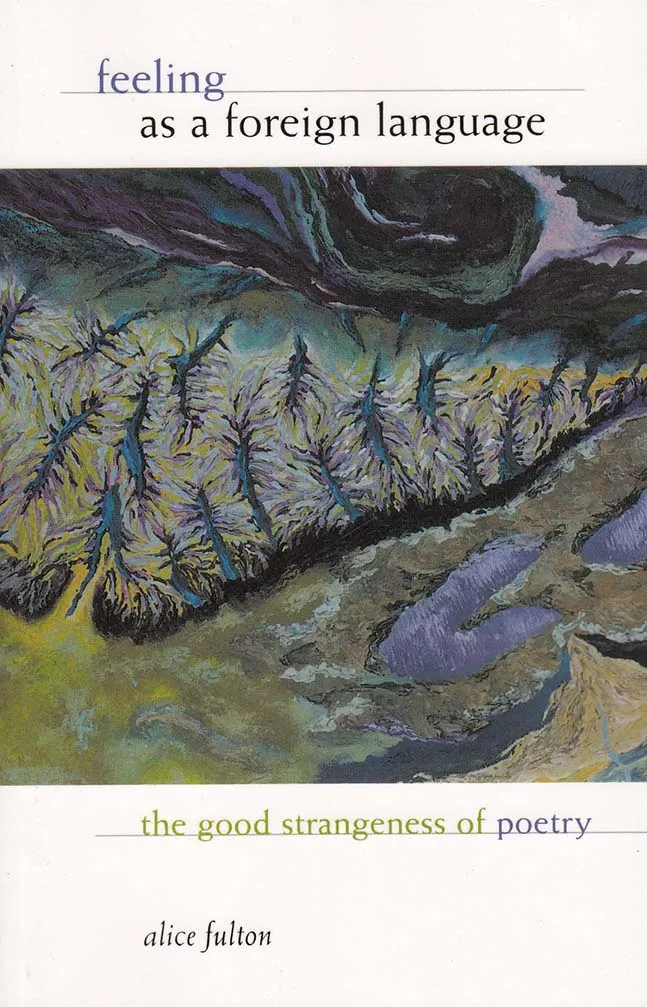
Cover of Feeling as a foreign language

Graywolf Press

Feeling as a foreign language

Alice Fulton

€18.00

In Feeling as a Foreign Language, poet and critic Alice Fulton considers poetry's uncanny ability to access and recreate emotions so wayward they go unnamed. How does poetry create feeling? What are fractal poetics? 

In a series of provocative, beautifully written essays concerning "the good strangeness of poetry," Fulton contemplates the intricacies of a rare genetic syndrome, the aesthetics of complexity theory, and the need for "cultural incorrectness." She also meditates on electronic, biological, and linguistic screens; falls in love with an outrageous 17th-century poet; argues for a Dickinsonian tradition in American letters; and calls for a courageous poetics of "inconvenient knowledge."

Language: English

recommendations

Cover of The Argonauts

Graywolf Press

The Argonauts

Maggie Nelson

Memoir €17.00

Maggie Nelson's The Argonauts is a genre-bending memoir, a work of autotheory offering fresh, fierce, and timely thinking about desire, identity, and the limitations and possibilities of love and language. It binds an account of Nelson's relationship with her partner and a journey to and through a pregnancy to a rigorous exploration of sexuality, gender, and family. An insistence on radical individual freedom and the value of caretaking becomes the rallying cry for this thoughtful, unabashed, uncompromising book.

Cover of The Hormone of Darkness: A Playlist

Graywolf Press

The Hormone of Darkness: A Playlist

Tilsa Otta, Farid Matuk

Poetry €19.00

In Tilsa Otta’s The Hormone of Darkness, we find a queer, Latinx person who has lived through iterations of authoritarian rule, and who answers these conditions by creating poetry that doubles down on a life force that precedes and exceeds received notions of the poetic. Here poetry is bawdy, fabulist, and spiritual—in short, it is alive. Otta has created a heaven where readers can go after they die. 

Drawing from four volumes spanning Otta’s career, translator-poet Farid Matuk has curated a playlist we can dance and dream to, one that honors Otta’s drive toward liberation through both perreo in the club and transdimensional wandering among the stars.

We can go on like that forever
building paradise from our urges
out of our fetishes our loves our vices
How lucky
We’ll wait for you then
Don’t be too long
Bookmark the page
We’ll be Here
—From “The New Heaven”

Translated from the Spanish by Farid Matuk.

Cover of Regaining Unconsciousness: Poems

Graywolf Press

Regaining Unconsciousness: Poems

Harryette Mullen

Poetry €18.00

Harryette Mullen is one of contemporary poetry’s most influential voices, for her inventive language play, keen wit, formal experimentation, and pointed critique of American culture. In Regaining Unconsciousness, her first new collection in twelve years, Mullen confronts the imminent dangers of our present to sound an alarm for our future, to wake us out of our complicity and despondency: Can we, even still, find our way to our unconscious selves, beyond our capacity to harm, subdue, and consume? 

In eleven taut sections written in the eleventh hour of our collective being, these poems address climate change, corporate greed, racist violence, artificial intelligence, the pollution of our oceans, individualism at the cost of mutual wellness, and the consequences of not addressing these pressing issues. Mullen imagines, as we must, our apocalypse, and yet, in an astounding feat, she does so with playfulness and wry referentiality that make these poems surprisingly buoyant, funny, and readable. Our end may be inevitable, Mullen admits, but maybe we begin with gratitude.

Cover of Homie

Graywolf Press

Homie

Danez Smith

Poetry €16.00

Homie is Danez Smith’s magnificent anthem about the saving grace of friendship. Rooted in the loss of one of Smith’s close friends, this book comes out of the search for joy and intimacy within a nation where both can seem scarce and getting scarcer. In poems of rare power and generosity, Smith acknowledges that in a country overrun by violence, xenophobia, and disparity, and in a body defined by race, queerness, and diagnosis, it can be hard to survive, even harder to remember reasons for living. But then the phone lights up, or a shout comes up to the window, and family—blood and chosen—arrives with just the right food and some redemption.

Part friendship diary, part bright elegy, part war cry, Homie is the exuberant new book written for Danez and for Danez’s friends and for you and for yours.

& colin kaepernick is my president, who kneels on the air
bent toward a branch, throwing apples down to the children
& vets & rihanna is my president, walking out of global summitswith wine glass in hand, our taxes returned in goldto dust our faces into coins
& my mama is my president, her grace stuntson amazing, brown hands breaking brown bread overmouths of the hungry until there are none unfed & my grandma is my president
& her cabinet is her cabinetcause she knows to trust what the pan knowshow the skillet wins the war  
—from “my president”

Cover of Dysphoria Mundi: A Diary of Planetary Transition

Graywolf Press

Dysphoria Mundi: A Diary of Planetary Transition

Paul B. Preciado

Essays €22.00

A revolutionary book tracing the collapse of the paradigms that have organized the world for centuries. 

In Dysphoria Mundi, Paul B. Preciado, best known for his 2013 cult classic Testo Junkie, has written a mutant text assembled from essays, philosophy, poetry, and autofiction that captures a moment of profound change and possibility. Rooted in the isolation of the COVID-19 pandemic, and taking account of the societal convulsions that have ensued, Preciado tries to make sense of our times from within the swirl of a revolutionary present moment.

The central thesis of this monumental work is that dysphoria, to be understood properly, should not be seen as a mental illness but rather as the condition that defines our times. Dysphoria is an abyss that separates a patriarchal, colonial, and capitalist order hurtling toward its end from a new way of being that, until now, has been seen as unproductive and abnormal but is in fact the way out of our current predicament.

With echoes of visionaries such as William S. Burroughs and Kathy Acker, Preciado’s theoretical writing is propelled by lyric power while providing us with a critical toolbox full of new concepts that can guide our thinking and our transition, cognitive emancipation, denormalization, disidentification, “electronic heroin,” digital coups, necro-kitsch. Dysphoria Mundi is Preciado’s most accessible and significant work to date, in which he makes sense of a world in ruins around us and maps a joyous, radical way forward.

Cover of Dregs, Beacons

Self-Published

Dregs, Beacons

Anna-Rose Stefatou

Poems on light and remnants. Light as mordant, as acid that etches through surface, as something that wraps itself around and between things, revealing form. The writing touches on dregs, remnants, residue and how we make sense of them, by making constellations and navigating through those diagrams. 

Anna-Rose Stefatou (b.1996, Athens) is a Greek-British artist based between Athens and London, working between moving image, installation, photography, and writing. Stefatou’s interdisciplinary works attend to stories attached to place and beginning to exist through writing, whether they become a structure to hold it, or whether language simply runs through them. Language is used both as an outset and as a distillation mechanism for ideas, with materials and imagery in visual works responding directly to the text. Gathering and repositioning knowledge guides her creative process: research includes archival footage, taking interviews, collecting objects, and location visits. This process is made visible through her material approach to the photographic image, transformed through different materials, forms and uses, as it unfolds and re-invents itself within new contexts. Stefatou graduated from the Slade School of Fine Art in 2019. Recently, she undertook a residency at Hospitalfield House, Scotland in 2023.  Upcoming projects include an exhibition at Pharmakeion, Athens in 2025 as well as a publication Dregs, Beacons that will be realised in 2025.

Cover of The Poeticians

Self-Published

The Poeticians

Pontus Pettersson

Poetry €5.00
The Poeticians is a publication of the performance of the collection of clothes and poetry called Writing Wounds To Heal by Swedish choreographer Pontus Pettersson. Made in velvet silk with the poetry burned out in the fabric exposing the texts, the poetry exposes both itself and the skin of the performer. Throughout the durational piece the performers are doing Pontus Petterssons cat practice and is one of the main ingredients of the project as well as the clothes/poems. The Poeticans is also a choreo-curational event that hosts different choreographic proposals inside of it. It is seen as module or installation where pieces, objects, performers can be inserted rather than a performance that executes and performs the same over and over. It was created as an extension of Pontus interest in poetry and choreography where hospitality and proximity is seen as key concepts in the development and execution of the event.
Cover of The Mirror of Simple Souls

Winter Editions

The Mirror of Simple Souls

Leah Flax Barber

Poetry €20.00

In her first book of poems, Leah Flax Barber revives an actress figure of the commedia dell'arte to consider her own destiny as a soon-to-be historical subject. Taking its title from Marguerite Porete's fourteenth-century Beguine classic, The Mirror of Simple Souls embodies the metaphysical thorniness of the book-as-object through sources as wide-ranging as Renaissance theater, Low German and Old French mystical texts, Kate Bush lyrics, and the melancholy dialectics of Walter Benjamin. In Flax Barber's stark, brutally compressed poems, the performance of writing is charged with the eros and anxiety of coming after: "Will it all be destroyed? / Definitely / I will hear it on my radio / In the 22nd century."

The Mirror of Simple Souls, a series of repeated beginnings and endings, is a form of speech act which, through a Freudian Durcharbeiten, or working through, brings about a new beginning. And, in its movement from this Freudian "working through" to a Hegelian Aufhebung, lets us begin, again, at the beginning, at the end. —CYNTHIA CRUZ

The spare poems of The Mirror of Simple Souls evoke and then draw back into shimmer. Herein, a performance that suffuses the horizon with beautiful absurdity: a shirt sewn with mirrors that reflect a strange and evanescing world-at-large, “an I where the nay was.” Drawing from film, mystical texts, commedia dell'arte, the reader finds that there “is paraphernalia of life / all over.” This paraphernalia is a kind of “segue music” for the endlessly indeterminate. The old adage claims that we can’t step into the same river twice, but Leah Flax Barber creates an evocative, provocative current through which each step is at once past, present, and future. —ELIZABETH ROBINSON

Leah Flax Barber is a daring and brilliant new poet. Her voice is restless and coiled and sprung as we discover "The demonic finalist / Of material culture / Is love / There is paraphernalia of life / All over / A woman.” There is also a take-no-prisoners attitude throughout this startling and powerful book. These poems are vital and necessary and perform “The wounded chance / To think in public.” This book will move you, scare you, and blow you away. —PETER GIZZI

Leah Flax Barber's first book reads like a journey, a kind of anabasis, passing back through the myth and history which are its own antecedents. It manifests, in the encounter, a saturnalian world: ludic, dark and sensuous, strange and vibrant with thought. I was delighted to travel with it. —CLAIRE DeVOOGD