rile*books

Search books

Search books by title, author, publisher, keywords...

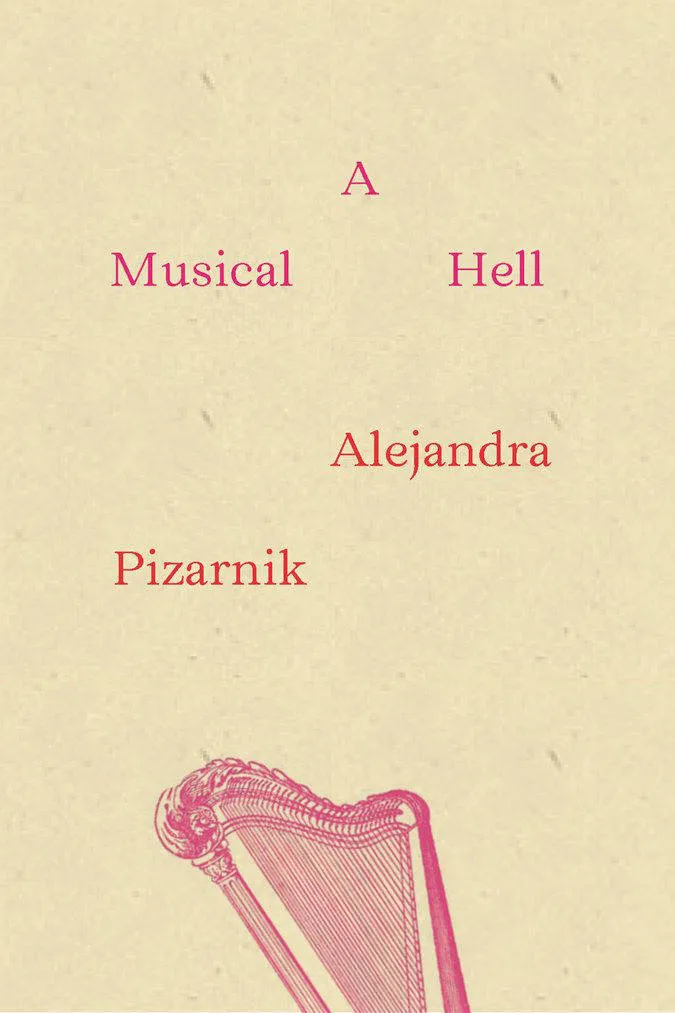
Cover of A Musical Hell

New Directions Publishing

A Musical Hell

Alejandra Pizarnik, Yvette Siegert trans.

€13.00

“An aura of legendary prestige surrounds the work of Alejandra Pizarnik,” writes César Aira. Her last collection to be published before her suicide in 1972, A Musical Hell is the first book of poems by Pizarnik to be published in its entirety in the U.S. Pizarnik writes at the edge of poetic impossibility, opening with a blues singer, expanding into silence, and closing into a theater of shadows and songs of the drowned.

Published in 2013 ┊ 64 pages ┊ Language: English, Spanish

recommendations

Cover of Sea, Poison

New Directions Publishing

Sea, Poison

Caren Beilin

LGBTQI+ €16.00

Cumin Baleen is a forty-one-year-old writer living in Philadelphia—this city of hospitals—who works at the upscale grocery Sea & Poison and is navigating the onset of an autoimmune condition. To start a medication that may help, an eye exam is required and this leads to a nightmarish laser eye surgery. The laser shoots into her brain, making her language spare and her sentences clause-less, a vexing constraint that stalls her book on gynecological malpractice: she wants others, in the realm of our for-profit medical industry that "renders the Hippocratic Oath its opposite," to see poison.

Meanwhile, Cumin is kicked out of her boyfriend Mari's studio after he falls for Janine, their landlord, and starts renting a closet in Maron's bedroom—polyamorous Maron who is hooking up with Alix, whom Cumin lusts after. Disheveled from medicines and medical scams, Cumin declares, "I don't know what to say, I'm saying I have a cracked appearance. It's not a pity party, it's a character sketch. Insofar as you'll need to be looking at me, that your mind should fill me up with its own swaying cognitive and toxic reeds if we are to do this, your imagination should touch me with its ridiculous poison."

Caren Beilin's hypnotic and fractured story is at once an homage to Shusaku Endo's terrifying novel of human vivisection The Sea and Poison and the spirit of OuLipo, the pioneering French writing group that sought new literary potential through constraints.

Caren Beilin was born in Philadelphia in 1983. She is the author of the novel Revenge of the Scapegoat, which won the Vermont Book Award for Fiction. Her other books are Blackfishing the IUD, Spain, The University of Pennsylvania, and Americans, Guests, or Us. She lives in Cleveland and Philadelphia and teaches at Case Western Reserve University.

Cover of The Hour of the Star

New Directions Publishing

The Hour of the Star

Clarice Lispector

Fiction €14.00

The devastating final work by Brazil’s greatest modern writer, The Hour of the Star tells the haunting tale of Macabéa—a typist who lives in the slums of Rio—underfed, sickly, and unloved, yet inwardly free.

Translated from the Portuguese by Benjamin Moser. With a contribution by Paulo Gurgel and Valente Colm Tóibín.

The Hour of the Star, Clarice Lispector's consummate final novel, may well be her masterpiece. Narrated by the cosmopolitan Rodrigo S.M., this brief, strange, and haunting tale is the story of Macabéa, one of life's unfortunates. Living in the slums of Rio de Janeiro and eking out a poor living as a typist, Macabéa loves movies, Coca-Cola, and her rat of a boyfriend; she would like to be like Marilyn Monroe, but she is ugly, underfed, sickly, and unloved. Rodrigo recoils from her wretchedness, and yet he cannot avoid realization that for all her outward misery, Macabéa is inwardly free. She doesn't seem to know how unhappy she should be. Lispector employs her pathetic heroine against her urbane, empty narrator—edge of despair to edge of despair—and, working them like a pair of scissors, she cuts away the reader's preconceived notions about poverty, identity, love, and the art of fiction. In her last novel she takes readers close to the true mystery of life, and leaves us deep in Lispector territory indeed.

Cover of Midwinter Day

New Directions Publishing

Midwinter Day

Bernadette Mayer

Poetry €17.00

Midwinter Day, as Alice Notley noted, is an epic poem about a daily routine. A poem in six parts, Midwinter Day takes us from awakening and emerging from dreams through the whole day-morning, afternoon, evening, night-to dreams again:...

a plain introduction to modes of love and reason/ Then to end I guess with love, a method to this winter season/ Now I've said this love it's all I can remember/ Of Midwinter Day the twenty-second of December// Welcome sun, at last with thy softer light/ That takes the bite from winter weather/ And weaves the random cloth of life together/ And drives away the long black night!

Cover of Lili Is Crying

New Directions Publishing

Lili Is Crying

Hélène Bessette, Kate Briggs

Fiction €17.00

A forgotten mid-century genius, recently rediscovered in France and never before translated into English, Hélène Bessette is a treasure and a bracing force to reckon with.

With a contribution by Eimear McBride
A New Yorker Best Book of 2025

Lili Is Crying, Hélène Bessette’s debut novel, conveys with singular force the fraughtness and depth of the troubling relationship between Lili and her mother, Charlotte. With a near-mythic quality, Bessette's stripped-back prose evokes at once the pain of thwarted love—of desire run cold—and the promise of renewal. Lauded by critics on its initial 1953 publication for its boundary-pushing style, Lili Is Crying catapulted Bessette to cult status in France. The novel is moving and maddening in turns, with its characters trapped in their own cruelties and sorrows, but in its spareness and strength it feels true. "Show me a woman who's chosen something." Bessette's books were hailed for their unusual economy of expression, rarity, strange humor, and sheer vivacity. She characterized her new kind of novel as "a freshly cut slice of life, whose force comes from its lack of commentary."

Cover of Exophony

New Directions Publishing

Exophony

Yoko Tawada

Non-fiction €17.00

Yoko Tawada's first essay collection in English presents and electrifying new side of the National Book Award-winner as she dives deep into her lifelong fascination with cross-hybridizing languages. The accent here, as in her fiction, is on the art of drawing closer to the world through defamiliarization. Tawada famously writes in both Japanese and German, but her interest in language reached beyond any mere dichotomy. 

The term "exophonic," which she first heard in Senegal, has a special allure for the author: "I was already familiar with similar terms. 'immigrant literature,' or 'creole literature,' but 'exophonic' had a much broader meaning, referring to the general experience of existing outside of one's mother tongue." Exophony opens a new vista into Yoko Tawada's world and delivers more of her signature erudite wit—at once cross-grained and generous, laser-focused and multidimensional, slyly ironic and warmly companionable.

A New Yorker Best Book of 2025. Translated from Japanese by Lisa Hofmann-Kuroda.

Cover of Gertrude Stein: Selections

University of California Press

Gertrude Stein: Selections

Gertrude Stein, Joan Retallack

Poetry €30.00

This selection of Gertrude Stein's work is taken from the period between 1905 and 1936, when the iconic modernist poet was engaged in an astounding number of still-surprising literary experiments, whose innovations continue to influence all the arts. Editor Joan Retallack has chosen complete texts or selections that lend themselves to a clarified vision of Stein's oeuvre. 

In her brilliant introduction, Retallack provides the historical and biographical context for Stein's lifelong project of composing a "continuous present," an effort which parallels many of the most important technological and scientific developments of her era—from moving pictures to Einstein's revision of our understanding of space and time. Retallack also addresses persistent questions about Stein's work and the best way to read it in our contemporary moment. In suggesting a performative "reading poesis" for these works, Retallack follows Stein's dictum by arguing that to actively experience the work is to enjoy it, and to enjoy it is to understand it. 

TEXTS
Melanctha (excerpt, from Three Lives, 1905)
The Making of Americans (excerpt, 1911)
Picasso (1911)
Flirting at the Bon Marche (1911)
Bon Marche Weather (1911)
Orta or One Dancing (excerpt, 1912)
Susie Asado (1912)
Tender Buttons: Objects, Food (1913)
Scenes from the Door (from Useful Knowledge, 1918)
Photograph (1920)
A Movie (1920)
An Elucidation (1923)
If I Told Him, A Completed Portrait of Picasso (1923)
Fourteen Anonymous Portraits (1923)
Are There Arithmetics (1923)
Business in Baltimore (1925)
Composition as Explanation (1926)
Patriarchal Poetry (excerpt, 1927)
Sentences and Paragraphs (from How to Write, 1930)
History or Messages from History (1930)
We Came. A History (1930)
Stanzas in Meditation (excerpt, 1932)
Lecture I (from Narration, 1934)
Identity a Poem (1935)
What Are Master-pieces and Why Are There So Few of Them (1936)

DOCUMENTS
“With Apologies to Gertrude Stein,” newspaper advertisement
Two love notes from Stein to Toklas (n.d.): “Dear dainty
delicious darling” and “Ir/Re/Sis/Ti /Belle”
Virgil Thomson, Letter to Gertrude Stein (May 30, 1933)
“Stein Opera Sung by All-Negro Cast,” New York Times (February 9, 1934)
Thornton Wilder, Introduction to Narration (1935)

Cover of Mirror Nation

And Other Stories

Mirror Nation

Don Mee Choi

Poetry €23.00

Much like Proust’s madeleine, a spinning Mercedes Benz ring outside Choi’s Berlin window prompts a memory of her father on the Glienicker Bridge between Berlin and Potsdam, which in turn becomes catalyst for delving into the violent colonial and neocolonial contemporary history of South Korea, with particular attention to the massacre by Korean government forces of hundreds of students taking part in the Gwangju Uprising of May 1980. Here, photographs, news footage, and cultural artefacts commingle with a poetry of grief that is both personal and collective. Inspired in part by W. G. Sebald and Walter Benjamin, Mirror Nation is a sorrowful reflection on the ways in which a place can hold a ‘magnetic field of memory’, proving that history doesn’t merely repeat itself; history is ever present, chiming the hours in a chorus against empire.

Don Mee Choi draws on friendships, literature and documentary materials to elucidate the personal griefs we suffer under the assaults of empire. Formally explosive and emotionally harrowing, Mirror Nation is a riveting investigation into the coded images that fuse memories of different times and places.
 Forrest Gander

Cover of The Letters of Douglas Oliver and J. H. Prynne

The Last Books

The Letters of Douglas Oliver and J. H. Prynne

Joe Luna

Poetry €25.00

Douglas Oliver (1937–2000) and J. H. Prynne (b. 1936) are two of the most original and ambitious poets of the contemporary era. Eschewing the conservativism of mainstream postwar British verse and embracing influences from America and Europe, each developed their craft through continuous correspondence and exchange as part of the febrile scene of poetical community and contestation that emerged in Cambridge in the 1960s. Their works over the following decades exhibit frequent shifts in form and style, from Prynne’s radical transformation and dispersal of the lyric tradition to Oliver’s adaptation of dream visions and medieval-inspired verse satires.

Their letters are a record of both the high stakes and playful experiments that constitute the writing lives of two singular poets determined not just to engage with modern political and social life during decades of crisis and upheaval, but to contribute through the circulation and publication of poetry to what Oliver calls “a community of political ethic.” Over the course of more than thirty years of friendship and mutual appreciation, the motivations for, and consequences of, their poems are constantly worked through, tested out, evaluated, and contradicted, always with a view to what the poetry means for the other, for the poetical communities they inhabit, and for the life of poetry itself.

This volume collects for the first time the majority of Oliver and Prynne’s correspondence, allowing new insights into the literary, political, and historical contexts of their lives and writing. An introduction, notes, and appendices provide a scholarly apparatus to situate Oliver and Prynne among the poets and publishers with whom they worked and socialized, and to identify and expand upon their frequent references to an enormous range of source material and reading matter.

“The correspondence between J. H. Prynne and Douglas Oliver is gripping and illuminating, brilliantly edited and completely absorbing. Two great poetic intelligences respond to each other’s work and to the society around them, thinking through the issues at stake in their poetic practice, their differences in approach, the different worlds they inhabit, their shared commitment to writing poetry and their admiration of each other’s work. The letters, complex as their matter can be, repay repeated reading; taken together, over a period of 33 years, they chart the context and creation of some of the most significant work in late twentieth-century poetry. This is an utterly engaging volume, and should be read by anybody interested in poetry and its place in the contemporary world.”—Ian Patterson

“For writers who welcome each other as peers, the exchange of letters is the spontaneous moment of exposure, the drawing out of selves. It is thinking in mutuality. In this thoughtfully edited and carefully, even beautifully, presented correspondence between Douglas Oliver and J. H. Prynne, two of the preeminent poets of the ‘British Poetry Revival’ of the post-World War II generations, we witness two writers of immense gifts thinking with each other, coming alive to thought and, ultimately, a shared world or community of wish. There is life, there is death; there is grief, there is anger – and love – but always there is a seeking, an attempt to arrive at a language for our worlds. Henceforth, one cannot imagine reading the work of either Oliver or Prynne without this correspondence and all that it offers in openings onto what Oliver himself saw as ‘the poet’s full performance [which] is the whole life’s work.’ It is a glimpse into an athanor of poetic creation.”—Michael Stone-Richards

Cover of Good Looking Pomes

Far West Press

Good Looking Pomes

Joseph Matick

Poetry €13.00

"Joseph Matick is a former poet, now bird. He flies over pastures and eats chemtrails as his karmic sentence for spending so many years without flying. (You still have time, kids). Remarkably, he wrote this book in Paris with Jack before his transformation into Frank 0' Hara for the front cover. This book is dedicated to his father and his son. And to all the gum chewing geniuses of the lower canal. He wrote this in the 9éme and was inspired by baseball, flowers, and getting money so as not to die. These are his simplest and most penetrating words."

KATE FOR AVEC JACK VERA INTL

Joseph Matick is an American poet and filmmaker based in Paris. He grew up on a farm in small-town America, moved to Chicago, and eventually to Paris, where he stayed. He studied at the Jack Kerouac School of Disembodied Poetics at Naropa University — of which he has said: “that place ripped the rug from under my feet” — and has been writing ever since. He is the author of four books: three published by Far West Press — The Baba Books (New American Babble, Post Meridiem Seasick Fuzz, Animal My Soul), Cherry Wagon, and Good Looking Pomes (March 31, 2026). His work appears in King Kong Magazine and is held in the collection of the American Library in Paris.

Translated to English for the first time. 

Cover of LllOovVee - Forbid me my love

Veer2

LllOovVee - Forbid me my love

Aodán McCardle

Poetry €13.00

It is right and necessary to be speaking with strangers. There are islands, backroads and cliffs of wet inked worded sea ridgelines where aodán McCardle’s work emerges concrete and lyric as a chant of delicately provoking permutations. forbid me my love, the first part of this beautiful book, is poetry as poiesis or making. By means of a series of concrete meditations, McCardle takes us where he, or perhaps the words themselves, unknit, erase, appear and disappear. Wor(l)ds of the size of terrorist and bomb are subject to a system of alterations that end up shooting lovebombs from the page as if love could become an error in the system. The second part of the book, LllOovVee, starts closer to verse. Reading it, one can almost hear aodán’s delicate Irish voice, but any easy reading gets explosively interrupted by the scanned handwritten, scribbled and scratched lines that open another set of permutations, one about what is behind us, how to be there here and what is it to be there then now, in the making, in the ear and in the eye with this revealing poetry.
 - Martín Gubbins 

Aodán McCardle is a performance poet, artist, & tattooist. In this book he combines all three artistic expressions into a performance. These poems are audacious. A poetic trajectory worthy of reading aloud.