Books
Books
in random order

Miss Nobody Knows
The first English translation of Leslie Kaplan's crystalline novella Miss Nobody Knows, about the lived aftermath of May '68: its hopes and failures and how they continue to resonate today.
“Ostensibly about the May '68 strike and a man who cannot deal with its aftermath, but really a love story to these moments when suddenly the utopian comes into view and no longer feels impossible. It’s a book to read right now so as to remember that there have been moments when people come together in the name of possibility, rather than in rage.” —Juliana Spahr
“Thank you for sending Leslie Kaplan's book, so strong and graceful, so… so… so… as if the novel were suspended between the animal and the human.” —Jean-Luc Godard, letter to Paul Otchakovsky-Laurens
“One thought he understood it all, the other wanted to see it all. Through two opposing characters, Leslie Kaplan brings to life something of May '68 … This novel breaks an opening out of the infinitely mad universe that was captured by Leslie Kaplan's first book, Excess-The Factory.” —Claire Devarrieux, Libération

Mystic Transport
Mystic Transport is an exhibition project initiated through a chance encounter between two artists, Koen Theys and Gülsün Karamustafa. Both are very much intertwined with the city they live in; Brussels and Istanbul and integrate visible and invisible materials and remnants from their immediate surroundings within their practice.
Intrigued by religious parades, the hamam, war propaganda, gender issues and the entertainment industry, Theys and Karamustafa use these phenomena as starting points for their video work, installations and performances. In doing so, both artists sketch a critical portrait of the society and culture in which we live and reside, reflecting on cultural canons and differing socio-economic realities. Mystic Transport thus results in unique crossovers.

Ding Dong Bell
Ding Dong Bell is an invitation to cross the threshold into a world that belongs not only to the imagination, but also to the concrete possibility of a different way of inhabiting reality. In this space, details weave together landscapes and reveal characters, hinting at unexpected encounters in a continuous search for shapes and textures, in a chromatic immersion and a sequence of perspectives on a syncretic and archaic world, on an alchemical pictorial practice, where the complex figurative iconography of living beings and cosmic constellations is progressively enriched with tonal stratifications and semantic density.
The collection of paintings outlines universes in which plants, animals, human beings, and subtle presences coexist outside any pre-established hierarchy. The forms cross each other lymphatically and transform without ever being fully accomplished, metamorphically generating a visual ecosystem based on the continuous exchange of substances and the visceral mixture of matter. In this fluid chorus, everything is constantly redefined in the process of becoming, yet without losing its identity. What emerges is a symbolic horizon that becomes a universal hope: an invitation to living beings, witnesses of contemporaneity, to cultivate mutual respect and nurture a providential alliance, where the different planes of existence vibrate in resonance.
The titles of the works, inspired by traditional English nursery rhymes, and the accompanying texts take the form of ancient and surreal chants, capable of evoking both the childhood of the world and its possible future. Their language, closer to illuminated manuscripts than to linear narration, constructs a vivid imaginary world in which whirlwinds and impulses evoke the idea of original totality: at the end of this long succession of worlds, everything seems to tend towards a single, shared substance of being.
Barbara Cammarata (born in 1977) lives and works in Catania (Sicily).

Tripwire 19 - Sean Bonney Tribute Issue
Sean Bonney Tribute Issue
Don’t say “Rest in Peace,” say Fuck the Police: A Sean Bonney Tribute Portfolio, featuring: Katharina Ludwig, Lama El Khatib & Haytham El Wardany, Anahid Nersessian, Vicky Sparrow, Koshka Duff, Max Henninger, Joshua Clover, Jasper Bernes, D.S. Marriott, Fran Lock, Joey Frances, Mathilda Cullen, Nicholas Komodore, David Lau, Eve Richens, Sacha Kahir, Uwe Möllhusen & Marie Schubenz, Kashif Sharma-Patel, Linda Kemp, Daniel Eltringham & Fred Carter, Hugo García Manríquez, Jèssica Pujol Duran & Macarena Urzúa Opazo. With additional work by Belén Roca, translated by Noah Mazer, Adelaide Ivánova, translated by Chris Daniels, stevie redwood, Cait O’Kane, Mau Baiocco, Peter Bouscheljong, translated by Jonathan Styles. Zheng Xiaoqiong, translated by Zhou Xiaojing, Mayamor, translated by Eric Abalajon, Afrizal Malna, translated by Daniel Owen, Jorge Carlos Fonseca, translated by Shook, James Goodwin, Amalia Tenuta. Plus Engagements: Anne Boyer interviewed by Eduardo Rabassa, Gail Scott interviewed by Michael Nardone, Noah Ross on David Melnick, Guillermo Rebollo Gil on Pedro Pietri, Coco Fitterman on Ennio Moltedo, Sam Moore on Aaron Shurin, David Grundy on Lorenzo Thomas

The Chroma Series
The Chroma Series lists elements of reality and systematically changes their color to evoke monochrome universes. The resulting poems may be conceived as mental films where quick-change art coexists with nonsense and politics.
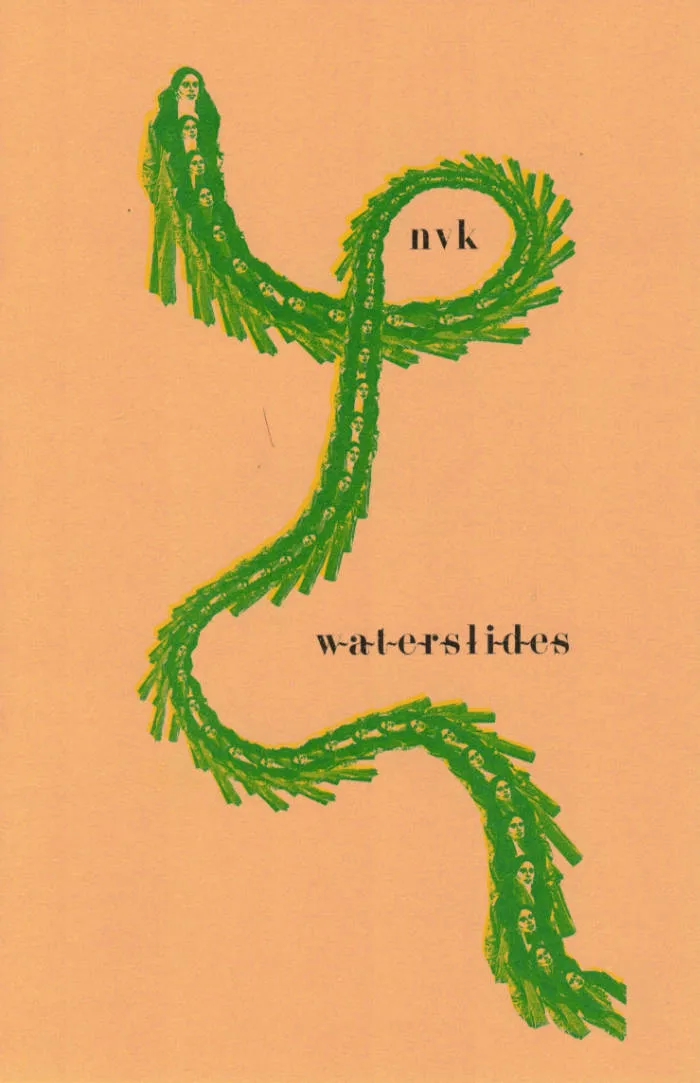
Waterslides
"Waterslides is a falling and plunging, short starts and stops aided by movement, until we splash, climb and plunge again. Each sliding is the same but different—with each descent new expectations and thoughts swirl, shifting focus and gaining new insights or blockages. Waterslides are brief moments of remembering, remembering as a present tense activity, one that happens as we think of it, projected on our now. The waterslide is the moment of past and present working in tandem, a movement of repeating, revisiting and remembering all at once.”
Written by nvk 2021-2023. Dedicated to Judi, MM & TNN.
A version of these poems was published as an audio work through Ignota Press’ The Mountain (2023) and included in a reading with James Loop on Montez Press Radio (2023). nvk would like to thank Jan Matthé, Stine Sampers and Michelangelo Miccolis for their patience & love.
This book was first presented at Kransen in Antwerp, May 6th 2023, with a performance by Sassy (costume by Rosa Schützendorf). Printed and bound at Risiko Press, Borgerhout. Cover image by nvk. Fonts: Adonis, Garamond Pro. Limited to 150 copies.
128x195mm, 16p., stapled, cover: green, yellow and black risoprint on 160gsm caramel paper, inside: black and blue riso on 120gsm Munken Pure paper.

The Book of Skies
Leslie Kaplan, Jennifer Pap and 1 more
The Book of Skies, like its predecessor Excess-The Factory, emerged from poet Leslie Kaplan's experience participating in the national strike and social revolution of ’68 in France. Early in ‘68 Kaplan, like others, left her studies in order to take on factory work, as an aspect of revolutionary practice. Excess—the Factory, puts the factory experience strikingly on the page in sparse and original language. The Book of Skies takes place in the period just after the ‘68 events as the central speaker now observes the places, landscapes, and people surrounding and relying on factory production in French cities, small and large. As the poem’s speaker moves from site to site, she finds possibility within the social spaces of the market, the street, the café, and even the factory itself. While class and gendered violence threaten to shut down hopes for freedom and renewal, the sky, as reality and as figure, functions as an aperture, drawing our attention upward and outward, even or especially when domestic and work-spaces are most violent or suffocating.
From the beginning of her career, French poet, playwright, and novelist Leslie Kaplan has been an important writer of the French left. She has published over twenty books in all three genres, many of which have been translated into German, Swedish, Spanish, Danish, Norwegian, and now, English. Her first book, L'exces l’usine (1982), gained the attention of writers such as Marguerite Duras and Maurice Blanchot, and became an important book for the ‘68 generation. In 2018, Commune Editions published Excess—The Factory, translated by Julie Carr and Jennifer Pap. This was the book’s first translation into English, though it had been translated into five other languages.

Conflict Is Not Abuse
From intimate relationships to global politics, Sarah Schulman observes a continuum: that inflated accusations of harm are used to avoid accountability. Illuminating the difference between Conflict and Abuse, Schulman directly addresses our contemporary culture of scapegoating. This deep, brave, and bold work reveals how punishment replaces personal and collective self-criticism, and shows why difference is so often used to justify cruelty and shunning.

Could It Be Love
Greer Lankton’s iconic and startling doll sculptures as we have never seen them before: through her own eyes.
Magic Hour Press is proud to present the first monograph on the trans visionary artist Greer Lankton (1958–96), whose lifelike doll sculptures shocked 1980s New York. Lankton’s dolls, which she began making as a child and produced obsessively until her death at age 38, were a means to explore her fraught relationship with the human body. In the book’s 100 photographs, all shot by Lankton herself, these figures take on a life of their own, kvetching at a party, strolling along a beach, or lounging on a stoop in the East Village. Among this extraordinary cast of oddballs—usually femme, often freakish, always radiating a glamorous confidence—we find characters of Lankton’s own invention alongside well-known icons such as Divine, Coco Chanel, Andy Warhol and even Lankton herself.
Born in 1958 to a Presbyterian minister in Michigan, Greer Lankton moved to New York in 1978 and became a rising star of the downtown scene. There, her deviant elegance was immortalized in photographs by Peter Hujar, David Armstrong, and Lankton’s close friend Nan Goldin, who described her as “one of the luminaries of the East Village renaissance: beautiful, glamorous, wild and hysterically funny.”
Edited by Francis Schichtel, Jordan Weitzman and Nan Goldin
Text by Hilton Als

Survival Takes a Wild Imagination: Poems
In the powerful follow up to her critically acclaimed debut collection, poet and activist Fariha Róisín is writing, praying, clawing, and scratching her way out of the grips of generational trauma on the search for the freedom her mother never received and the kindness she couldn’t give.
This collection of poetry asks a kaleidoscope of Who is my family? My father? How do I love a mother no longer here? Can I see myself? What does it mean to be Bangladeshi? What is a border? Innately hopeful and resolutely strong, Fariha's voice turns to the optimism and beauty inherent in rebuilding the self, and in turn, the world that the self moves through. Ubiquitous to the human experience, Survival Takes a Wild Imagination is an illuminating breath of fresh air from a powerful poetic voice.

Myth Lab: Theories of Plastic Love
Myth Lab: Theories of Plastic Love is a genre-defiant sex-trip to post-human dimensions. If C.G Jung, magic-mushroom shaman Terence McKenna and Camille Paglia (Sexual Personae) had a three-way while binging on George Bataille and undergoing Hormone Replacement Therapy, their baby might be the erotic cocktail of Myth Lab. Its extreme theme is nothing less than the fate of the species.
“Brilliant and wild, Jack Skelley’s Myth Lab is a manifesto of exuberance disguised as a sci-fi sex test-center for the invention of communal futures. Skelley’s a mad scientist, scholar and poet.” - Chris Kraus, author of After Kathy Acker
“In Myth Lab, Jack Skelley adroitly molds an “Einsteinian elasticity between objects and ether” to the “clitoverse.” If this formulation seems too vast, just think about a) the last time you felt good about power and b) all the ways to say yes to pleasure as a source of liberation. In conducting a “cosmologic psychoanalysis,” Myth Lab thrillingly hot wires our neurons to an endless mirror stage reflective of our own instinctual nature.” - Kim Rosenfield, author of Phantom Captain
"An explosion of clit-cock-and-pop-culture worship. Skelley’s eroto-celestial universe fights back not only against the denial of desire – “also known as fuckheadocracy and market forces” – but against death itself." - Francesca Lia Block, author of Weetzie Bat
"A hallucinatory book that straddles gender studies, science-fiction, and cultural criticism (to name but three of many genres). Ever eager to use a newfound Skelley-ism, I urge everyone to read Myth Lab and be “Kardashian'd” with love (i.e buy it now, it's great)." - Susan Finlay, author of The Jacques Lacan Foundation
"In Jack Skelley’s Myth Lab, something weird and beautiful is forged in the crucible of infinite horny grief. It’s an epic, delirious descent into the inferno, navigating the concentric circles of romance and desire as literary malady, TikTok psyop, benevolent cosmological principle, and more. Simultaneously a quest, a physics experiment and an elegy. I loved following its narrator - a tender, erotomanic, Blakean particle - seeking and finding visionary head." - Daisy Lafarge, author of Love Bug

ZILCH
In banana boxes, Maxime Le Bon collects and stores a lot of documents in a jumble. Most of them are printed, cut out from newspapers, magazines, old publications, erratas and other fragments of texts. Added to this are drawings that he improvises - some of them torn or stained that he don't want to display or throw away. This collection of heterogeneous items is then being rearranged and slipped into plastic pockets where he stores them. Unstable and in constant change, this improbable archive grows with the years. It sedimented layers of experiences and constitutes this heterogeneous deposit from which can emerge all sorts of fragmentary narratives and accidental arrangements. The publication ZILCH brings together a selection of images from this extensive archive.

BRICKS FROM THE KILN #8
Matthew Stuart, Andrew Walsh-Lister
This eighth instalment of BFTK is on letters and letters. It takes the double meaning of this word as its point of dispatch, inviting recipients to think through and respond to — directly and indirectly — ideas around correspondence, addressing and alphabets. What it means to be in correspondence with somebody, the initiation and continuation of this communicative exchange and what happens when it is severed or lost. How to write directly towards a you, to you; to a particular reader, object, locale. The volume is littered with letters. There are letters about letters, letters to letters, letters that crease, fold, tear and rip, letters that are sent and lost, found and read. There are letters that pile up, their combinations arranged and rearranged to form comprehensive linguistic logics, and there are letters that are simply letters. Contributions sit in eight-page signatures, of which there are twenty-six in total. Of the eight hundred bound copies, twenty-six are left unbound, returned to discrete correspondence, loose abécédaire units for exchange — letters to be leafed through and addressed once more.
PLEASE TAKE A LOOK AT YOUR
SHADOW IN THAT MIRROR
Chang Yuchen
(pp.1–8, A)
BESTIARY FOR A NON-GENETIC DESCENDANT
Bhanu Kapil
(pp.9–16, B)
THROW STUFF AWAY
Hannah Regel
(pp.17–24, C)
THE MOON HATH XXX DAYS:
LETTERS FOR LETTERS
Helen Marten
(pp.25–32, D)
WHAT DOES THE LOSS FEEL LIKE?
Meg Miller
(pp.33–48, E, F)
LIGHT UP THE A
Kate Briggs
(pp.49–56, G)
THE POSTCODE CONNECTION
Rebecca Ross
(pp.57–72, H, I)
(LETTER) TO S… LABYRINTH-CORTEX
Michèle Métail, trans. Thea Petrou
(pp.73–80, J)
RACKETY CORRESPONDENCES /
A CORRESPONDING RACKET
Nisha Ramayya
(pp.81–96, K, L)
THE COIN OF THE REALM
Lucie Elven
(pp.97–104, M)
UNFOLDING FOLDED FANTASIES:
A CORRESPONDENCE WITH THE SEATED SCRIBE
Fatema Abdoolcarim
(pp.105–112, N)
DEAR DEAREST DEAR MOTHER
Alice Butler
(pp.113–120, O)
/ DON’T BOTHER THE CREASE
Tice Cin
(pp.121–128, P)
FEELING LETTERS, SEEING BLUE
Gemma Blackshaw
(pp.129–144, Q, R)
LINES OF GRACE AND DISGRACE
Francis Haselden
(pp.145–152, S)
AN ABC OF MIMICRY
Jeffrey Stuker & Jan Tumlir
(pp.153–176, T, U, V)
ADDRESS
Céline Mathieu
(pp.177–184, W)
MY VOICE FOLDS YOU
Thea Petrou
(pp.185–192, X)
A LONG DISTANCE LULLABY
Vibeke Mascini
(pp.193–200, Y)
DEBT OF GOLD CAN BE PAID OFF,
DEBT OF KINDNESS IS CARRIED OVER DEATH
Chang Yuchen
(pp.201–208, Z)
LETTERS ON LETTERS
FROM LETTERS ON LETTERS
Matthew Stuart
(covers)

Heights of Macchu Picchu
Pablo Neruda’s Alturas de Macchu Picchu is a poem that distrusts solitary authority even as it passes through a single voice, moving from the lyric “I” toward a collective utterance grounded in labor, history, and shared breath.
Producing the first collaborative translation of Alturas de Macchu Picchu is not incidental but consonant with its deepest claims. Attentive to Neruda’s unique lyric pressure, this new English version resists the tradition of singular, authoritative renderings by allowing meaning, rhythm, and decision to emerge through dialogue and negotiation.
In this way, the translation does not merely transmit Neruda’s poem but enacts its insistence that voice is a collective achievement, not a solitary possession.

Godlike
New York poet Paul Vaughn has a trick for enjoying poetry readings: He simply imagines the reader died a long time ago. Paul is twenty-seven, married, and an admired poet himself. R. T. Wode’s mission is to give offense. He’s also a poet, freshly landed in the city, and, at age sixteen, unknown.
Paul worships T. They embark on a tempestuous affair, dropping acid and crashing parties and perambulating the grit and grime of New York City circa 1972. Paul is in love with T., but T. is in love with experience. Their relationship disintegrates.
A novel of compelling originality and transcendent beauty by legendary musician and poet Richard Hell, Godlike transposes the notorious romance of Paul Verlaine and Arthur Rimbaud to the East Village in its squalid, glorious ’70s heyday. The book comprises a version of Paul’s 1997 hospital notebooks: diaries amidst poems and essays, along with, most pertinently, the poet’s third-person memoir-novelette of his youthful time with the now-famous T. Godlike is infused as well with evocations—and sometimes actual poems—of many New York poets of the era, from Ted Berrigan and Ron Padgett to Edwin Denby and James Schuyler. It achieves a lyricism both profane and profound as it conjures the frenetic vitality as well as the existential malaise of an era. It’s a searching meditation on art, life, love, and the impossibility of everything.

The Queer Arab Glossary
When conventional language does not equip us with the tools to speak about ourselves, we create our own. Slang expresses words and feelings that break down boundaries. It is a form of protest and fills in the gaps.
The Queer Arab Glossary is the first published collection of Arabic LGBTQ+ slang. This bold guide captures the lexicon of the queer Arab community in all its differences, quirks and felicities. Featuring fascinating facts and anecdotes, it contains more than 300 terms in both English and Arabic, ranging from the humorous to the harrowing, serious to tongue-in-cheek, pejorative to endearing. Here, leading queer Arab artists, academics, activists and writers offer insightful essays situating this groundbreaking glossary in a modern social and political context.
With beautiful, witty illustrations, The Queer Arab Glossary is a powerful response to pervasive myths and stereotypes around sexuality and an invitation to take a journey into queerness throughout the Arab world.
Contributors include Saqer Almarri, Nisrine Chaer, Sophie Chamas, Rana Issa, Adam HajYahia, Suneela Mubayi, Mejdulene Bernard Shomali, Hamed Sinno and Abdellah Taïa.
The Queer Arab Glossary was made possible with the generous support of the Arab Fund for Arts and Culture – AFAC, Mophradat, Bashar Assaf and Mohammed Fakhro.
Foreword by Rabih Alameddine

The Land of All Time
The latest collection from prolific American poet Clark Coolidge, who has often been associated with the Language School and the New York School but has truly forged a unique style. A life-long jazz drummer, his poems can be approached as improvisational compositions with strange arrangements of words, statements, and sounds that are vibrant, frequently hilarious, and jarring. His upended syntax and surprising associations reflect a world awash in information; an advanced civilization dealing with ever more rapid change. His poems are explorations into the possibilities of language. This kind of work could, serendipitously, lead to new patterns of thinking, new definitions, new meanings, perhaps even new ways of dealing with old problems.

Grandma’s Story
‘May my story be beautiful and unwind like a long thread . . .’, she recites as she begins her story.
The storyteller is the living memory of her time: at once an oracle, weaver, healer, warrior, witch, protectress, teacher and great mother. Her powers are to do with passing on – not only the stories but transmission itself: ‘what grandma began, granddaughter completes and passes on to be further completed.’
In contrast to the idea that a story is ‘just a story’, pioneering postcolonial feminist theorist and filmmaker Trinh T. Minh-ha recodes ideas about truth and fantasy to tell a different story about power, civilisation, history, medicine and magic. Grandma’s Story shows how creative speech is connected to women’s powers of enchantment, drawing upon and speaking with storytellers including Theresa Hak Kyung Cha, Clarice Lispector, Maxine Hong Kingston, Leslie Marmon Silko and Zora Neale Hurston – all who may be known as ‘she who breaks open the spell’.
The story as a cure and a protection is at once musical, historical, poetical, ethical, educational, magical, and religious.

Broken Villas
Written in response to three “physical” photographs, ‘Broken Villas’ contains and considers how a vessel might clasp tightly to known volumetric identities, but also loom with a set of accentuated clues towards otherness: the excavated seams in the earth and what we fill those holes with, imaginary or otherwise; the glacial erraticism of the boulder; the queer crimping of a hotel pillowcase; the modes via which objects are housed as display, but also packaged away, with sorrow, with fear, with erotism etc.

Sforzando - Pastels 2020 - 2022
At midday, March 17th, 2020, Macron’s government decided to place France in suspended animation. Total confinement. The first in a series of strict debilitating lockdowns to combat the spiralling Covid-19 pandemic. This first confinement lasted 55 days. It ended on 11th May 2020. The first part of a dramatic trilogy.
One month in, in April 2020, David West picked up a box of pastels that used to belong to his mother. He had had them for many years but never used them. New to the medium, locked in his Paris studio, he sets himself to the task. Naturally, violence ensues. Folk horror. Animals are disembowelled. Faceless sexualised female bodies perform. Screaming faces educate. Covered figures stand motionless. Shadows. Hooded beings populate. Stabbing, scratching, fading, softening, sforzando. Crescendo. Schadenfreude.
Occasional respite comes when West ventures outside - andante - but the externalised screaming pushes him back in. Hagazussa. Ghosts from West’s past, real and unreal, appear and disappear, figures and shapes, compositional arcs, a slimy snaking emerald hand parts the waves for colour to gush forth a new language verde fosforescente, worm purple, rosa shocking, vermillion, cobalt, ultra-black.
This book reproduces a small selection of some 300 works, in chronological order, in an attempt to document time, evolution, revolt, epiphany and joy. Joy in colour, horror, form, symphony, and finally, West’s visions of a new utopia. Marcato. Decrescendo.
Softcover (21cm x 29.7cm)
100 Pages
50 copies
Signed and numbered by David West

Sung Hwan Kim: A Record of Drifting Across the Sea
A richly illustrated exploration of Sung Hwan Kim’s complex record of migrant stories, displacement and belonging, border-crossings and translation.
In A Record of Drifting Across the Sea (2017–), Sung Hwan Kim looks at histories of migration. The artist parses the traces –archival and bodily – left by undocumented Korean migrants who came to the US by way of Hawai’i at the turn of the twentieth century, and ponders over their impact on other migrant and indigenous communities. As an ongoing film and installation series, comprising two chapters and a third in progress, A Record unsettles the limits of the ‘one work’ with its distributive, open-ended and collaborative nature.
In this speculative inquiry, Janine Armin explores each chapter in Kim’s multi-layered work as a mycelial network of feelers entangling and extending the wider work in-process. Engaging history through embodiment, folklore and myth, as much as through archival material, Kim navigates and crosses the boundaries between displacement and belonging. Focusing on the artist’s attempt to escape from representation, Armin illuminates and attends to the different stories and non-sovereign ways of being together towards which his work points us.
This title is part of the One Work book series, which focuses on artworks that have significantly changed the way we understand art and its history.

Pfeil Magazine #18 – Body
From its anatomy and autonomy to its death and diet, this issue focuses on the motif Body and all its meanings, direct and indirect, for instance as in relation to human and non-human bearers of bodies, its inhabitants like bacteria and organs, its social, medical and juridical conditions, its intoxications, chemical processes, traumas, transitions, well-being, replacements, weaknesses, and its opposites.
Contributors: Adam Dickinson, Andrea Éva Győri, A.L. Steiner, Alexandra Ivanciu, Barak Zemer, Bernhard Willhelm, Clara Lena Langenbach, Clémentine Bedos, Constance DeJong, Daisy Hildyard, Fanny Howe, Hanne Loreck, Hasti, Holly Hunter, Ingrid Jäger, Jannis Marwitz, Jess Arndt, Johannes Kuczera, Jolanta Nowaczyk, Henriette Maier, Mag Gabbert, Maja Smrekar, Manuel Vason, R.I.P. Germain, Rebekka Endler, Sonja Yakovleva
Within the format of a magazine, each page of Pfeil represents the floor, walls, or ceiling which together create an imagined room displaying a printed exhibition. Each issue is dedicated to a specific word, and artists are invited and given space to work on and with this term, and to construct or deconstruct the architecture around it. Combined, the contributions transform into an organic display surrounding the leitmotif.

Amalgamemnon
History and literature seem to be losing ground to the brave new world of electronic media and technology, and battle lines are being drawn between the humanities and technology, the first world and the third world, women and men. Narrator Mira Enketei erases those boundaries in her punning monologue, blurring the texts of Herodotus with the callers to a talk-radio program, and blending contemporary history with ancient: fairy-tale and literal/invented people (the kidnappers of capitalism, a girl-warrior from Somalia, a pop singer, a political writer), connected by an elaborate mock-genealogy stretching back to the Greek gods, move in and out of each other's stories. The narrator sometimes sees herself as Cassandra, condemned by Apollo to prophesy but never to be believed, enslaved by Agamemnon after the fall of Troy. Brooke-Rose amalgamates ancient literature with modern crises to produce a powerful novel about the future of culture.
Christine Frances Evelyn Brooke-Rose was a British writer and literary critic, known principally for her later, experimental novels.

Heatwave #2
In an era when many “radical” theorists were seeking out the peaceable expression of politics in “everyday utopias,” Joshua Clover stressed that politics was always, at root, a fiery confrontation with the powers that be. To these ends, he not only helped bring together a new generation of young communists but also pushed them to engage directly with the rising tide of class conflict, understanding full well that the street and the shopfloor are the true classrooms of the partisan.
Heatwave is, in a sense, an attempt to embody this spirit at a larger scale. Like Joshua, we hope to serve as an engine of engagement, linking our readers to their own history and to one another. Like Joshua, we adopt a principle of ecumenicism, refusing the false dividing lines inherited from the long dissolution of the last global communist movement. At the same time, like Joshua, we also insist on a theoretically rigorous approach that invokes the real complexity of revolutionary theory and history, actively seeks evidence for its claims, and engages in good faith with opposing positions. And, like Joshua, we maintain that the partisan project is inherently incendiary, requiring confrontation with the rulers of the world, rather than gradualist compromise or secessionist retreat. Finally, communism requires an unambiguous commitment to internationalism. Although our project is currently anglophone, we recognize that elaborating a partisan politics requires learning from the self-activity of the dispossessed at the global scale.
The name "Heatwave" echoes that of an old Situationist magazine ("Britain's most incandescent journal" of 1966), but with added urgency in an era where every summer is the hottest on record. While the statistical certainty of catastrophe is inescapable, "revolt" names many species of conflagration, including that peculiar variety we call communism. We must sift through the ashes to find it.