rile*books

Search books

Search books by title, author, publisher, keywords...

Cover of I am Four Quartets by T.S Elliot

Time has fallen asleep in the afternoon sunshine

I am Four Quartets by T.S Elliot

Sébastian Hendrickx

€12.00

For the project Time has fallen asleep in the afternoon sunshine a group of people/ performers memorize a book of their choice. Together they form a library collection consisting of living books. After years of learning by heart and reciting for readers, some of the books have now been written down from memory to create new editions, versions resulting from this process. This book is one of those books, chosen by one person, learned by heart and recited many times, and now written down again from memory. This edition is not a re-edition of the original text. It is a re-writing of the text after the process of reading, memorizing and reciting, with all the alterations that might have occured in the course of this process.

www.timehasfallenasleepintheafternoonsunshine.be

Hardcover ┊ Language: English

recommendations

Cover of Appendix #3: Orality

Time has fallen asleep in the afternoon sunshine

Appendix #3: Orality

Victoria Pérez Royo, Léa Poiré and 1 more

Time has fallen asleep in the afternoon sunshine Appendix #3 Orality includes contributions by Simon Asencio, Bruno De Wachter, Peter Szendy, Clara Amaral, Itziar Okariz, Jude Joseph, Léa Poiré and Mette Edvardsen.

Time has The Appendixes #1–4 is an editorial series by Mette Edvardsen, Léa Poiré and Victoria Pérez Royo that developed out of the project Time has fallen asleep in the afternoon sunshine. For a two-year residency at Les Laboratoires d’Aubervilliers* (2022–23), they came together as a small work group, shaping the work process, hosting presentation formats and making this publication series on paper as four cahiers.

The cahiers comprise a collection of commissioned texts and contributions created for this context, selected documents and traces from work sessions and encounters organized during their residency, texts read together and republished for this occasion, a collection of references, notes in progress, unfinished thoughts and loose fragments – on paper, between pages.

The Appendixes are organized around four themes: (1) The gesture of writing, (2) How to organize a library, (3) Orality and (4) Translation. In addition to being published on paper, the editorial series also consisted of other formats of presentations, exchanges and meetings organized as workshops, fieldwork, performances, conferences, collective readings and oral publications, taking place during their residency at Les Laboratoires d’Aubervilliers and in the vicinity.

The Appendixes is the work that continues, material that adds on, some of it perhaps too long or too detailed, unfit or unfinished. The four themes that their research is formulated around originate in specific experiences and questions from the practices of Time has fallen asleep in the afternoon sunshine (2010 – ongoing), and also the large publication on the project ‘A book on reading, writing, memory and forgetting in a library of living books’ (2019). The research was both a means of exploring these themes in greater depth and also of bringing them into contact with other artists and researchers working on similar or related subjects. The Appendixes offered them both the contexts and the pretexts for things to happen (in time, in space, on paper).

The Appendixes #1–4, published in these cahiers, do not present an overview or a summary of all of the activities and presentations that took place during the two years at Les Laboratoires d’Aubervilliers. What these cahiers offer is a space in which to hold some thoughts together and to share them in this form. It is one more step along the way, extending the research and work already begun and that will now continue.

Cover of Verzamelde gedichten - Against the Forgetting

Time has fallen asleep in the afternoon sunshine

Verzamelde gedichten - Against the Forgetting

Bruno De Wachter

For the project Time has fallen asleep in the afternoon sunshine a group of people/ performers memorize a book of their choice. Together they form a library collection consisting of living books. After years of learning by heart and reciting for readers, some of the books have now been written down from memory to create new editions, versions resulting from this process. This book is one of those books, chosen by one person, learned by heart and recited many times, and now written down again from memory. This edition is not a re-edition of the original text. It is a re-writing of the text after the process of reading, memorizing and reciting, with all the alterations that might have occured in the course of this process.

www.timehasfallenasleepintheafternoonsunshine.be

Cover of Seltsame Sterne starren zur Erde

Time has fallen asleep in the afternoon sunshine

Seltsame Sterne starren zur Erde

Sonia Si Ahmed

For the project Time has fallen asleep in the afternoon sunshine a group of people/ performers memorize a book of their choice. Together they form a library collection consisting of living books. After years of learning by heart and reciting for readers, some of the books have now been written down from memory to create new editions, versions resulting from this process. This book is one of those books, chosen by one person, learned by heart and recited many times, and now written down again from memory. This edition is not a re-edition of the original text. It is a re-writing of the text after the process of reading, memorizing and reciting, with all the alterations that might have occured in the course of this process.

Cover of Mon Songe

Time has fallen asleep in the afternoon sunshine

Mon Songe

Vincent Dunoyer

For the project Time has fallen asleep in the afternoon sunshine a group of people/ performers memorize a book of their choice. Together they form a library collection consisting of living books. After years of learning by heart and reciting for readers, some of the books have now been written down from memory to create new editions, versions resulting from this process. This book is one of those books, chosen by one person, learned by heart and recited many times, and now written down again from memory. This edition is not a re-edition of the original text. It is a re-writing of the text after the process of reading, memorizing and reciting, with all the alterations that might have occured in the course of this process.

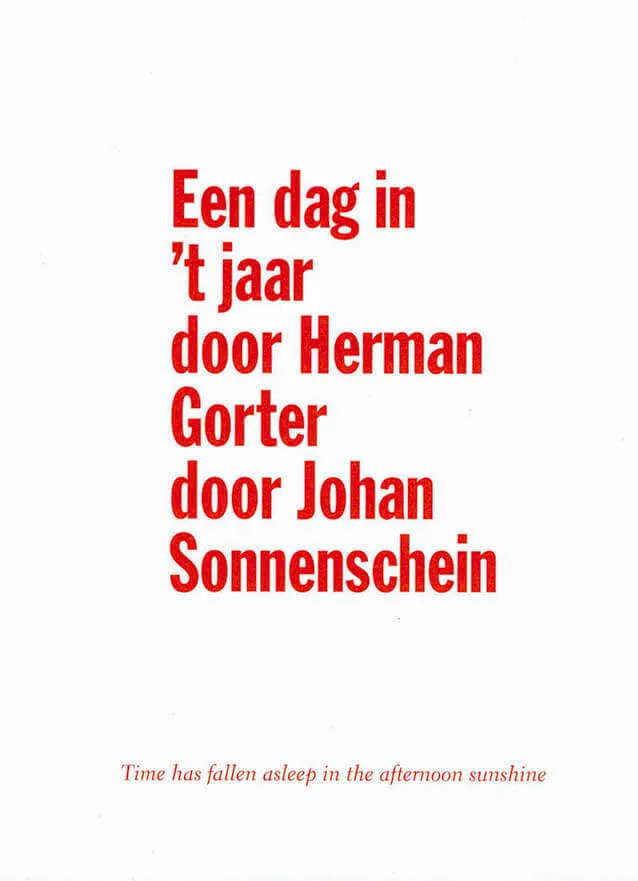
Cover of Een dag in 't jaar door Herman Gorter

Time has fallen asleep in the afternoon sunshine

Een dag in 't jaar door Herman Gorter

Johan Sonnenschein

For the project Time has fallen asleep in the afternoon sunshine a group of people/ performers memorize a book of their choice. Together they form a library collection consisting of living books. After years of learning by heart and reciting for readers, some of the books have now been written down from memory to create new editions, versions resulting from this process. This book is one of those books, chosen by one person, learned by heart and recited many times, and now written down again from memory. This edition is not a re-edition of the original text. It is a re-writing of the text after the process of reading, memorizing and reciting, with all the alterations that might have occured in the course of this process.

Cover of Épopées Célestes / Epopee celesti

Éditions Empire

Épopées Célestes / Epopee celesti

Gustavo Giacosa, Barbara Safarova

A veritable panorama of Art Brut at an international level, through 180 works selected from Bruno Decharme's collection.

Art brut has never ceased to shake up the history of art and nourish minds resistant to norms as it questions classic notions of art and creation as well as those relating to the normal and the pathological. But who are they, these artists of a special kind, witnesses to another world, strangers to stylistic trends and influences? They stay—or are kept—away from the culture of fine art as well as the codes and places that constitute it such as schools, academies, museums, art fairs, etc.

Featuring A.C.M., Noviadi Angkasapura, Anselme Boix-Vives, Marie Bodson, Giovanni Bosco, Gustavo Enrique Buongermini, Aloïse Corbaz, Fleury-Joseph Crépin, Egidio Cuniberti, Henry Darger, Fernand Desmoulin, Janko Domsic, Dong-Hyun Kim, Jaime Fernandes, Eugen Gabritschevsky, Pietro Ghizzardi, Madge Gill, Paul Goesch, Jorge Alberto Hernández Cadi, Paul Humphrey, Zdeněk Košek, Joseph Lambert, Gustave Pierre Marie Le Goarant de Tromelin, Augustin Lesage, Pascal Leyder, Alexander Pavlovitch Lobanov, Ramon Losa, Dwight Mackintosh, Lázaro Antonio Martínez Durán, Mettraux, Edmund Monsiel, John Bunion Murray, Iwona Mysera, Koji Nishioka, Masao Obata, Jean Perdrizet, M. Pierron, Photographies Spirites, Miloslava Ratzingerová, Marco Raugel, Achilles G. Rizzoli, Leopold Strobl, Harald Stoffers, Mose Tolliver, Melvin Way, Scottie Wilson, Adolf Wölfli, Anna Zemánková, Carlo Zinelli, Unica Zürn.

Cover of Grace Crowley

Kunstverein Amsterdam

Grace Crowley

Riet Wijnen

Grace Crowley is a publication based on letters sent to the Australian artist and pioneer of modernist painting Grace Crowley (1890–1979) by friends, family and colleagues. Parts of those letters, which are now housed in the Art Gallery of New South Wales and the State Library of New South Wales archives in Sydney, were transcribed and categorised by Riet Wijnen in subsections such as ‘Marital Status’, ‘Teaching’, ‘Hosting’, ‘Eurasia’, ‘X’, ‘Being A Woman’, ‘War’, ‘$’ and ‘Making Work’. The result is an alternative biography constructed solely through a living set of relations.

Cover of The Almond

1080 Press

The Almond

Theadora Walsh

“Today is the day with the letter,” Celan writes to Bachmann on October 30, 1957. Theadora Walsh’s essay-poem, The Almond concerns, for I hesitate to write “about” or “is in relation to”, the love between Paul Celan and Ingeborg Bachmann. Two Austrian writers flung across Europe by the atrocities of the Holocaust, excavating the narrows of a language not theirs, or taken from them. An almond is the closest two people can be, and becomes the binding structural conceit of the book, two segments reaching across the blank page to each other, across history, time and language.