rile*books

Search books

Search books by title, author, publisher, keywords...

Cover of The Complete Works of Pat Parker

Sinister Wisdom

The Complete Works of Pat Parker

Julie R. Enszer ed., Pat Parker ed.

€23.00

A Midsummer Night’s Press and Sinister Wisdom are pleased to announce the publication of Sinister Wisdom 102: The Complete Works of Pat Parker with a new introduction by poet and scholar Judy Grahn; an afterword by volume editor Julie R. Enszer, with extensive notes on the poems; photographs of Parker and a bibliography.

'In The Complete Works of Pat Parker, we have a trove of her artistic and political engagements-poetry and stories and plays and speeches; these are not separate realities. They intertwine in her now classic works, Movement in Black (1978), Womanslaughter (1978), and Jonestown & Other Madness (1985). But here too are less celebrated and uncollected works, plays especially, that show off Parker’s willingness to experiment, to push us towards more politicized realities.' - Alexis de Veaux

Included in Sinister Wisdom 102: The Complete Works of Pat Parker are Parker’s masterwork, Movement in Black, as well as Jonestown & other madness. Parker’s prose writing is collected in The Complete Works along with two unpublished plays and a number of previously uncollected poems. Editor Julie R. Enszer notes, “The breadth of creative output collected here demonstrates the seriousness of Parker’s overall work as a writer. Beginning in 1963, when she was nineteen years old, and continuing until she died in 1989, Parker took her work as a writer seriously. Gathering as much of it as possible into a single volume invites readers to take it seriously as well.”

Language: English

recommendations

Cover of Lost & Found: The CUNY Poetics Document Initiative, Series VI

CUNY Center for the Humanities

Lost & Found: The CUNY Poetics Document Initiative, Series VI

CUNY

Lost & Found: The CUNY Poetics Document Initiative publishes unexpected, genre-bending works by important 20th century writers. Unearthed from personal and institutional archives in the United States and abroad, these materials are edited by doctoral students at the Graduate Center, CUNY.

LOST & FOUND SERIES VI presents work by Gregory Corso, Judy Grahn, Bobbie Louise Hawkins, and Ted Joans. While the styles and experiences of these writers are radically different, each project presented here enacts a commitment to the exploration of knowledge unbound by disciplinary constraints.

Gregory Corso: Naropa Lectures 1981, introduced by Anne Waldman, includes two transcribed and annotated lectures that illustrate Corso's vast storehouse of cultural knowledge, animating his poetics both on the page and in the classroom.

Bobbie Louise Hawkins: The Sounding Word presents two very different lectures from the Jack Kerouac School of Disembodied Poetics, and a new interview with the author. Whether looking at iconic French novelist Colette or examining the poetics of prose, The Sounding Word describes an unflinching empirical approach to knowledge and its transmission through direct experience.

Judy Grahn: Selections from Blood, Bread, and Roses explores mythic, societal, and personal relationships to menstruation throughout time, and is accompanied by a recent interview with the legendary poet, teacher, scholar, and activist.

Ted Joans: Poet Painter / Former Villager Now / World Traveller, introduced by Diane di Prima, presents an array of previously unpublished texts on jazz, surrealism, travel guides to Africa and Paris, his inimitable Negative Cowboy, and photographs from his life and times. As writers, each considers and refigures the malleable conditions of historical truth and the pursuit of knowledge as part of their creative process. And as readers, we are encouraged to do the same.

SERIES VI includes:

Gregory Corso: Naropa Lectures 1981 (Part I & II) (ed. William Camponovo, Mary Catherine Kinniburgh, Öykü Tekten)

Bobbie Louise Hawkins: The Sounding Word (ed. Iris Cushing)

Judy Grahn: Selections from Blood, Bread, and Roses (ed. Iemanjá Brown & Iris Cushing)

Ted Joans: Poet Painter / Former Villager Now / World Traveller (Part I & II) (ed. Wendy Tronrud & Ammiel Alcalay)

Cover of Celebrating the Michigan Womyn's Music Festival

Sinister Wisdom

Celebrating the Michigan Womyn's Music Festival

Sinister Wisdom

Sinister Wisdom 103: Celebrating the Michigan Womyn's Music Festival honors the forty-year legacy of the Michigan Womyn’s Music Festival (1976–2015). Sinister Wisdom 103: Celebrating the Michigan Womyn's Music Festival celebrates this embodiment of radical feminist separatist collaboration, transformational self-defined autonomous spaces, a commitment to sisterhood and matriarchal culture, and a musical city sprung from the earth for one week in the woods.

A collective of five womyn each with a deep connection to Fest operated by consensus to create this issue. Striving to represent a range of womyn’s voices, values, traditions, and experiences of Fest, the collective highlighted what Fest has meant to generations of womyn, documented its chronology, and bore witness to the power of this community. Sinister Wisdom 103: Celebrating the Michigan Womyn's Music Festival includes womyn from multiple races, geographies, sexualities, generations, and gender and other social identities. Just as Fest brought together womyn from various backgrounds, our collection includes a range of artistic experience, from seasoned authors and photographers to those womyn new to publishing.
Sinister Wisdom 103: Celebrating the Michigan Womyn's Music Festival remembers the transformations, possibilities, and hopes for spaces cultivating the ongoing empowerment of womyn.

Cover of The Letters of Audre Lorde and Pat Parker 1974-1989

the87press

The Letters of Audre Lorde and Pat Parker 1974-1989

Julie R. Enszer

Poets Audre Lorde and Pat Parker first met in 1969; they began exchanging letters regularly five years later. Over the next fifteen years, Lorde and Parker shared ideas, advice, and confidence through the mail. They sent each other handwritten and typewritten letters and postcards often with inserted items including articles, money, and videotapes.

The Letters of Audre Lorde and Pat Parker 1974-1989 gathers this unique correspondence in which Lorde and Parker discuss their work as writers as well as the intimate details of their lives, including periods when each lived with cancer. These letters are a rare opportunity to glimpse inside the minds and friendship of two great twentieth century poets.

Introduction by Mecca Jamilah Sullivan.

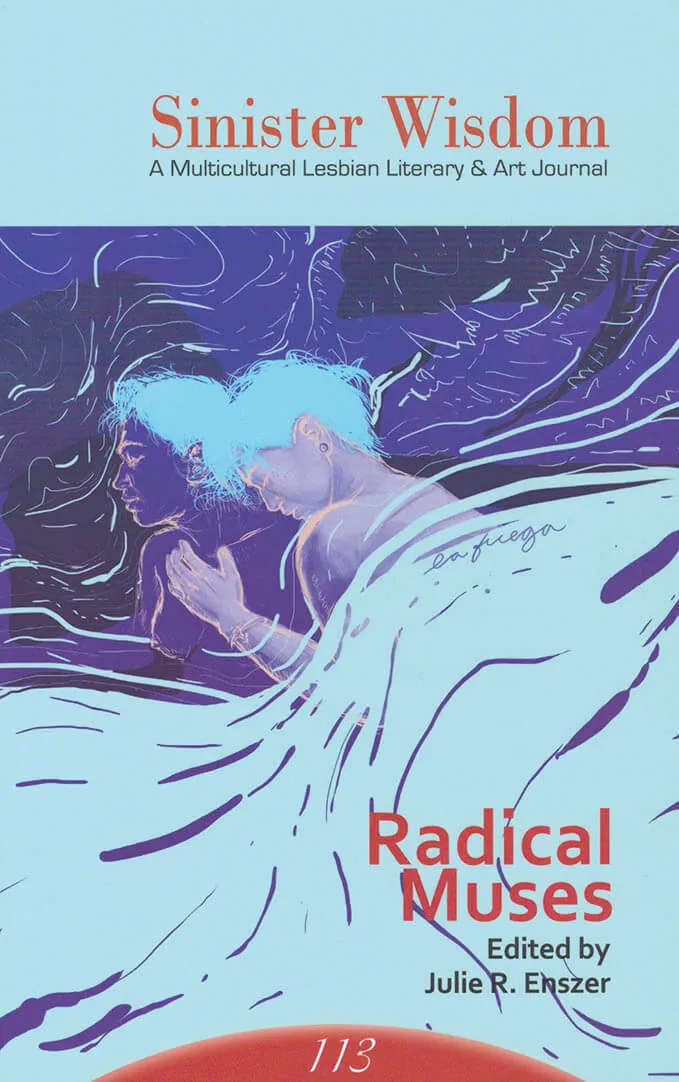
Cover of Radical Muses (Sinister Wisdom nr. 113)

Sinister Wisdom

Radical Muses (Sinister Wisdom nr. 113)

Julie R. Enszer

Sinister Wisdom 113: Radical Muses features an eclectic array of contemporary poetry, prose, and art by lesbians from around the world, including new work by: Andrea Assaf, Tara Shea Burke, Cheryl Clarke, Marina Chirkova, Estela González, Barbara Haas, Nancy E. Lake, Vi Khi Nao, H. Ní Aódagaín and much more!

Cover of Love Belongs to Those Who Do the Feeling: New & Selected Poems (1966-2006)

Red Hen Press

Love Belongs to Those Who Do the Feeling: New & Selected Poems (1966-2006)

Judy Grahn

Poetry €22.00

An exciting collection of new and selected poetry by Judy Grahn. The book contains selections from Judy's entire body of poetic work from The Work of a Common Woman, The Queen of Wands and The Queen of Swords, to new poems written between 1997 and 2008.

Judy's poetry is rangy and provocative. It has been written at the heart of so many of the important social movements of the last forty years that the proper word is foundational.

Cover of Weaving Language I

Essay Press

Weaving Language I

Francesca Capone

Essays €18.00

Weaving Language I: Lexicon is the first book in the Weaving Language series, which examines the poetics of weaving traditions through historical research as well as contemporary practices. Attempting to dismantle and rebuild commonplace understandings of the history of writing, Weaving Language focuses on fiber-based forms as a longstanding but often overlooked medium for record-keeping, storytelling, and poetry.

In Weaving Language I: Lexicon, weaving processes are mapped onto English grammar to suggest a method for reading woven works. Offering visual vocabularies as both discrete concrete poems as well as a collection of translatable terms, this book invites readers, writers, and weavers to participate by considering weaving as a system that can be decoded. Textile forms are broken into the basic building blocks of language, presented as a visual/textual lexicon.

Weaving Language I: Lexicon was initially self-published by Capone in 2012 and in 2015 re-issued in an edition of five as an artists’ book, which was awarded the Frances Mason Harris ’26 Prize from Brown University.

Essay Press’s edition makes this important work available for the first time in a trade edition. The edition has also been newly edited and significantly expanded into a multivocal work that represents the contributions of a small collective of artists including Martha Tuttle, Allison Parrish, Sarah Zapata, Adjua Gargi Nzinga Greaves, Amaranth Borsuk, and Imani Elizabeth Jackson, thanks to funding from the Oregon Arts Commission and the Ford Family Foundation. The book also includes an afterword by Kit Schluter and diagrams by Anni Albers (with permissions from the Josef and Anni Albers Foundation).

Plans are underway to similarly expand and reissue the two additional books in the series both previously published in limited editions currently out of print: Weaving Language II: Language is Image, Paper, Code, & Cloth (information as material, York, UK, 2018) and Weaving Language III: Writing in Threads (Center of Craft, Asheville, NC, 2017). The Weaving Language project has been accompanied by numerous gallery shows, including “Material Memory,” a show running from October 7 through November 9, 2022, at Nationale in Portland, Oregon, to accompany the release of the Essay Press edition of Weaving Language I.

Artists’ books from the Weaving Language series are held by the collections of the Museum of Modern Art Library in New York, NY; the Thomas J. Watson Library at the Metropolitan Museum of Art in New York, NY; the Harris Collection of American Poetry and Plays at the John Hay Library at Brown University in Providence, RI; and at the Joan Flasch Artists’ Book Collection at the School of the Art Institute of Chicago in Chicago, IL.

Cover of Feminist Fatwas

Everyday Analysis

Feminist Fatwas

Rafia Zakaria

Feminist Fatwas traces how Muslim feminists are resisting misogynistic interpretations of the Quran (like the verse male clerics have used to condone wife-beating). 

For centuries, the translators and interpreters of the Holy Quran have been men. This is changing now as more and more Muslim feminists cast their eye on the patriarchal contexts of these interpretations. Feminist Fatwas tells the story of  Verse 34 in Chapter 4 which has been interpreted by male clerics as condoning a husband beating his wife. This essay traces the groundbreaking work of knocking down this misogynist Quranic interpretations. The story of how Muslim feminists are doing this work is a chronicle of the slow and quiet feminist revolution taking place within Islam as women take on significant and powerful roles. 

Rafia Zakaria is a Pakistani-American attorney, feminist, journalist, and author. She has written for The Nation, Guardian Books, The New Republic, The Baffler, Boston Review, and Al Jazeera. In 2021, she published Against White Feminism, in which she critiques the emphasis that conventional feminist thought places on the experiences of white women while excluding women of color

Cover of Resisting Erasure: Capital, Imperialism and Race in Palestine

Verso Books

Resisting Erasure: Capital, Imperialism and Race in Palestine

Adam Hanieh, Robert Knox and 1 more

Essays €15.00

A materialist analysis of the links between global capitalism, energy politics, and racial oppression in Palestine. 

Why has Palestine become a defining fault line of contemporary politics?

Challenging mainstream narratives that reduce Palestine to ancient hatreds, humanitarian tragedy, or legal abstractions, Resisting Erasure places Israeli settler-colonialism within the broader historical arc of imperialism, race, and fossil capitalism in the Middle East.

Resisting Erasure is a succinct and far-reaching critique of the socio-economic and political forces that sustain the Israeli settler-colonial project. An essential introduction for anyone looking to understand what Palestine reveals about the world – and what it demands of us today.