rile*books

Search books

Search books by title, author, publisher, keywords...

Cover of The Book of Advice

Ugly Duckling Presse

The Book of Advice

Ghazal Mosadeq

€20.00

The Book of Advice, an experiment in self-translation, stems from the andarznameh tradition of classical Persian literature, a form that moves between verse and prose as it engages invented or familiar sayings and folktales. Originally written in Persian between 2018-2020, the book now speaks in both English and Persian, opening at once from the back and the front, in a voice both distanced and familiar. The vicissitudes of the everyday preoccupy its intimately impersonal speaker as she wrestles with the inadequacy and mobility of language. 

Ghazal Mosadeq is a poet, editor and translator. She is the founder of Pamenar Press, an independent publisher of poetry, translation, hybrid and critical writing. Her own work has been published by Sheirsman, Fence, Arc Poetry, Fiddlehead, Asymptote, Modern Poetry In Translation and Words Without Borders, among others. She is a member of the editorial advisory board for the Journal of British and Irish Innovative Poetry.

The Book of Advice knows 'we didn’t have to break the flower stem/ to let the/ light pass through,' even as it knows we have already broken everything we could. Here, no one knows our names, nor the name of our horse, though someone did once ask. From the sliver between a face and its forgettable name, from the sliver between what’s been said and what’s yet to be said, slightly but exactly differently, Ghazal Mosadeq offers a chasm. The floor is deep, but, when you land, very tender. No one hails us, but the well wishes, oh, open your mouth for the well wishes." —Farid Matuk

Published in 2026 ┊ 206 pages ┊ Language: English, Farsi

recommendations

Cover of Magic Episodes and Other Synchronicities

Ugly Duckling Presse

Magic Episodes and Other Synchronicities

Scott Burton, Eduardo Costa and 2 more

LGBTQI+ €24.00

Their relationship is forged in charismatic, darting, and deep correspondence: dishy gossip, shop talk, and the auditioning of ideas and shaping of artistic practices." 
—Nate Lippens

When Scott Burton (1939–1989) and Eduardo Costa (b. 1940) met in New York City in 1968, they developed a close friendship that lasted until Burton’s death. In letters from the 1970s, they gossiped and shared thoughts about the rapid changes taking place in the art world, queer life, and their work as writers and artists. Burton and Costa’s letters show a vibrant transnational queer artistic friendship and offer a new perspective on the struggle to establish conceptual, critical artistic practices in the Americas. As Costa moved from New York to Buenos Aires to Rio de Janeiro, he and Burton discussed the art communities of North and South America, including Costa’s friend Hélio Oiticica and the lasting influence of Marcel Duchamp. Both artists found the letters to be a source of emotional and intellectual nourishment—as will their readers.

Cover of Sonnet(s)

Ugly Duckling Presse

Sonnet(s)

Ulises Carrión

Poetry €20.00

A lost gem of permutational conceptualism from a key figure in artist's book culture, available again

Known internationally as one of Mexico's most important conceptual artists, Ulises Carrión (1941-89) played a decisive role in defining and conceptualizing the genre of the artists' book through his manifesto, The New Art of Making Books (1975), which he wrote soon after the 1972 publication of SONNET(S) and his move from Mexico City to Amsterdam, where he opened the legendary bookshop gallery, Other Books and So, the first space dedicated exclusively to artists' publications and an important precursor to such artists' book hubs as Printed Matter.

One of Carrión's earliest bookworks, SONNET(S) represents a landmark shift in the artist's output from poetry to artists' books. Here, Carrión takes a single poem by Dante Gabriel Rossetti through 50 typographic and procedural permutations. This republication is supplemented by new essays on Carrión's bookworks by contemporary artists, writers, and scholars from Mexico, Europe and the US. 

Published March 2021

Cover of The Close Chaplet

Ugly Duckling Presse

The Close Chaplet

Laura Riding

Poetry €23.00

Long out of print, The Close Chaplet is Laura Riding's first book, originally published in 1926. Riding deliberately ceased writing poems after 1940, when she came to see poetry as irrevocably flawed as a means of expression. These poems demonstrate Riding's early desire to depart from the close and well-tilled ground of traditional lyric poetry. According to her biographer, Elizabeth Friedman, many of the poems for THE CLOSE CHAPLET were brought in typescript from New York, a few were added in Egypt, and the entire text was carefully edited by Robert Graves.

In his introduction, Mark Jacobs writes that Riding was identifying herself with the pre-moment, the 'what-was-there' before Creation. How did the world, the universe, come to exist, why does it exist, why does it die, why do we? From these questions, Riding begins to develop a theory about the role of women as the origin of all human beings, the only animals with written language. This edition also includes Riding's essay A Prophecy or a Plea, a statement of her poetics initially published in 1926.

Laura Riding was a poet, novelist, short-story writer, essayist, and publisher. While primarily known for the critical works that she co-authored with Robert Graves — A Pamphlet Against Anthologies and A Survey of Modernist Poetry — Riding also left behind an incredibly powerful body of poetry and prose works that, regrettably, remain little read today. These include THE CLOSE CHAPLET (Ugly Duckling Press, 2020), EXPERTS ARE PUZZLED (Ugly Duckling Presse, 2018), CONVALESCENT CONVERSATIONS (Ugly Duckling Presse, 2018), The Lives of Wives, and The Progress of Stories. Famously rejecting poetry early in her career, she spent the last decades of her life co-writing a theoretical work on linguistics, Rational Meaning, with her husband Schuyler Jackson. She was awarded the Bollingen Prize in 1991, the very same year she died.

Cover of Winter Night Rabbit Worries

Ugly Duckling Presse

Winter Night Rabbit Worries

Yoo Heekyung, Stine An

Poetry €20.00

Winter Night Rabbit Worries is Yoo Heekyung’s fifth poetry collection, published in Korean in 2023. Structured as a series of stories, the book presents narrative and linguistic architectures that dissolve the opposition between those materials that construct the this and the that side of life—past and future, truth and falsehood, memory and fantasy. As readers move from one story to another, they will encounter a dizzying yet tender experience in which the boundaries between self and other unravel, and new stories begin to take shape.

“The story arrives like an overcoat emerging from a blizzard, its shoulders heavy with worries piled like snow. You shake off the snow, remove your wet coat, and pause to warm yourself by the stove. That pause is where Yoo Heekyung’s poems come into being: a moment when a kind heart stands quietly by the stove with its back turned to us.” —Kim So Yeon

Yoo Heekyung (b. 1980) is an acclaimed Korean poet, playwright, and essayist. He is the author of over ten collections of poetry and prose, including Today’s Morning Vocabulary (『오늘 아침 단어』), Photography and Poetry (『사진과 시』), and And Next Spring We Will (『이다음 봄에 우리는』). He is a playwright with the theater company dock (독) and a member of the poetry collective jaknan (작란). A recipient of Today’s Young Artist Award from the South Korean Ministry of Culture and Hyundae Munhak Literary Award (2020), Yoo lives in Seoul where he runs the poetry bookshop and project space wit n cynical.

Stine An is a poet, translator, and performer in New York City. Her poems and translations appear in Best Literary Translations 2024, Poem-a-Day, Best Experimental Writing 2018, Words Without Borders, Asymptote, and elsewhere. A 2024 NEA Translation Fellow and 2022–2023 Emerge—Surface—Be Fellow, Stine is the author of SMMER CRSH (Sarabande Books) and the translator of Today’s Morning Vocabulary by Yoo Heekyung (Zephyr Press).

Cover of God Is a Bitch Too

Ugly Duckling Presse

God Is a Bitch Too

María Paz Guerrero, Camilo Roldán

Poetry €14.00

God Is a Bitch Too is the accelerated and acidic English-language debut of Colombian poet María Paz Guerrero­. In this chapbook, god is needy, Latin American, and an overweight woman. No one asks god to dance. Someone speaks, someone tries: “One is the measure of their body.”

God Is a Bitch Too is #13 in the Señal series for contemporary Latin American poetry in bilingual editions.

Cover of Wretched Strangers

Boiler House Press

Wretched Strangers

Ágnes Lehóczky, JT Welsch

Poetry €18.00

In response to surges of violent British nationalism and political paranoia around borders, and to related social and ethical crises, JT Welsch and Ágnes Lehóczky have assembled an anthology to mark the vital contribution of non-UK-born writers to this country’s poetry culture. Wretched Strangers brings together innovative writing from around the globe, celebrating the irreducible diversity such work brings to ‘British’ poetry. While documenting the challenges faced by writers from elsewhere, these pieces offer hopeful re-conceptions of ‘shared foreignness’ as Lila Matsumoto describes it, and the ‘peculiar state of exiled human,’ in Fawzi Karim’s words.

The book is published by Boiler House Press to commemorate the anniversary of the June 2016 EU Referendum and in solidarity through struggles ongoing and to come. Proceeds will be donated to charities fighting for the rights of refugees.

Alireza Abiz • Astrid Alben • Tim Atkins • Andre Bagoo • Veronica Barnsley • Khairani Barokka • Leire Barrera-Medrano • Katherine E. Bash • Áine Belton • Caroline Bergvall • Sujata Bhatt • Rachel Blau DuPlessis • Fióna Bolger • Ben Borek • Andrea Brady • Serena Braida • Wilson Bueno • James Byrne • Kimberly Campanello • J.R. Carpenter • Mary Jean Chan • che • Matthew Cheeseman • Iris Colomb • Giovanna Coppola • Anne Laure Coxam • Sara Crangle • Emily Critchley • Ailbhe Darcy • Nia Davies • Tim Dooley • Benjamin Dorey • Angelina D’Roza • Katherine Ebury • Dan Eltringham • Ruth Fainlight • Kit Fan • León Felipe • Alicia Fernández • Veronica Fibisan • Steven J Fowler • Livia Franchini • Ulli Freer • Anastasia Freygang • Kit Fryatt • Monika Genova • Geoff Gilbert • Peter Gizzi • Chris Gutkind • Cory Hanafin • Edmund Hardy • David Herd • Jeff Hilson • Áilbhe Hines • Alex Houen • Anthony Howell • Nasser Hussain • Zainab Ismail • Maria Jastrzębska • Lisa Jeschke • Evan Jones • Loma Sylvana Jones • Maria Kardel • Fawzi Karim • Kapka Kassabova • Özgecan Kesici • Mimi Khalvati • Robert Kiely • Michael Kindellan • Igor Klikovac • Ágnes Lehóczky • Éireann Lorsung • Patrick Loughnane • John McAuliffe • Aodán McCardle • Niall McDevitt • Luke McMullan • Christodoulos Makris • Ethel Maqeda • Lila Matsumoto • Luna Montenegro • Stephen Mooney • Ghazal Mosadeq • Erín Moure • Vivek Narayanan • Cristina Navazo-Eguía Newton • Alice Notley • Terry O’Connor • Wanda O’Connor • Gizem Okulu • Claire Orchard • Daniele Pantano • Astra Papachristodoulou • Fani Papageorgiou • Richard Parker • Sandeep Parmar • Albert Pellicer • Pascale Petit • Adam Piette • Jèssica Pujol Duran • Alonso Quesada • Ariadne Radi Cor • Nat RahaNisha Ramayya • Peter Robinson • William Rowe • Lisa Samuels • Jaya Savige • Ana Seferovic • Sophie Seita • Seni Seneviratne • Timea Sipos • Zoë Skoulding • Irene Solà • Samuel Solomon • Agnieszka Studzinska • James Sutherland-Smith • George Szirtes • Rebecca Tamás • Harriet Tarlo • Shirin Teifouri • Virna Teixeira • David Toms • Sara Torres • Kinga Toth • Claire Trévien • David Troupes • Arto Vaun • Juha Virtanen • J. T. Welsch • David Wheatley • Elżbieta Wójcik-Leese • Jennifer Wong • Isaac Xubín • Jane Yeh

Cover of The Hormone of Darkness: A Playlist

Graywolf Press

The Hormone of Darkness: A Playlist

Tilsa Otta, Farid Matuk

Poetry €19.00

In Tilsa Otta’s The Hormone of Darkness, we find a queer, Latinx person who has lived through iterations of authoritarian rule, and who answers these conditions by creating poetry that doubles down on a life force that precedes and exceeds received notions of the poetic. Here poetry is bawdy, fabulist, and spiritual—in short, it is alive. Otta has created a heaven where readers can go after they die. 

Drawing from four volumes spanning Otta’s career, translator-poet Farid Matuk has curated a playlist we can dance and dream to, one that honors Otta’s drive toward liberation through both perreo in the club and transdimensional wandering among the stars.

We can go on like that forever
building paradise from our urges
out of our fetishes our loves our vices
How lucky
We’ll wait for you then
Don’t be too long
Bookmark the page
We’ll be Here
—From “The New Heaven”

Translated from the Spanish by Farid Matuk.

Cover of Moon Mirrored Indivisible

University of Chicago Press

Moon Mirrored Indivisible

Farid Matuk

Poetry €18.00

Multilayered lyric poems that resist systems of power and foster intimacy. 

An inheritor of lineages marked by colonial and gendered violence, Farid Matuk approaches the musical capacities of verse not as mere excitation or decoration, but as forms that reclaim pleasure and presence. Entering the sonic constellations of Moon Mirrored Indivisible, the reader finds relief from nesting layers of containment that systems of power impose on our bodies and imaginations. In this hall of historical mirrors, fictions of identity are refracted, reflected, and multiplied into a vast field of possibilities. Matuk’s meditations on place and power offer experiments in self-understanding, moving through expansive conversations between a lyric “I” and others, including poets, the speaker’s partner, ancestors, and the reader, and creating spaces for strange intimacy. Each of the book’s four sections of poems builds on the other to ask how we might form a collective—a people—not founded in orthodoxies of originality but in the mutual work of mirroring one another.

Cover of Tripwire 22

Tripwire Journal

Tripwire 22

Periodicals €18.00

Featuring work by Sara M Saleh, Joni Prince, Shatr Collective, Carlos Soto Román, Petra Kuppers, Diane Ward, Dianna Settles, Mayra Santos-Febres translated by Seth Michelson, Elena Gomez & Chelsea Hart, Noah Mazer, Daniel Borzutzky, Ash(ley) Michelle C., Ghazal Mosadeq, Darius Simpson, Mohammed Zenia, Mario Payeras translated by Dan Eltringham, Ferreira Gullar translated by Chris Daniels, Christophe Tarkos translated & read by Marty Hiatt, Andrew Spragg on Tom Raworth, Matthew Rana on Ida Börjel, & Paisley Conrad on Harryette Mullen

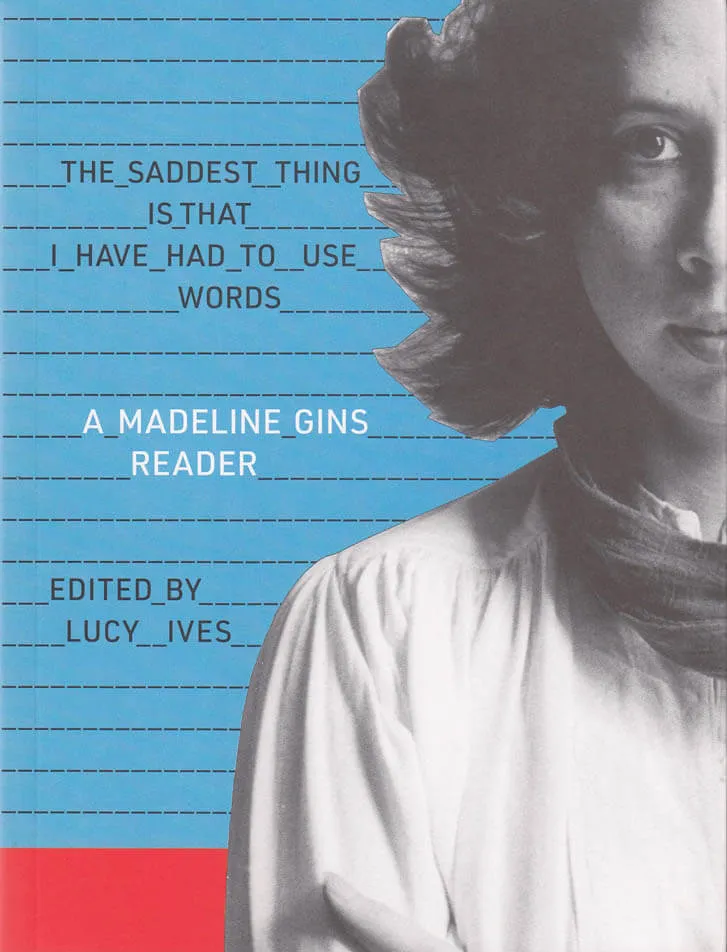
Cover of The Saddest Thing Is That I Have Had to Use Words: A Madeline Gins Reader

Siglio Press

The Saddest Thing Is That I Have Had to Use Words: A Madeline Gins Reader

Madeline Gins

Anthology €28.00

Poet, philosopher, speculative architect and transdisciplinary artist, Madeline Gins is well known for her collaborations with her husband, the artist Arakawa, on the experimental architectural project Reversible Destiny, in which they sought to arrest mortality by transforming the built environment. Yet, her own writings — in the form of poetry, essays, experimental prose and philosophical inquiries — represent her most visionary and transformative work. Like Gertrude Stein before her, Gins transfigures grammar and liberates words. Like her contemporaries in conceptual art, her writing is attuned to the energized, collaborative space between reader and page.

The Saddest Thing Is That I Have Had to Use Words: A Madeline Gins Reader is a revelatory anthology, edited and with an introduction by the writer and critic Lucy Ives. It brings never-before-published poems and essays together with a complete facsimile reproduction of Gins' 1969 masterpiece, WORD RAIN (or A Discursive Introduction to the Intimate Philosophical Investigations of G, R, E, T, A, G, A, R, B, O, It Says), along with substantial excerpts from her two later books What the President Will Say and Do!! (1984) and Helen Keller or Arakawa (1994). Long out of print or unpublished, Gins' poems and prose form a powerful corpus of experimental literature, one which is sure to upend existing narratives of American poetics at the close of the 20th century.

Edited by Lucy Ives. 

Cover of A Catalogue of Risk

Wendy's Subway

A Catalogue of Risk

Alisha Mascarenhas

Poetry €18.00

Alisha Mascarenhas’s A Catalogue of Risk is a volte-face of the neoliberal market economy’s construction of isolated, individual safety. In her debut book of poems, Mascarenhas lingers in the question of risk as it arises in daily life and intimacy. Through a close study and partial translation of philosopher-psychoanalyst Anne Dufourmantelle’s Éloge du risque (2011), her poems posit risk as a fissure, through which we might imagine yet-unknown futures.

Alisha Mascarenhas’s A Catalogue of Risk is the recipient of the 2022 Carolyn Bush Award.

Alisha Mascarenhas (b. 1989) is a poet and translator and the author, most recently, of the chaplet Contagion Fields (Belladonna* 2021). She has contributed writing to Pamenar Press, The Poetry Project Newsletter, The Recluse, Peripheral Review, and The Felt, among others. Alisha was a 2023 resident at La Baldi Artist’s Residency in Montegiovi, Italy. She holds an MFA in Writing from Pratt Institute in Brooklyn, where she now lives.

There is a body lying across Alisha Mascarenhas’s A Catalogue of Risk. Here is a book of generosity and perdition, that could not anticipate the death of its author, the one these works are addressed to, written for, dreamt by, in a stream of proximities. A strange dismantling of time occurs as a result of quiet reversals in which light is diffracted across belated syntaxes, reaching past life to the living. Though A Catalogue of Risk is “running past the flowers,” it is a slow text that grieves the day’s illuminations. It is a lesson in transmission in which we, readers, are the apprentices of grace, at the edge also of drowning. Here is a book that has been “hungering to be emptied.” So, too, is it a book of promise.
Nathanaël

A Catalogue of Risk is a book of luminous attention. Alisha Mascarenhas gives us the language of a mind tracking both internal and external weathers, tuning and returning herself to beauty, fear, grief and desire. Attending a cascade of emotions, the poet dwells in questions, knowing that to keep open to difficult questions is to keep open to desire. That she risks such openness, thinking always with others, through pain and love, is an astonishment. 
— Madhu Kaza

A Catalogue of Risk poses an evocative challenge, one of prismatic nuance: to pursue multiple angles of intimacy along the life-death continuum of how risk holds, unfolds, and makes one whole. “The definition” of what risk is “is shaded in questions” and runs a gamut of desires and sensations at once libidinal and cerebral. Alisha Mascarenhas risks risk itself with this generous offering of exquisite phenomenology and experiential trace in the form of a full-saturation poetics glowing in amplitude and intensity.
— Brenda Iijima

Cover of A Queen in Bucks County

Nightboat Books

A Queen in Bucks County

Kay Gabriel

Poetry €18.00

An epistolary sequence about sex, exchange and social space set along the Northeast Corridor. 

In A Queen in Bucks County, our protagonist Turner, who both is and is not the writer, makes his pleasurable way through miserable space. Men "buy him things," lovers drive across state lines, users down volatile cocktails to see what happens, landlords turn tenants out, and Turner writes poetic tracts to friends about it. Part pornography, part novel, all love letter, A Queen in Bucks County is an experiment in turning language upside down to see what falls out.

2023 LAMBDA LITERARY AWARD FINALIST