rile*books

Search books

Search books by title, author, publisher, keywords...

Cover of Publishing as Practice

Inventory Press

Publishing as Practice

Various

€35.00

Publishing as Practice centers on the work of three contemporary artists/book publishers who have developed fresh ways of broaching the political in publishing. 

This book documents a residency program at Ulises—a curatorial platform based in Philadelphia—that explores publishing as an incubator for new forms of editorial, curatorial and artistic practice. Over the course of two years, three participants (Hardworking Goodlooking, Martine Syms/Dominica, and Bidoun) activated Ulises as an exhibition space and public programming hub, engaging the public through workshops, discussions, and projects. 

Hardworking Goodlooking is a design and publishing imprint working primarily out of the Philippines. Dominica is an imprint run by artist Martine Syms dedicated to exploring Blackness as a topic, reference, marker, and audience in visual culture. Bidoun, a non-profit organization and magazine, focuses on art and culture from the Middle East and its diasporas. Each organization approached their residency at Ulises in a unique way, bringing a new understanding of what it means to practice publishing. 

Edited by Kayla Romberger, Gee Wesley, Nerissa Cooney, Lauren Downing, and Ricky Yanas, Publishing as Practice features a preface by David Senior, Head of Library and Archives at the San Francisco Museum of Modern Art, and Ulises Carrión’s 1975 publishing manifesto “The New Art of Making Books.” Publishing as Practice also includes writing from Clara Balaguer, Hardworking Goodlooking, Martine Syms/Dominica, Bidoun, Lauren Downing, Kayla Romberger, and Gee Wesley alongside interviews, excerpts, and documentation from each residency. 

Language: English

recommendations

Cover of Anna Oppermann: Drawings

Inventory Press

Anna Oppermann: Drawings

Anna Oppermann

Painting €40.00

Surreal, psychedelic riffs on domestic objects from a trailblazing feminist artist. 

From her beginning in the mid-1960s through the early '70s, German artist Anna Oppermann (1940-1993) - best known for her encyclopedic, immersive installations - created an astonishing series of surreal, almost psychedelic drawings that quietly explode the private space of the home, and her experience within it. These early drawings contribute to a feminist reentering of spheres traditionally associated with women, casting everyday objects as symbolic, consequential protagonists: houseplants sprawl to take over the picture plane, windows and mirrors provide views into other worlds and tables display drawings that themselves open out into new domestic scenes. By placing her own body—her knees, arms, the back of her head—as reference points in the work, Oppermann emphasizes the gendered realms of the home and the relationships that we form to our private spaces.

This volume gathers these drawings and early installations in an English-language publication for the first time.

Cover of Clara Istlerová: a Life Among Letters

Inventory Press

Clara Istlerová: a Life Among Letters

Anežka Minaříková, Clara Istlerová

Clara Istlerová: A Life Among Letters is the first publication in the United States to delve into the design landscape of the former Czechoslovakia through the lens of Czech designer Clara Istlerová (born 1944). A trailblazer in her field, Istlerová was one of the few women in the male-dominated field of Czech typography. This publication introduces readers to Istlerová’s renowned book designs, particularly highlighting the analog processes she utilized to create one of the most influential books on Czech architecture, Švácha, Rostislav. From Modernity to Functionalism (Odeon, 1985).

The publication features an intimate interview with Istlerová conducted by editor Anežka Minaříková, accompanied by work from Istlerová’s personal archive alongside discussions detailing her creative process. Offering a vivid portrayal of an era where design was a tangible, labor-intensive endeavor carried out in close collaboration with typesetters and printers, the publication unveils the Czech design narrative of the twentieth century to English-speaking readers, highlighting Istlerová’s lasting impact and central role.

Design by Anežka Minaříková and Marek Nedelka

Cover of Miam 08 : Artefact

Miam Editions

Miam 08 : Artefact

Various

"Cet ouvrage est un magazine participatif regroupant les oeuvres de 48 artistes autour d'un thème commun, l'artefact. Vertige du passé ou projection contemporaine, l'artefact nous parle. Il raconte les cultures, en façonne le souvenir et promet ainsi un voyage à travers les créations humaines. Ce sont ces témoignages tangibles de l'existence que nous souhaitons vous offrir grâce aux interprétations captivantes de l'artefact. Chaque page de ce nouveau numéro est une invitation à plonger dans les méandres de l'histoire ou de la fiction, à explorer les différentes strates de l'humanité à travers le primes de ses réalisations matérielles."

Alexandre Daram, Alice Royer, Audrey Poujoula, Audrey Ramos, Basile, Bordel j’ai glissé, Cel, Charlie Udave, Collectif IPN, Elliott Sanchez, Emilia Pesty, Marie Derrien, Fils Kurylak, Flora Rushiti, Hélène Berlemon, Inès Day, Julie Plantefeve, Kaspar kaspar.wtf, Kawani DS, Kiara Patry, Laura Zanti, Lauriane Rolo, Le Bayou Club Graphique, Lea Canovas, Lili Archer, Lily Terrible, Lisa Dehove, Lola Marty, Louis Kervel, Lutine Cabarrou, Maeva Iorio, Maké, Martin Régnier, Maxoy, Meuneurol, Nathanael Brelin, Nurzen & Jack Montaly, Oscar, Pierre Touron, Ptit Lylou, Rachel Roland, Rose Meybeck, Sarah Josserand, Theo Grandchamp. 

Cover of How To Sleep Faster 9

Arcadia Missa

How To Sleep Faster 9

Various

Periodicals €10.00

The platform, free speech and contempt

Cover of How to Sleep Faster 1

Arcadia Missa

How to Sleep Faster 1

Various

Periodicals €10.00

How to Sleep Faster is published as part of the collaborative discussion that form the critical direction of the gallery. and sits alongside the first two exhibitions – Sleep Faster (February), and How to Carve Totem Poles (March). It has been put together as an open ended continuation of this dialogue through which we seek to understand the contradictions / complexities that define and form our experience, existence and participation in a contemporary digital-analogue creative environment.

Arcadia Missa Publications; Rozsa Farkas, Tom Clark, Jammie Nicholas, Laura Farley (eds).

Cover of == #2 (edition)

Capricious

== #2 (edition)

Matt Keegan

First launched in 2012, and published by mfc michèle didier (micheledidier.com), == is a small-run arts publication, edited by Matt Keegan. ==#2, 2015, is designed by Su Barber and published in an edition of 500 by Capricious Publishing. Barber and Keegan worked together on North Drive Press (northdrivepress.com) between 2005-2010, and this publication shares a variety of traits with NDP.

==#2 is a non-thematic arts publication contained in a box with a 96-page bound volume featuring artist-to-artist interviews, texts, and transcriptions. Six loose multiples are also included.

Contributors include: Sam Anderson, Uri Aran, Fia Backström, Darren Bader, Judith Barry, Stefania Bortolami, Daniel Bozhkov, Milano Chow, Anna Craycroft, Lucky DeBellevue, Cristina Delgado, Haytham El-Wardany, Jake Ewert, Vincent Fecteau, Corrine Fitzpatrick, Harrell Fletcher, Rachel Foullon, Aurélien Froment, Kenny Greenberg, Calla Henkel, Leslie Hewitt, Jaya Howey, Adelita Husni-Bey, Iman Issa, Ruba Katrib, Jill Magid, Jo Nigoghossian, Aaron Peck, Max Pitegoff, David Placek, Olivia Plender, Lisa Robertson, Andrew Russeth, Amy Sillman, Diane Simpson, Greg Parma Smith, Jessica Stockholder, Martine Syms, and Anicka Yi.

Cover of Mousse #92

Mousse Publishing

Mousse #92

Various

Periodicals €16.00

Regions surface often in this issue—across arts, tales, and gatherings of individuals and meanings—as a possibility to bypass the borders of nation-states and the meta-geographies of colonial modernity.

Slavs and Tatars; Hera Chan on Stephanie Comilang; Stephanie Bailey on Ho Tzu Nyen; Drifting into the Atmospheric by Sohrab Mohebbi; Lauren Cook contributes nine newly commissioned note-like fiction pieces; Asad Raza on Édouard Glissant; Mira Dayal in conversation with Shanzhai Lyric, TJ Shin, and jina valentine; Temporary Communities, Four Points on Radically Public Institutions by Elvira Dyangani Ose; A Signature Truer Than the Name by Dani Blanga Gubbay; tidbits: Ruoru Mou by Amy Jones; Virginia Ariu by Brit Barton; Bagus Pandega by Harry Burke; Ceidra Moon Murphy by Alex Bennett; Oshay Green by Ikechúkwú Onyewuenyi; Shafei Xia in conversation with Danielle Shang; books by Christian Rattemeyer; Guest Design: Lamm & Kirch.

This issue comes with different covers, randomly distributed.

Mousse is a bimonthly contemporary art magazine. Established in 2006, Mousse contains interviews, conversations, and essays by some of the most important figures in international criticism, visual arts, and curating today, alternated with a series of distinctive articles in a unique tabloid format.

Cover of Thievery and Songs

Salzburger Kunstverein

Thievery and Songs

Gernot Wieland

Publication accompanying the exhibition Gernot Wieland (08.02.-05.07.2020). 

One can summarize Gernot Wieland and his work as an intertwining of the man, the artist, and the artwork. With Gernot, we experience in his artwork and in his presence more of a quiet, constant fascination with what is around him and what has affected or influenced or indeed shaped him sinde his childhood. These impressions - whether quirky memories or indeed tragic experiences and the non-stop grappliing with what has happened - arise in his artwork or in his conversation, whether directly or not. Alongside self-analysis and presentation through his artwork is an analysis of societal norms and indeed repressed aspects of society as it expresses itself, even violently, in hegemonic structures - in the classroom and upon children, for example. From his sketches or film narratives we catch a powerful glimpse upon a concentration of trauma, repression, and guilt placed upon his generation, an Austrian condition manifesting itself in obscene and absurd ways.

Cover of HOOT nr. 3 — Kamilé Krasauskaité

GUFO

HOOT nr. 3 — Kamilé Krasauskaité

Gufo, Clément Faydit and 1 more

Last year, on a summer night in Marseille, someone, within all the hungry people I am meeting during my dinners, specifically set her attention on my projects. Later during the fall I received a call from Austė ZDANČIŪTĖ, the cultural attache at the Lithuanian embassy in France, who introduced me to Kamilè Krasauskaitè. Since that fall, we kept on exchanging and making future plans in France where she would have a residency. The more we chatted, the closest we began. Kamilè is a almost-thirty-years-old Lithuanian artist that has been including sourdough bread in her work and builds a poetic and mesmerising world around that dimension of food, fermentation, senses, environment, rituals...Through our communication I decided to share that encounter that we managed to welcome in Marseille. We kneaded some bread together, shared it in a forest of Marseillais sunflowers, walked the streets, met people, questioned and compared artists' lives in Europe. This issue might be an excerpt of all the long conversations we had, it was hot and sunny in Marseille, it was in June.

Cover of WILL YOU MARRY ME?

Nero Editions

WILL YOU MARRY ME?

Sara Leghissa, Marzia Dalfini

The ultimate ambition of this book-tool is to “disappear on the street”. Its pages collect words and stories of people whose right to exist and be visible in public spaces was forced to confront the concepts of “legality” and “justice”.

Considering the assumption that the law is a fluid parameter, which changes depending on where we are in the world, the historical period in which we live and the sort of privileges we enjoy, the law defines what is considered moral, licit, in other words, what is right. It distributes power and the perception of power in society, defining, categorizing, dividing and controlling.

WILL YOU MARRY ME? is a public lecture and an artist’s book by Sara Leghissa and Marzia Dalfini, investigating a specific portion of the spectrum of illegality, namely the relationship between illegal acts and public space. It explores how we can act disobedience before everyone’s eyes, suggesting possible forms of complicity and public resistance.

All the content was collected by the artist during meetings and conversations that took place in Prato, Milan, Ramallah, Marseille, Madrid, Nyon and Lausanne and with this book-tool their words become manifestos that the reader is invited to detach and relocate into the public space.

Designed by Marzia Dalfini. Published by NERO with the support of L’Altra.

Format: 42 x 29,7 cm
Pages: 28
Language: IT / EN
Year: 2021

Cover of Mon Songe

Time has fallen asleep in the afternoon sunshine

Mon Songe

Vincent Dunoyer

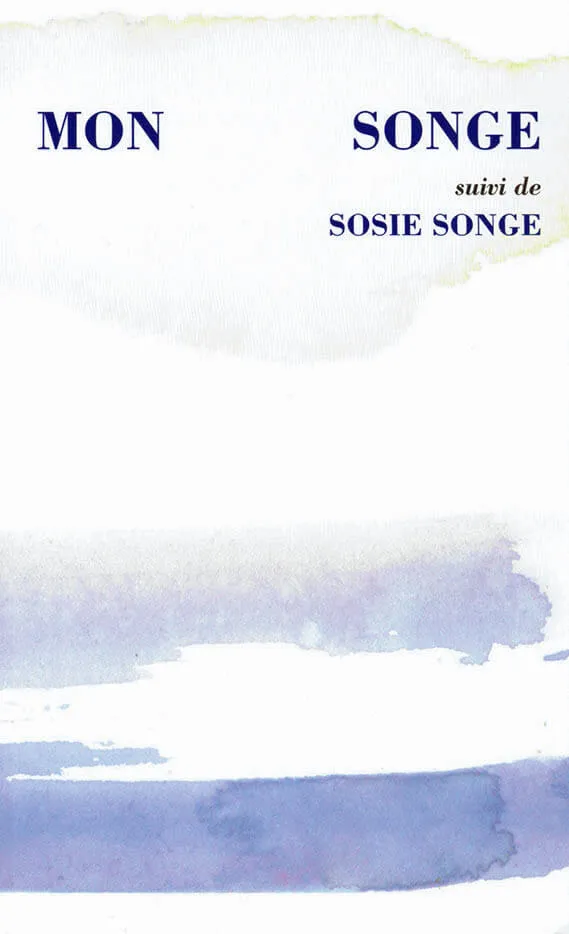
For the project Time has fallen asleep in the afternoon sunshine a group of people/ performers memorize a book of their choice. Together they form a library collection consisting of living books. After years of learning by heart and reciting for readers, some of the books have now been written down from memory to create new editions, versions resulting from this process. This book is one of those books, chosen by one person, learned by heart and recited many times, and now written down again from memory. This edition is not a re-edition of the original text. It is a re-writing of the text after the process of reading, memorizing and reciting, with all the alterations that might have occured in the course of this process.

Cover of The Book of Na

Wendy's Subway

The Book of Na

Na Mira

Fiction €28.00

In The Book of Na, translation acts at the edge of perception. Tracing across projects in film, video, and performance, Na Mira reflects on the violent fragmentation of bodies while refusing the containment of geographic and corporeal borders. In 1977, a name is cut at an immigration office. This gap turns into an intergenerational score for becoming heat, hexagram, hologram. Using oracular and glitching technologies, Mira witnesses what escapes data: doppelgängers, dreams, endangered tigers, tesseracts, A. Turiyasangitananda Coltrane's stairs, Theresa Hak Kyung Cha in a theater, Korean shamanism, frozen ligaments, wildfires, borderlands, subatomic particles, and pink. Syncing to a clock with neither face nor hands, Mira’s hauntological permutations in time, death, and relation travel outside the symbolic order and draw energy from the void.

Na Mira’s autobody rites have been presented at sites including Seoul Museum of Art; Museum of Contemporary Art, Los Angeles; Portland Institute of Contemporary Art; Participant Inc., New York; and Whitney Museum of American Art, New York. She earned an MFA from the University of California, Los Angeles. She grew up between the US and East Asia and teaches outside.