rile*books

Search books

Search books by title, author, publisher, keywords...

Cover of Organic Music Theatre – Festival de jazz de Chateauvallon 1972 (2 vinyl LP)

Blank Forms

Organic Music Theatre – Festival de jazz de Chateauvallon 1972 (2 vinyl LP)

Don Cherry

€37.00

Don Cherry’s New Researches featuring Naná Vasconcelos.

In the late 1960s, the American trumpet player and free jazz pioneer Don Cherry (1936–1995) and the Swedish visual artist and designer Moki Cherry (1943–2009) began a collaboration that imagined an alternative space for creative music, most succinctly expressed in Moki's aphorism "the stage is home and home is a stage." By 1972, they had given name to a concept that united Don's music, Moki's art, and their family life in rural Tagårp, Sweden into one holistic entity: Organic Music Theatre. Captured here is the historic first Organic Music Theatre performance from the 1972 Festival de jazz de Chateauvallon in the South of France, mastered from tapes recorded during its original live broadcast on public TV. A life-affirming, multicultural patchwork of borrowed tunes suffused with the hallowed aura of Don's extensive global travels, the performance documents the moment he publicly jettisoned his identity as a jazz musician, and represents  the start of his communal "mystical" period, later crystallized in recordings such as Organic Music Society, Relativity Suite, Brown Rice, and the soundtrack for Alejandro Jodorowsky's The Holy Mountain.

Language: English

recommendations

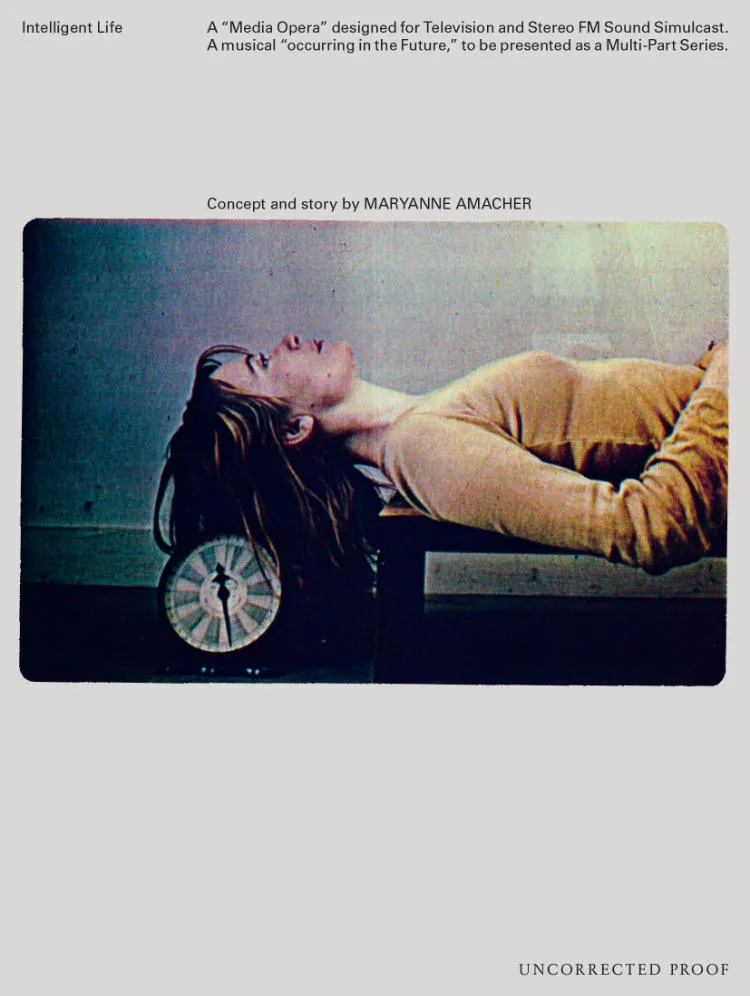
Cover of Intelligent Life

Blank Forms

Intelligent Life

Maryanne Amacher

Comprehensive and previously unpublished documentation on the American composer's unproduced magnum opus.

Had it been produced, Maryanne Amacher's media opera Intelligent Life would have represented the summation of the composer's concept to date. As she wrote to John Cage in the autumn of 1983, following the untimely deaths of the opera's patrons—Wies Smals, founder of De Appel, and curator Josine van Droffelaar, in a plane crash in the Swiss Alps—she would have at last had the support to "communicate the finest of my thought to others." Amacher's serial, intended for broadcast, sought to transmit her evolving ideas about perception, listening, and composition to a broader public—shifting music away from "nod and tap recognition" toward a transformative practice that could awaken intelligence to "unrecognized and new perceptual modes."

Set in the year 2021, Intelligent Life follows the employees of Supreme Connections LLC, a music entertainment corporation navigating a future in which artificial intelligence generates music faster than composers can. Anticipating an industry-wide downturn, Supreme Connections president Aplisa Kandel seeks advanced technologies that will revolutionize the act of listening and the future of music, including a bio-music script that lets the user hear Bach from the aural perspective of a reindeer and a wearable device that goes beyond replicating the mechanical tympanic resonances of the listening subject to produce the "listening mind" or the "sophisticated perceiver"—capturing and reproducing all the emotional and psychological associations unique to each individual.
Though Amacher could not realize Intelligent Life in any of its intended forms—she theorized its publication as a serialized radio broadcast and television simulcast, among other configurations—she continued designing "treatments" for the opera for much of her career. This volume makes the most complete of these working documents—including episodic scripts, notes on the use of LaserDisc, and an illustrated storyboard for the pilot—available to the public for the first time.

Maryanne Amacher (1938-2009) was a composer of large-scale fixed-duration sound installations and a highly original thinker in the areas of perception, sound spatialization, creative intelligence, and aural architecture. She is frequently cited as a pioneer of what has come to be called “sound art,” although her thought and creative practice consistently challenges key assumptions about the capacities and limitations of that genre. Often considered to be a part of a post-Cagean lineage, her work anticipates some of the most important developments in network culture, media arts, acoustic ecology, and sound studies.

Cover of Better Do It Now before You Die Later: Sonny Simmons with Marc Chaloin

Blank Forms

Better Do It Now before You Die Later: Sonny Simmons with Marc Chaloin

Sonny Simmons, Marc Chaloin

Though his years in the New York free-jazz scene of the sixties cemented his reputation as "one of the most forceful and convincing composers and soloists in his field," saxophonist Sonny Simmons (1933–2021) was nearly forgotten by the '80s, which found him broke, heavily dependent on drugs and alcohol, and separated from his wife and kids. "I played on the streets from 1980 to 1994, 365 days a year," Simmons tells jazz historian and biographer Marc Chaloin. "I would go to North Beach, and I'd sleep in the park. The word got around town that Sonny is a junkie, really strung out."

The resurrection of Simmons' career―upon the release of his critically acclaimed Ancient Ritual (Qwest Records) in 1994―has become a modern legend of the genre. In the last two decades of his musical career, Simmons broke through to a new echelon of recognition, joining the pantheon of great innovators and masters of the music. But to this day he remains an undersung figure. Here, in the first ever book dedicated to his life, Simmons recounts his childhood in the backwoods of Louisiana, his adolescence in the burgeoning Bay Area jazz scene and his star-studded life in New York playing alongside the greats.

Cover of N° 6 : Soundshine, Moki Cherry

Libraryman

N° 6 : Soundshine, Moki Cherry

Moki Cherry

A Congregation of Clouds assembles eight artistic voices in the form of printed matter. These publications do not speak in unison; instead, they drift, accumulate, and resist.

To congregate is to gather—sometimes in quiet reflection, sometimes in protest, sometimes in ritual. Clouds do not ask permission to form. They appear when conditions allow, under a shared sky, without needing to resolve into one.

Edited and designed by Tony Cederteg

Cover of Spectres IV: A Thousand Voices

Shelter Press

Spectres IV: A Thousand Voices

Bartolomé Sanson, François J. Bonnet

The fourth issue of the annual publication dedicated to sound and music experimentation, co-published by Shelter Press and Ina GRM – Groupe de Recherches Musicales, around the topic of voice.

The voice is everywhere, infiltrating everything, making civilisation, marking out territories with infinite borders, spreading from the farthest reaches to the most intimate spaces. It can be neither reduced nor summarised. And accordingly, when taken as a theme, the voice is inexhaustible, even when seen in the light of its very particular relation with the sonic or the musical, as is the case in most of the texts collected in this volume. There is no point therefore in trying to circumscribe or amalgamate the multiple avatars of the voice. We must rather try to apprehend what the voice can do, to envisage its landscape, its potential effects.
 
Spectres is an annual publication dedicated to sound and music experimentation, co-published by Shelter Press and Ina GRM – Groupe de Recherches Musicales.

Edited by François J. Bonnet and Bartolomé Sanson.

Contributions by Joan La Barbara, Sarah Hennies, Peter Szendy, Youmna Saba, Lee Gamble, Ghédalia Tazartès, David Grubbs, Stine Janvin, Pierre Schaeffer, Akira Sakata, Haela Ravenna Hunt-Hendrix, Yannick Guédon, François J. Bonnet, John Giorno.

Cover of Ductus

Self-Published

Ductus

Paul Abbot

Performance €10.00

DUCTUS is the latest solo project by Paul Abbott, featuring 51 minutes of audio, across 12 tracks, and a 42 page booklet featuring new writing. DUCTUS was written and recorded in Edinburgh and Porto in 2019. 

DUCTUS presents a playful weave of collapsing time through a number of speculative elements and fictional characters. Abbott feels his way through learning drums, rhythm and writing as fleshy research technologies. DUCTUS is the latest stage in a process considering sound, the body, imagination, and language through music. This features as part of ongoing investigations using real and imaginary drums, synthetic sounds, performance and writing.

Cover of Black Case Volume I and II – Return From Exile

Blank Forms

Black Case Volume I and II – Return From Exile

Joseph Jarman

Poetry €20.00

The republication in print form of the poems of Art Ensemble of Chicago's founding member breathes new life into a forgotten document of the Black Arts Movement.

In 1977, Art Ensemble of Chicago Publishing Co. published Jarman's Black Case Volume I and II: Return From Exile, a collection of writing conceived across America and Europe between 1960 and 1975. Comprised largely of Jarman's flowing, fiery free verse—influenced by Amus Mor, Henry Dumas, Thulani Davis, and Amiri Baraka—the book also features a manifesto for “GREAT BLACK MUSIC,” notated songs, concert program notes, Jarman's photos, and impressions of a play by Muhal Richard Abrams, the founder of the Association for the Advancement of Creative Musicians of which Jarman was also an original member.

Jarman writes poetry of personal revolutionary intent, aimed at routing his audience's consciousness towards growth and communication. He speaks with compassionate urgency of the struggles of growing up on Chicago's South Side, of racist police brutality and profound urban alienation, and of the responsibility he feels as a creative artist to nurture beauty and community through the heliocentric music that he considers the healing force of the universe. A practicing Buddhist and proponent of Aikido since a 1958 awakening saved him from the traumatic mental isolation of his time dropped by the US army into southeast Asia, Jarman sings praise for the self-awareness realization possible through the martial arts.

With cosmic breath as its leitmotif, his poetry both encourages and embodies a complete relinquishing of ego. While some of the poems contained within Black Case have already been immortalized via performances on classic records by Jarman and Art Ensemble of Chicago, its republication in print form breathes new life into a forgotten document of the Black Arts Movement.

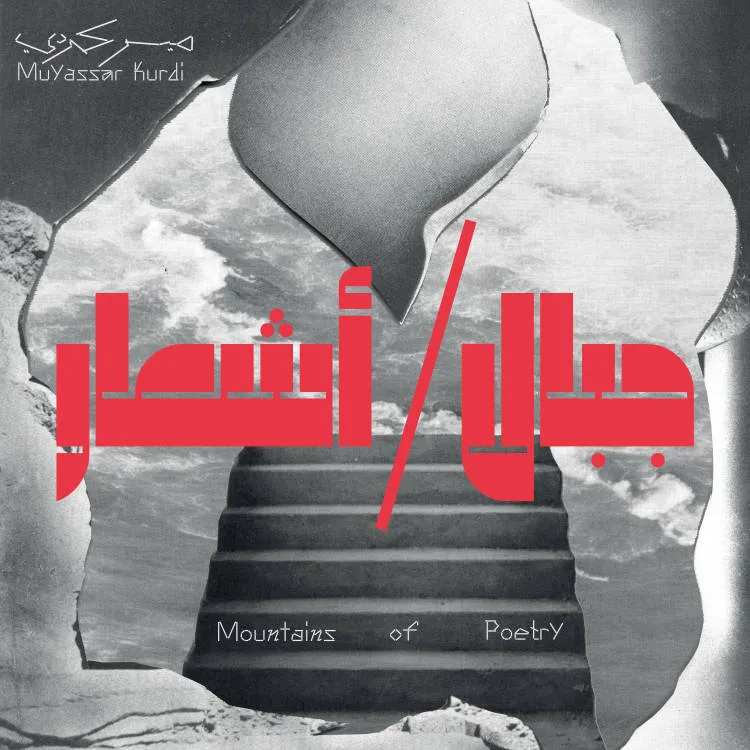
Cover of Mountains of Poetry (Limited Edition 12" Coloured)

Bilna'es

Mountains of Poetry (Limited Edition 12" Coloured)

Muyassar Kurdi

Mountains of Poetry is a new 8-track studio album produced and developed by interdisciplinary artist Muyassar Kurdi. The album traces the entwined relations between one’s body and land, driven by a sense of urgency. Embedded in the earth, Kurdi imagines her body as a site for sonic excavation of memory and longing. The artist’s voice paired with electronic sound honors the ancient and the futuristic that together form a ritualistic reflection to navigate the tender space of remembering, forgetting and mourning. Departing from her usual emphasis on vocal abstraction, Kurdi turns to concrete words that punctuate the sonic landscape, gathering them into mountains of poetry.

Cover of أحمد [Ahmed] – Writing

KASK & Conservatorium

أحمد [Ahmed] – Writing

[Ahmed]

[Ahmed] is the quartet of Pat Thomas (piano), Joel Grip (double bass), Antonin Gerbal (drums) and Seymour Wright (alto saxophone). Since 2014, أحمد [Ahmed] have excavated and re-imagined the music of Ahmed Abdul-Malik, in an ever ongoing search for future music.

[Ahmed] – Writing (EXV01) gathers together the [Ahmed] ‘paper’ texts from the last decade: liner-notes; covers of the releases; and writing by the band members – Antonin and Joel have written two fresh ones for this book, Seymour’s have appeared alongside the records, and some of Pat’s come from a time (long) before [Ahmed]. “Together, the ideas-energy in these things gives a sense of what we have done, do, think together (and apart) in living music, how our different ways come together, and how, together, we learn through be-doing [Ahmed]… These texts are woven together (the etymology of text is from weave) through (and into) a rich fabric of enquiry. A collaborative weaving together of difference(s) to make a whole (thing).” (Seymour Wright)

Contributions by Pat Thomas, Seymour Wright, Antonin Gerbal, Joel Grip, Robert Levin, James G. Spady, John Chantler, Edward George, Fred Moten

Edited by [Ahmed]
Series Editors: Stoffel Debuysere, Jef Lambrechts, Will Holder
Initiated by Stoffel Debuysere
Produced and designed by Will Holder [lps’ original design: Maja Larsson]