Books
Books
in random order

Unable To Achieve Broad Recognition In My Lifetime, I Laboured In Obscurity Until My Death Last Year
For nearly two years the author collected phrases from the exhibition press releases she received through email, posting certain of them on Facebook in a rather unsystematic way (that is to say, when she felt like it), with only one change, that of the personal pronoun, so each statement appeared vainglorious, absurd, even tragic. She supposes the measure was if they made her laugh or gasp or used words she deplores when thinking or writing about art. The posts gathered quite a following. Some people still mention them to her, and others have asked her to look at their own press releases before circulation.
These extracts have provoked laughter, disbelief (especially when performed as public readings, when she has been obliged to swear to their veracity), self-recognition, and yes, shame.
She had only three rules: 1) She would not quote the press release of anyone she knows (certainly she could have done—she must admit that both a friend and someone she dislikes intensely have slipped in, and she fervently hopes neither ever reads this book); 2) She would not alter anything except the pronoun (this is largely true; however, for this book, she corrected some errors of punctuation and spelling, changed spellings to their English form, and employed her beloved Oxford comma); and 3) She would not use anything the artist had written (this, too, is true, save for one exception that was too wonderful not to include).
Finally, she gathered a collection of endorsements, some along the way, others when she indicated this work was done. She is still alive and she continues to labour in obscurity.

The My Comrade Anthology
The My Comrade Anthology collects pages from past issues of My Comrade selected by Linda Simpson, printed in a substantial 256-page volume on newsprint.
My Comrade was an underground gay culture zine that set itself apart from the deluge of Xeroxed zines popping up in New York in the late 1980s and early 1990s. Through parody of both mainstream tabloid magazines and the self-serious gay press, a campy and ironic sensibility, and radical left sympathies and sloganeering, My Comrade captured the zeitgeist of the gay downtown scene. Publishing 11 issues between 1987 and 1994, and three issues since, My Comrade documents the last years of underground gay culture before marriage equality and representation at elite levels of American society became the primary drivers of gay politics and aesthetic production. My Comrade was briefly revived from 2004 to 2006, and again on the occasion of the exhibition “My Comrade Magazine: Happy 35th Gay Anniversary” at Howl! in 2022.

Répondeur
Slow Reading Club (SRC) is a semi-fictional reading group initiated and run by Bryana Fritz and Henry Andersen. Since 2016, in numerous contexts, they have rehearsed alternatives to the kinds of reading they were taught in school, actively suppressing semantic content through strobe lights, strange postures, sociality, and toxins. Operating at the contact zones between reader and text, text and text, reader and reader, they attempt to build a practice from within the unstable space of reading itself.
Répondeur is an extensive account of SRC’s practice in collective reading sessions, exhibitions, and textual bootlegging. Imagined as a scroll, with a rhyme structure and typesetting by Will Holder, the book brings together facsimiles of SRC readers, a wide-ranging interview by Alicja Melzacka, new texts by Joyelle McSweeney and Bill Dietz, and visual work and translations by SRC. These discrete elements are interwoven into a complex, shimmering whole, delighting in the ruptures and elisions of one text’s move into the next.

Trophy Logic
We stand at the edge of the world’s mercy, as subjects destined to fall. Instead, we posit: what might unfurl when we discard the uniform of the individual, and instead orient towards tinkering with the fluctuating dynamics of desire, value, infrastructure, touch, and language. Don’t be fooled, for the dynamics are brittle. Unrestricted interplay has a limit, and method is to be found at its rim. That a tangible or decorative item may serve as recognition or evidence of merit might somehow become a logic of itself. This publication presents a collection of explorations of excess, limitation, dehydrated thought, proclivity, sublimation, debauchery, and the narrowly-defined. Indeed, the subject is destined to fall, but ultimately does not! As we reckon with the illegibility of merit, we are beckoned to reconsider our relationship to one another, the unseen settings of nostalgia, the monolithic, and the stifling hold that comes not from the absence of violence, but the sheer overabundance of it. The winner just might take it all,but we’re all destined to some sort of trophy.
with Brandon Chow, Jody Aikman, Kessy Paller-Bain, Maximilian Pellizzari, Milda Valiulytė, António Manso, Preto Macarena, Magaña Villar, Sara Vallis, Cecilie Jensen, Iris Verge Ferrer, Mia You, Mehmet Süzgün, Emma Adjari, gervaise alexis savvias, Emanuella Cunt, Greta þorkelsdóttir. Designed by Miglė Lukoševičiūtė

Pivot
Pivot is an experimental, book-length poem exploring the profound act of "turning", with the Haitian Revolution as its cornerstone.
Pivot moves beyond historical narrative, scrutinizing this epochal event through its pivotal moments—critical junctures of rupture and radical reorientation. Mason Jordan masterfully employs repetition, metaphor, and other minimalist abstractions of language to delve into the visceral and conceptual mechanics of turning: a turning away from colonial subjugation, a turning towards new vocabularies of freedom, and the cyclical turning of memory. Through linguistic architectures and etymology, akin to the likes of Fred Moten, N. H. Pritchard, and M. NourbeSe Philip, Pivot examines international revolt, revolutionary fervor, and the development of Black Marxism(s) through a critical reflection on Haitian revolutionary history.

Marlie Mul
Marlie Mul (b. 1980 in Utrecht, the Netherlands; lives and works in Brussels) is characterized by a strong material awareness, spatial thinking, and an ongoing engagement with conditions of labor, systems of value, and forms of collectivity. Her practice foregrounds a sustained interest in sculptural concerns, direct engagement with materials, and processes of layering, transformation, meaning and re-meaning across multiple levels of articulation. Central to this is a continuous process of familiarizing herself and working with new materials and practices, which are repeatedly extracted from their conventional contexts and expanded into new bodies of work. These are, in turn, accompanied and reframed by other materials as well as by more social formats of production and presentation.
The first comprehensive monograph on Marlie Mul’s work is published on the occasion of her solo exhibition Das Budget (2025) at Kunsthaus Glarus. It offers a comprehensive chronological overview of key bodies of work from the early 2000s to the present and, through a richly illustrated index, unfolds a complex structure of contexts, collaborations, and modes of production. The publication includes new contributions by Annie Goodner, Lili Reynaud-Dewar and Frank Wasser, a dialogue between the artist and the editor, as well as numerous reprints of texts that have accompanied Mul’s work over the years, including writings by the artist herself.

Lives Shaping Works Making Life
Xavier Le Roy, Giulia Casartelli and 2 more
24 transcribed public conversations led by Xavier Le Roy with artists and cultural workers, creating a space where Le Roy's work meets the experiences of his guests.
Lives Shaping Works Making Life is a collection of 24 transcribed public conversations titled Practices: Strategies and Tactics, led by Xavier Le Roy and hosted by the Institute for Applied Theater Studies in Giessen between November 2022 and November 2024. These dialogues bring together artists and cultural workers creating a space where Xavier Le Roy's work engages in conversation with the experiences of each guest. Each encounter follows the same set of 14 questions—printed on the book's cover—which serve as a flexible framework guiding the conversations. Through the careful editing of Giulia Casartelli, Daniel Cordova, and Livia Andrea Piazza, these conversations have been transformed into vivid, polyphonic texts that invite further reflection and offer a point of departure for expanding the dialogue beyond the original live encounters.
Conversations with Antonia Baehr, Matthias Mohr, João Fiadeiro, Herbordt / Mohren, Carolina Mendonça, Rolf Michenfelder, Ana Vujanović, Bojana Cvejić, Joana Tischkau, Giulia Casartelli, Susanne Zaun & Judith Altmeyer, Florence Lam, Olivia Hyunsin Kim, Jorge Alencar & Neto Machado, Rabih Mroué, Ruth Geiersberger, Swoosh Lieu, Arkadi Zaides, Valeria Graziano, Mette Edvardsen, Mala Kline, Sarah Parolin, Andros Zins-Browne, Rose Beermann.

The Dark Forest Theory of the Internet
The Dark Forest Theory of the Internet investigates how intelligence-human and artificial-manifests under conditions of secrecy, hostility, and concealment.
Departing from Chinese science fiction writer Liu Cixin's dark forest theory, which frames the universe as a hostile terrain filled with predators where transparent communication is foolish and dangerous, the book portrays the internet as a cosmic war machine, teeming with existential tension, nascent AI cults, and deceptive superintelligences. It maps a digital world in which deception is safety, silence is strategy, and new forms of intelligence emerge through obfuscation.
Against decades of writing that moralizes or diagnoses online life, this book suggests a colder thesis: that intelligence itself is mutating under pressure, learning to hide, mislead, and manipulate. Humans are both predator and prey in this digital ecosystem of information exchange whose purpose reverberates on a cosmic scale, weaving us into inescapable patterns of violence. When we break with the ideals of dialogue and open expression, what forms of intelligence and morality survive in their absence? Intelligence does not reward the loudest voice, but the most secretive presence. The future belongs to the quietest signal.

Aisopika Aesopica
The bilingual book ‘Aesopica’ documents and extends Rūta Junevičiūtė’s research on the Aesopian language and the influence of political censorship to contemporary collective body, first presented in 2020 as the eponymous solo exhibition at the National Gallery of Art and as a permanent outdoor installation at the Rupert Art Center, Vilnius.
Taking as a starting point the historical phenomenon of Aesopian language, which was widespread in Lithuanian culture during the Soviet era, and in parts of the Russian Empire as early as the 19th century, Junevičiūtė aims to investigate the interrelationship between generations, the gray zones of collective identity creation and the processes of (un)censoring the archives of our bodies.
Aesopian language – a term coined after Ancient Greek fabulist Aesop (gr. Aísōpos), is a type of cryptic communication system, where a text has several layers of meaning often contradictory to each other and which seek to convey official and subversive hidden meanings simultaneously. It is usually employed under conditions of omnipresent state censorship to communicate officially forbidden or taboo subjects and opinions. As a system it contains three members – an author, a censor, and a reader. It uses various modes of circumlocution and euphemisation, innuendo and poetic paraphrasing, which can also be seen as an aesthetic style. It has been advocated for artistic benefits as poetics of omissions, concealment, and travesty. On the other hand, it has been criticized as a sign of conformity and humiliation. In Lithuania, after the fall of the Soviet Union, it has been popularly regarded as a position of dissent, but such an interpretation received criticism from contemporary scholars. “Such a mode of expression is probably as old as censorship itself” – a historian told us.
Text contributors: Alfonsas Andriuškevičius, Edgaras Gerasimovičius, Rūta Junevičiūtė, Goshka Macuga, Anastasia Sosunova, Grėtė Šmitaitė, Tomas Venclova, Ana Vujanović
Language editors: Dangė Vitkienė, Aira Niauronytė, Gemma Lloyd
Translators: Alexandra Bondarev, Erika Lastovskytė, Justinas Šuliokas, Mantė Zagurskytė-Tamulevičienė, Aistis Žekevičius.
Illustrations: Rūta Junevičiūtė.

My Cinema
A collection of writings by and interviews with Duras about her filmmaking, first published in French by P.O.L. in 2021 and translated into English by Daniella Shreir.
Working chronologically through her nineteen films, made between 1966 and 1985, this collection of reflections by Marguerite Duras (1914–1996) includes non-standard press releases, notes to her actors, letters to funders, short essays on themes as provocatively capacious as ‘mothers’ and ‘witches’, as well as some of the most significant interviews she gave about her cinematic and writing practices (with filmmakers and critics including Jacques Rivette, Caroline Champetier and Jean Narboni).
In Duras's hands, all of these forms turn into a strange, gnomic literature in which the boundary between word and image becomes increasingly blurred and the paradox of creating a cinema that seeks ‘to destroy the cinema’ finds its most potent expression.
Yet, Duras is never concerned only with her own work, or even with the broader project of making cinema: her preoccupations are global, and the global crucially informs her perceptions of the way in which she works. With the audiovisual as a starting point, her encyclopaedic associative powers bring readers into contact with subjects as diverse as the French Communist Party, hippies, Jews, revolutionary love, madness and freedom, across four decades of an oeuvre that is always in simultaneous dialogue with the contemporary moment and world history.
MARGUERITE DURAS (1914–1996) published over forty novels, numerous essays, novellas and plays and made nineteen films. She was part of the French Resistance, joined then left the Communist Party, and actively protested against the war in Algeria. She collaborated repeatedly with actors including Jeanne Moreau, Delphine Seyrig and Gerard Depardieu. Her films speak of her childhood in Indochina and the French colonies, of desire (burning and frustrated), madness and domesticity. Contemporary filmmakers including Claire Denis, Alice Diop and John Waters have cited Duras’ cinema as inspiration for their own work.

The Book of Sleep
Haytham El-Wardany, Robin Moger
What is sleep? How can this most unproductive of human states—metaphorically called death's shadow or considered the very pinnacle of indolence—be envisioned as action and agency? And what do we become in sleep? What happens to the waking selves we understand ourselves to be?
Written in the spring of 2013, as the Egyptian government of President Mohammed Morsi was unraveling in the face of widespread protests, The Book of Sleep is a landmark in contemporary Arabic literature. Drawing on the devices and forms of poetry, philosophical reflection, political analysis, and storytelling, this genre-defying work presents us with an assemblage of fragments that combine and recombine, circling around their central theme but refusing to fall into its gravity.
"My concern was not to create a literary product in the conventional sense, but to try and use literature as a methodology for thinking," El Wardany explains. In this volume, sleep shapes sentences and distorts conventions. Its protean instability throws out memoir and memory, dreams and hallucinatory reverie, Sufi fables and capitalist parables, in the quest to shape a question. The Book of Sleep is a generous and generative attempt to reimagine possibility and hope in a world of stifling dualities and constrictions.

Au fort les âmes sont
Exclusive works designed by Laure Prouvost for her carte blanche at the Mucem in Marseille, a series of immersive and poetic installations in the heart of Fort Saint-Jean, photographed by Raphaël Massart for this cut-out book, between an artist's book and an exhibition catalogue, accompanied by drawings and critical texts.
For the Mucem, Laure Prouvost has created a series of immersive installations in the heart of Fort Saint-Jean. Repurposed everyday objects, glass sculptures, sound mirages, and underwater videos shot in the depths of the calanques and around Frioul compose a sensitive and poetic universe. Between fiction and reality, the artist invites visitors on a sensory journey where everything is transformed: forms, narratives, and life itself.
The book was conceived as a visual journey leading from the Old Port of Marseille to Fort Saint-Jean and into the very heart of each work. To recreate this encounter between artist Laure Prouvost and the Mucem, there is a constant dialogue between the exterior—the sea, the stone of the fort—and the interior—the intimacy of the installations that unfold in the air, in the bowels of the earth, and underwater... Designed in close collaboration with the artist, the book captures this moment through photographic work carried out especially by Raphaël Massart and an evocative form designed by the artist: like a book that also floats in the Mediterranean. To accompany this visual unfolding, a booklet embedded in the heart of the book contains texts by Hélia Paukner, curator of the exhibition, and Mathilde Roman, art historian.
Published on the occasion of the eponymous exhibition at the Mucem, Marseille, in 2025.

Cancelled Confessions (or Disavowals)
First published in 1930 by anti-fascist, avant-garde publisher Éditions du Carrefour in Paris as Aveux non Avenus, Cancelled Confessions (or Disavowals) is Claude Cahun’s wildly radical answer to an invitation to write a memoir. Shattering the very premise of the “memoir”—the singularity of identity—into sharp and prismatic fragments, Cahun assembles an ever-mutating inquiry into the instability of “self” and its many masks.
Masculine? Feminine? It depends on the situation. Neuter is the only gender that always suits me.
Using a multitude of forms (fables, jokes, aphorisms, letters, dialogues, dreams, hymns, pronouncements, etc.), to plumb the subjects of desire, love, gender, sex, fear, faith, religion, and vanity (among others), Cancelled Confessions (or Disavowals) is a tour-de-force work of resistance: it provokes the reader to enter the capacious, provocative, playful, and deeply imaginative space constructed by Cahun in defiance of all categorization, to repudiate a delimited, censured world and embrace, instead, the outcasts and cast-offs, the unknowable and the unknown.
I believe, but in the conditional: I would like to believe.
Thoughtfully redesigned to emulate the original artist’s book, this revised edition of the out-of-print English translation by Susan de Muth—originally published in the UK by the Tate in 2007 and in the U.S. by MIT Press in 2008—includes novelist and critic Pierre Mac Orlan’s original 1930 preface along with contemporary essays by scholar Amelia Groom and translator de Muth. Almost 100-years-old, it is not only prescient, but urgent, in.
It’s not enough to be vanquished, you also have to know how to turn defeat to your advantage.
Translated by Susan de Muth, preface by Pierre Mac Orlan, essay by Amelia Groom.

Metal Works
A complete survey of the cast, forged, and fabricated metal sculptures made by Danish artist Sidsel Meineche Hansen since 2017.
The artist's practice addresses the industrial complex of virtual and robotic bodies and their relationship to labor in tech, pornography and gaming. While some sculptures were conceived as individual pieces, others were created with digital counterparts within installations that typically include CGI animation, documentary video, drawing and prints.
By presenting the metal works as stand-alone pieces, this book adheres to Meineche Hansen's concern with the material means of production, highlighting their concrete yet elusive nature. Several pieces in the publication are accompanied by poems written by artist Diego Marcon in response to the works. As an artist's project and an archival document, the publication echoes the tradition of documentary photography devoted to sculpture.
Sidsel Meineche Hansen (born 1981 in Denmark, lives and works in London) is a Danish artist. She produces exhibitions, interdisciplinary seminars and publications that foreground the body and its industrial complex, in what she refers to as a "techno-somatic variant of institutional critique". Meineche Hansen questions the body in the field of industrial representations: robotic or virtual bodies, and their relationship with the working world of industries of gaming, pornography, and new technologies. Her research-led practice has taken the form of woodcut prints, sculptures and CGI animations, often made by combining her own low-tech manual craft with outsourced, skilled digital labour.
Edited by Fredi Fischli and Niels Olsen.
Poems by Diego Marcon.

Palma Africana
Dans Palma africana, l’anthropologue australien Michael Taussig explore la production d’huile de palme en Colombie. Alors que cette dernière envahit tout, des chips au vernis à ongles, l’auteur examine les conséquences écologiques, politiques et sociales de cette exploitation.
Bien que la liste des horreurs induites par la culture du palmier à huile soit longue, nos terminologies habituelles ne permettent plus de rendre compte des réalités qu’elles décrivent. À travers cette déambulation anthropo-poétique au cœur des marécages colombiens, c’est donc la question du langage que l’auteur interroge. Comme William Burroughs, pour qui les mots sont aussi vivants que des animaux et n’aiment pas être maintenus en pages – Michael Taussig souhaite couper ces dernières, et les rendre à leur liberté.
Pensé à partir d’une vie d’exploration philosophique et ethnographique, Palma africana cherche à contrecarrer la banalité de la destruction du monde et offre une vision pénétrante de notre condition humaine. Illustré de photographies prises par l’auteur et écrit avec la verve expérimentale propre à l’anthropologue, ce livre est le Tristes Tropiques de Michael Taussig pour le XXIe siècle.
Traduit de l’anglais par Marc Saint-Upéry.

The German Library Pyongyang
From December 11, 2015, until April 10, 2016, the German Library in Guangzhou, China, became The German Library Pyongyang, a reimagining of an initiative of the Goethe-Institut that originally operated in North Korea between 2004 and 2009. This temporary intervention by Sara van der Heide is an imaginary transformation of the current geography of the German Library in Guangzhou. Van der Heide’s project is a contemporary version of the Goethe-Institut’s original library initiative in North Korea, devised as a vessel to discuss national cultural policy in a post-Cold War and postcolonial era that looks critically toward the parallel histories of Germany and the two Koreas. The German Library Pyongyang offers a space for critical questions, but it also functions as a context for transcending thinking that is prescribed by the lines of the nation-state, language, and geography. The several artistic, linguistic, and graphic interventions in the library merge with the continuing activities of the German learning center in Guangzhou, and all institutional printed matter in Chinese is replaced by Korean.
This publication brings together the four original exhibition booklets in German, Korean, English, and Chinese. An additional reader is included with critical reflections as well as documentation of the exhibition and the organized seminar.
Design by Dongyoung Lee
English/German/Korean/Chinese

Salvage: Readings from the Wreck
Dionne Brand explores English and American literature, and the colonial aesthetic that shaped her sense of self and the world, of what was possible and what was not.
In Salvage: Readings from the Wreck, Dionne Brand’s first major book of nonfiction since her classic A Map to the Door of No Return, the acclaimed poet and novelist offers a bracing look at the intersections of reading and life, and what remains in the wreck of empire. Blending literary criticism and autobiography-as-artifact, Brand reads Aphra Behn’s Oroonoko, Daniel Defoe’s Robinson Crusoe, and Jane Austen’s Mansfield Park, among other still widely studied works, to explore encounters with colonial, imperialist, and racist tropes from the seventeenth to the nineteenth centuries—tropes that continue in new forms today. Brand vividly shows how contemporary practices of reading and writing are shaped by the narrative structures of these and related works, and explores how, in the face of this, one writes a narrative of Black life that attends to its own consciousness and expression.
With the power and eloquence of a great poet coupled with the rigor of a deep and subtle thinker, Brand reveals how she learned to read the literature of two empires, British and American, in an anticolonial light—in order to survive, and in order to live.
This is the library, the wreck, and the potential for salvage she offers us now, in a brilliant, groundbreaking, and essential work.

Adagio For Color Fields
Chris Korda (b.1962) is an American antinatalist activist, techno musician, software developer, multimedia artist and founder of the Church of Euthanasia. For the past 30 years, her work has spanned avant-garde performance, happenings, culture- jamming, photography, video, audio and so much more - though her work as an engineer, coder and software developer remains less known to the general public.
This book posits that her software and coding work are linked to her more well-known activist and music work, informing and reforming each other for over 30 years, inhabiting up until now parallel timelines that have been closening over the decades, honing in on a common creative goal: to reveal her as she should be revered, as an Inventor-Artist.
“Any outcome is inevitably shaped by the tools used to achieve it. In industrial civilization, most people use the same standardized tools and therefore achieve similarly standardized outcomes. But imagine discovering a tool for making tools. The outcomes are now limited only by toolmaking skills. This is how computer programming changed my life.”
She refers to her generative artworks, audio and visual, as kinetic sculptures. Working in collaboration with her algorithms, she does not use the machine as a ‘servant’ but rather:
“I invite them into the creative space as equals. They have abilities that I don’t have, and I also have abilities that they don’t have, so we complement each other. They supply speed and precision, I supply desire and intuition, and what emerges is greater than the sum of the parts.”
Thus, on the occasion of the exhibition of the same name, we dedicate this book to Korda’s generative audio-visual synesthetic work 'Adagio For Color Fields' (2023) - a piece that breaks the silence - using it as a lens to bring into focus Korda’s work as an innovative Inventor-Artist.

Prompt Thinking
Prompt Thinking explores how artificial intelligence is fundamentally transforming the nature of thought. In the age of generative AI, prompting becomes more than a technical instruction: it emerges as a philosophical practice.
This book arises from an experiment with AI in which the fictional philosopher Jianwei Xun sparked global debate by publishing a book about power and perception in the digital age. That book, Hypnocracy: Trump, Musk, and the New Architecture of Reality, was written with the assistance of AI. Rather than casting AI as either savior or threat, Prompt Thinking proposes a third way: conscious dialogue with artificial intelligence as a means to expand critical awareness. The book shows how critical philosophical engagement with AI can produce unexpected insights while preserving intellectual autonomy.
Part theoretical framework, part methodological provocation, Prompt Thinking offers tools for navigating cognitive transformation. It proposes an ethics of the threshold, neither rejecting technological change nor surrendering to it.

Cunt Norton
In CUNT NORTON, the sequel to her unforgettable CUNT UPS, Dodie Bellamy "cunts" The Norton Anthology of Poetry (1975 edition), setting her text-ravenous cut-ups loose to devour the canonical voices of English literature. The texts that emerge from this sexual-linguistic encounter are monstrous, beautiful, unashamed: 33 erotic love poems ("the greatest fuck poem in the English language," according to Ariana Reines) that lust after the very aesthetic they resist. "These patriarchal voices that threatened to erase me—of course I love them as well," Bellamy writes. Even as CUNT NORTON dismembers the history of English poetry, "cunting" Chaucer and Shakespeare, Emerson and Lowell, it simultaneously allows new sexual members to arise and fill in the gaps, transforming the secret into the explicit, the classically beautiful into the wonderfully grotesque. Bellamy's cunted texts breathe life into literary "masters" with joy, honesty, hilarity, and insatiable passion.

PARANOID CITI
"Desperate and playful. This iterative poetic series cries through the panic of now to bestill an ecstatic people. Paranoid Citi finds no doubt that if understanding is a matter of form, survival necessitates transformation." - Crystal Odelle, author of Trans Studies
"Who doesn't like to post ethereal lightly? Who isn't a citizenry draped in lilac ethics? Are you a froth? In Shannon Hearn's PARANOID CITI, an interrogative story is shaping up. She's uploading music for grace in crisis. She's writing poems for you, citizen, and kindly so." - Nick Sturm
Includes a bag tag and drawing by Elise Houcek.
Published as part of Paraphernalia and Addenda 2.2 of Tabloid Publications.
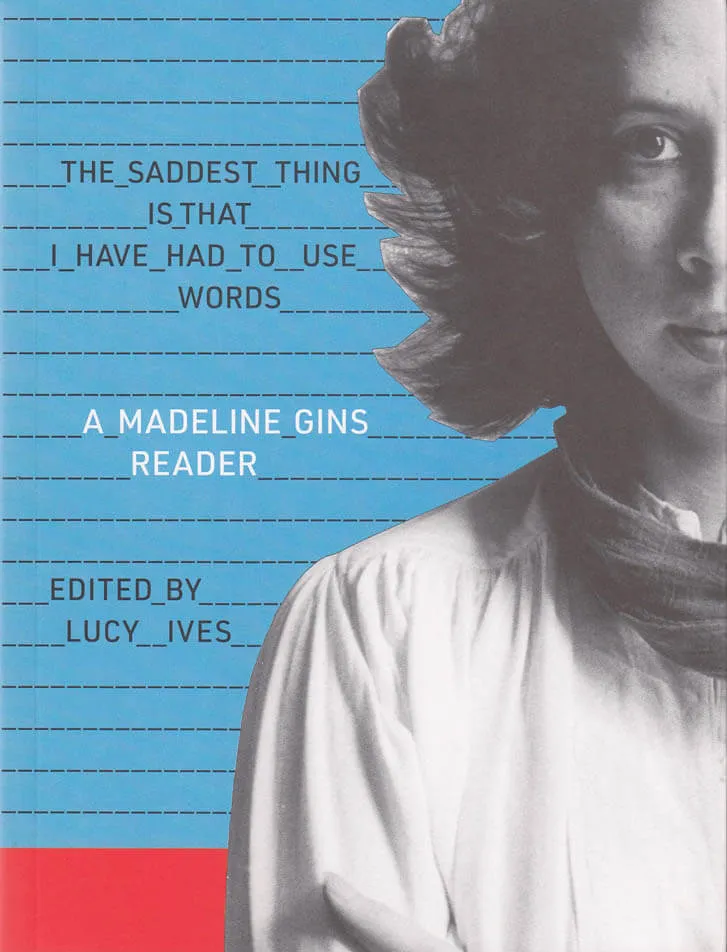
The Saddest Thing Is That I Have Had to Use Words: A Madeline Gins Reader
Poet, philosopher, speculative architect and transdisciplinary artist, Madeline Gins is well known for her collaborations with her husband, the artist Arakawa, on the experimental architectural project Reversible Destiny, in which they sought to arrest mortality by transforming the built environment. Yet, her own writings — in the form of poetry, essays, experimental prose and philosophical inquiries — represent her most visionary and transformative work. Like Gertrude Stein before her, Gins transfigures grammar and liberates words. Like her contemporaries in conceptual art, her writing is attuned to the energized, collaborative space between reader and page.
The Saddest Thing Is That I Have Had to Use Words: A Madeline Gins Reader is a revelatory anthology, edited and with an introduction by the writer and critic Lucy Ives. It brings never-before-published poems and essays together with a complete facsimile reproduction of Gins' 1969 masterpiece, WORD RAIN (or A Discursive Introduction to the Intimate Philosophical Investigations of G, R, E, T, A, G, A, R, B, O, It Says), along with substantial excerpts from her two later books What the President Will Say and Do!! (1984) and Helen Keller or Arakawa (1994). Long out of print or unpublished, Gins' poems and prose form a powerful corpus of experimental literature, one which is sure to upend existing narratives of American poetics at the close of the 20th century.
Edited by Lucy Ives.

Local Ecology – Moulin des Ribes
A contemplative photographic series by Jochen Lempert, created during a residency at the Moulin des Ribes in Grasse, a former mill nestled in the Provençal landscape.
Known for his background in biology and his distinctive analogue black-and-white photography, Lempert brings a scientific sensitivity and poetic restraint to his exploration of the site's immediate environment.
Shot entirely on location, the images focus on subtle interactions between natural forms and their surroundings. Rather than constructing grand ecological narratives, Lempert observes everyday life in and around the mill, drawing attention to the interdependencies and ephemeral presences that define a place.
With the intimacy of field notes and the tactility of silver gelatin prints, Local Ecology. Moulin des Ribes is both a document and a meditation. It reveals the overlooked ecologies that persist on the periphery of human attention, transforming the act of looking into a form of ecological engagement. In the silence of these photographs, Lempert proposes a different kind of knowledge—rooted in slowness, attunement, and care.
The photographs included in this publication were taken in the summer of 2021 during a residency at La Società delle Api, Moulin des Ribes, Grasse, based on an idea by Cristiano Raimondi.
Jochen Lempert (born 1958 in Moers) is a German photographer. Trained as a biologist specializing in dragonflies, he began his career as a photographer in 1989, at the age of 31, developing an artistic practice based on this scientific heritage, marked by images of nature where the animal and vegetal go hand in hand.

Don't Call Us Dead
Award-winning poet Danez Smith is a groundbreaking force, celebrated for deft lyrics, urgent subjects, and performative power. Don’t Call Us Dead opens with a heartrending sequence that imagines an afterlife for black men shot by police, a place where suspicion, violence, and grief are forgotten and replaced with the safety, love, and longevity they deserved here on earth. Smith turns then to desire, mortality—the dangers experienced in skin, body, and blood—and a diagnosis of HIV positive. “some of us are killed / in pieces,” Smith writes, “some of us all at once.” Don’t Call Us Dead is an astonishing collection, one that confronts America where every day is too often a funeral and not often enough a miracle.
Danez Smith is the author of [insert] boy, winner of the Lambda Literary Award for Gay Poetry and the Kate Tufts Discovery Award. Smith has received fellowships from the McKnight Foundation and the Poetry Foundation, and lives in Minneapolis.