Books
Books
in random order

Multiplication of Organs (Manifesto) – Body, Technology, Identity, Desire
A queering of psychoanalysis put together by the forerunner of Inactual Magazine.
Organ Multiplication Manifesto is an essay that delves into the transformations of sociality and sexuality in the context of digital technologies. Using an interdisciplinary approach that blends philosophy, erotic literature, media theory, psychoanalysis, gender studies, and neuroscience, the text explores how devices, platforms, and technologies shape and produce normative systems that influence our perceptions, desires, and relationships with others. By examining the interplay between desire and digital mediation and drawing comparisons with authors such as Deleuze, Ballard, Žižek, Butler, Preciado, Bataille, and others, this book aims to present a new theoretical, critical, and philosophical perspective in the contemporary discourse on the relationship between humans, technology, and society.
This book begins with an analysis of three iconic erotic texts from Masoch, Ballard and Bataille, and uses this analysis as the departure point for its main theoretical work on the four topics listed in the subtitle. The book passes through a lot of interesting phases, including an analysis of Phenomenology and Gucci, class struggle and OnlyFans and much more, until eventually arriving at the actual manifesto for Organ Multiplication and the beautifully named notion of the "Caged Sun".
Foreword by Vincenzo Estremo.
Afterword by Franco "Bifo" Berardi.
"One may think that the history of the human culture is going to be enormously impoverished by the disappearance of the body, one may think that, on the contrary, human culture has been enriched by the renounce to presence and physical contact. It is not the intention of Damato to save this dilemma, His intention is rather to open a new field of investigation, and possibly to start a reflection on a more advanced dilemma: will the change of perception make possible the emergence of a new ontology, or is the disappearance of the body going to mark the final dissolution of human life itself?" — Franco "Bifo" Berardi
Christian Nirvana Damato is a writer, curator, and independent researcher working in the fields of philosophy, technology, psychoanalysis, and visual culture. He teaches media theory at the IED in Turin and runs various workshops on publishing and writing. He writes for and collaborates with various magazines and publishing houses. He is the founder and editorial director of Inactual. He has also published Medial Disorders. Interpretive and Non-statistical Compendium of Technological Disorders. Vol I, with contributions by Geert Lovink, Alfie Bown, Isabel Millar, Eyal Weizman (Forensic Architecture) et al. (ed. by, Inactual, 2024), Wearable Statistical Desires. Re-programming the performativity of the body through digisexuality (Mimesis 2025; Everyday Analysis, 2025) and Medial Disorders Vol II.

Gay Pompeii 79 A.D.
With her debut chapbook, award-winning author and curator Legacy Russell returns to poetry with her GAY POMPEII, a collection of lyric poems that begin at the end of the world.
Rising out of Russell's 2022-2023 Digital Fellowship for Pompeii Commitment. Archaeological Matters, the first long-term, contemporary art programme established by the Archaeological Park of Pompeii, the author and curator explores ash, filth, dirt, and decay, intersectional with the fetishistic mythos of Pompeii and its destruction in 79 CE by the eruption of Mount Vesuvius. Pompeii today is a UNESCO World Heritage Site that receives over two million visitors per year to view its archeological excavation. Russell puts the mass voyeurism, sensation, extraction, and loss of Pompeii—a devastating moment frozen in time—to work. In GAY POMPEII, the site becomes a device with which Russell unspools birth, death, genocide, visual culture, and space-time. The title of this compilation underscores the essence and demand of capitalism: to be carefree in the face of looming extinction. Russell's GAY POMPEII is a selfie taken at the edge of catastrophe and a polyphonic elegy.
Legacy Russell (born 1986 in New York City) is a curator and writer. She is the Executive Director & Chief Curator of the experimental arts institution The Kitchen. Formerly she was the Associate Curator of Exhibitions at The Studio Museum in Harlem. Russell holds an MRes with Distinction in Art History from Goldsmiths, University of London with a focus in Visual Culture. Her academic, curatorial, and creative work focuses on gender, performance, digital selfdom, internet idolatry, and new media ritual. Russell's written work, interviews, and essays have been published internationally.

A Nazi Word for a Nazi Thing
An essay on art, bodies and fascism.
In an era where identity politics is being weaponised against the very people it has sought to make visible, how can we reclaim complexity?
In 1937 the Nazis staged an exhibition of seized modernist artworks. Named Entartete ‘Kunst’ – Degenerate ‘Art’ – it sought to define degeneracy, display it and destroy it.This act of violent appropriation is one episode in a long and ongoing history of the erasure of queer and non-normative cultures.
A Nazi Word for a Nazi Thing works against this erasure; it is a manifesto – a catalogue for an exhibition that could never take place. Drawing on work from dissident sexologist Magnus Hirschfeld to South African artist Zanele Muholi, as well as a century of queer cinema from Sergei Eisenstein to Pedro Almodóvar, So Mayer creates an archive of resistance.
‘This book is a small revolution that becomes a party that you won’t be leaving soon. I believe we’re living in a time of fresh erasures, systemic violences working that global pandemic to take some other bodies out. Looking so freshly at the history of queerness, sexual deviance and the long long coordinated erasures of colonialism, bigotry and transphobia the essential non binary nature of art opens up right here like the wildly singing flower it is and So Mayer’s compelling version makes sense, makes me listen.’
— Eileen Myles
‘A Nazi Word for a Nazi Thing is a reflective, creative walk through some of the worst – and best – people of the last hundred years, looking at the power of images and their relationship(s) with text. In a time of rising fascism, So Mayer highlights ways that artists have found strategies of resistance, and offers hope in historical analysis.’
— Juliet Jacques

Profusione
A comprehensive overview of the unique work of the Italian artist born in 1931 and "discovered" late on the international scene, with numerous texts and an interview.
Published after the eponymous exhibition at Consortium Museum, Dijon, April 26th – September 8th 2024.
Born in Naples, Italy, in 1931, Isabella Ducrot is a young artist with a young career. Like many women of her generation, she moved into art after raising her children. Her formative years were marked by continuous travels with her late husband, during which they amassed hundreds of Persian miniatures and rare antique textiles of many kinds.
Contributions by Franck Gautherot & Seungduk Kim, Verena Lueken, Tobias Pils, Tschabalala Self, Andrea Viliani, Miranda Fengyuan Zhang.

Rage Assassine: Mettre Fin au Racisme
Avant que Black Lives Matter et #MeToo ne viennent secouer l’Amérique et le monde occidental, bell hooks montrait, dans cet essai incisif, que l’abolition du racisme et l’éradication du sexisme vont de pair. Sans le féminisme, la lutte antiraciste reste une affaire d’hommes. Sans l’antiracisme, le féminisme s’expose à servir de courroie aux logiques de domination raciale. L'autrice insiste sur le bien-fondé de la rage qui anime les masses populaires et la jeunesse noire et sur la nécessité d’en faire un moteur de changement social radical. Elle propose une théorie et une pratique révolutionnaires, dont la fin est une communauté solidaire fondée sur l’égalité réelle et la volonté de tou.te.s de travailler au changement.
Traduit de l'anglais par Ségolène Guinard.
GLORIA JEAN WATKINS, connue sous son nom de plume BELL HOOKS, née en 1952, est une intellectuelle, féministe, et militante étasunienne. Elle a publié plus de trente livres et de nombreux articles, et est apparue dans plusieurs films documentaires. Traduits dans de nombreuses langues, ses ouvrages sont considérés parmi les plus importants sur la question aux Etats-Unis et suscitent un réel engouement en France depuis quelques années. Les éditions divergences ont déjà traduit et publié trois de ses ouvrages dont La volonté de changer et A propos d'amour.

Two Revolutions a Day
Two Revolutions a Day marks the first in-depth publication devoted to the work of Sophie Nys, whose artistic practice over the past two decades has unfolded through an enterprising interplay of research, observation, and formal experimentation. Moving between exhibition-making, design, and subtle acts of re-framing, Nys has developed an oeuvre that resists fixed categories while remaining acutely attentive to the structures – historical, linguistic, psychological – that shape how meaning is produced and circulated.
Rather than presenting a linear retrospective, Two Revolutions a Day is organised as an extended conversation between Nys and critic Christophe Van Gerrewey that mirrors the artist’s own methods. Together, they revisit key works and exhibitions from the early 2000s to today, tracing recurring motifs and questions while allowing contradictions and shifts in perspective to remain visible.
Throughout the book, Nys’s fascination with systems of power and authority intersects with a sensitivity to intimacy, subjectivity, and the everyday, engaging with feminist perspectives that examine the politics of representation. Historical figures, marginal anecdotes, and overlooked documents appear alongside reflections on resistance, collaboration, design, and the conditions under which artworks –and the social roles they inhabit – come into being. Language, in particular, emerges as both material and problem: a tool that promises clarity while constantly slipping, misfiring, or revealing its own limits.

Telling is Listening: Selected Essays 1973-2014
Ursula K. Le Guin, Conner Bouchard-Roberts
An essential collection of essays on language, the imagination, and the art of words by one of the great literary masters of the last century.
This book traces a long sweep (1973-2014) through Ursula K. Le Guin's career; offering both a portrait of the author as a philosopher and a reference text for new generations of wordworkers and bookmakers.

Issue 9: John Akomfrah
This special, limited-edition issue of Plaster celebrates Akomfrah’s commission for the British Pavilion at the 60th International Art Exhibition, La Biennale di Venezia. The linen presentation box contains: an essay by Akomfrah’s long-time friend and collaborator, the BAFTA-winning film curator June Givanni; an interview with Akomfrah by Harriet Lloyd-Smith; original portraits by photographer Siam Coy and a fold-out poster featuring an exclusive still from Akomfrah’s film installation, Listening All Night To The Rain, now screening in the British Pavilion at the Venice Biennale.
With creative direction by Constantine // Spence and design by Emma Ralph.

KAMERA CAHIER N° 9
Peter Downsbrough (New Jersey, US, 1940) lives and works in Brussels (Belgium). Associated with major international art movements such as minimal art, conceptual art, and visual poetry, his work spans across various mediums including sculpture, wall pieces and room pieces, books, work on paper, photography, film, and video. The work, which has affinities with architecture and typography, explores the traditional use of space and language, while criticizing power structures, e.g. urbanism, that influence social interactions and shape the landscape.
A special edition issue curated, designed and published by AVARIE, Paris and Labor Neunzehn, Berlin. It accompanies KAMERA SERIES, while it is an independent and valuable object to collect.
The central idea that informs and directs the booklets’ montage is the interplay between the concepts of addition and subtraction. This is achieved by unveiling a missing image in the screening or an unreleased second from an artist's film, expanded to 24 pages. Additionally, each booklet contains a piece directly removed from the show.
The editing establishes a dialogue between film frames and performed writings derived from texts, scripts, storyboards, and notes. The KAMERA exhibition is consequently extended into a physical space—the book—allowing for its widespread dissemination, complementing and contrasting with its potential online occurrence.
KAMERA SERIES is a screening program of experimental films, video art works and printed matter taking place in a former GDR building in Berlin. Each event showcases a retrospective of selected films by an artist and a small exhibition of his/her publications or works on paper over a span of 4 days.

Chapel Road
Louis Paul Boon, Adrienne Dixon
A meta-textual matryoshka doll of a novel from a renowned voice in Flemish literature.
The twisting narrative of Louis Paul Boon's 1953 masterpiece follows a young girl named Ondine and her brother Valeer, born into poverty at the turn of the century in the industrial city of Aalst, Belgium. Ondine's coming of age is interwoven with a reworking of the medieval fable of Reynard the Fox, as well as a metanarrative in which an author named Louis Paul Boon and his colorful group of friends discuss the writing of a novel named Chapel Road, debating how best to present Ondine's story.
Groundbreaking among post-war Dutch literature for its postmodern structure and irreverent, dialect-studded use of language, Boon's allegory of the rise and fall of socialism in Flanders presents his theory of the novel as a type of "illegal writing" where digressions are far more important than a carefully constructed plot.
Introduction by Chad W. Post
Louis Paul Boon (1912-1979) started out as a house painter but went on to become the author of a large and rich oeuvre spanning several genres: from the compelling historical epics he composed later in life to his sharp, witty work as a newspaper columnist and his tongue-in-cheek, scabrous novels. Boon is one of the most important writers of Flemish literature in the twentieth century, a keen observer of society, the individual and the interplay between them.
Adrienne Dixon is a translator of Dutch and Flemish literature.
Chad W. Post is the founder and publisher of Open Letter Books. He is also the editorial director of Dalkey Archive Press, where he was formerly the associate director. Over the course of his career, he founded the Translation Database, the Best Translated Book Awards, multiple literary podcasts (Two Month Review, Three Percent), the Three Percent website, and currently writes two newsletters: The Three Percent Problem, and Mining the Dalkey Archive. He is also the author of The Three Percent Problem: Rants and Responses on Publishing, Translation, and the Future of Reading. His articles and book reviews have appeared in a range of publications. In 2018 he received the Words Without Borders Ottaway Award for the Promotion of International Literature.

Textes à lire à voix haute
A collection of texts by fifteen contemporary Brazilian authors who approach the notions of care and privilege from a transfeminist, anti-racist and decolonialcritical perspective.
Edited by Diane Lima, Cíntia Guedes, abigail Campos Leal.
Texts by Ricardo Aleixo, Pacha Ana, Castiel Vitorino Brasileiro, Monna Brutal, Rebeca Carapiá, Pêdra Costa, Ingrid Martins, muSa Michelle Mattiuzzi, Jota Mombaça, tatiana nascimento, Elton Panamby, Grace Passô, Miro Spinelli, Preto Téo, Lucas Veiga.
Translated from the Portuguese (Brasil) by Luana Almeida, Valentina D'Avenia, Léa Meier, aurore/a zachayus.

Robida 11 - on orchards
The eleventh issue of Robida magazine, is collection of essays, photographic explorations, visual narratives, art projects, and poetic texts all centered on the orchard as landscape and fruit trees as powerful metaphors and living archives of stories and memories.
Robida is a situated, multilingual cultural magazine published by Robida collective. Each issue explores a topic connected and generated by Topolò/Topolove, the village on the border between Italy and Slovenia where the collective is based.
The chosen topic is thrown into the world and interpreted by people who have never been to Topolò. What people send back after the open call is not only a contribution to the exploration of a defined theme but also a new interpretational tool to explore the collective’s relation to Topolò.
CONTRIBUTORS
Alessandra Saviotti, Alja Piry, Aljaž Škrlep, Alessandra Faccini, Anastasia Kolas, Andrea Martinelli, Andreina Trusgnach, Angelica Calabrese, antonisotzu, Antônio Frederico Lasalvia, Cassidy McLeod McKenna, Companion–Platform, Danijel Losic, Derek Scott Russell, Dora Ciccone, Eda Aslan, Elena Braida, Elena Rucli, Emmy Elvira Wassén, ERBA, Francesca Farris, Francesca Battaglia, Francesca Lucchitta, Giovanni Aloi, Giulia Bertuletti, Gregor Božič, Greta Biondi, ife collective, Jana Kiesser, Jannete Mark, jean ni, Jennifer Shin, Jessica Hollis, Jip van Steenis, Julina Vanille Bezold, Kristína Mičová, Lalie Thébault Maviel, Laura Savina, Lina v. Jaruntowski, Lindsay Buchman, Luca Vettori, Luca Battista, Ludovica Battista, Luigi Coppola, Luisa Gastaldo, Maria Elena Vecchio, Marta Pagliuca Pelacani, Martina Havlová, Martina Motta, Mia Frances LaRocca, Michael Marder, Nataša Kramberger, Ola Korbańska, Paolo Bosca, Rachele Daminelli, Rosie Ellison-Balaam, Sasha Arutyunova, Serena Abbondanza, Silvia Mascheroni, Stephanie Rebonati-Cannizzo, Teresa Carretta, Terry Cueball, Vesna Liponik, Victoria King, Vida Rucli, Vittoria Rubini
Languages: English (mainly), Italian, Slovene, French, German + local, minoritarian lan(d)guages and dialects from the regions of Benečija, Valchiavenna, Abruzzi, Bari, su Logudoru, Corsica, Gorenjska, Cetuna and the White Carpatians region.

Steal This Book
Eleven performance-based projects by Dora García, documented through letters, emails and other elements from the artist's private correspondence with various interpreters of performances, whether they were direct collaborators of simple spectators.
Edited and prefaced by François Piron, Steal This Book, a tribute to Abbie Hoffmann's pamphlet of the same name, is not a definitive attempt at rendering the pieces on which it is based; it calls for a free, active and contradictory reception, that of an open archive. Part epistolary novel, part rough screenplay and part user's manual, Steal This Book proposes a body of discussions, questions without answers and endless ramblings, in place of the critique's or the artist's voice.
The book has also been presented in exhibitions as a Dora García sculpture meant to be stolen, but it can also be purchased in selected bookstores worldwide.
Contrary to the idea that would have art addressing the greatest possible number of people, Dora García (born in 1965 in Valladolid, lives and works in Barcelona), best known for her performance devices, is interested in what is enacted at the individual scale: in a radically conceptual form, at once accessible and elegant, she elects to transmit oddly coded messages, their ask being to bestir a specific relation with each and every visitor. Dora García is interested in everything that intervenes in the communication between an artist and his/her public: art no longer represents the world, but itself becomes a producer of realities often on the borderline of fiction and make-believe. It urges us to undergo experiences other than ordinary situations, at once simple and hard to grasp.
Dora García has had solo exhibitions at the MACBA in Barcelona, the Reina Sofia in Madrid and the SMAK in Gent. She represented Spain at the Venice Biennale in 2011, and was a part of the Skulptur Projekte Münster 07, the Sydney Biennial in 2009, the Biennale de Lyon in 2009 and Documenta 13 in 2012.


Publi Fluor, Letter Business in Brussels
A self-taught typographic letterer, Chrystel Crickx used to cut out letters by hand and sell them by the piece in her Publi Fluor shop in Schaerbeek, Belgium. Commercialized between 1975 and 2000 for local advertising and signage purposes, these letters have since been digitized and made more widely available to users outside of the Belgian borders and in other contexts. At the margins of standard means of communication, they have contributed to shape (and still do) the urban visual landscape, in Brussels and elsewhere.
This non-standard, collective essay attempts both to recount the life of a type model — as well as of its successive authors and their tools — while expanding the field of investigation to examine the cracks between the different stories summoned up by Chrystel Crickx's practice summons up.

Men in the Off Hours
In Men in the Off Hours, Carson offers further proof of her tantalizing gifts. Reinventing figures as diverse as Oedipus, Emily Dickinson, and Audubon, Carson sets up startling juxtapositions: Lazarus among video paraphernalia, Virginia Woolf and Thucydides discussing war, Edward Hopper paintings illuminated by St. Augustine. And in a final prose poem, she meditates movingly on the recent death of her mother. With its quiet, acute spirituality and its fearless wit and sensuality, Men in the Off Hours shows us a fiercely individual poet at her best.

SIXFINGERAFTERWARDS
William Rowe, the poet, and eminent translator of Latin American poetry from Vallejo to Raul Zurita & others presents his latest book of poems, Sixfingersafterwards, in six sections. The title word ‘afterwards’, which refers to a large part of the first section of poems takes inspiration from an Ayahuasca session. According to Freud, Afterwardness or Nachtraglichkeit as originally harmless memory can later be re-experienced as traumatic through the lens of new mature understanding. The Marxists view the capitalist state as inherently connected to a ‘death culture’ where the pursuit of profit overrides the human life, turning the system into a form of a vampirism that consumes the living labour. All the sections are written with a deep commitment, elaborating a painful truth in a remarkable open poetic sensitivity. Our language ravaged by ‘vampirism’ where ‘Language itself seemed to form death communiques.’ Other sections are about love, ‘when my daughter says she loves me very much.’ Or a section of Quechua poems translated by Rowe, which shed light on the extensive range of his writing and interconnectedness of his creativity. The poems in this collection leave nothing out of the traumatic pain from capitalism nor its ‘dark dark shine of money.
I dreamt of Rowe, reading these poems to the track called Walking on the ceiling, by the late Chicago blues guitarist, who played with six fingers. I renamed it to Walking the ceiling toward eternity, to honour the Sixfingersafterwards. A must-read!
- Ulli Freer

Drag King Dreams
Max Rabinowitz, a butch lesbian bartender at an East Village club, is shaken when her friend, a transvestite, is murdered. As the community of cross-dressers, drag queens, lesbians, and gay men stand together in the face of this tragedy, Max taps into the activist spirit she thought had disappeared.
Leslie Feinberg is an editor, writer, and political organizer. Stone Butch Blues, Feinberg's first novel, is an internationally acclaimed classic of trans literature. It won the Lambda Award and the American Library Association Lesbian and Gay Book Award. Feinberg's other works Trans Liberation, Trans Gender Warriors, and Transgender have also been at the forefront of the trans movement. Feinberg lives with her wife, Minnie Bruce Pratt, near New York City.

Stars at Midday –نجوم الضُهر
Stars at Midday –نجوم الضُهر is a personal diary in which the artist and filmmaker Noor Abed compiles visual and poetic notes from the production phase of her film A Night We Held Between, filmed in Palestine in 2023 with family and friends.
Like the film, the book interweaves narrative fragments, song and diaristic observations, creating a fusion of natural and composed sequences of movement, of documentary and fictional elements.
Through a choreography of bodies, sites, stories, and temporalities, Abed’s work prompts contemplation on the manifestations of social action and resistance in everyday life.

Entropia Vol. 1 & 2
Entropia (vol. I & II) – written by William Kherbek and edited in collaboration with Jack Clarke – is a publication which seeks to recount and re-examine a decade of artistic curation, production, and critique between London, Berlin, and other urban art centres from 2010 to 2020.
Comprised of two volumes, this publication contains a compendium of over one hundred reviews and interviews with luminaries of contemporary art (Vol I), as well as a speculative attempt to create a newly generated algorithmic art(ificial) critic (Vol II). Together they serve to document, excoriate, and theorise an art world which is simultaneously hegemonic and precarious, complicit and constructive, driven by values, yet fed by extraction, all filtered through Kherbek’s precise, aphoristic, acerbic, lens.
The publications include contextual contributions from both Josie Thaddeus-Johns, writer for the New York Times, The Financial Times, Frieze; and Rozsa Farkas, director of London-based gallery Arcadia Missa.

Could It Be Love
Greer Lankton’s iconic and startling doll sculptures as we have never seen them before: through her own eyes.
Magic Hour Press is proud to present the first monograph on the trans visionary artist Greer Lankton (1958–96), whose lifelike doll sculptures shocked 1980s New York. Lankton’s dolls, which she began making as a child and produced obsessively until her death at age 38, were a means to explore her fraught relationship with the human body. In the book’s 100 photographs, all shot by Lankton herself, these figures take on a life of their own, kvetching at a party, strolling along a beach, or lounging on a stoop in the East Village. Among this extraordinary cast of oddballs—usually femme, often freakish, always radiating a glamorous confidence—we find characters of Lankton’s own invention alongside well-known icons such as Divine, Coco Chanel, Andy Warhol and even Lankton herself.
Born in 1958 to a Presbyterian minister in Michigan, Greer Lankton moved to New York in 1978 and became a rising star of the downtown scene. There, her deviant elegance was immortalized in photographs by Peter Hujar, David Armstrong, and Lankton’s close friend Nan Goldin, who described her as “one of the luminaries of the East Village renaissance: beautiful, glamorous, wild and hysterically funny.”
Edited by Francis Schichtel, Jordan Weitzman and Nan Goldin
Text by Hilton Als
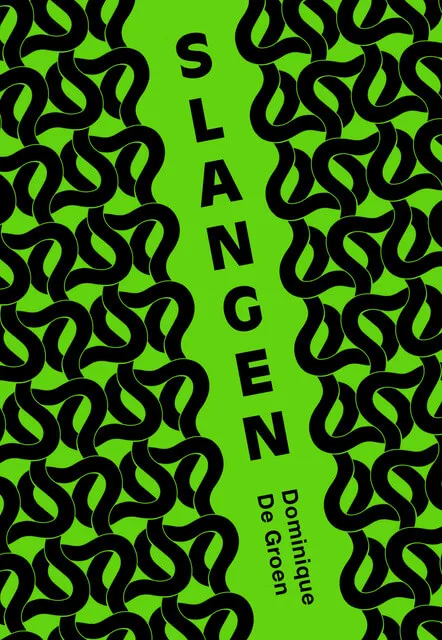
Slangen
Slangen krioelen in de sarcofaag van het heden, in de krochten van de popcultuur, in de mummie van de natuur, in wondes en rot vlees, in artificiële woestijnen en op geoliede dad bods. Ze wentelen zich rond beursgrafieken, raken verstrengeld met wurgende algoritmes, orkestreren een trage ondergrondse revolutie. Een meisje snijdt zich aan een nepdiamanten piramide en werpt haar slangenvel van zich af.
Dominique De Groen is schrijver en beeldend kunstenaar. Ze publiceerde de dichtbundels Shop Girl (2017), Sticky Drama (2019) en offerlam (2020). Ze werd genomineerd voor de Poëziedebuutprijs Aan Zee 2018, de Herman de Coninckprijs 2020 en de Fintroliteratuurprijs 2021 en won de Frans Vogel Poëzieprijs 2019 en de Fintropublieksprijs 2021.

Lassie, Des amis pour la vie
Ce que je vois, c’est comment un animal se détermine à créer une relation avec un garçon malheureux.
Fiction vu en boucle gamine, que je superposais à ma chienne, une colley comme Lassie.
Suivi par Émilie Ferrat.

Hardscapes / Here
Hardscapes / Here documents and brings together two exhibition projects by artists Nina Canell and Maria Hassabi. Produced on the occasion of the exhibitions of the same name curated by Samuele Piazza at the OGR Torino, the publication consists of two graphically specular books that merge into a single volume. Essays, unpublished materials and a rich set of photographic materials form the driving force behind two visual narratives that offer new keys to understanding the research of the two artists.
Hassabi's live installation Here calls on visitors to share space and spend time with six performers portrayed in a decelerated rhythmic choreography within a sculptural environment. In constant motion, the dancers contribute to a situation of shifting presence, demonstrating the contestable nature of the "here and now." Immobility and slowing down are thus used both as techniques and as subjects of representation: the performing bodies oscillate between dance and sculpture, subject and object, living body and static image.
Canell's Hardscapes combines two works that focus on the concepts of circulation and transformation as well as on unexpected forms of coexistence. Energy Budget (2017–18), a video that alternates between two subjects: a basement in which a leopard snail crawls over an electrical panel, and the gradual shifting of the frame away from "dragon gates"—portal-like openings in huge buildings on the Hong Kong waterfront. Muscle Memory (16 Tonnes) (2020–21) is a floor sculpture, decomposed and transformed by the density of moving bodies, which literally crumbles under the soles of passing visitors.
In addition to texts by the curator, the publication includes essays by Felicia Leu and Laura Preston, along with a conversation by Maria Hassabi and Nina Canell with Lorenzo Giusti.
Published on the occasion of the epoymous exhibitions at OGR Torino in 2022.
Edited by Samuele Piazza.
Texts by Lorenzo Giusti, Felicia F. Leu, Samuele Piazza, Laura Preston.