rile*books

Search books

Search books by title, author, publisher, keywords...

Cover of The Secret History Of Kate Bush (And The Strange Art Of Pop)

Antenne Books

The Secret History Of Kate Bush (And The Strange Art Of Pop)

Fred Vermorel

€17.00

The Secret History of Kate Bush, first published in 1982 as Kate was on the verge of superstardom, is a daring and unorthodox dive into the world of music, fame, and cultural obsession. Written by Fred Vermorel—a close associate of Malcolm McLaren and Vivienne Westwood, and renowned for his subversive "anti-biographies"—the book shatters the boundaries of traditional celebrity profiles. Told from the perspective of a die-hard fan, it unveils the mystique of one of pop’s most elusive icons while exposing the capitalist machinery driving the entertainment industry. Part biography, part cultural critique, and entirely provocative, this is not just a book about Kate Bush but a rebellious manifesto against the commodification of art.

Republished in 2022 by Le Gospel in France, this special edition goes even deeper with unpublished treasures from Vermorel’s personal archive. Featuring an exclusive interview with Kate’s father, Dr. Robert Bush, a razor-sharp foreword by novelist and musician Tony O’Neill (Digging the Vein), and Vermorel’s own afterword reflecting on his explosive work four decades later, this is a must-read for anyone fascinated by Kate Bush, the art of fandom, and the raw power of creative rebellion. Fred Vermorel is a pioneer of the in-depth study of celebrity and fan cultures, best known for his controversial "anti-biographies" of pop icons including the Sex Pistols, Kate Bush, Vivienne Westwood, and Kate Moss.

Published in 2024 ┊ 160 pages ┊ Language: English

recommendations

Cover of The Autobiography of H. LAN Thao Lam

Dorothy, a publishing project

The Autobiography of H. LAN Thao Lam

Lana Lin

Situated between memoir, social criticism, and conceptual art, The Autobiography of H. Lan Thao Lam is an incisive response to a modernist classic and an affecting exploration of the poetics and politics of our times. "We are supposed to know where we are with biography and autobiography, they are the literary equivalents of the portrait and the self-portrait," writes Jeanette Winterson about Gertrude Stein's 1932 classic, The Autobiography of Alice B. Toklas. By narrating her own story from the perspective of her partner, Stein invented a literary form that was both intimate and uncanny, blurring lines of authority and identity as it winds through a story of two women living and loving together through a tumultuous moment in history. Almost a century later, experimental filmmaker and artist Lana Lin has resurrected Stein's project to tell another story of queer love, life, and artistic collaboration in a differently discordant age. At heart a candid chronicle of her partner Lan Thao's life journey from Vietnam during the war and her own troubled history as a gender-queer Taiwanese American, Lin's Autobiography draws in subjects as varied as photography, tropical fruit, New York real estate, and queer theorist Eve Sedgewick's eyeglasses, weaving a landscape of living that is also a critical investigation of race and gender in our time. 

Lana Lin is a writer, artist, and filmmaker based in New York and Connecticut. She is the author of the book Freud's Jaw and Other Lost Objects: Fractured Subjectivity in the Face of Cancer and film and video works including The Cancer Journals Revisited. Her various works and collaborative projects (with Lan Thao Lam as "Lin + Lam") have exhibited at festivals and art and educational spaces throughout the world, including the Museum of Modern Art, Whitney Museum, and New Museum, New York; The National Gallery of Art, Washington, D.C.; Gasworks, London; the Taiwan International Documentary Festival and Taiwan Film and Audiovisual Institute, New Taipei City; Arko Art Center, Korean Arts Council, Seoul; and the 2018 Busan Biennale. Having had three years of psychoanalytic training before dropping out, she sometimes still dreams of becoming a psychoanalyst one day.

Cover of Memories That Smell Like Gasoline

Nightboat Books

Memories That Smell Like Gasoline

David Wojnarowicz

Erotica €23.00

David Wojnarowicz, one of the most provocative artists of his generation, explores memory, violence, and the erotism of public space—all under the specter of AIDS.

Here are David Wojnarowicz’s most intimate stories and sketches, from the full spectrum of his life as an artist and AIDS activist. Four sections—”Into the Drift and Sway,” “Doing Time in a Disposable Body,” “Spiral,” and “Memories that Smell like Gasoline”—are made of images and indictments of a precocious adolescence, and his later adventures in the streets of New York. Combining text and image, tenderness and rage, Wojnarowicz’s Memories That Smell Like Gasoline is a disavowal of the world that wanted him dead, and a radical insistence on life.

The new and revised edition features a foreword by Ocean Vuong and a note from the editor, Amy Scholder.

Cover of About Ed

New York Review of Books

About Ed

Robert Glück

Biography €19.00

A moving story about love, AIDS, grief, and memory by one of the most adventurous writers to come out of San Francisco's LGBTQ+ scene.

Bob Glück met Ed Aulerich-Sugai in 1970. Ed was an aspiring artist; Bob wanted to write. They were young men in San Francisco at the high tide of sexual liberation and soon, and for eight years, they were lovers, after which they were friends. Ed was an explorer in the realms of sex. He was beautiful, fragile, exasperating, serious, unassuaged. In 1994 he died of HIV. His dream notebooks became a touchstone for this book, which Glück has been working on for some two decades, while also making his name as a proponent of New Narrative writing and as one of America's most unusual, venturesome, and lyrical authors. About Ed is about Ed, who remains, as our dead do, both familiar and unknowable, faraway and close. It is about Bob too.

The book is a hybrid, at once fiction and fact, like memory, and it takes in many things through tales of political activism and domestic comedy and fury to questions of art and love and experiences of longing and horror. The book also shifts in register, from the delicate to the analytic, to funny and explicit and heartbroken. It begins in the San Francisco of the early 1980s, when Ed and Bob have been broken up for a while. aIds is spreading, but Ed has yet to receive his diagnosis. It follows him backward through his life with Bob in the 1970s and forward through the harrowing particulars of death. It holds on to him and explores his art. It ends in his dreams.

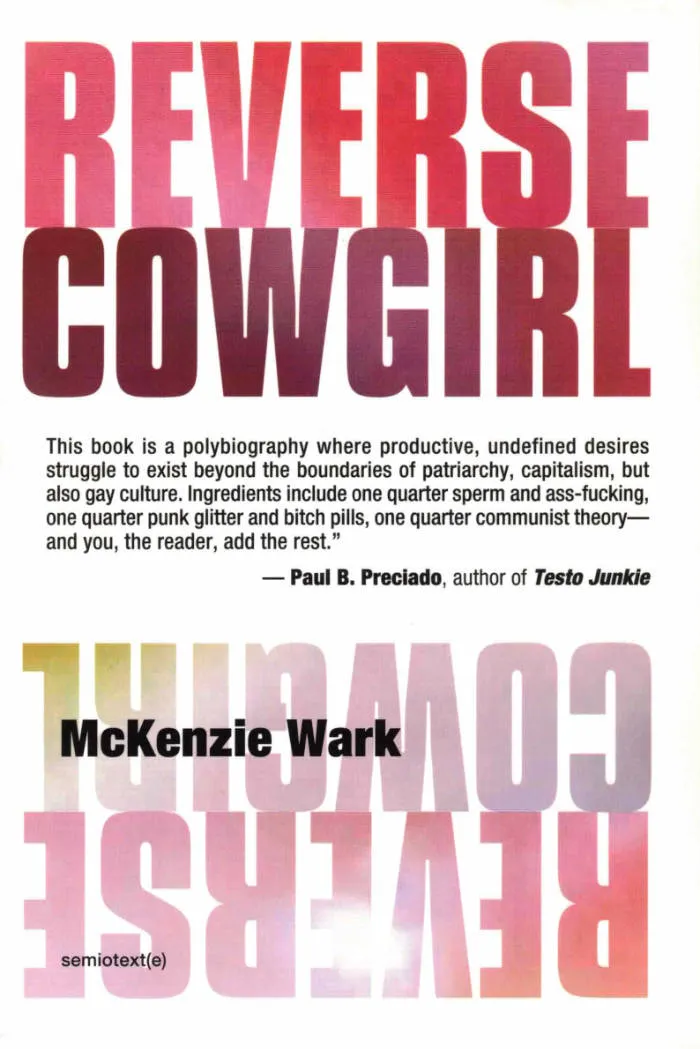
Cover of Reverse Cowgirl

Semiotext(e)

Reverse Cowgirl

McKenzie Wark

Fiction €16.00

McKenzie Wark invents a new genre for another gender: not a memoir but an auto-ethnography of the opacity of the self.

Another genre for another gender.

What if you were trans and didn't know it? What if there were some hole in your life and you didn't even know it was there? What if you went through life not knowing why you only felt at home in your body at peak moments of drugs and sex? What if you expended your days avoiding an absence, a hole in being? Reverse Cowgirl is not exactly a memoir. The author doesn't, in the end, have any answers as to who she really is or was, although maybe she figures out what she could become.

Traveling from Sydney in the 1980s to New York today, Reverse Cowgirl is a comedy of errors, chronicling the author's failed attempts at being gay and at being straight across the shifting political and media landscapes of the late twentieth century. Finding that the established narratives of being transgender don't seem to apply to her, Wark borrows from the genres of autofiction, fictocriticism, and new narrative to create a writing practice that can discover the form of a life outside existing accounts of trans experience: an auto-ethnography of the opacity of the self.

Cover of Spectres IV: A Thousand Voices

Shelter Press

Spectres IV: A Thousand Voices

Bartolomé Sanson, François J. Bonnet

The fourth issue of the annual publication dedicated to sound and music experimentation, co-published by Shelter Press and Ina GRM – Groupe de Recherches Musicales, around the topic of voice.

The voice is everywhere, infiltrating everything, making civilisation, marking out territories with infinite borders, spreading from the farthest reaches to the most intimate spaces. It can be neither reduced nor summarised. And accordingly, when taken as a theme, the voice is inexhaustible, even when seen in the light of its very particular relation with the sonic or the musical, as is the case in most of the texts collected in this volume. There is no point therefore in trying to circumscribe or amalgamate the multiple avatars of the voice. We must rather try to apprehend what the voice can do, to envisage its landscape, its potential effects.
 
Spectres is an annual publication dedicated to sound and music experimentation, co-published by Shelter Press and Ina GRM – Groupe de Recherches Musicales.

Edited by François J. Bonnet and Bartolomé Sanson.

Contributions by Joan La Barbara, Sarah Hennies, Peter Szendy, Youmna Saba, Lee Gamble, Ghédalia Tazartès, David Grubbs, Stine Janvin, Pierre Schaeffer, Akira Sakata, Haela Ravenna Hunt-Hendrix, Yannick Guédon, François J. Bonnet, John Giorno.