rile*books

Search books

Search books by title, author, publisher, keywords...

Cover of Wisdom

Sinister Wisdom

Wisdom

Sinister Wisdom

€10.00

Sinister Wisdom 33: Wisdom asks the questions: How do we express the wisdom we've come to have, the wisdom we still seek? How has wisdom been passed on to us? What's stayed through time - from family, other womyn, from what we've read, from experience?

Creative Work By

Adrienne Rich
Gloria Anzaldúa
Chrystos
Melanie Kaye/Kantrowitz
Leslita Williams
Barbara Ruth
Paula Brooks
Teya Schaffer
Lynn Crawford
Jan Hardy
Judy Meisksin
Margaret Tongue
Rose Romano
Nancy Humphreys
Patricia Filipowska

And More!

Language: English

recommendations

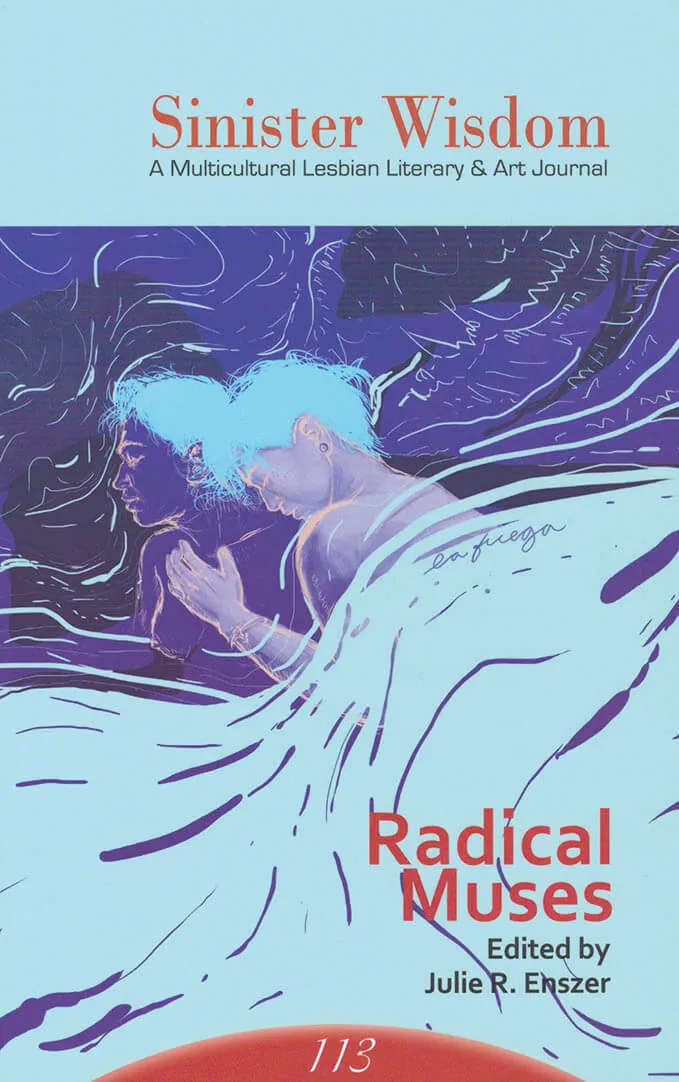
Cover of Radical Muses (Sinister Wisdom nr. 113)

Sinister Wisdom

Radical Muses (Sinister Wisdom nr. 113)

Julie R. Enszer

Sinister Wisdom 113: Radical Muses features an eclectic array of contemporary poetry, prose, and art by lesbians from around the world, including new work by: Andrea Assaf, Tara Shea Burke, Cheryl Clarke, Marina Chirkova, Estela González, Barbara Haas, Nancy E. Lake, Vi Khi Nao, H. Ní Aódagaín and much more!

Cover of Mother Reader

Seven Stories Press

Mother Reader

Moyra Davey

Essays €27.00

'My aim for Mother Reader has been to bring together examples of the best writing on motherhood of the last sixty years, writing that tells firsthand of the mother's experience.

Many of the writings in Mother Reader comment on and interpolate one another, in citations, in footnotes, in direct homage. As I was assembling this collection one text would lead to one another, treasure-hunt fashion, the clue provided by an acknowledgement or bibliography. And just as often the writing circles back.

In Mother Reader chapters are excerpted from autobiographies, memoirs, and novels; entries are lifted from diaries; essays and stories are culled from collections, anthologies, and periodicals. My project has been to assemble a compendium or sampler of these ''kindred spirit'' works on motherhood, so that readers, and especially mothers with limited time on their hands, can access in one volume the best literature on the subject and know where turn to continue reading." [Moyra Davey in the introduction]

Writings by Margaret Atwood, Susan Bee, Rosellen Brown, Myrel Chernick, Lydia Davis, Buchi Emeta, Annie Ernaux, Mary Gaitskill, Susan Griffin, Nancy Hutson, Mary Kelly, Jane Lazarre, Ursula K. Le Guin, Doris Lessing, Ellen McMahon, Margaret Mead, Vivian Montgomery, Toni Morrison, Tillie Olsen, Alicia Ostrker, Grace Paley, Sylvia Plath, Adrienne Rich, Sara Ruddick, Lynda Schor, Mira Schor, Dena Schottenkirk, Mona Simpson, Elizabeth Smart, Joan Snyder, Elke Solomon, Susan Rubin Suleiman, Alice Walker, Joy Williams, Martha Wilson, Barbara Zucker.

Cover of Eye to Eye: Portraits of Lesbians

Anthology Editions

Eye to Eye: Portraits of Lesbians

JEB

Photography €45.00

In 1979, JEB self-published her first book, Eye to Eye: Portraits of Lesbians. In a work that was revolutionary for its era, JEB made photographs of lesbians from different ages and backgrounds in their everyday lives—working, playing, raising families, and striving to remake their worlds. The photographs were accompanied by writings from acclaimed authors including Audre Lorde, Adrienne Rich, Joan Nestle, and others. Various women pictured in the book also shared their personal stories. Eye to Eye signaled a radical new way of seeing, moving lesbian lives from the margins to the center, and reversing a history of invisibility. More than just a book, it was an affirmation of the existence of lesbians that helped to propel a political movement. Reprinted for the first time in forty years, Eye to Eye is a faithful reproduction of a work that still resonates today. This edition features additional essays from artist and writer Tee A. Corinne, former World Cup soccer player Lori Lindsey, and photographer Lola Flash.

Cover of Celebrating the Michigan Womyn's Music Festival

Sinister Wisdom

Celebrating the Michigan Womyn's Music Festival

Sinister Wisdom

Sinister Wisdom 103: Celebrating the Michigan Womyn's Music Festival honors the forty-year legacy of the Michigan Womyn’s Music Festival (1976–2015). Sinister Wisdom 103: Celebrating the Michigan Womyn's Music Festival celebrates this embodiment of radical feminist separatist collaboration, transformational self-defined autonomous spaces, a commitment to sisterhood and matriarchal culture, and a musical city sprung from the earth for one week in the woods.

A collective of five womyn each with a deep connection to Fest operated by consensus to create this issue. Striving to represent a range of womyn’s voices, values, traditions, and experiences of Fest, the collective highlighted what Fest has meant to generations of womyn, documented its chronology, and bore witness to the power of this community. Sinister Wisdom 103: Celebrating the Michigan Womyn's Music Festival includes womyn from multiple races, geographies, sexualities, generations, and gender and other social identities. Just as Fest brought together womyn from various backgrounds, our collection includes a range of artistic experience, from seasoned authors and photographers to those womyn new to publishing.
Sinister Wisdom 103: Celebrating the Michigan Womyn's Music Festival remembers the transformations, possibilities, and hopes for spaces cultivating the ongoing empowerment of womyn.

Cover of The Power of Adrienne Rich: A Biography

Nan A. Talese

The Power of Adrienne Rich: A Biography

Hillary Holladay

Poetry €30.00

The first comprehensive biography of Adrienne Rich, feminist and queer icon and internationally revered National Book Award winning poet.

Adrienne Rich was the female face of American poetry for decades. Her forceful, uncompromising writing has more than stood the test of time, and the life of the woman behind the words is equally impressive. Motivated by personal revelations, Rich transformed herself from a traditional, Radcliffe-educated lyric poet and married mother of three sons into a path-breaking lesbian-feminist author of prose as well as poetry. In doing so, she emerged as both architect and exemplar of the modern feminist movement, breaking ranks to denounce the male-dominated literary establishment and paving the way for the many queer women of letters to take their places in the cultural mainstream. Drawing on a wealth of unpublished materials, including Rich's correspondence and in-depth interviews with numerous people who knew her, Hilary Holladay digs deep into never-before-accessed sources to portray Rich in full dimension and vivid, human detail.

Cover of The Lesbian Body

Winter Editions

The Lesbian Body

Monique Wittig

Non-fiction €22.00

In this genre- and gender-breaking work of theory-fiction, legendary writer and cofounder of the 1970s French feminist movement Monique Wittig celebrates the body—lesbian, literary and defiantly political—and challenges the order of heterosexuality in literature. 

First published in French in 1973, The Lesbian Body mines the relationship between a lover and a beloved—also a writer and a text—to explore the ideological and historical constructions of the female subject. Organized according to the principle of montage, poetic passages are juxtaposed with anatomic lists that mark lesbian eros. Through expressions of joy, violence, and tenderness, the site of pleasure is celebrated. In her transfiguration of gender and its paradigms, Wittig transformed French vocabulary, feminizing grammar and lesbianizing myths. This edition brings the English translation of Wittig’s groundbreaking work back into circulation for the first time since the mid-1980s, revised according to the author's notes, and with an introduction by Paul B. Preciado.

The Lesbian Body is a fundamental work of lesbian existence. Wittig's applied vision is a state of natural delirium, a revolutionary excess of utopianism, refusal, and mutual self-creation. Revisiting it reveals how much passionate free thought has been lost, and simultaneously, how many of her tropes and discoveries have integrated into our collective consciousness.” — Sarah Schulman

“In this stunning new rendering of The Lesbian Body by the French author, theorist, activist and teacher, the late Monique Wittig, we are plunged into an imagined world of passionate violence and erotic lesbian mayhem intertwined in strikingly bold poetic images. Wittig, in the reach and volatility of her imagination, stands alongside such important American writers as Audre Lorde, Adrienne Rich, and Valerie Solanas, all of whose work deserves to be read again, or for the first time.” — Esther Newton

“To read the book is to be forced by Wittig into another grammar and happily contaminated by its strange forms. You will never think straight again.” — Jack Halberstam

“For me, Wittig opened up a sense of the world that had been, quite literally, unimaginable. She tore us apart.” — Judith Butler

“Together with Ursula Le Guin and Samuel R. Delany, Wittig is the first to design a nonbinary utopia, a world in which the binary categorization of sexes and genders will have ceased to exist.” — Paul B. Preciado

Introduction by Paul B. Preciado
Translated by David Le Vay

Cover of Parapraxis 05: Economies

Parapraxis

Parapraxis 05: Economies

Periodicals €25.00

Like Freud’s prototypical baby, we struggle over whether to keep our body together or to give it away. We all live these scenes of bodily loss. Freud and Marx both sing harmoniously: what we give up, we give under duress. We are not easy with what we’ve been tasked with, but the task has been the same since birth, doubled in the name of emancipation: first, there’s nothing less than to survive alienation and exploitation, then there’s staying alive for one another’s sake. Perhaps the storied antagonism between Freud and Marx turns on the difficulty of holding these tasks together, balanced on the knife’s edge that separates self-interest from collective liberation.

Capitalism does not produce itself all alone, no matter its disciplines and political-economic constraints on the reproduction of society. If Marx taught us anything, it’s that capitalism produces its own gravediggers, the proletariat—“the unreason of reason,” he quipped, where the dominant social order encounters its unconscious element. Through the bad exchange of capitalism comes a gothic reversal, from preconscious life to premature death, where workers end up burying themselves instead of the system that provides the grave plot. That exchange is felt internally, in a rift that cleaves open the self. Freud, for his part, helps us describe how political economy hammers our lives into unreasonable and reasonable shapes, imaginary and real, as countless and heterogeneous as the individual faces in a collective mass. For each and for all, we bring psychoanalysis to bear on the political-economic problems we suffer in common.

King Ketamine. Beyond the vibecession. Austere Mothers. Sick at Work. Money, Feces, Babies, Gifts. Essays by Juliana Spahr, Peter Coviello, Nicolás Medina Mora, Jyoti Rao, and Hannah Proctor. Images of Red Vienna from Wilhelm Reich’s camera, dispatches from Lebanon, and more.

Cover of Parapraxis 06: Resistance

Parapraxis

Parapraxis 06: Resistance

Non-fiction €25.00

In 1911, Sigmund Freud addressed his followers gathered at Nuremberg, where he restated the import of his practice: “the task of psychoanalysis lies not at all in the discovering of complexes, but in the dissolving of resistances.” A formal antipode to political resistance, psychoanalytic resistance dams up desire and obstructs traumatic knowledge. It is conservative, allergic to change, and aims for the kind of frictionless normativity against which the unconscious drives rail. Meanwhile, we associate political resistance with change itself, with a blockade that pushes for revolution—rather than a blockage that censors its very possibility. If we read Freud as urging his followers to help their patients move through their resistance, psychoanalysis is a project on the side of material and political reality by bringing patients out of isolation and into social struggles. However, psychoanalysis is often glossed in reverse: as a project of isolated relief for the stubborn individual.

Should psychoanalysis only succeed at rendering patients compliant in their cure? Is psychoanalysis a tool for nullifying political resistance? If so, Freud’s edict for the aim of psychoanalysis is now but an epitaph. It would be easy, then, to give up the ghost, to let psychoanalysis go. But why should psychoanalysis retreat from collective symptoms back into the consulting room for individual treatment—away from strikes, riots, and uprisings, and toward complacency and normativity, if not quite literally marriage and babies? Why should the clinic not dare to be in and of the world?

Feeling restless. Hunger tactics. Laughing in the face of fascism. Breaking through. Diagnosing revolution. Madness in the Maghreb. Essays by Fady Joudah, Jamieson Webster, Dylan Saba, Yasmin El-Rifae, Ussama Makdisi, Mary Turfah, Hannah Proctor, and more.

In Memory of Joshua Clover (1962-2025).