rile*books

Search books

Search books by title, author, publisher, keywords...

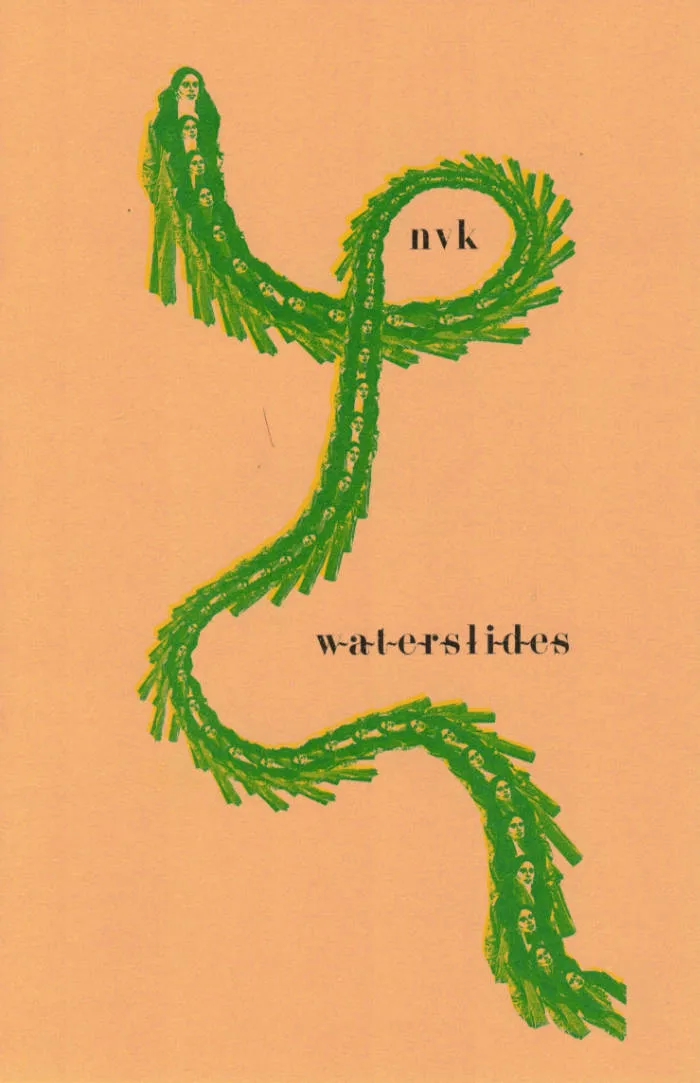
Cover of Waterslides

Risiko Press

Waterslides

nvk

€10.00

"Waterslides is a falling and plunging, short starts and stops aided by movement, until we splash, climb and plunge again. Each sliding is the same but different—with each descent new expectations and thoughts swirl, shifting focus and gaining new insights or blockages. Waterslides are brief moments of remembering, remembering as a present tense activity, one that happens as we think of it, projected on our now. The waterslide is the moment of past and present working in tandem, a movement of repeating, revisiting and remembering all at once.”

Written by nvk 2021-2023. Dedicated to Judi, MM & TNN.

A version of these poems was published as an audio work through Ignota Press’ The Mountain (2023) and included in a reading with James Loop on Montez Press Radio (2023). nvk would like to thank Jan Matthé, Stine Sampers and Michelangelo Miccolis for their patience & love.

This book was first presented at Kransen in Antwerp, May 6th 2023, with a performance by Sassy (costume by Rosa Schützendorf). Printed and bound at Risiko Press, Borgerhout. Cover image by nvk. Fonts: Adonis, Garamond Pro. Limited to 150 copies.

128x195mm, 16p., stapled, cover: green, yellow and black risoprint on 160gsm caramel paper, inside: black and blue riso on 120gsm Munken Pure paper.

Language: English

recommendations

Cover of Pleasureis Amiracle

Nightboat Books

Pleasureis Amiracle

Bianca Rae Messinger

Poetry €18.00

A book of poems written out of a depressive episode, in which a devotional approach to music and desire reestablishes communication between the poet's body and the world. 

In pleasureis amiracle, the poems invoke the lyric and refuse it, moving between time and sound—words re-connect and re-cohere, resisting separation and challenging readers to feel their way to meaning. Perception becomes a many-limbed entanglement from which the reader is never let go. Music is both divine and accessible, a sublimation of everyday movements into an erotics of sensation. 

An experiment in form as much as content, it asks what can be cured by music, what is trans about desire, and how can one allow the body to feel what the mind sees, or vice versa. 

Cover of OEI #82-83 Art in the Age of Kleptomania

OEI editör

OEI #82-83 Art in the Age of Kleptomania

Jonas J. Magnusson, Cecilia Grönberg and 1 more

Periodicals €35.00

Aeron Bergman and Alejandra Salinas, co-editors at INCA Press (along with Irena Borić), are the guest-editors of this issue of OEI: it contains essays, artworks, and archival materials by 21 artists, theorists, writers, and artist-run spaces (mostly from the Americas).

The subject of the issue is art and neoliberalism, and it encompasses essays, images and other works by Dorothée Dupuis, Max Jorge Hindered Cruz, Luciano Concheiro, Yvonne Osei, Diego Bruno, John Riepenhoff, Suhail Malik, Good Weather, The Luminary, Bikini Wax, Beta-Local and more.

Cover of I Am Abandoned

Primary Information

I Am Abandoned

Barbara T. Smith

Poetry €20.00

I Am Abandoned documents a little-known, but visionary performance by Barbara T. Smith. Taking place in 1976, it featured a conversation in real time between two psychoanalytic computer programs (known today as two of the earliest chatbots) alongside a staging of Francisco Goya’s The Naked Maja (1795–1800) and The Clothed Maja (1800–1807), in which the artist projected an image of the famous painting on top of a female model. The publication includes a full transcript of the “conversation” between the two programs; documentation and ephemera from the performance; Smith’s reflections on the night; and an afterword by scholar and artist Mashinka Firunts Hakopian.

I Am Abandoned was part of the exhibition The Many Arts and Sciences at the California Institute of Technology (Caltech) and rather than simply celebrate new technology, Smith also sought to challenge what she saw as a “built-in problem” that “computers were only a new example of the male hypnosis.” In collaboration with computer scientist Dick Rubinstein, she enlisted the computer science teams at Caltech and the Massachusetts Institute of Technology to mount a conversation between a program named DOCTOR, which was designed to be a surrogate therapist, and another named PARRY, which was trained to mimic a paranoid schizophrenic patient.

While the computer operator worked in the next room, each new page of the conversation was projected on the wall where a model dressed as The Clothed Maja reclined beneath the text, with a slide of the nude version of the same painting, The Naked Maja, projected onto her. The audience was rapt with attention for the livestreamed conversation. The performance went on for nearly two hours, before the model eventually grew furious from being ignored (abandoned) by the computer operator, stormed over, and attempted to seduce him. Shortly after, the gallery director pulled the plug on the entire event, claiming it distracted the audience for too long from the other works on view.

To revisit I Am Abandoned today is to see the artistic and truly liberatory potential that art can have when it intervenes in new technologies. Much like the original performance, in which the model grew alienated from the proceedings, what gradually emerges are the stakes these new technologies present. Against today’s backdrop of AI and a still male-dominated tech field, Smith’s early work with emerging technologies, and in this case chatbots, is prophetic and hints at the contemporary conversation around the gendered and racialized machinic biases of our current computational landscape. Though Smith, like many women of her generation, was overlooked by the landmark surveys of art and technology during the 1960s and 70s, her career incisively probed new technologies, using them to question gender dynamics, community, and self. Her projects from the Coffin books (1966–67), created with a 914 Xerox copier in her dining room, to performances like Outside Chance (1975), which created a small snow squall in Las Vegas out of 3,000 unique, computer-generated snowflakes, and the interactive Field Piece (1971), where participants’ movements altered the soundscape of a fiberglass forest, all exemplify her open-ended approach to art and tech. “Each person lit their own way,” Smith remembers, “And produced their own soundtrack.”

Barbara T. Smith is an important figure in the history of feminist and performance art in Southern California. Her work—which spans media and often involves her own body—explores themes of sexuality, traditional gender roles, physical and spiritual sustenance, technology, communication, love, and death. Smith received a BA from Pomona College in 1953, and an MFA in 1971 from the University of California, Irvine. There she met fellow artists Chris Burden and Nancy Buchanan, with whom she co-founded F-Space in Santa Ana, the experimental art space where many of her performances were staged. Smith’s work has been exhibited since the 1960s in solo exhibitions, at the Institute of Contemporary Art, Los Angeles (2024), the Getty Research Institute, Los Angeles (2023), and Pomona College Museum of Art (2005), and featured in group exhibitions, including how we are in time and space: Nancy Buchanan, Marcia Hafif, Barbara T. Smith, Armory Center for the Arts, Pasadena (2022), State of Mind: New California Art Circa 1970, Orange County Museum of Art, Santa Ana (2012); WACK! Art and the Feminist Revolution, Museum of Contemporary Art, Los Angeles (2007); and Out of Actions: Between Performance and the Object, 1949–1979, Museum of Contemporary Art, Los Angeles (1998). Smith is the recipient of the Nelbert Chouinard Award (2020), Civitella Ranieri Visual Arts Fellowship, Umbria, Italy (2014); Durfee Foundation’s Artists’ Resource for Completion (2005, 2009); Women’s Caucus for Art, Lifetime Achievement Award (1999); and several National Endowment for the Arts Grants (1973, 1974, 1979, 1985). The Getty Research Institute acquired Smith’s archive in 2014 and published her memoir, The Way to Be, in 2023. Her survey catalog, Proof: Barbara T. Smith was published by the Institute of Contemporary Art, Los Angeles in 2024.

Cover of Love Poems

Editions Lutanie

Love Poems

Rene Ricard

Poetry €20.00

Three long poems by American writer, artist and actor Rene Ricard (1946-2014), an icon of the New York underground in the 1970s, accompanied by a series of drawings by American painter Robert Hawkins.

After Rene Ricard 1979–1980 and God with Revolver, Editions Lutanie publishes a third collection of poetry by the American writer, artist, and actor Rene Ricard (1946–2014), Love Poems.

Reprising the rare, eponymous book published by Richard Hell through CUZ Editions in 1999, Love Poems features three poems by Ricard and a series of black-and-white drawings by Robert Hawkins). Haunted by death, betrayal, and guilt, Ricard's poems speak from a wounded heart. Hawkins's accompanying drawings have the simplicity of children's book illustrations, but feature menacing shadows, broken cigarettes, used condoms, and petal-less flowers.

Translated into French by Manon Lutanie and Rachel Valinsky, and presented in a bilingual edition, the poems are followed by a newly commissioned afterword by Hawkins retracing his encounter, friendship, and collaboration with Ricard.

With Love Poems, Editions Lutanie reaffirms its decade-long commitment—initiated the year of Ricard's passing—to reissue his out-of-print works for English-speaking readers, while also presenting them for the first time to a French-speaking audience.

"With three simple poems, Rene Ricard exposes us to the often strained love within class stratification, between those coming together from different worlds, whether Bowery panhandlers or street hustlers, Hollywood movie stars or the highest echelon of European aristocratic wealth. Rene Ricard writes poems that are always honest. Sometimes painfully so."
—Patrick Fox

Robert Hawkins (born 1951 in Sunnyvale, California) is an American artist who lives and works in London. A fabled figure of the 1980s and early 1990s East Village art and punk scene, his work is and has been collected by artists and writers including Jean-Michel Basquiat, Glenn O'Brien, and Jim Jarmusch. Among Hawkins' first exhibitions was Lower Manhattan Drawing Show, a group exhibition curated by Keith Haring at 77 White Street Gallery above the Mudd Club, in 1981.

Rene Ricard was an American writer, artist, and actor. He was born in 1946 and grew up in New Bedford, Massachusetts. After a troubled childhood, he fled to Boston as a teenager, where he came into contact with literary and artistic circles. At the age of eighteen, he moved to New York City and became a central figure in the city's artistic and literary scene. Ricard appeared in several films by Andy Warhol and continued to act in many independent films throughout his life. In the 1980s, he wrote two major collections of poetry, as well as important essays and articles, some of which were instrumental in launching the careers of artists such as Julian Schnabel and Jean-Michel Basquiat (about whom he wrote the famous article "The Radiant Child" in Artforum in 1981). Beginning in the 1990s, he developed a pictorial body of work and exhibited his paintings in various galleries in the UK and the US. He died in New York in 2014.

Edited by Manon Lutanie .
Translated from the English (American) by Manon Lutanie and Rachel Valinsky.
Drawings and afterword by Robert Hawkins.

Cover of Metal Works

Lenz Press

Metal Works

Sidsel Meineche Hansen

Poetry €20.00

A complete survey of the cast, forged, and fabricated metal sculptures made by Danish artist Sidsel Meineche Hansen since 2017.

The artist's practice addresses the industrial complex of virtual and robotic bodies and their relationship to labor in tech, pornography and gaming. While some sculptures were conceived as individual pieces, others were created with digital counterparts within installations that typically include CGI animation, documentary video, drawing and prints.

By presenting the metal works as stand-alone pieces, this book adheres to Meineche Hansen's concern with the material means of production, highlighting their concrete yet elusive nature. Several pieces in the publication are accompanied by poems written by artist Diego Marcon in response to the works. As an artist's project and an archival document, the publication echoes the tradition of documentary photography devoted to sculpture.

Sidsel Meineche Hansen (born 1981 in Denmark, lives and works in London) is a Danish artist. She produces exhibitions, interdisciplinary seminars and publications that foreground the body and its industrial complex, in what she refers to as a "techno-somatic variant of institutional critique". Meineche Hansen questions the body in the field of industrial representations: robotic or virtual bodies, and their relationship with the working world of industries of gaming, pornography, and new technologies. Her research-led practice has taken the form of woodcut prints, sculptures and CGI animations, often made by combining her own low-tech manual craft with outsourced, skilled digital labour.

Edited by Fredi Fischli and Niels Olsen.
Poems by Diego Marcon.