rile*books

Search books

Search books by title, author, publisher, keywords...

Cover of Villainy

Nightboat Books

Villainy

Andrea Abi-Karam

€17.00

Harnessing street protest as a poetic formation, Villainy exhibits the desires that bring queers into public space.

Andrea Abi-Karam answers the call to action for poetry itself to become the radical accomplice it was destined to be in their second book, Villainy. In order to live through the grief of the Ghostship Fire & the Muslim Ban, Villainy foments political action in public spaces, and indexes the various emotional states, such as rage, revelry, fear, grief, and desire to which queers must tend during protest. In scenes loaded with glitter, broken glass, and cum, Abi-Karam insists that in order to shatter the rising influence of new fascism we must embrace the collective work of antifascists, street medics, and queer exhibitionists and that the safety that we risk is reckless and necessary. Disruptive and demanding, these punk poems embody direct action and invite the audience into the desire-filled slippage between public sex and demonstration. At heart, Villainy aims to destroy all levels of hierarchy to establish a participatory, temporary autonomous zone in which the targeted other can thrive. 

Published September 2021

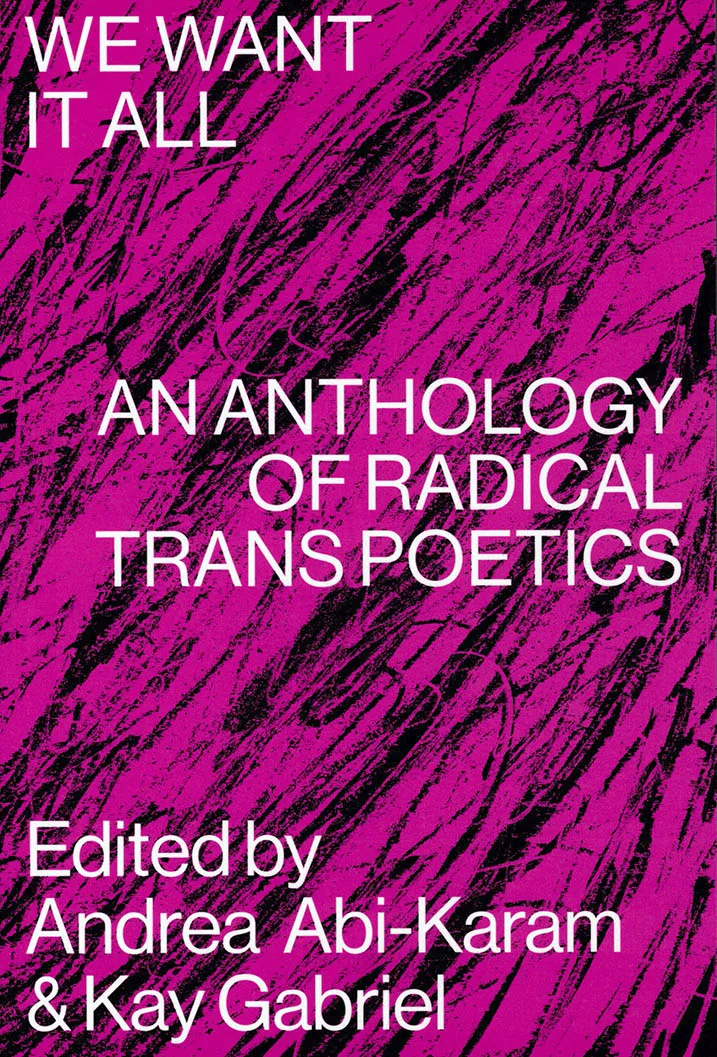
Andrea Abi-Karam is an arab-american genderqueer punk poet-performer cyborg, writing on the art of killing bros, the intricacies of cyborg bodies, trauma and delayed healing. Selected by Bhanu Khapil, Andrea's debut EXTRATRANSMISSION (Kelsey Street Press, 2019), is a poetic critique of the U.S. military's role in the War on Terror. Simone White selected their second assemblage, Villainy for publication in Fall 2021 at Nightboat Books. With Kay Gabriel, they co-edited We Want It All: An Anthology of Radical Trans Poetics released by Nightboat Books in November 2020. They are a Leo currently obsessed with queer terror and convertibles.

Published in 2021 ┊ 112 pages ┊ Language: English

recommendations

Cover of Memories That Smell Like Gasoline

Nightboat Books

Memories That Smell Like Gasoline

David Wojnarowicz

Biography €23.00

David Wojnarowicz, one of the most provocative artists of his generation, explores memory, violence, and the erotism of public space—all under the specter of AIDS.

Here are David Wojnarowicz’s most intimate stories and sketches, from the full spectrum of his life as an artist and AIDS activist. Four sections—”Into the Drift and Sway,” “Doing Time in a Disposable Body,” “Spiral,” and “Memories that Smell like Gasoline”—are made of images and indictments of a precocious adolescence, and his later adventures in the streets of New York. Combining text and image, tenderness and rage, Wojnarowicz’s Memories That Smell Like Gasoline is a disavowal of the world that wanted him dead, and a radical insistence on life.

The new and revised edition features a foreword by Ocean Vuong and a note from the editor, Amy Scholder.

Cover of Dreaming in the Fault Zone: A Poetics of Healing

Nightboat Books

Dreaming in the Fault Zone: A Poetics of Healing

Eleni Stecopoulos

Essays €28.00

A virtuosic inquiry into the forms and uses of healing, from ancient and modern medicine to contemporary literature, ecology, and protest.

In the era of the “chronic acute” long predating COVID-19, Eleni Stecopoulos set out to investigate the imagination, aesthetics, and ideology of healing—its mysteries and mystifications, its many channels and codes. Fusing lyric inquiry with cultural criticism, Dreaming in the Fault Zone explores art’s treatment of our conditions at a time of both increased cynicism about healing and longing for it. Stecopoulos talks to physicians, poets, psychotherapists, disability activists, ethnographers, spiritual seekers; curates performances and takes part in community rituals; documents pilgrimages and visits therapeutic landscapes. Whether writing about the poet H.D.’s psychoanalysis with Freud or madness and apartheid in Bessie Head’s novel A Question of Power, the salve of demagogues or a global alliance of people with contested illnesses, Stecopoulos confronts the poetics and politics of affliction, empathy, memory, and survival. Weaving together esoteric scenes and everyday practice, with flashes of humor, these essays travel in a space of impasse and unending experiment.

Cover of Fuel

Nightboat Books

Fuel

Rosie Stockton

Poetry €18.00

Traversing multivalent intimacies from the underworld of California’s Central Valley oil fields to the quotidian domestic and love’s painful retraction, Stockton’s poems articulate the blurry modes of extraction, fantasy, loss, gender, and labor as they interact and overlap in the shadow of environmental and personal collapse. Between gas station gifts, Venmo requests, and nocturnal love letters, Fuel unravels the self and violent systems of domination, longing for a togetherness that transcends its own ending.

In these poems, Stockton plunges into petrologic, long drives, the beginnings of ends—whatever enters into love between people and makes it so abstract, or common. In other words, its great subject is the edge, and Fuel is a book of horizons. - Benjamin Krusling

Rosie Stockton is the author of Permanent Volta (Nightboat Books 2021) which was the recipient of the Sawtooth Prize as well as being a finalist for the California Book Awards in Poetry and the Publishing Triangle’s Audre Lorde Award for Lesbian Poetry. Their poems have been published by Social Text Journal, VOLT, Jubilat, Apogee, Mask Magazine, Tripwire and WONDER PRESS. They hold an M.A. in Creative Writing from Eastern Michigan University and are currently a Ph.D. Candidate in the Gender Studies Department at UCLA. Rosie lives and works in Los Angeles.

Cover of Apparitions: (Nines)

Nightboat Books

Apparitions: (Nines)

Nat Raha

Poetry €18.00

Injecting the disruptive potential of collective action into the body of the poem, Nat Raha's invigorating experiment resuscitates Anglophone poetry.

Amidst the violence of capitalism and state and imperial power, there is Nat Raha's apparitions (nines) in its "charred golden minidress," ushering us into a space of grief and resistance, the embodiment and intimacy of queer, trans, and diasporic Black and brown people. Written as a series of "niners," a poetic form consisting of nine nine-syllable lines, apparitions (nines) is at once a brash and subversive rejoinder to the Anglophone sonnet, as well as an ode to beauty, collectivity, and tenderness which emerges from—and far surpasses—constraint.

"These poems are eccentric in the most literal sense, Raha’s writing pushing at the edges of the mainstream of poetry, presenting a punk, transfeminist revision of poetic norms. . . apparitions (nines) deserves to be read—for its insights and newness, and the studs of pleasure it doles out." - Lou Selfridge, Frieze

“Welcome the poems that split us open, ‘frequencies/ to be removed from the air.’ Nat Raha has sharpened the lines, their serrated letters leaving us marked, poems to touch again on the skin, feel our doom undo its direction for enduring solidarity; the best love.” - CAConrad

Dr Nat Raha is a poet and activist-scholar whose previous books of poetry include of sirens, body & faultlines (2018), countersonnets (2013), and Octet (2010). Her work has appeared in 100 Queer Poems (2022), We Want It All: An Anthology of Radical Trans Poetics (Nightboat, 2020), Liberating the Canon: An Anthology of Innovative Literature (2018), on Poem-a-Day, and in South Atlantic Quarterly, TSQ: Transgender Studies Quarterly, Transgender Marxism,and Wasafiri Magazin. With Mijke Van der Drift, she co-edits the Radical Transfeminism zine and has co-authored articles for Social Text, The New Feminist Literary Studies, and the book Trans Femme Futures: Abolitionist Ethics for Transfeminist Worlds. Nat completed her PhD in queer Marxism at the University of Sussex, and is Lecturer in Fine Art Critical Studies at the Glasgow School of Art.

Cover of The Faggots and Their Friends Between Revolutions

Nightboat Books

The Faggots and Their Friends Between Revolutions

Larry Mitchell

Poetry €17.00

The Faggots and Their Friends Between Revolutions is a beloved queer utopian text written by Larry Mitchell with lush illustrations by Ned Asta, published by Calamus Press in 1977. Part-fable, part-manifesto, the book takes place in Ramrod, an empire in decline, and introduces us to the communities of the faggots, the women, the queens, the queer men, and the women who love women who are surviving the ways and world of men.

This new edition will feature essays from performance artist Morgan Bassichis, who adapted the book to music with TM Davy in 2017 for a performance at the New Museum, and activist filmmaker Tourmaline.

Cover of A Queen in Bucks County

Nightboat Books

A Queen in Bucks County

Kay Gabriel

Poetry €18.00

An epistolary sequence about sex, exchange and social space set along the Northeast Corridor. 

In A Queen in Bucks County, our protagonist Turner, who both is and is not the writer, makes his pleasurable way through miserable space. Men "buy him things," lovers drive across state lines, users down volatile cocktails to see what happens, landlords turn tenants out, and Turner writes poetic tracts to friends about it. Part pornography, part novel, all love letter, A Queen in Bucks County is an experiment in turning language upside down to see what falls out.

2023 LAMBDA LITERARY AWARD FINALIST

Cover of Not a Force of Nature

Futurepoem

Not a Force of Nature

Amy De'Ath

Poetry €21.00

If capital makes life a seething, complex nightmare for most people on the planet's surface, if "words do cleave the producer from the land," then what does all this dispossession feel like? Amy De'Ath turns poetry into a hot, potent, and highly funny form of criticism, in which social force is felt intimately, and voiced in the acid niceness of a work email. Amy's poems move like pieces of machinery in a cognitive amusement park, which spit you a thousand feet into the air but keep your viewpoint fixed on the same spot as before—what's different? "Land in Saskatchewan, land in Delhi," or "everything…that you want from women and gays." Not a Force of Nature makes me want to change everything. "Behold me I'm you now," Amy writes—we should be so lucky, to be thus transformed. — Kay Gabriel

Not a Force of Nature's expertly crafted poems explore the catastrophe we live among and speak through. They form a sort of feminist manifesto addressed to all forms of resistance. But also: here are love sonnets! This book is angrily precise and always a lot of fun. "No, you're a Canadianist!" — Kevin Davies

Not a Force of Nature is the kind of book that becomes possible only after rejecting the "we" evoked so often in contemporary literary culture—sometimes said to need poetry now more than ever, sometimes called community. Amy De'Ath's motley vision of solidarity, of "actual emboldened people," is way weirder, more lively, and possible. Nor do these poems content themselves, like the ghost of Marxist theory past, with pointing towards the contradictions that surround them. Do you remember email? Sonnets? Not a Force of Nature is like that, thrashing inside generic forms and always coming next: after the tendency of the rate of profit to fall, after Jane's abortion service, after the 1970s, 80s, and 90s, after Creeley, after Raworth, after Mayer, after the Xenofeminist Manifesto, after Pluto enters Aquarius. "There are still tactics like this roaming free," De'Ath writes. There are still these fervent lyric parries. Be with Not a Force of Nature now. — Stephanie Young

Through slips of verbal acuity, Amy De'Ath scrapes her way out of determinism to a world "made by hands," where our material relations are ours to make and break. History is long and history is short. History is translucent. De'Ath presents the Ferris wheel of capitalist production, where the subject lives once as worker, twice as commodity. Here, in these "concrete trousers," is a "totally liberated" working class poem turning everything into nothing as praxis. — Anahita Jamali Rad

Cover of Or, on Being the Other Woman

Duke University Press

Or, on Being the Other Woman

Simone White

Poetry €18.00

Throughout this book-length poem, Simone White considers the dynamics of contemporary black feminist life, attesting to the narrative complexities of writing and living as a black woman and artist.

In Or, on being the other woman, Simone White considers the dynamics of contemporary black feminist life. Throughout this book-length poem, White writes through a hybrid of poetry, essay, personal narrative, and critical theory, attesting to the narrative complexities of writing and living as a black woman and artist. She considers black social life—from art and motherhood to trap music and love—as unspeakably troubling and reflects on the degree to which it strands and punishes black women. She also explores what constitutes sexual freedom and the rewards and dangers that come with it. White meditates on trap music and the ways artists such as Future and Meek Mill and the sonic waves of the drum machine convey desire and the black experience. Charting the pressures of ordinary black womanhood, White pushes the limits of language, showing how those limits can be the basis for new modes of expression.