rile*books

Search books

Search books by title, author, publisher, keywords...

Cover of three six five: prompts, act, divinations

Siglio Press

three six five: prompts, act, divinations

Lucy Ives

€36.00

There are 365 exercises for writing in this book, but it is not simply a book of writing exercises.

three six five is a “how-to” book of questions—not answers. It is an ars poetica of expanding possibility, a tarot deck of acts instead of images, a book of bending hours, a diary of contemplation and imagination, an antidote to consumption in the shape of care and attention.

These prompts, acts, and divinations—in alchemical combinations with new drawings by Nick Mauss—invite both aspiring and experienced writers to learn and unlearn, to mine memory and forgetting, to enter impossible spaces and create new ways of telling time, to inhabit multiple, other, and conflicting perspectives, to discover the elasticity of language and its constraints, to write by drawing, walking, listening, and even by being distracted.

While this is an inexhaustible compendium for writing, it is also an enduring reservoir for those who have no desire to be(come) a writer. Many exercises take the form of play, encourage collaboration with friends, strangers, and non-human beings, and operate off the page, often in the world, in the spirit of discovery rather than result. All intend to nurture and cultivate possibility.

Published in 2026 ┊ 416 pages ┊ Hardcover ┊ Language: English

recommendations

Cover of Cancelled Confessions (or Disavowals)

Siglio Press

Cancelled Confessions (or Disavowals)

Claude Cahun

First published in 1930 by anti-fascist, avant-garde publisher Éditions du Carrefour in Paris as Aveux non Avenus, Cancelled Confessions (or Disavowals) is Claude Cahun’s wildly radical answer to an invitation to write a memoir. Shattering the very premise of the “memoir”—the singularity of identity—into sharp and prismatic fragments, Cahun assembles an ever-mutating inquiry into the instability of “self” and its many masks.

Masculine? Feminine? It depends on the situation. Neuter is the only gender that always suits me.

Using a multitude of forms (fables, jokes, aphorisms, letters, dialogues, dreams, hymns, pronouncements, etc.), to plumb the subjects of desire, love, gender, sex, fear, faith, religion, and vanity (among others), Cancelled Confessions (or Disavowals) is a tour-de-force work of resistance: it provokes the reader to enter the capacious, provocative, playful, and deeply imaginative space constructed by Cahun in defiance of all categorization, to repudiate a delimited, censured world and embrace, instead, the outcasts and cast-offs, the unknowable and the unknown.

I believe, but in the conditional: I would like to believe.

Thoughtfully redesigned to emulate the original artist’s book, this revised edition of the out-of-print English translation by Susan de Muth—originally published in the UK by the Tate in 2007 and in the U.S. by MIT Press in 2008—includes novelist and critic Pierre Mac Orlan’s original 1930 preface along with contemporary essays by scholar Amelia Groom and translator de Muth. Almost 100-years-old, it is not only prescient, but urgent, in.

It’s not enough to be vanquished, you also have to know how to turn defeat to your advantage.

Translated by Susan de Muth, preface by Pierre Mac Orlan, essay by Amelia Groom.

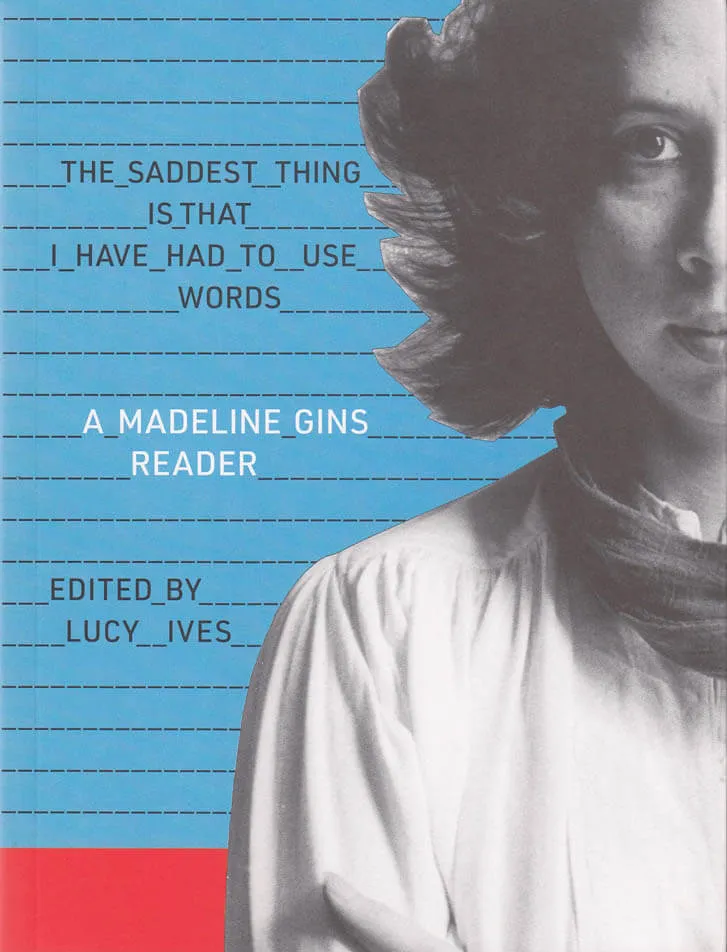
Cover of The Saddest Thing Is That I Have Had to Use Words: A Madeline Gins Reader

Siglio Press

The Saddest Thing Is That I Have Had to Use Words: A Madeline Gins Reader

Madeline Gins

Poetry €28.00

Poet, philosopher, speculative architect and transdisciplinary artist, Madeline Gins is well known for her collaborations with her husband, the artist Arakawa, on the experimental architectural project Reversible Destiny, in which they sought to arrest mortality by transforming the built environment. Yet, her own writings — in the form of poetry, essays, experimental prose and philosophical inquiries — represent her most visionary and transformative work. Like Gertrude Stein before her, Gins transfigures grammar and liberates words. Like her contemporaries in conceptual art, her writing is attuned to the energized, collaborative space between reader and page.

The Saddest Thing Is That I Have Had to Use Words: A Madeline Gins Reader is a revelatory anthology, edited and with an introduction by the writer and critic Lucy Ives. It brings never-before-published poems and essays together with a complete facsimile reproduction of Gins' 1969 masterpiece, WORD RAIN (or A Discursive Introduction to the Intimate Philosophical Investigations of G, R, E, T, A, G, A, R, B, O, It Says), along with substantial excerpts from her two later books What the President Will Say and Do!! (1984) and Helen Keller or Arakawa (1994). Long out of print or unpublished, Gins' poems and prose form a powerful corpus of experimental literature, one which is sure to upend existing narratives of American poetics at the close of the 20th century.

Edited by Lucy Ives. 

Cover of Glaring

Wendy's Subway

Glaring

Benjamin Krusling

Poetry €18.00

Glaring: a sustained look of anger, an obvious fact, a situation of such brightness and intensity that vision is obscured. In his debut book of poems, Benjamin Krusling is concerned with reading domination and violence and entering their psychotic motion, the better to do otherwise. Through the thicket of anti-blackness, militarism, surveillance, impoverishment, and interpersonal abuse and violence, Glaring investigates the things that haunt daily life and make love difficult, possible, necessary.

Benjamin Krusling's Glaring is the winner of our 2019 Open Reading Period, and was selected by guest judge Lucy Ives.

Cover of Spells: 21st Century Occult Poetry

Silver Press

Spells: 21st Century Occult Poetry

Sarah Shin, Rebecca Tamas

Poetry €17.00

Spells are poems; poetry is spelling.

Spell-poems take us into a realm where words can influence the universe.

Spells brings together over forty contemporary voices exploring the territory where justice, selfhood and the imagination meet the transformative power of the occult. These poems unmake the world around them, so that it might be remade anew.

Kaveh Akbar, Rachael Allen, Nuar Alsadir, Khairani Barokka, Emily Berry, A.K. Blakemore, Jen Calleja, Anthony V. Capildeo, Elinor Cleghorn, CAConrad, Nia Davies, Paige Emery, Livia Franchini, Alexis Pauline Gumbs, Will Harris, Caspar Heinemann, Lucy Ives, Rebecca May Johnson, Bhanu Kapil, Amy Key, Daisy Lafarge, Dorothea Lasky, Francesca Lisette, Canisia Lubrin, Karen McCarthy Woolf, Lucy Mercer, Hoa Nguyen, Precious Okoyomon, Rebecca Perry, Nat Raha, Nisha Ramayya, Ariana Reines, Sophie Robinson, Erica Scourti, Sarah Shin, Himali Singh Soin, Tai Shani, Rebecca Tamás, Bones Tan Jones, Dolly Turing, Jane Yeh, Flora Yin Wong

Introduced by So Mayer
Afterword by Sarah Shin

Cover of Sick issue 6

Self-Published

Sick issue 6

Olivia Spring

Poetry €16.00

Writing on the fragmentation of chronic illness, why ‘full access’ isn’t something arts venues should aim for, the complexities of receiving gender-affirming care while living with chronic illness, the realities of constantly having to ration your energy, an interview with musical artist Dead Gowns, abortion access and bodily autonomy, poetry, artwork, book recommendations, and much more.

Essays, features, poetry, art, interviews & more from Vida Adamczewski, A/Bel Andrade, Amy Berkowitz, Khairani Barokka, Jax Bulstrode, Sarah Courville, Jen Deerinwater , Amy Dickinson, Mizy Judah Clifton, Alton Melvar M Dapanas, Dead Gowns, Sergey Isakov, Theo LeGro, Elias Lowe, Cathleen Luo, Jameisha Prescod, Olivia Spring, Leigh Sugar, Oriele Steiner, Emerson Whitney, Chantal Wnuk, Caroline Wolff, and Emma Yearwood

SICK is an independent, thoughtful magazine exploring illness and disability, founded & edited by Olivia Spring and designed by Kaiya Waerea. Founded in Norwich, UK in 2019, we are currently based in Maine, USA and London, UK. We typically publish one issue per year.

Cover of Unable To Achieve Broad Recognition In My Lifetime, I Laboured In Obscurity Until My Death Last Year

Ma Bibliotheque

Unable To Achieve Broad Recognition In My Lifetime, I Laboured In Obscurity Until My Death Last Year

Sharon Kivland

For nearly two years the author collected phrases from the exhibition press releases she received through email, posting certain of them on Facebook in a rather unsystematic way (that is to say, when she felt like it), with only one change, that of the personal pronoun, so each statement appeared vainglorious, absurd, even tragic. She supposes the measure was if they made her laugh or gasp or used words she deplores when thinking or writing about art. The posts gathered quite a following. Some people still mention them to her, and others have asked her to look at their own press releases before circulation.

These extracts have provoked laughter, disbelief (especially when performed as public readings, when she has  been obliged to swear to their veracity), self-recognition, and yes, shame.

She had only three rules: 1) She would not quote the press release of anyone she knows (certainly she could have done—she must admit that both a friend and someone she dislikes intensely have slipped in, and she fervently hopes neither ever reads this book); 2) She would not alter anything except the pronoun (this is largely true; however, for this book, she corrected some errors of punctuation and spelling, changed spellings to their English form, and employed her beloved Oxford comma); and 3) She would not use anything the artist had written (this, too, is true, save for one exception that was too wonderful not to include).

Finally, she  gathered a collection of endorsements, some along the way, others when she indicated this work was done. She is still alive and she continues to labour in obscurity. 

Cover of The Book of Na

Wendy's Subway

The Book of Na

Na Mira

Fiction €28.00

In The Book of Na, translation acts at the edge of perception. Tracing across projects in film, video, and performance, Na Mira reflects on the violent fragmentation of bodies while refusing the containment of geographic and corporeal borders. In 1977, a name is cut at an immigration office. This gap turns into an intergenerational score for becoming heat, hexagram, hologram. Using oracular and glitching technologies, Mira witnesses what escapes data: doppelgängers, dreams, endangered tigers, tesseracts, A. Turiyasangitananda Coltrane's stairs, Theresa Hak Kyung Cha in a theater, Korean shamanism, frozen ligaments, wildfires, borderlands, subatomic particles, and pink. Syncing to a clock with neither face nor hands, Mira’s hauntological permutations in time, death, and relation travel outside the symbolic order and draw energy from the void.

Na Mira’s autobody rites have been presented at sites including Seoul Museum of Art; Museum of Contemporary Art, Los Angeles; Portland Institute of Contemporary Art; Participant Inc., New York; and Whitney Museum of American Art, New York. She earned an MFA from the University of California, Los Angeles. She grew up between the US and East Asia and teaches outside.

Cover of Cockfight

Feminist Press

Cockfight

María Fernanda Ampuero

Fiction €16.00

Thirteen stories explore domestic horrors and everyday violence, providing an intimate and unflinching portrait of twenty-first-century Latin America.

Named one of the ten best fiction books of 2018 by the New York Times en Español, Cockfight is the debut work by Ecuadorian writer and journalist María Fernanda Ampuero.

In lucid and compelling prose, Ampuero sheds light on the hidden aspects of the home: the grotesque realities of family, coming of age, religion, and class struggle. A family’s maids witness a horrible cycle of abuse, a girl is auctioned off by a gang of criminals, and two sisters find themselves at the mercy of their spiteful brother. With violence masquerading as love, characters spend their lives trapped reenacting their past traumas.