rile*books

Search books

Search books by title, author, publisher, keywords...

Cover of This Household of Earthly Nature: An Essay: A Year, a Life, a Country, a Global Network

Roof Books

This Household of Earthly Nature: An Essay: A Year, a Life, a Country, a Global Network

Cody-Rose Clevidence

€20.00

In This Household of Earthly Nature poet and poetic essayist Cody-Rose Clevidence delves into the far reaches of our planet, from homestead to information theory, from ancient history to global economics to possible futures, connecting all things; Walmart, shipping lanes, what it means to have family, friends and memories, to labor, love, to ways of knowing, and all of us together inside these vast and shifting networks. Rooted firmly in the Anthropocene, in the fragmented and information-dense internet-connected world and also in their own rural daily life, this essay-poem charts a mind grappling with what it means to be alive now, in this particular time in our planet's and our species' evolution, from the domestication of the first grain to whatever is inevitably coming next.

Published in 2025 ┊ 174 pages ┊ Language: English

recommendations

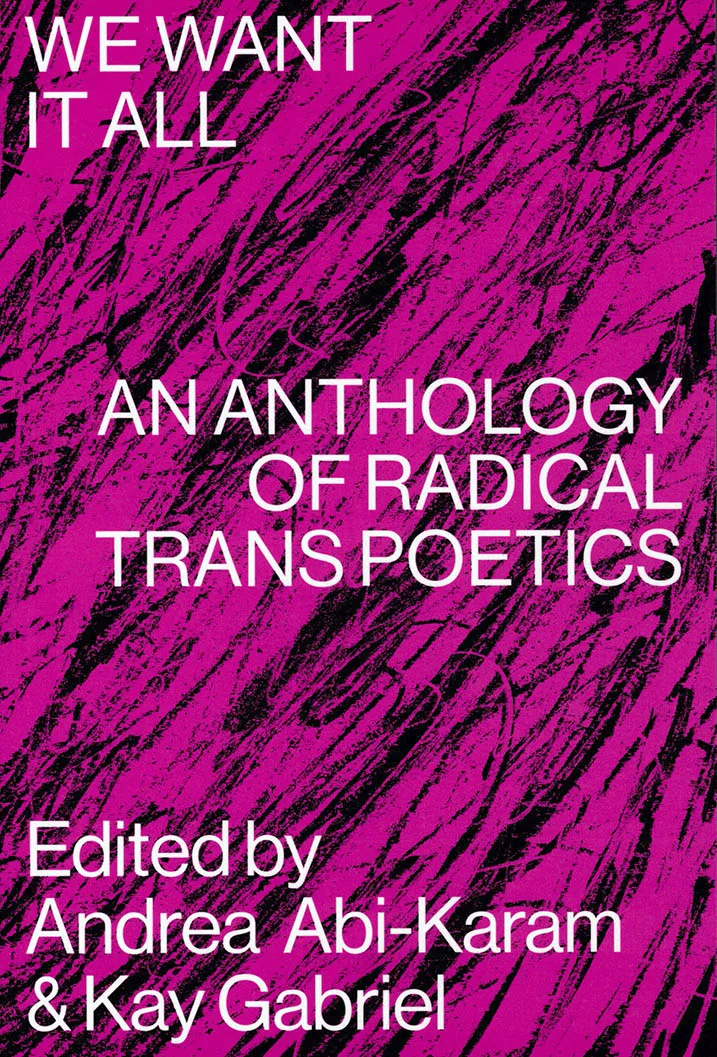
Cover of We Want It All: An Anthology of Radical Transpoetics

Nightboat Books

We Want It All: An Anthology of Radical Transpoetics

Kay Gabriel, Andrea Abi-Karam

Poetry €23.00

An anthology of formally inventive writing by trans poets against capital and empire.

With texts by: Andrea Abi-Karam, New York City Sam Ace, South Hadley, MA Bahaar Ahsan, Berkeley, CA jasper avery, Philadelphia, PA Ari Banias, Berkeley, CA Jo Barchi, Chicago, IL Joss Barton, St. Louis, MO Levi Bentley, Philadelphia, PA Jessica Bet, Baltimore, MA Rocket Caleshu, Los Angeles, CA Ching-in Chen, Seattle, WA listen chen, Vancouver, BC Faye Chevalier, Philadelphia, PA Cody-Rose Clevidence, Arkansas Miles Collins-Sibley, Easthampton, MA Valentine Conaty, New York City CA Conrad, Philadelphia, PA Jimmy Cooper, Rochester, MI Maxe Crandall, Oakland, CA José Díaz, Boston, MA Aaron El Sabrout, New Mexico Ian Khara Ellasante, Lewiston, ME Caelan Ernest, New York City, NY NM Esc, San Diego, CA joshua jennifer espinoza, Los Angeles, CA Logan February, Ibadan, Nigeria Ray Filar, Brighton, UK Nora Collen Fulton, Montreal, Canada Kay Gabriel, New York City Callie Gardner, Cardiff, Wales Jesi Gaston, Chicago, IL Harry Josephine Giles, Edinburgh, Scotland Aeon Ginsberg, Baltimore, MD Caspar Heinemann, Berlin, Germany Kamden Hilliard, Greenville, SC Stephen Ira, New York City Cyrée Jarelle Johnson, New York City Peach Kander, New York City Jayson Keery, Western, MA Evan Kleekamp, Los Angeles, CA Noah LeBien, New York City Ty Little, Richmond, VA Zavé Martohardjono, New York City Amy Marvin, Philadelphia, PA Natalie Mesnard, New York City Bianca Rae Messinger, Iowa City, IA Liam O'Brien, New York City Xandria Phillips, Madison, WI Rowan Powell, Santa Cruz, CA Nat Raha, Edinburgh, Scotland Holly Raymond, Philadelphia, PA Jackie S, New York City Trish Salah, Toronto, Canada Raquel Salas Rivera, Philadelphia, PA Mai Schwartz, New York City Kashif Sharma-Patel, London, UK Julian Talamantez Brolaski, Oakland, CA Charles Theonia, New York City Jamie Townsend, Oakland, CA Nora Treatbaby Laurel Uziell, London, UK Rachel Franklin Wood, Boulder, CO Clara Zornado Akasha-Mitra xtian w. and Anaïs Duplan, NYC.

Kay Gabriel is a poet and essayist. She's the author of Elegy Department Spring / Candy Sonnets 1 (BOAAT Press, 2017), the recipient of fellowships from Lambda Literary and the Poetry Project, and recently completed her PhD at Princeton University.

Andrea Abi-Karam is an arab-american genderqueer punk poet-performer cyborg, writing on the art of killing bros, the intricacies of cyborg bodies, trauma & delayed healing. Their chapbook, THE AFTERMATH (Commune Editions), attempts to queer Fanon's vision of how poetry fails to inspire revolution. Andrea's first book, EXTRATRANSMISSION (Kelsey Street Press, 2019), is a poetic critique of the U.S. military's role in the War on Terror.

Cover of The Grimace of Eden, Now

Fonograf Editions

The Grimace of Eden, Now

Cody-Rose Clevidence

Poetry €19.00

The playful, inventive, and lyrically quick poems comprising The Grimace of Eden, Now orbit the strange space halfway between Tennyson and the Metaverse, veering between the natural world and a sci-fi universe, between inner feelings and outward observations, with questions of divinity alongside domestic life, spiders, dishes, and spaceships. The roving eye of these poems wanders through spacetime carrying irreverent theologies and exploring what it could mean to be living, sensate, and awake in this weird moment in time, exposing a mixture half of awe and half of madness. 

Cody-Rose Clevidence is the author of Aux Arc / Trypt Ich (Nightboat Books, 2021), Listen My Friend, This is the Dream I Dreamed Last Night (The Song Cave, 2021), Flung/Throne (Ahsahta, 2018), and BEAST FEAST (Ahsahta Press, 2014), as well as several chapbooks (Fonograf Editions, flowers and cream, NION, garden door press, Auric). Occasionally a visiting poetry professor at the Iowa Writers Workshop, they live in the Arkansas Ozarks alongside three loyal, sentient pets, and the continuous void.

Cover of Barking Up the Wrong Tree

How To Become

Barking Up the Wrong Tree

Sophie T. Lvoff

Poetry €6.00

How To Become est une maison d'édition autogérée basée à Paris. Nous publions les textes d'auteuces engagés dans des pratiques féministes et peu diffusés par le réseau des grandes maisons d'édition françaises.

Créée en 2016, elle est composée d'artistes et écrivaires en majorité gouines, HTB publie de la litterature expérimentale née d'influences post-post- sapphiques ainsi qu'un choix de tradu d'auteuices non traduites en langue française. HTB s'articule autour d'ateliers d'écriture: How to Become a Lesbian, et d'une revue annuelle publiant les choses issues de l'atelier.

Cover of T (poem)

Materials

T (poem)

Laurel Uziell

Poetry €13.00

T is a long poem in multiple parts and its author's second book. “The two genders are YES and NO, so you stutter or else shut up forever”. 

From the Afterword: "Between 2017-2018 I was involved in a trial with a group of TERFs after a scuffle emerged during a counter protest against a ‘debate’ about sex-based rights in light of proposed reforms to the Gender Recognition Act which would have made trans people’s lives marginally easier. Luckily I wasn’t actually in the dock, but I appeared to give evidence, and for everyone involved it was a humiliating ordeal as we were doxxed, harrassed online and in real life, while the relentless media campaign which ensued took a toll on the entire trans community. The caricaturesque reduction of a complex interrelation of political positions, epistemologies, traumas and personal grievances into two ‘sides’ ultimately worked to further the persecution of trans people, but nevertheless highlighted a social logic on whose terms the so called debate was forced to appear: sex was pitted against gender (or more revealingly ‘gender identity’), objective biology against subjective ‘self-identification’, nature against culture, or perhaps, first nature against second nature."

What does a poet say (what does anyone say), when placed on the stand, how answer the binary logics forced like a cage in the legally-grounded violence which splittingly interrogates solidarity, the splitting invocation of law? In answer, T spreads across the page as if desperately finding a form for speech acts forced into a garrotted tick-box, a witness stand, video evidence, Nature’s originary disguise as history or vice versa, wrapped inside ‘common sense’ as a pronominal shroud, in the policing of body, speech, and every fungible fibre of being. The author writes: “I want the whole text to be a kind of horrific inorganic body with awkward parts, both to replay at the level of form some of the critiques of organicist thinking with reference to nature that the poem tries to articulate, and also, more glibly, to be somewhat like a trans body, awkwardly fitting together with some parts undercutting others”. An extended enquiry into Materialism and its material (fleshed) stakes, driven through the heart and to the heart of things, T sees lyric poem shudder to line-broken essay to fragment of play to citational drop; in tight compression sprawling, a poem whose argument is necessary and necessarily incomplete, poetry can do thinking, this thinking we do outside and within it, sprung trap, open and closing door. 

Cover of Piero Heliczer. Poems & Documents / Poèmes & Documents

After 8 Books

Piero Heliczer. Poems & Documents / Poèmes & Documents

Sophie Vinet, Benjamin Thorel and 1 more

Poetry €25.00

Poet, editor, filmmaker, actor, child star in Mussolini’s Italy, founder of The Dead Language Press and of the Paris Filmmakers Cooperative, Piero Heliczer (1937–1993) was an essential yet secret agent of the 1960s and ’70s counterculture. In the course of his nomadic existence in Rome, New York, London, Amsterdam, Paris, and Préaux-du-Perche, where he spent the last few years of his life, he met and worked with a constellation of avant-garde writers, forged friendships with figures from the Beat Generation and the British Poetry Revival as well as the New York art scene. At the crossroads of many underground experiences, Heliczer’s name appears in books dedicated to the artists and poets he collaborated with during his lifetime—names by the likes of Gregory Corso, Barbara Rubin, Andy Warhol, Jack Smith, Ira Cohen, or The Velvet Underground, a band he participated in creating with his friend Angus MacLise.

This myth obscures the fact that Piero Heliczer was first and foremost a poet. Today, this part of his work is overlooked; it is all the more difficult to encounter because Heliczer himself never collected it. So it was scattered, or lost, in the course of his wanderings. Heliczer favored the circulation of his works rather than their archiving: he was committed to the production of mobile forms—flyers, broadsides, and other ephemera—disseminated his verses in magazines, and preferred public readings and performances to the finished form of the book.

The present volume gathers a significant number of Heliczer’s poetic works through facsimile reproduction of his contributions to more than thirty periodicals—mostly stemming from poets’ presses or universities—published between 1958 and 1979. This collection isn’t “complete”—but it makes available again poems that, in some cases, never circulated after their initial publication. 

Un recueil de poèmes de Piero Heliczer (1937–1993), auteur, éditeur et cinéaste, figure de l’underground et de la contre-culture, proche de Andy Warhol, Gerard Malanga, et Jack Smith. Sa poésie, héritière de la Beat Generation, restitue en métaphores et images saisissantes des expériences et des visions personnelles, tout en s’appuyant sur des formes héritées de la tradition anglaise et des partis-pris typographiques originaux. Ce recueil rassemble des facsimilés des publications originales de poèmes de Heliczer – périodiques d’artistes, revues miméographiées, petits magazines… – accompagnées de leurs traductions en français, ainsi que de plusieurs documents, parmi lesquels une reproduction intégrale d’une publication rare de 1961, Wednesday Paper, et, en insert, un facsimilé d’un placard de 1975, The Handsome Policeman.

Traduction des poèmes: Rachel Valinsky
Publié avec l’aide du CNAP

Cover of Love Is Colder Than the Lake

Nightboat Books

Love Is Colder Than the Lake

Liliane Giraudon

Poetry €18.00

Searing in its energies and mysterious in its icy depths, Love is Colder than the Lake is a tour-de-force of the experimental French poet Liliane Giraudon's power and range. 

Love is Colder than the Lake weaves together stories dreamed and experienced, fragments of autobiographical trauma, and scraps of political and sexual violence to create an alchemical and incantatory texture that is all Giraudon's own. In its feminist attention and allusive stylistic registers, Love is Colder than The Lake claims a unique position among contemporary French literature. The heroes (or anti-heroes) in this collection include Rainer Werner Fassbinder, Lorine Niedecker, Emma Goldman, Chantal Akerman, the Marquis de Sade, and the unnamed lake itself. Giraudon's writing, editing, and visual work have been influential in France for decades, and English-speaking readers will thrill to this challenging, important voice.

Liliane Giraudon was born in Marseille in 1946. She continues to live and work in Marseille, and her writing is inseparable from the place, shaped by the vibrant community of poets and writers and artists Giraudon has herself shaped, as well as by the city's gritty and diverse cosmopolitanism. Giraudon's many books have, since 1982, been primarily published by France's P.O.L. editions. Giraudon has also been instrumental as an editor for influential reviews such as Banana Split, Action Poétique, and If. She performs and collaborates widely, including with Nanni Balastrini, Henri Delui, Jean-Jacques Viton, and many others. Two of her books ( Fur and Pallaksh, Pallaksh) were published in English by Sun & Moon Press in 1992 and 1994, respectively. She lives in Marseille, France.

Lindsay Turner is the author of the poetry collections Songs & Ballads (Prelude Books, 2018) and The Upstate (University of Chicago Press, 2023). She has twice received French Voices awards for her translations from the French, which include books of poetry and philosophy by Stéphane Bouquet, Souleymane Bachir Diagne, Anne Duforumantelle, Ryoko Sekiguchi, and others. She is Assistant Professor of English and Creative Writing at Case Western Reserve University in Cleveland, Ohio.

Sarah Riggs is a poet and multivalent artist. Her most recent book The Nerve Epistle appeared in 2021. Translation is one of her arts, for which she received a Griffin prize with Etel Adnan, and Best Translated Book Award, also for Adnan's Time (Nightboat, 2019). Riggs lives in Brooklyn, after many years in Paris. Author residence: Marseille, France.

Cover of The Consequences

ness books

The Consequences

Max Brett

Poetry €13.00

The Consequences is a hybrid collection of prose and poetry; an autofictional examination of the pain of a transatlantic relocation from New York to the blanketing beige of Paris to rejoin a totemic muse. It also focuses on corgi attacks, Maryland, painful anxiety, the struggle to accept the things one cannot change, the third party and the past as adamantine shackles. The "towering sexual iconography of Mike Immerman" looms over the disorientation of a reluctant resident in “the City of Light.”