rile*books

Search books

Search books by title, author, publisher, keywords...

Cover of T (poem)

Materials

T (poem)

Laurel Uziell

€13.00

T is a long poem in multiple parts and its author's second book. “The two genders are YES and NO, so you stutter or else shut up forever”. 

From the Afterword: "Between 2017-2018 I was involved in a trial with a group of TERFs after a scuffle emerged during a counter protest against a ‘debate’ about sex-based rights in light of proposed reforms to the Gender Recognition Act which would have made trans people’s lives marginally easier. Luckily I wasn’t actually in the dock, but I appeared to give evidence, and for everyone involved it was a humiliating ordeal as we were doxxed, harrassed online and in real life, while the relentless media campaign which ensued took a toll on the entire trans community. The caricaturesque reduction of a complex interrelation of political positions, epistemologies, traumas and personal grievances into two ‘sides’ ultimately worked to further the persecution of trans people, but nevertheless highlighted a social logic on whose terms the so called debate was forced to appear: sex was pitted against gender (or more revealingly ‘gender identity’), objective biology against subjective ‘self-identification’, nature against culture, or perhaps, first nature against second nature."

What does a poet say (what does anyone say), when placed on the stand, how answer the binary logics forced like a cage in the legally-grounded violence which splittingly interrogates solidarity, the splitting invocation of law? In answer, T spreads across the page as if desperately finding a form for speech acts forced into a garrotted tick-box, a witness stand, video evidence, Nature’s originary disguise as history or vice versa, wrapped inside ‘common sense’ as a pronominal shroud, in the policing of body, speech, and every fungible fibre of being. The author writes: “I want the whole text to be a kind of horrific inorganic body with awkward parts, both to replay at the level of form some of the critiques of organicist thinking with reference to nature that the poem tries to articulate, and also, more glibly, to be somewhat like a trans body, awkwardly fitting together with some parts undercutting others”. An extended enquiry into Materialism and its material (fleshed) stakes, driven through the heart and to the heart of things, T sees lyric poem shudder to line-broken essay to fragment of play to citational drop; in tight compression sprawling, a poem whose argument is necessary and necessarily incomplete, poetry can do thinking, this thinking we do outside and within it, sprung trap, open and closing door. 

Published in 2020 ┊ 56 pages ┊ Language: English

recommendations

Cover of đừng giấu cơn điên / don’t hide the madness

Materials

đừng giấu cơn điên / don’t hide the madness

Nhã Thuyên, Kaitlin Rees

Poetry €13.00

Nhã Thuyên’s đừng giấu cơn điên / don’t hide the madness contains eight poems excerpted from the forthcoming book vị nước (taste of water). To read this work is to be wrenched out of oneself and into the opening and closing world of language: a world in equal parts vegetal, liquid, human, stone, at once bordered river and open sea, enclosed maze and open field; a labyrinth, but a labyrinth of the utmost clarity; a rising or collapsing building made of words that’s not a ‘dwelling’ so much as a refusal to dwell, which is its loneliness and bereftness and consolation and strength, all at once. “Steps here pulled forth by some line of poetry out of time”, such work “fabricate[s] a bed out of sea, build[s] a house out of tremendous immensity”. It’s the result of a lifelong investigation of the Vietnamese language, deep, joyous, scrupulous and sometimes painful; of a lifelong investigation of the whole deep field of history and time as it’s lived deep within the person and in the field beyond the personal that poetic language affords us. This is a realm, not of simple freedom, but of the struggle for the fullest record and the fullest measure towards which a poet can strive. Don’t hide the madness. Don’t be at peace. [D.G.]

NHÃ THUYÊN secludedly anchors herself to Hà Nội, Việt Nam and totters between languages. She has authored several books in Vietnamese and/or in English translations, including viết (writing) (2008), rìa vực (edge of the abyss) (2011), từ thở, những người lạ (words breathe, creatures of elsewhere) (2015), and bất\ \tuẫn: những hiện diện [tự-] vắng trong thơ Việt (un\ \martyred: [self-] vanishing presences in Vietnamese poetry) (2019). Her next book of poetry vị nước (taste of water) is waiting to see the moon. She has been unearthing her notebooks and rubbing her words in Berlin as a 2023 DAAD Artists-in-Berlin fellow, and learning to quietly speak up with care.

KAITLIN REES is a translator, editor, and public school teacher based in New York City. She translates from the Vietnamese of Nhã Thuyên, with whom she co-founded AJAR, the small bilingual journal-press that organizes an occasional poetry festival. Her translations include moon fevers (Tilted Axis, 2019), words breathe, creatures of elsewhere (Vagabond Press, 2016), and the forthcoming book of poetry taste of water.

Cover of Ghosts

Materials

Ghosts

Sean Bonney

Poetry €13.00

Poems written in Berlin between September 2015 and the Summer of 2017. This pamphlet contains selected work from the pamphlet Cancer: Poems after Katerina Gogou, previously published in a limited edition, and an ongoing sequence entitled Our Death, as well as other pieces from the period. These are poems haunted by catastrophe, light, fires, the sun, violence and love. As Bonney writes: “We were talking about prophecy, about defeat and war, about how nobody knows what those words really mean, and what they will come to mean”. Drawing on writers like Baudelaire, Artaud, Anita Berber and Hölderlin like “marks on a calendar”, “a kind of cacophony”, or “the beginnings of a map”, these poems are vital indices of where we are.

Cover of Faux Ice

Materials

Faux Ice

James Goodwin

Poetry €13.00

James Goodwin’s Faux Ice contains six poems: ‘Roman Street Sweeper’, ‘Technomarine’, ‘Meridian Walk’, ‘Astroturf’, ‘Star Bright Ice’, and ‘Faux Ice, or The Same as Fantasy?’ Goodwin writes:

“A constrained economy of expression is the formative approach I’ve taken with these poems. I was motivated, in my early attempts, to reproduce, as a crystallised element of black lyric expressivity, the condensed form of the grime lyric, and its invocations of blackness as a poetic description of being immersed in and by indistinction. Or aspects of the black life of poetry which do not derive their origins, causes, or relations from communicative modes of clarification in language. And so the poems in Faux Ice are oblique expressions and articulations of the ways reality is refracted by [the] questions of what is real, informing, say, the experience of seeing without being seen on the one hand and having no others on the other.”

Inheriting from eskibeat and drill and from other sources of experimental Black sociopoetics, these poems, with their dispersed and insistently plural voices, aren’t interested in building up, but in dismantling a stable subject, their icy conditions always displaced and subject to change.

“shot of this glean of jewel with the

force of a technomarine to

connect the more looks around the

pressure-encrusted, iced out skip and

lack of any protection”

JAMES GOODWIN is the author of Fleshed out For All the Corners of the Slip (the87press, 2021), and Aspects Caught in The Headspace We’re In: Composition for Friends (Face Press, 2020). He is currently completing a PhD at Birkbeck College, University of London.

Cover of Of · The · Abyss

Materials

Of · The · Abyss

J.H. Prynne

Poetry €12.00

A sequence of ten poems; in separated continuance, an outcry that ventriloquises and manifests languages of exclusion and yet with dogged persistence protests them. 

“Oh strike the light, float the boat, for sake of common peril they are fallen away as gathered up in sight of lamentable in- difference and will go down against us”. 
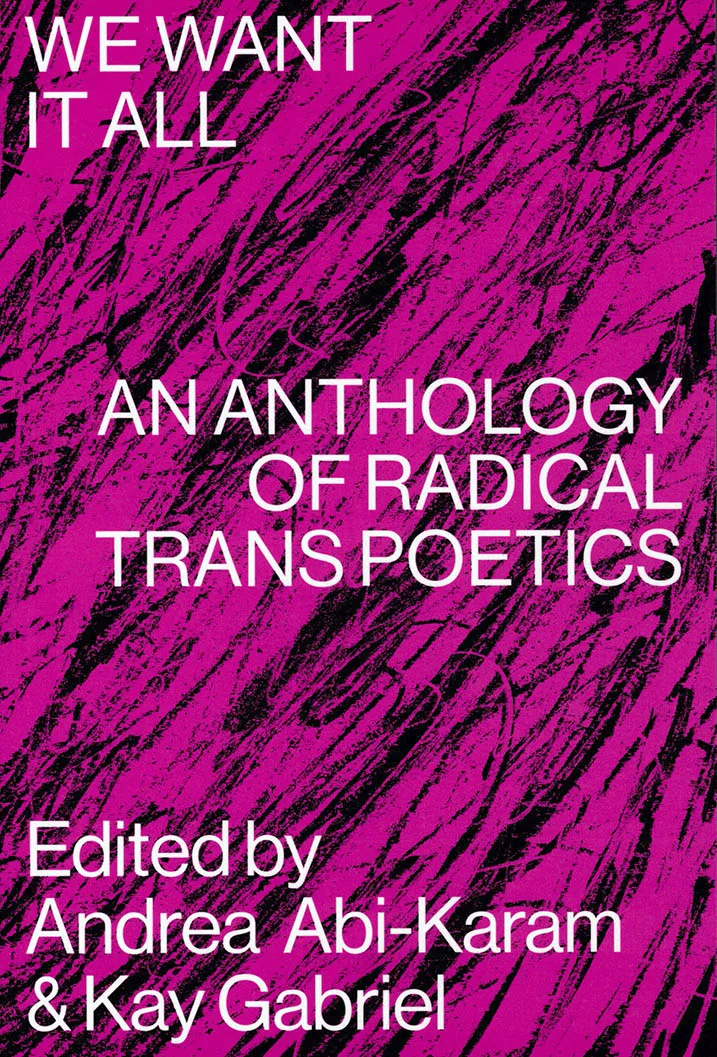
Cover of We Want It All: An Anthology of Radical Transpoetics

Nightboat Books

We Want It All: An Anthology of Radical Transpoetics

Kay Gabriel, Andrea Abi-Karam

Poetry €23.00

An anthology of formally inventive writing by trans poets against capital and empire.

With texts by: Andrea Abi-Karam, New York City Sam Ace, South Hadley, MA Bahaar Ahsan, Berkeley, CA jasper avery, Philadelphia, PA Ari Banias, Berkeley, CA Jo Barchi, Chicago, IL Joss Barton, St. Louis, MO Levi Bentley, Philadelphia, PA Jessica Bet, Baltimore, MA Rocket Caleshu, Los Angeles, CA Ching-in Chen, Seattle, WA listen chen, Vancouver, BC Faye Chevalier, Philadelphia, PA Cody-Rose Clevidence, Arkansas Miles Collins-Sibley, Easthampton, MA Valentine Conaty, New York City CA Conrad, Philadelphia, PA Jimmy Cooper, Rochester, MI Maxe Crandall, Oakland, CA José Díaz, Boston, MA Aaron El Sabrout, New Mexico Ian Khara Ellasante, Lewiston, ME Caelan Ernest, New York City, NY NM Esc, San Diego, CA joshua jennifer espinoza, Los Angeles, CA Logan February, Ibadan, Nigeria Ray Filar, Brighton, UK Nora Collen Fulton, Montreal, Canada Kay Gabriel, New York City Callie Gardner, Cardiff, Wales Jesi Gaston, Chicago, IL Harry Josephine Giles, Edinburgh, Scotland Aeon Ginsberg, Baltimore, MD Caspar Heinemann, Berlin, Germany Kamden Hilliard, Greenville, SC Stephen Ira, New York City Cyrée Jarelle Johnson, New York City Peach Kander, New York City Jayson Keery, Western, MA Evan Kleekamp, Los Angeles, CA Noah LeBien, New York City Ty Little, Richmond, VA Zavé Martohardjono, New York City Amy Marvin, Philadelphia, PA Natalie Mesnard, New York City Bianca Rae Messinger, Iowa City, IA Liam O'Brien, New York City Xandria Phillips, Madison, WI Rowan Powell, Santa Cruz, CA Nat Raha, Edinburgh, Scotland Holly Raymond, Philadelphia, PA Jackie S, New York City Trish Salah, Toronto, Canada Raquel Salas Rivera, Philadelphia, PA Mai Schwartz, New York City Kashif Sharma-Patel, London, UK Julian Talamantez Brolaski, Oakland, CA Charles Theonia, New York City Jamie Townsend, Oakland, CA Nora Treatbaby Laurel Uziell, London, UK Rachel Franklin Wood, Boulder, CO Clara Zornado Akasha-Mitra xtian w. and Anaïs Duplan, NYC.

Kay Gabriel is a poet and essayist. She's the author of Elegy Department Spring / Candy Sonnets 1 (BOAAT Press, 2017), the recipient of fellowships from Lambda Literary and the Poetry Project, and recently completed her PhD at Princeton University.

Andrea Abi-Karam is an arab-american genderqueer punk poet-performer cyborg, writing on the art of killing bros, the intricacies of cyborg bodies, trauma & delayed healing. Their chapbook, THE AFTERMATH (Commune Editions), attempts to queer Fanon's vision of how poetry fails to inspire revolution. Andrea's first book, EXTRATRANSMISSION (Kelsey Street Press, 2019), is a poetic critique of the U.S. military's role in the War on Terror.

Cover of Ad Học

Wendy's Subway

Ad Học

Teline Trần

Poetry €12.00

Teline Trần's Ad Học traverses the improvisational structures that shape social life in order to reflect their valences as both insufficient and abundant. In their first poetry chapbook, Trần locates those junctures with bittersweet pleasure and biting critique and asks how to sustain both at once. This is, Trần shows us, the work of living, against and within the ongoing attrition and amnesia at scales historical and governmental, interpersonal, familial, and social. Ad Học asks the reader to turn inwards, towards a personal politic, to self-revolution, in order to seek horizons dreamier, queerer, and hopefully insurgent.

Teline Trần is a writer from Orange, California or Gabrieleño/Tongva land. They write about home and interstitial faith via several mediums such as fiction, poetry, film, and ultimately, the browser. Teline works as the Membership and Community Engagement Coordinator at Wendy’s Subway, where they were a Fellow in 2020. They also work as the Development Coordinator at Mekong NYC, a Southeast Asian grassroots organization in the Bronx. They hold a degree in Comparative Literature from Reed College.

Cover of Hermaphrodite Logic: A History of Intersex Liberationv

Verso Books

Hermaphrodite Logic: A History of Intersex Liberationv

Juliana Gleeson

LGBTQI+ €20.00

How the intersex liberation movement exposed medical harms and became an inspiration to rethink sex and gender. 

Hermaphrodite Logic is a bold examination of intersex liberation. Juliana Gleeson reveals how a movement challenged systemic medical abuses to reshape our understanding of sex. Blending philosophical insights and personal testimonies, Gleeson argues that intersex people have been harmed not just for therapeutic reasons but to ease professional and parental anxieties.

Cover of Plastic: A Poem

Soft Skull Press

Plastic: A Poem

Matthew Rice

Poetry €16.00

Set during a single twelve-hour night shift in an injection molding factory, plastic is a book-length poem exploring the life of the industrial worker turned poet.

Bringing together memoir, ekphrasis, and satire, plastic is based on Matthew Rice’s experience working in a plastic molding factory for ten years. Illustrating alienated twenty-first-century Irish labor in poetic form, plastic engages with the inflictions and implications of a “post-industrial,” “post-Troubles” society, all while weaving in depictions of factory work from literature, film, and the visual arts.

Time-stamped to highlight the claustrophobia of the worker’s experience, Rice meditates on masculinity, sectarianism, and intergenerational trauma. But at its core is a poem about feeling a calling while being submerged in the world of menial labor—making plastic airplane parts by night, making poetry by day.

Invoking the brevity of Seamus Heaney, plastic is an expansive and imaginative poem that offers the working class a grace, dignity, and truth not often found in contemporary literature.

MATTHEW RICE was born in Belfast. He holds an MA in poetry from Queen’s University Belfast and is currently undertaking a PhD at the Seamus Heaney Centre at Queen’s. His debut collection, The Last Weather Observer, was published in 2021 to critical acclaim, highly commended for the Forward Prize for Best First Collection, and included in the Arts Council of Northern Ireland’s top ten books of the year.

Cover of The Queer Art of Failure

Duke University Press

The Queer Art of Failure

Judith Halberstam

The Queer Art of Failure is about finding alternatives—to conventional understandings of success in a heteronormative, capitalist society; to academic disciplines that confirm what is already known according to approved methods of knowing; and to cultural criticism that claims to break new ground but cleaves to conventional archives.

Jack Halberstam proposes “low theory” as a mode of thinking and writing that operates at many different levels at once. Low theory is derived from eccentric archives. It runs the risk of not being taken seriously. It entails a willingness to fail and to lose one’s way, to pursue difficult questions about complicity, and to find counterintuitive forms of resistance.

Tacking back and forth between high theory and low theory, high culture and low culture, Halberstam looks for the unexpected and subversive in popular culture, avant-garde performance, and queer art. Halberstam pays particular attention to animated children’s films, revealing narratives filled with unexpected encounters between the childish, the transformative, and the queer. Failure sometimes offers more creative, cooperative, and surprising ways of being in the world, even as it forces us to face the dark side of life, love, and libido.

Cover of Glaring

Wendy's Subway

Glaring

Benjamin Krusling

Poetry €18.00

Glaring: a sustained look of anger, an obvious fact, a situation of such brightness and intensity that vision is obscured. In his debut book of poems, Benjamin Krusling is concerned with reading domination and violence and entering their psychotic motion, the better to do otherwise. Through the thicket of anti-blackness, militarism, surveillance, impoverishment, and interpersonal abuse and violence, Glaring investigates the things that haunt daily life and make love difficult, possible, necessary.

Benjamin Krusling's Glaring is the winner of our 2019 Open Reading Period, and was selected by guest judge Lucy Ives.