Something Some Things Something Else
Language: English
Language: English
Lesson on Gravity is a slice of Anne Juren’s ongoing artistic research into ‘fantasmical anatomies’. ‘What happens when our sense of ground, orientation and support is lost? What are the risk and the promise of detaching ourselves from the pull of gravity?’ As this apocryphal Feldenkrais lesson embraces moments of intrusion and fragmentation, poetry and flights of fancy, it shows how language is alive, embodied and liquid. It also invites the reader to treat the book itself as a body, an unruly tongue sticking somewhere in its folds and creases
Anne Juren is a choreographer, dancer and Feldenkrais practitioner. In 2021 she finished her PhD at Stockholm University of the Arts with the project Studies on Fantasmical Anatomies.
Published by Varamo Press in the essay series Gestures
First edition, March 2023
Graphic design by Michaël Bussaer
18 July 1936, Bayonne. After hearing the news of the Fascist uprising, the Spanish dancer and bailaora Antonia Mercé y Luque, known as La Argentina, suffers a syncope and dies in fateful synchrony with the Second Republic. History, and the artist’s body, have been seized and broken by the event.
In close dialogue with images and historical documents, Isabel de Naverán pursues the reverberations of that shock and how it resonates with collective pain and artistic translations (by Federico García Lorca, Gertrude Stein, Kazuo Ohno and others). How does history affect and move through bodies? How do living bodies carry and pass on cultural legacy and collective memory? What do these complex movements reveal about the present? Wrap, History and Syncope is an affective journey that invites the reader into tracing and revisiting other bodies, to ultimately dance their difference and multiplicity for oneself.
Isabel de Naverán is a writer and researcher. Concern with the passage and use of time is the backbone of her work, which focuses on bodily transmission and the examination of the concept of historical time by way of ephemeral and fugitive practices. She holds a PhD in art from the University of the Basque Country.
Translation from Spanish: Toni Crabb
Graphic design: Michaël Bussaer
ROT is the catalogue for a community of practices.
ROT is a medicine and a ritual. The prescription for a new therapy.
ROT is a manual without instructions. A map. A party.
ROT touches upon sci-fi doomed scenarios.
ROT works within the ruins of the future.
ROT engages in weird beautification processes.
ROT uses mushrooming as a research method.
ROT hosts essays, stories, poetry, interviews, visuals, recipes, horoscopes and more.
ROT is mouldy.
ROT is glossy and asks to be touched.
With contributions by Adrijana Gvozdenović, Agnese Krivade, Alix Eynaudi, Anne Juren, Asli Hatipoglu, Carolina Mendonça, Cécile Tonizzo, Coline Gautier, Daniele Gasparinetti, Deborah Robbiano, Eleanor Ivory Weber, Elke Van Campenhout, Ēriks Ašmanis, Eve Gabriel Chabanon, Gary Farrelly, Goda Palekaitė, Günbike Erdemir, Jaime Llopis, Jennifer Russo, Jeroen Peeters, Jonas Palekas, Kristin Wiking, Lucia Palladino, Luciano Maggiore, Marko Gutić Mižimakov, Michelle Anay Woods, Muna Mussie, Muslin Brothers, Natasha Papadopoulou, Nina Janela, Norberto Llopis, Paloma Bouhana, Peggy Pierrot, Sandra Muteteri Heremans, Santiago Ribelles Zorita, Sara Manente, Sébastien Tripod, Sina Seifee, Sofie Durnez, Wilson Le Personnic
Sara Manente is a multidisciplinary artist and researcher who promotes collaborative situations in heterogeneous formats. Drawing on the imagery and matter of living cultures and mycelium brought into relation with live arts, her recent projects reflect on the possibility of contamination between pedagogy, research, performance and publication.
Published by Varamo Press
First edition, August 2023
136 pages, 22 x 30 cm, perfect binding
ISBN 978-82-693189-2-0
Graphic design by Deborah Robbiano
This publication brings together the texts from the pieces Black (2011), No Title (2014), We to be (2015) and oslo (2017) created and performed by Mette Edvardsen. These pieces have been developed using language as material, looking into the relationship between writing and speaking, between language and voice. Mette Edvardsen is working on the verge of the visible, considering choreography as writing.
Imagine words approaching a dance eyes closed or sleepwalking, words adrift beyond what can be envisioned beforehand, prompting writer and reader alike into a zone where time multiplies, where bodies grow footnotes and paper skin, savour the taste of language, attune their ears to the wavelength of blue. In a string of brief essays on her practice of writing choreographic poetry and scores, Janne-Camilla Lyster offers reflections on time, memory and the senses, on translation, punctuation and rhythm, on mistakes and crevasses, on the impossible and yet other things. What does it take to enter another form of existence, say, a chair?
Janne-Camilla Lyster is a writer, dancer and choreographer. She has published poetry, novels, essays and plays.
An artist text centring around the ghost lamp “like a sentinel an eerie outpost watching over the theatre.”
140x200mm
14 pages
edition of 150
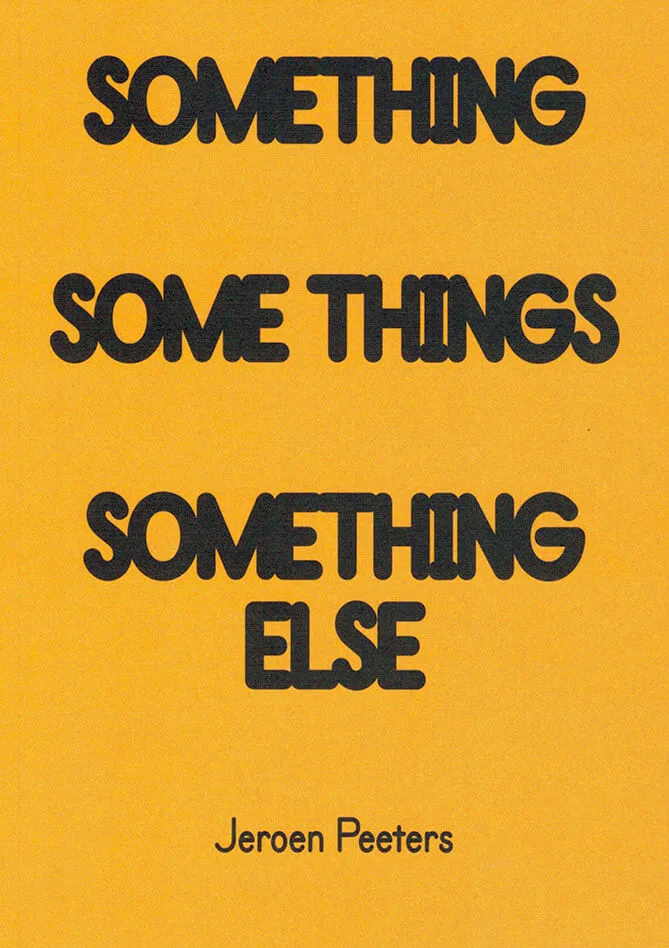
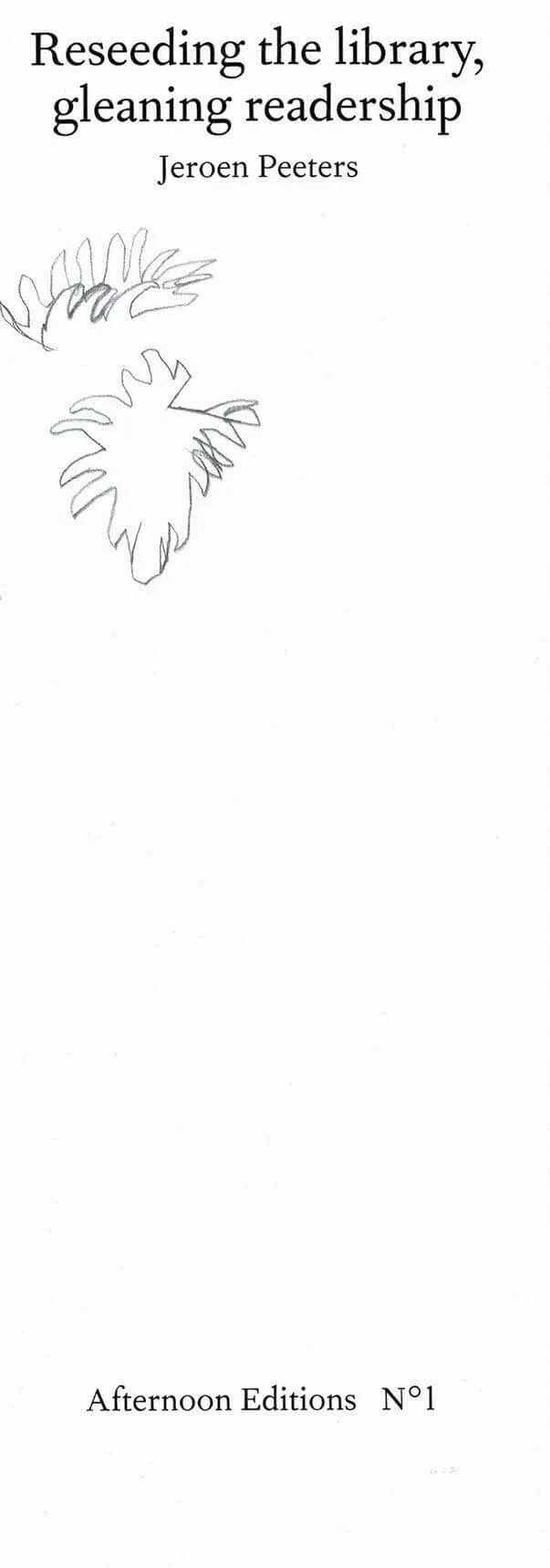
Afternoon Editions no. 5: a collection of found papers annotated by Jeroen Peeters, titled Bookmarks of sorts. During several years Jeroen Peeters collected notes left by readers in library books: faded reader tickets, scraps with notes, a shopping list, train tickets and other little papers used as bookmarks. He noted each time the date and the book in which they were found. Afterwards he wrote commentaries to this collection, an essay on alternative reading practices, marginalia and extra-illustration, on the exchange between readers and the imaginary community lingering in all those library books.
Time has fallen asleep in the afternoon sunshine
Victoria Pérez Royo, Léa Poiré and 1 more
Time has fallen asleep in the afternoon sunshine Appendix #3 Orality includes contributions by Simon Asencio, Bruno De Wachter, Peter Szendy, Clara Amaral, Itziar Okariz, Jude Joseph, Léa Poiré and Mette Edvardsen.
Time has The Appendixes #1–4 is an editorial series by Mette Edvardsen, Léa Poiré and Victoria Pérez Royo that developed out of the project Time has fallen asleep in the afternoon sunshine. For a two-year residency at Les Laboratoires d’Aubervilliers* (2022–23), they came together as a small work group, shaping the work process, hosting presentation formats and making this publication series on paper as four cahiers.
The cahiers comprise a collection of commissioned texts and contributions created for this context, selected documents and traces from work sessions and encounters organized during their residency, texts read together and republished for this occasion, a collection of references, notes in progress, unfinished thoughts and loose fragments – on paper, between pages.
The Appendixes are organized around four themes: (1) The gesture of writing, (2) How to organize a library, (3) Orality and (4) Translation. In addition to being published on paper, the editorial series also consisted of other formats of presentations, exchanges and meetings organized as workshops, fieldwork, performances, conferences, collective readings and oral publications, taking place during their residency at Les Laboratoires d’Aubervilliers and in the vicinity.
The Appendixes is the work that continues, material that adds on, some of it perhaps too long or too detailed, unfit or unfinished. The four themes that their research is formulated around originate in specific experiences and questions from the practices of Time has fallen asleep in the afternoon sunshine (2010 – ongoing), and also the large publication on the project ‘A book on reading, writing, memory and forgetting in a library of living books’ (2019). The research was both a means of exploring these themes in greater depth and also of bringing them into contact with other artists and researchers working on similar or related subjects. The Appendixes offered them both the contexts and the pretexts for things to happen (in time, in space, on paper).
The Appendixes #1–4, published in these cahiers, do not present an overview or a summary of all of the activities and presentations that took place during the two years at Les Laboratoires d’Aubervilliers. What these cahiers offer is a space in which to hold some thoughts together and to share them in this form. It is one more step along the way, extending the research and work already begun and that will now continue.