rile*books

Search books

Search books by title, author, publisher, keywords...

Cover of Riding In Silence & The Crying Dervish

Self-Published

Riding In Silence & The Crying Dervish

Mashid Mohadjerin

€59.00

The work of Iranian-Belgian artist Mashid Mohadjerin (°1976, Teheran) is an intricate tapestry of personal and collective memory, weaving together photography, text, video, and archival material to explore themes of displacement, resistance, and identity.

Family chronicles merge with momentous political events and are set against the background of a broader history of the MENA-region. Mohadjerin uncovers invisible nuances hidden beneath the extraordinary and the familiar.

In Riding in Silence & The Crying Dervish (2025), Mashid Mohadjerin draws from the depths of her family history, unraveling the echoes of migration, forced departures, and the quiet endurance of those caught between worlds. The book builds on her previous work, Freedom is Not Free (2021), where she explored the role of women in movements of resistance across the MENA region. However, in this latest series, she turns her gaze towards the intersection of masculinity, political ideology, and displacement, examining how historical forces shape personal narratives in ways both visible and unseen.

Published in 2025 ┊ 236 pages ┊ Hardcover ┊ Language: English

recommendations

Cover of touxs mes queers sont des poéte·sses

Self-Published

touxs mes queers sont des poéte·sses

saël teukam tamo

Poetry €8.00

Car archiver nos écrits et nos paroles n'a jamais été aussi important, car il faut rendre compte de nos existences, de ce moment, pour nous et pour les futurs queers en recherche de repères oui, nous avons écrit, donc oui vous pourrez écrire aussi ! oui, nous avons existé, donc oui, vous existerez aussi ! car oui, nous sommes toustes poéte·sses ! car nos vies sont des poèmes et être queer est de la poésie car touxs mes queers sont des poéte·sses! 

Because preserving our writings and our words has never been more important, because we must bear witness to our lives, to this moment, for ourselves and for future queers in search of guidance yes, we have written, so yes, you can write too! yes, we have existed, so yes, you will exist too! because yes, we are all poets! because our lives are poems and being queer is poetry because all my queers are poets!

Cover of Elizabeth in the Woolds

Self-Published

Elizabeth in the Woolds

Jennifer Brewer

Elizabeth in the Woolds is the product of two superimposed compositional strategies; a thematic aggregate based on notes dating back to 2008 and an epic prose narrative. Elizabeth is the device through which this simultaneous register moves. Screen writing provides a model for multiple voices. In a film script, the narrator can be the camera; there’s a machine at the centre of the story structure which figures a demand for resolution of plot; a contrario, the thematic approach (S, U, N, as electric light) obliterates chronology, and enumerates an atemporal topological figure, or the way the world is built.

(730pp., self-published first edition of 50, Kortrijk, 2021) 

Cover of Real Estate Portfolio

Self-Published

Real Estate Portfolio

Claire Barrow

Zines €17.00

Real Estate Portfolio by Claire Barrow
7 panel concertina + covers / total of 16 pages 
9.6 × 14 cm folded / 98 cm extended
Riso 250gsm recycled offset exterior, litho 135gsm recycled offset interior 
Glassine sleeve, digitally printed on the front & back

Self-published edition of 300, signed by the artist
Constructed in the UK (£0.016 per cm²)

The zine was drawn in one session using the right wrong hand.

Cover of Koreografi

Self-Published

Koreografi

Ann-Christin Berg Kongsness

Performance €14.00

Koreografi / Choreography is a magazine initiated and edited by Solveig Styve Holte, Runa Borch Skolseg and Ann-Christin Berg Kongsness. The magazine consists of texts written by Nordic artists within the field of dance and choreography.

Cover of Hortus

Self-Published

Hortus

Lilia Luganskaia

Photography €35.00

The Hortus  project is an open investigation into the nature of seemingly common objects through 'Floriography', urban gardens, and the history of female rights. Hortus was inspired by urban gardens in West Amsterdam and created with its plants by Lilia Luganskaia. 

Joanna Cresswell about the 'Hortus':

History teaches us that a language of flowers can communicate endless things about the culture in which it emerged, and herein lies Lilia Luganskaia's interest. Taking inspiration from the world of 19th Century sentimental flower books, Hortus presents itself as a set of notes towards a modern handbook for contemporary floriography, considering what the discipline might look like today. By collecting common flora across one year in the urban gardens around her home in Amsterdam and cross-referencing their meanings with publications from the past, Luganskaia reflects on their natures, their roles, and the symbolic familiarity they might hold for the communities living with them. A female artist and reader of the twenty-first century, she seeks out the essence of modern life through her lens, and through flowers, just like the women who came before her. 

Lilia Luganskaia (1990) Russian - Dutch multidisciplinary artist and author, based in Amsterdam. In her artistic practice, Lilia uses her background in documentary techniques to focus on what she calls ‘investigating reality’.  Her practice is research-based, Lilia decodes abstract notions such as love, tourism, bureaucracy, politics, and feminism through the use of constructed images, sculptures, videos, and installations. One of the key elements of her work is to understand multiple aspects of the photographic image.

Cover of Miam 09 : Les oiseaux ne chantent pas : ils crient de douleur

Miam Editions

Miam 09 : Les oiseaux ne chantent pas : ils crient de douleur

Various

4SPIKE & howawfulallanis, Alex Less, Alice Royer, Alligataure, Amelie Clicquot, Anjol, Arañada, Axel Fievet , Axelle Bourguignon, Baron & Tosma, Charlie Cooper, Charlotte Sallan Gémard, Délora Abbal, Elliott Sanchez, Erimoczi, femo, Fleur Douglas, Gaia Bergelin & Inès Camrla, Justine Bouvet, Kara, Kiara Patry, Lilian Magardeau & Elisa Grondin, Loreleï, Lucile Moreau, Manon Souza, Marie Martin Design, Mira, Migraine, Nathan Peron, Nathanael Brelin, Nomaison, Ema Tomas, Othilie Jourde Ledoux, Piquico , Rémy Bellariva, Séraphin Degroote Ferrera et Arthur Diguet, Syan Fischer, Tanikawa Sari, Vanessa Kintzel, Virginie Contier, Viviane Le Borgne, Zoé Vincent. 

Cover of Writing Out Loud

If I Can't Dance

Writing Out Loud

Jon Mikel Euba

Writing Out Loud is a publication that brings together the transcriptions of eight lectures by the artist Jon Mikel Euba that were live translated from Spanish to English during the course Action unites, words divide (On praxis, an unstated theory) at the DAI. The lectures were delivered across the academic year 2014 – 2015 at the invitation of If I Can’t Dance. They sit within a larger writing-centred project by the artist that he has pursued for almost a decade, through which he aims to define a form of praxis that could evolve into a technical theory.

Cover of ESDS Archives 3 : Pascal Doury - carnet inédit c.97-99

Editions L'Amazone

ESDS Archives 3 : Pascal Doury - carnet inédit c.97-99

Pascal Doury

Facsimilé d'un carnet inédit de Pascal Doury réalisé par Jonas Delaborde (Der Vierte Pförtner Verlag) et co-produit par les Editions l'Amazone, réalisé dans le cadre de la publication des Archives Elles Sont de Sortie suite à la parution de Choquer le monde à mort. Elles Sont de sortie. Bruno Richard - Pascal Doury.

Cover of Ten Non-Binary Hertz – Going Virile

Nadine

Ten Non-Binary Hertz – Going Virile

Dagmar Dirkx, Ot Lemmens

Zines €14.00

This publication brings together a text by Dagmar Dirkx and reproductions of Ot Lemmens' installation Going Virile

Prior to starting to work on their public installation Going Virile, two of the eight display windows were vandalized and cracked. Having intended to work around the idea of passing in a trans-masculine context, Ot turned their gaze to the relationship of masculinity to violence, questioning the reproduction of ideas around masculinity through transmasculine embodiment. They designed and screenprinted 6 patterns of which a few are reproduced in this publication. 

During that process they invited Dagmar Dirkx to experiment with writing a text in parallel to their work. The text Ten Non-Binary Hertz arose from a conversation between the Dagmar and Ot about trans-masculinity in relation to desire, violence and the idea of passing.

Text by Dagmar Dirkx
Translation by Titane Michiels
Design by Ot Lemmens
Made possible by VGC Brussel and Nadine vzw

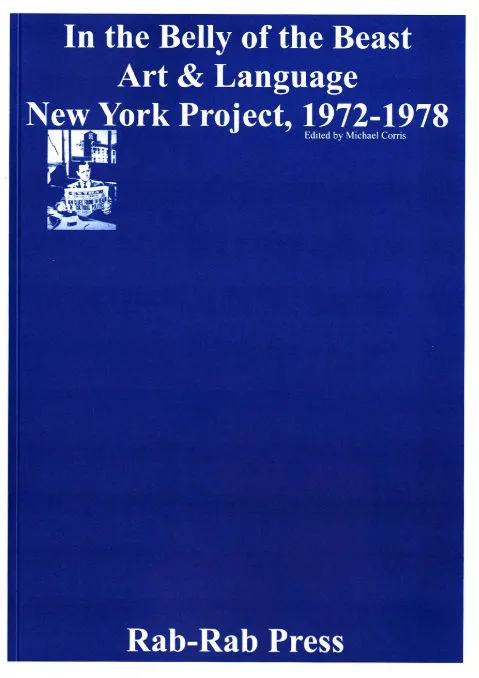
Cover of In the Belly of the Beast – Art & Language New York Project 1972-1978

Rab-Rab Press

In the Belly of the Beast – Art & Language New York Project 1972-1978

Art & Language

Edited by Michael Corris, the expanded edition of In the Belly of the Beast: Art & Language New York Project 1972-1978 is a survey of the tumultuous years of the political Conceptualism in the mid-seventies New York.

Artists have always experimented with politics, either by organizing themselves or uniting in support of a broader political movement. Today, "activist art" is taught in universities, supported by foundations, and featured in museums and international exhibitions. Is this the only possible way?

In the Belly of the Beast tells a different story, of the work of politically engaged artists and the conflicts they experienced. It is the history of artists wishing to continue working within the boundaries of the artworld and those who were intent on establishing new ideological and class relationships with activists to build a political party.

During the 1970s in New York, the Art & Language collective pioneered institutional critique; published a Marxist-influenced journal; agitated against racism and sexism in museums; challenged the cultural imperialism of international exhibitions; and forged a framework for a socialist organization of artists. This new edition includes previously unpublished documents illuminating the contradictions and disputes that lay at the center of the organization and practices of Art & Language and left-wing groups, such as the Anti-Imperialist Cultural Union and the Artists' Meeting for Cultural Change, mobilizing artists in New York at the time.

The new and expanded edition of In the Belly of the Beast features an extensive interview with Michael Corris, who annotated a collection of previously unavailable documents from the period, including manuscripts, pamphlets, transcripts, and letters.

Art & Language is the name of a group of English artists who choose to work collectively, and the title of a magazine that they founded in 1968. Proposing a critical analysis of the relations between art, society, and politics, Art & Language marks, even in its name, the importance of the “textual turning point” in the 1960s.

Since 1976, Art & Language's project has continued, through Mel Ramsden and Michael Baldwin, with the literary and theoretical collaboration of Charles Harrison. Working with very varied mediums, from painting to rock, these co-founders of Conceptual art remain, even today, attached to observing the consequences of what they themselves call the “depressing collapse of modernism.”