rile*books

Search books

Search books by title, author, publisher, keywords...

Cover of Rêveries du promeneur solitaire

Time has fallen asleep in the afternoon sunshine

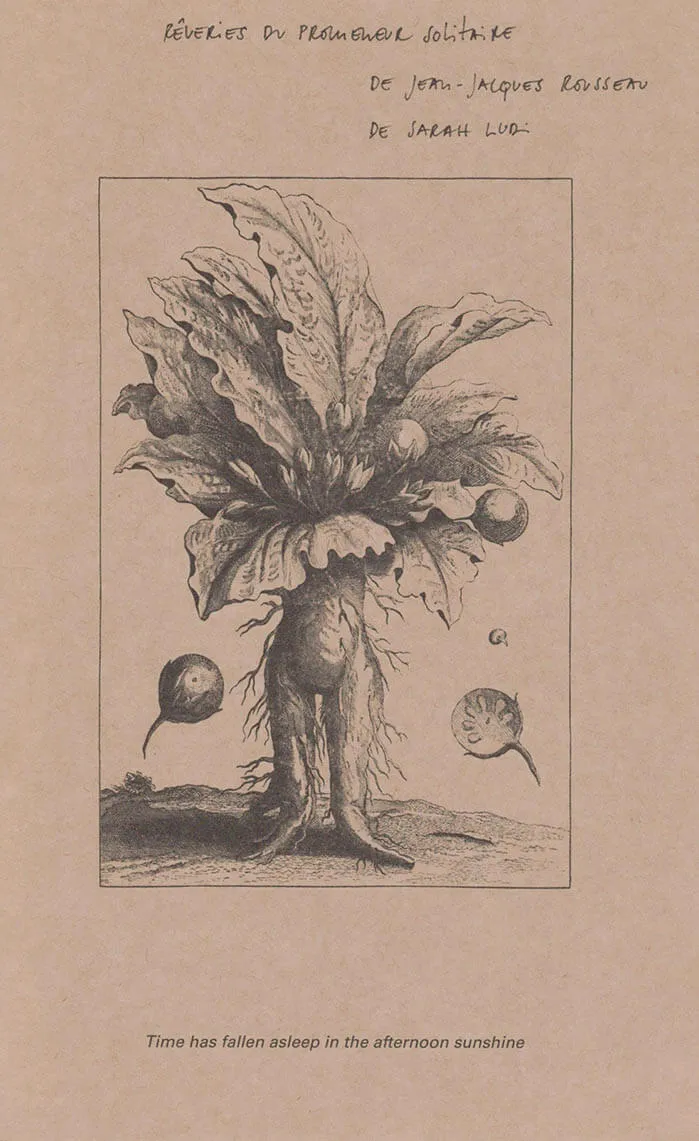
Rêveries du promeneur solitaire

Sarah Ludi

€12.00

For the project Time has fallen asleep in the afternoon sunshine a group of people/ performers memorize a book of their choice. Together they form a library collection consisting of living books. After years of learning by heart and reciting for readers, some of the books have now been written down from memory to create new editions, versions resulting from this process. This book is one of those books, chosen by one person, learned by heart and recited many times, and now written down again from memory. This edition is not a re-edition of the original text. It is a re-writing of the text after the process of reading, memorizing and reciting, with all the alterations that might have occured in the course of this process.

Language: English

recommendations

Cover of Appendix #1: The gesture of writing

Time has fallen asleep in the afternoon sunshine

Appendix #1: The gesture of writing

Victoria Pérez Royo, Léa Poiré and 1 more

Performance €15.00

The Appendixes #1-4 is an editorial series by Mette Edvardsen, Léa Poiré and Victoria Pérez Royo that came out of the project Time has fallen asleep in the afternoon sunshine. For a two-year residency at Les Laboratoires d'Aubervilliers (2022-23), they came together as a small work group, shaping the work process, hosting presentation formats and making the publication series on paper as four cahiers.

The cahiers comprise a collection of commissioned texts and contributions created for this context, selected documents and traces from work sessions and encounters organized during the residency, texts read together and republished for this occasion, a collection of references, notes in progress, unfinished thoughts and loose fragments - on paper, between pages.

p 5-7 Almost on my way to you
p 8-10 Presque en route vers toi
Laía Argüelles Folch

p 12-13 Exercise in translation of Breve ensayo sobre la carta (Brief essay on the letter) by Laía Argüelles Folch
p 14-15 Exercice de traduction de Breve ensayo sobre la carta (Bref essai sur la lettre) de Laía Argüelles Folch
Quim Pujol, Paula Caspão, Simon Asencio, Pascal Poyet, Mette Edvardsen, Léa Poiré, Victoria Pérez Royo & Laía Argüelles Folch

p 16-17 Like a dinosaur upon awakening
p 18-19 Comme un dinosaure au réveil
Pascal Poyet

p 20-23 Is she a translator?
p 24-27 Est-elle traductrice?
Olivia Fairweather

p 28-29 New edition revised by my author
p 30-31 Nouvelle édition revue par mon auteur
Léa Poiré

p 32 Notes from a translation in progress
p 33 Notes d'une traduction en cours
Kate Briggs

p 34-37 Mothers & tongues
p 38-41 Langues (maternelles)
Mette Edvardsen

p 42-43 Collective reading of Finnegans Wake by James Joyce
p 44-45 Lecture collective de Finnegans Wake de James Joyce
Dora García and readers, et les lecteur·rices

p 46-49 Notes for a talk that did not happen
p 50-53 Notes pour une conférence qui n'a pas eu lieu
Olivia Fairweather

p 54-65 Meticulous comparison of two books with their versions rewritten from memory, excerpts from a work document
Comparaison méticuleuse de deux livres avec leurs versions réécrites de mémoire, extraits d'un document de travail
Julián Pacomio & Ángela Millano

Cover of Appendix #3: Orality

Time has fallen asleep in the afternoon sunshine

Appendix #3: Orality

Victoria Pérez Royo, Léa Poiré and 1 more

Performance €15.00

Time has fallen asleep in the afternoon sunshine Appendix #3 Orality includes contributions by Simon Asencio, Bruno De Wachter, Peter Szendy, Clara Amaral, Itziar Okariz, Jude Joseph, Léa Poiré and Mette Edvardsen.

Time has The Appendixes #1–4 is an editorial series by Mette Edvardsen, Léa Poiré and Victoria Pérez Royo that developed out of the project Time has fallen asleep in the afternoon sunshine. For a two-year residency at Les Laboratoires d’Aubervilliers* (2022–23), they came together as a small work group, shaping the work process, hosting presentation formats and making this publication series on paper as four cahiers.

The cahiers comprise a collection of commissioned texts and contributions created for this context, selected documents and traces from work sessions and encounters organized during their residency, texts read together and republished for this occasion, a collection of references, notes in progress, unfinished thoughts and loose fragments – on paper, between pages.

The Appendixes are organized around four themes: (1) The gesture of writing, (2) How to organize a library, (3) Orality and (4) Translation. In addition to being published on paper, the editorial series also consisted of other formats of presentations, exchanges and meetings organized as workshops, fieldwork, performances, conferences, collective readings and oral publications, taking place during their residency at Les Laboratoires d’Aubervilliers and in the vicinity.

The Appendixes is the work that continues, material that adds on, some of it perhaps too long or too detailed, unfit or unfinished. The four themes that their research is formulated around originate in specific experiences and questions from the practices of Time has fallen asleep in the afternoon sunshine (2010 – ongoing), and also the large publication on the project ‘A book on reading, writing, memory and forgetting in a library of living books’ (2019). The research was both a means of exploring these themes in greater depth and also of bringing them into contact with other artists and researchers working on similar or related subjects. The Appendixes offered them both the contexts and the pretexts for things to happen (in time, in space, on paper).

The Appendixes #1–4, published in these cahiers, do not present an overview or a summary of all of the activities and presentations that took place during the two years at Les Laboratoires d’Aubervilliers. What these cahiers offer is a space in which to hold some thoughts together and to share them in this form. It is one more step along the way, extending the research and work already begun and that will now continue.

Cover of Verzamelde gedichten - Against the Forgetting

Time has fallen asleep in the afternoon sunshine

Verzamelde gedichten - Against the Forgetting

Bruno De Wachter

For the project Time has fallen asleep in the afternoon sunshine a group of people/ performers memorize a book of their choice. Together they form a library collection consisting of living books. After years of learning by heart and reciting for readers, some of the books have now been written down from memory to create new editions, versions resulting from this process. This book is one of those books, chosen by one person, learned by heart and recited many times, and now written down again from memory. This edition is not a re-edition of the original text. It is a re-writing of the text after the process of reading, memorizing and reciting, with all the alterations that might have occured in the course of this process.

www.timehasfallenasleepintheafternoonsunshine.be

Cover of Een dag in 't jaar door Herman Gorter

Time has fallen asleep in the afternoon sunshine

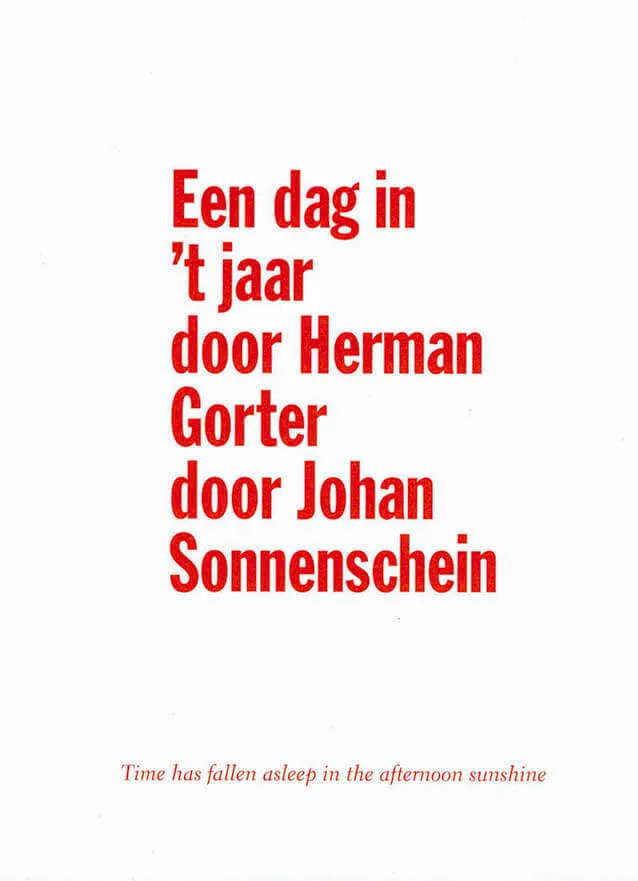
Een dag in 't jaar door Herman Gorter

Johan Sonnenschein

For the project Time has fallen asleep in the afternoon sunshine a group of people/ performers memorize a book of their choice. Together they form a library collection consisting of living books. After years of learning by heart and reciting for readers, some of the books have now been written down from memory to create new editions, versions resulting from this process. This book is one of those books, chosen by one person, learned by heart and recited many times, and now written down again from memory. This edition is not a re-edition of the original text. It is a re-writing of the text after the process of reading, memorizing and reciting, with all the alterations that might have occured in the course of this process.

Cover of Mon Songe

Time has fallen asleep in the afternoon sunshine

Mon Songe

Vincent Dunoyer

For the project Time has fallen asleep in the afternoon sunshine a group of people/ performers memorize a book of their choice. Together they form a library collection consisting of living books. After years of learning by heart and reciting for readers, some of the books have now been written down from memory to create new editions, versions resulting from this process. This book is one of those books, chosen by one person, learned by heart and recited many times, and now written down again from memory. This edition is not a re-edition of the original text. It is a re-writing of the text after the process of reading, memorizing and reciting, with all the alterations that might have occured in the course of this process.

Cover of bruit

Gevaert Editions

bruit

Hugo Bonamin

Hardcover, offset printing, 508 p., 31.8 x 25 cm.  Printed by Cultura, Gent
Edition of 265 copies. A deluxe edition, accompanied by an original work numbered n/508  (oil pastel on paper A3), has been produced in 35 copies signed and numbered by the artist .

Cover of Meriem Bennani: Life on the Caps

The Renaissance Society

Meriem Bennani: Life on the Caps

Meriem Bennani

Meriem Bennani's Life on the CAPS is the final chapter in her film trilogy of the same name. Set in a supernatural, dystopian future surrounding a fictional island in the middle of the Atlantic Ocean, it is rooted in Bennani’s research and reflections on the histories of island societies, biotechnology, and vernacular music. Layering live-action footage and computer-generated animation, Bennani intuitively adapts editing techniques that evoke documentary film, science fiction, phone footage, music videos, and reality TV. Her one-person exhibition at the Renaissance Society marked the debut of this personal, electric yet melancholic consideration of what it is to live in a state of limbo, and this accompanying book captures the film through a combination of still images and selections from a transcript of the film.

This volume includes essays by Emily LaBarge and Elvia Wilk and transcripts of conversations between Meriem Bennani and: Omar Berrada; Fatima Al Quadiri, Negar Azimi, and Tiffany Malakooti; Amal Benzekri; and Aziz Bouyabrine.

Cover of Seltsame Sterne starren zur Erde

Time has fallen asleep in the afternoon sunshine

Seltsame Sterne starren zur Erde

Sonia Si Ahmed

For the project Time has fallen asleep in the afternoon sunshine a group of people/ performers memorize a book of their choice. Together they form a library collection consisting of living books. After years of learning by heart and reciting for readers, some of the books have now been written down from memory to create new editions, versions resulting from this process. This book is one of those books, chosen by one person, learned by heart and recited many times, and now written down again from memory. This edition is not a re-edition of the original text. It is a re-writing of the text after the process of reading, memorizing and reciting, with all the alterations that might have occured in the course of this process.

Cover of Salvation

Primary Information

Salvation

Jimmy DeSana

Salvation is a previously-unpublished artist book by Jimmy DeSana that he conceptualized shortly before his death in 1990. The publication contains 44 of the artist’s late photographic abstractions that quietly and poetically meditate on loss, death, and nothingness. Depicted within the works are images of relics, body parts, flowers, and fruits that DeSana altered using collage and darkroom manipulations to create pictures that are both intimate and other-worldly. Salvation provides a nuanced and sophisticated counterpoint to the prevailing work around HIV/AIDS at the time, which tended to favor bold political statements.

Variations of many of the works in this book were first presented at DeSana’s last show with Pat Hearn Gallery in 1988. Shortly thereafter, the artist began assembling a maquette of Salvation, using black and white images as place holders for the color works that he intended to comprise the final layout of the publication. Sadly, he was unable to fully realize Salvation in his lifetime, but on his deathbed, he dictated instructions to his longtime friend Laurie Simmons for completing the work; instructions which she noted on each page of the single-copy maquette. With these notes, Simmons was able to match extant slides  and sequencing. Simmons’ studio chose color gels from DeSana’s archive for each corresponding black and white image in the assembly of the publication. Thankfully, due to this recuperative work, Salvation—long-considered to be DeSana’s last major work—is now available for the first time, with every step taken to honor and embody DeSana’s original vision.

Jimmy DeSana (1949-1990) grew up in Atlanta, GA, and received his bachelor’s degree from the Georgia State University in 1972 before relocating to New York’s East Village in the early 1970s. Recent solo and two-person exhibitions include The Sodomite Invasion: Experimentation, Politics and Sexuality in the work of Jimmy DeSana and Marlon T. Riggs, Griffin Art Projects, Vancouver, Canada, 2020, and Remainders, Pioneer Works, Brooklyn, NY, 2016. DeSana’s work can be found in numerous public collections including the Institute of Contemporary Art, Boston, MA; Metropolitan Museum of Art, New York; Museum of Contemporary Art, Chicago, IL; Museum of Fine Arts, Houston, TX; Museum of Modern Art, New York, NY; and the Whitney Museum of American Art, New York, NY, among others. A major retrospective of DeSana’s work was exhibited at the Brooklyn Museum, New York, in 2022, accompanied by a catalogue co-published by the Brooklyn Museum and DelMonico Books.

Cover of The Error is Regretted

The Green Box

The Error is Regretted

Anita Di Bianco

‘Corrections and Clarifications’ is an ongoing newsprint project by Anita Di Bianco, an edited compilation of daily revisions, retractions, re-wordings, distinctions, and apologies to print news from September 2001 to the present. In essence, a reverse chronological catalogue of lapses in naming and classification, tangled catchphrases, and patterns of misspeak and inflection.

Previous editions have examined the printed news media in the United States and United Kingdom, Germany, Austria and Switzerland, and other international press from Asia, Turkey, and the Balkans printed in English. The publication includes text contributions by Di Bianco and Francesco Gagliardi.

108 p, ills bw, 24 x 32 cm, hb, German/English