rile*books

Search books

Search books by title, author, publisher, keywords...

Cover of Malina

New Directions Publishing

Malina

Ingeborg Bachman

€16.00

Malina invites the reader on a linguistic journey, into a world that stretches the very limits of language with Wittgensteinian zeal and Joycean inventiveness, where Ingeborg Bachmann ventriloquizes, and in the process demolishes, Proust, Musil, and Balzac, and yet filters everything through her own utterly singular idiom. Malina is, quite simply, unlike anything else; it's a masterpiece. 

In Malina, Bachmann uses the intertwined lives of three characters to explore the roots of society's breakdown that lead to fascism, and in Bachmann's own words, "it doesn't start with the first bombs that are dropped; it doesn't start with the terror that can be written about in every newspaper. It starts with relationships between people. Fascism is the first thing in the relationship between a man and a woman, and I attempted to say that here in this society there is always war. There isn't war and peace, there's only war."

Language: English

recommendations

Cover of Midwinter Day

New Directions Publishing

Midwinter Day

Bernadette Mayer

Poetry €17.00

Midwinter Day, as Alice Notley noted, is an epic poem about a daily routine. A poem in six parts, Midwinter Day takes us from awakening and emerging from dreams through the whole day-morning, afternoon, evening, night-to dreams again:...

a plain introduction to modes of love and reason/ Then to end I guess with love, a method to this winter season/ Now I've said this love it's all I can remember/ Of Midwinter Day the twenty-second of December// Welcome sun, at last with thy softer light/ That takes the bite from winter weather/ And weaves the random cloth of life together/ And drives away the long black night!

Cover of Lili Is Crying

New Directions Publishing

Lili Is Crying

Hélène Bessette, Kate Briggs

Fiction €17.00

A forgotten mid-century genius, recently rediscovered in France and never before translated into English, Hélène Bessette is a treasure and a bracing force to reckon with.

With a contribution by Eimear McBride
A New Yorker Best Book of 2025

Lili Is Crying, Hélène Bessette’s debut novel, conveys with singular force the fraughtness and depth of the troubling relationship between Lili and her mother, Charlotte. With a near-mythic quality, Bessette's stripped-back prose evokes at once the pain of thwarted love—of desire run cold—and the promise of renewal. Lauded by critics on its initial 1953 publication for its boundary-pushing style, Lili Is Crying catapulted Bessette to cult status in France. The novel is moving and maddening in turns, with its characters trapped in their own cruelties and sorrows, but in its spareness and strength it feels true. "Show me a woman who's chosen something." Bessette's books were hailed for their unusual economy of expression, rarity, strange humor, and sheer vivacity. She characterized her new kind of novel as "a freshly cut slice of life, whose force comes from its lack of commentary."

Cover of Glass, Irony & God

New Directions Publishing

Glass, Irony & God

Anne Carson

Poetry €16.00

Known as a remarkable classicist, Anne Carson weaves contemporary and ancient poetic strands with stunning style in Glass, Irony and God. This collection includes: "The Glass Essay," a powerful poem about the end of a love affair, told in the context of Carson's reading of the Bronte sisters; "Book of Isaiah," a poem evoking the deeply primitive feel of ancient Judaism; and "The Fall of Rome," about her trip to "find" Rome and her struggle to overcome feelings of a terrible alienation there.

Anne Carson was born in Canada and teaches ancient Greek for a living.

Cover of Nightwood

New Directions Publishing

Nightwood

Djuna Barnes

Nightwood, Djuna Barnes' strange and sinuous tour de force, "belongs to that small class of books that somehow reflect a time or an epoch" (Times Literary Supplement). That time is the period between the two World Wars, and Barnes' novel unfolds in the decadent shadows of Europe's great cities, Paris, Berlin, and Vienna—a world in which the boundaries of class, religion, and sexuality are bold but surprisingly porous.

The outsized characters who inhabit this world are some of the most memorable in all of fiction—there is Guido Volkbein, the Wandering Jew and son of a self-proclaimed baron; Robin Vote, the American expatriate who marries him and then engages in a series of affairs, first with Nora Flood and then with Jenny Petherbridge, driving all of her lovers to distraction with her passion for wandering alone in the night; and there is Dr. Matthew-Mighty-Grain-of-Salt-Dante-O'Connor, a transvestite and ostensible gynecologist, whose digressive speeches brim with fury, keen insights, and surprising allusions. Barnes' depiction of these characters and their relationships (Nora says, "A man is another persona woman is yourself, caught as you turn in panic; on her mouth you kiss your own") has made the novel a landmark of feminist and lesbian literature.

Cover of Autobiography of Cotton

And Other Stories

Autobiography of Cotton

Cristina Rivera Garza, Christina MacSweeney

Fiction €19.00

A novel about how cotton workers transformed the Mexico-US borderlands, by a Pulitzer Prize–winning author.

In 1934, a young José Revueltas traveled to Tamaulipas to support the cotton workers’ strike in Estación Camarón, which became the basis of his landmark novel, Human Mourning. In her own groundbreaking novel, Autobiography of Cotton, Cristina Rivera Garza recounts her grandparents’ journey from mining towns to those same cotton fields as it intersects with Revueltas’s life in a vivid and evocative history of cotton cultivation along the Mexico-US border.

Through archival research and personal narrative, Rivera Garza chronicles the way cotton transformed the borderlands by reconstructing the cotton workers’ strike and reveals how cycles of deprivation and ecocide persist across generations. Deeply personal and politically acute, Rivera Garza crafts a new kind of border novel that tells how a brittle land radically altered her grandparents’ lives and the territories they helped develop. An intimate fictionalization, Autobiography of Cotton reveals a rich social history of agricultural colonization, labor activism, environmental degradation, and cross-border migration.

Cover of Shapes found for living

Ma Bibliotheque

Shapes found for living

Nick Norton

Fiction €15.00

Books in dreams were once made of scrolls and parchments. Once, books in dreams could only manifest themselves as clay. Scratches became meaningful. Books still tumble down. Most rooms are flooded; the waters are generally at ankle height.

Shapes Found for Living offers short tales—rumours and fables coalescing  from the uneven experience of living in this century and vivifying the reader’s imagined memory theatre. The collection moves from rude immediacy via questioning forms of language depicting unstable mental states, the near madness of trying to live or love,  to the absurd remnants of an (envisioned) ancestral recall. 

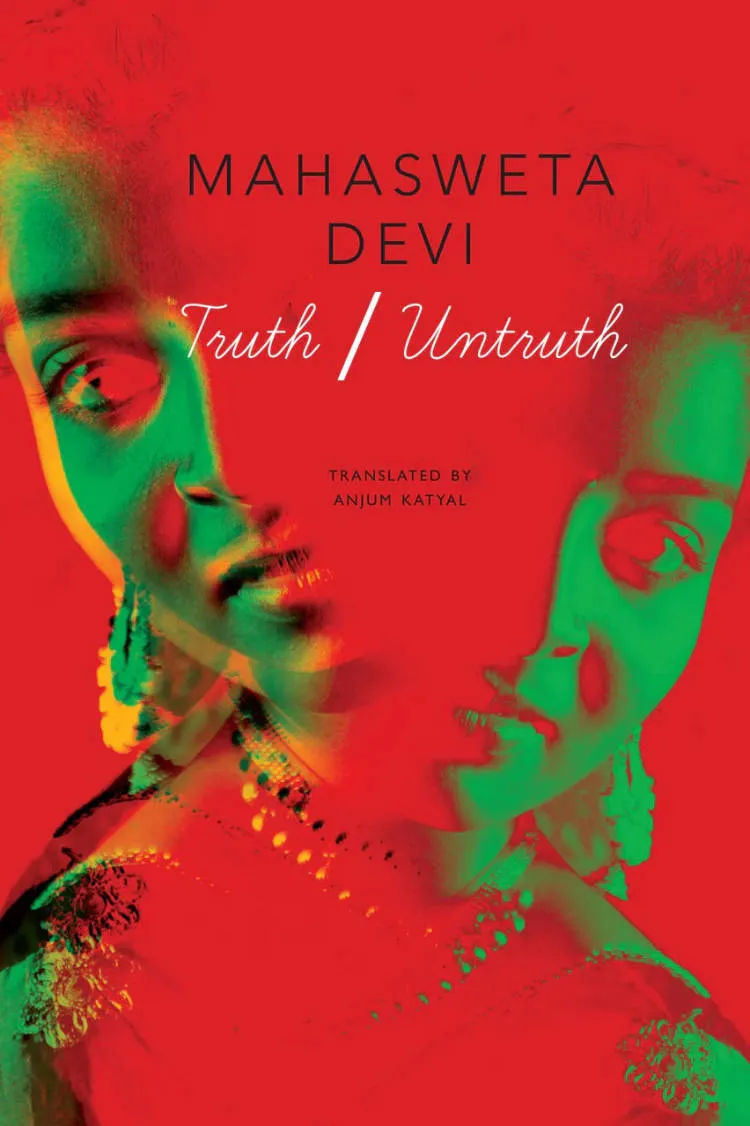
Cover of Truth / Untruth

Seagull Books

Truth / Untruth

mahasweta devi, Anjum Katyal

Fiction €22.00

A trenchant, darkly humorous, and unsentimental look at Calcutta society. 

Set in Calcutta in the mid-1980s, Truth/Untruth is a fast-paced thriller built around the death of the pregnant Jamuna—a maid in a newly affluent residential apartment complex—and Arjun, the upwardly mobile businessman who seduced her. Packed with a cast of colourful characters, this novel is a trenchant, darkly humorous, and unsentimental look at the different segments of Calcutta society: from the middle-class culture vultures to the unscrupulous ‘promoter’ class and the domestic helpers and slum goons who form an intrinsic part of the city’s life. All are implicated in a complex web of guilt and bizarre twists and turns. Sex, lies, death—the great modernist themes—run like a thread through this book, exposing societal greed, lust, corruption, and moral hypocrisy with a sardonic tone that spares none. An unusual novel by an author who is otherwise known for her hard-hitting activist-feminist stories, Truth/Untruth underlines the exploitative vicious cycle that defines urban relations between the haves and have-nots.

‘Although not of the margins herself, Devi was accomplished in writing from the margins [ . . . ] However, it is indeed worth it if you are looking for an exhilarating social commentary and biting satire that remains relevant today. Devi also reflects the jargon and dialects of the lower classes as deftly as the peculiarities of upper-class speech patterns. A feat of this work is Katyal’s ability to mediate these multiple registers, rewarding the reader with sharp writing that is at once funny, sardonic, and darkly pleasurable to read.‘—Jack Greenbert, Cha: An Asian Literary Journal.

Cover of Little F

Feminist Press

Little F

Michelle Tea

A new epic novel about a teenage queer runaway from cult classic author of Black Wave and Valencia Michelle Tea. A Literary Hub Notable Small Press Book of 2025.

In Spencer's fantasies, the breezy, queer streets of Provincetown, MA, are utopia, a place where he can be free. Yet when a violent attack in his suburban Arizona schoolyard sends him to the hospital, he decides queer utopia can't wait. And one night, with the help of his best friend, the teenage witch Joy, he hitches a ride to find it.

The cross-country road odyssey that follows brings Spencer from new moon rituals in Arizona canyons to Texas bus stations, from the luxe drag stages of Houston's Montrose district to the jazz-soaked streets of the French Quarter and beyond. This new novel from Michelle Tea tells the story, by turns raw, romantic, and sweet, of a sheltered boy taking his first leap into queer life, among all the complicated queers who live it.

"Tea's conversational tone and her way of writing deeply personal experience . . . presents a very necessary counter-narrative to mainstream histories of American punk, feminism, and sexual identity." – The Brooklyn Rail

Michelle Tea is the author of over twenty books of fiction, memoir, poetry and children's literature. Her autofiction Valencia, a cult classic, won the Lambda Literary Award for Best Fiction. Her essay collection Against Memoir was awarded the PEN/Diamonstein-Spielvogel Award for The Art of the Essay. Tea is also the recipient of awards from the Rona Jaffe Foundation and the Guggenheim Foundation. The founder of Drag Queen Story Hour, she has received honors from the American Library Association and Logo Television. Tea curated the Sister Spit Books series at City Lights Publishers and founded the ongoing imprint Amethyst Edition at the Feminist Press.

Cover of Some Monologues

Wendy's Subway

Some Monologues

Tyler Coburn

Fiction €25.00

Working at the nexus of performance, art writing, and fiction, Tyler Coburn creates monologues that explore how the “I” is marked in speech. His myriad topics—alternate history, legal personhood, digital labor, and resonant frequency, to name a few—defy straightforward modes of presentation, often insisting on site-specificity and social intimacy at the expense of conventional documentation. 

Some Monologues collects, for the first time, the scripts of Coburn’s work from the past fifteen years, many of which have not previously been published. Accompanying them are texts by eleven artists, writers, curators, and scholars who experienced these performances firsthand, collaborated in their making, conversed with the artist about them, or share an interest in the subjects they engage. Written in theoretical, poetic, and autobiographical registers, these contributions offer new perspectives on the monologue as an expansive and relational form.

Introduction by Elvia Wilk. Contributions by Yu Araki, A.E. Benenson, Mashinka Firunts Hakopian, Sven Lütticken, Kameelah Janan Rasheed, Spyros Papapetros, Camille Richert, Théo Robine-Langlois, Ian Wallace, and Michelle Wun Ting Wong.

Tyler’s scripts refuse to fix an authorial voice; instead, they make the conditions of authorship itself their subject. Blurring the boundaries between fiction and document, the human and the bureaucratic, the self and its doubles, his work thinks through systems from the inside, often using language as both architecture and trap. In their precision and porousness, I recognize a shared pursuit: how to locate agency within constraint, and how to turn the administrative or the technological into a site of intimacy. — Jill Magid

In Tyler Coburn’s Some Monologues, a binary that remains constitutive for the ideological continuity of modern life, in all its colonial and capital forms, is undone: digital vs. physical. In troubling that chasm, Coburn plays out the repercussions of these ideologies of anthropomorphic naturalism, guiding us through their resonances, doubles, codings, and relays. But he also renders himself as the relay of these transferences, in the process expanding art’s premodern calling: to exist as an invocation. Reification suddenly appears as what is situated between embodiment and disembodiment, with both potentially destabilized. Some Monologues, the book, is this destabilization’s ideal format: as much documentation, an echo, of Coburn’s works through their scripts, as it is an instruction manual for denaturalizing our sense/s. — Kerstin Stakemeier

Tyler Coburn is an artist, writer, and professor based in New York. He received a 2024 Andy Warhol Foundation Arts Writers Grant, and his writing has appeared in ArtReview, BOMB, C Magazine, Dis, e-flux journal, frieze, LEAP, Metropolis M, Mousse, and Rhizome. Coburn is the author of four books: I’m that angel (self-published, 2012), Robots Building Robots (CCA Glasgow, 2013), Richard Roe (Sternberg, 2019), and Solitary (Sternberg and Art Sonje Center, 2022). He has presented artwork at such venues as Centre Pompidou, Paris; Bergen Kunsthall; Hayward Gallery, London; Para Site, Hong Kong; and Kunstverein Munich.